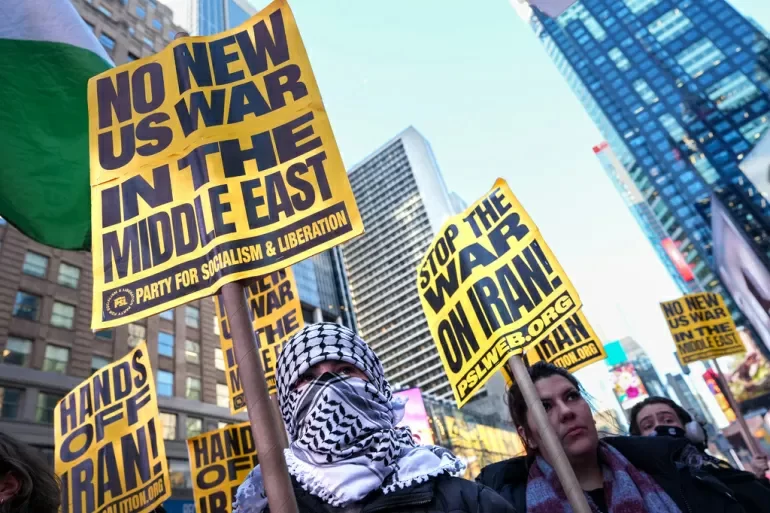
June 7 marks 100 full days since the United States and Israel launched their open military conflict against Iran, a milestone that arrives as stalled peace talks, persistent domestic backlash, and growing economic fallout continue to turn the war into one of the most significant political liabilities for sitting U.S. President Donald Trump and his Republican Party.
Public opposition to the conflict predates its official outbreak. Pre-war polling consistently showed a majority of American voters opposed large-scale bombing campaigns against Iran, and that sentiment has not shifted since military operations began on February 28. Today, broad swathes of the electorate view the war as an unnecessary and harmful venture that runs counter to core U.S. national interests. “Few Americans believe this war serves the United States’ interests,” explained Shibley Telhami, a political science professor at the University of Maryland, echoing the clear consensus of public opinion.
The conflict got off to an unplanned, sudden start when U.S. strikes targeted senior Iranian leadership, including Supreme Leader Ali Khamenei, while diplomatic talks over Iran’s nuclear program were still scheduled. Unlike previous large-scale U.S. wars, such as the 2003 invasion of Iraq under George W. Bush, the Trump administration never built public support or prepared the American people for military engagement, catching both voters and policymakers off guard. Iran responded to the initial attack with widespread drone and missile strikes, and moved to close the Strait of Hormuz, the strategically critical global chokepoint for oil and natural gas exports. The closure immediately sent global energy prices soaring, passing direct economic shocks onto American households in the form of higher energy and grocery costs.
While a temporary ceasefire was reached on April 6, low-intensity skirmishes and the Iranian blockade of the Strait of Hormuz have continued, with no substantive progress toward a permanent peace deal. Despite Trump’s repeated public claims that a peace agreement is imminent, no diplomatic breakthrough has materialized.
Latest polling underscores the depth of public discontent: only 16% of registered voters believe the U.S. will achieve a clear victory in the conflict, and a majority of voters – including one-third of self-identified Republican voters – view the war as damaging to U.S. interests. The widespread economic fallout, which has pushed up overall cost of living for working- and middle-class Americans, has transformed the conflict from a purely foreign policy issue into a core domestic economic concern.
The backlash comes just months ahead of November’s critical midterm congressional elections, where Democrats are aiming to flip control of Congress to block Trump’s policy agenda. Political analysts warn that the war’s unpopularity could have severe electoral consequences for the GOP. If Republicans lose control of Congress, Trump will face massive barriers to advancing his domestic policy agenda, and could even face impeachment proceedings.
Critics across the political spectrum argue that Trump’s response to the crisis has further eroded public confidence. The president, who ran for office in 2016 positioning himself as a peace candidate and opponent of endless foreign wars that erode U.S. resources, has brushed off domestic criticism, stating that his only goal is preventing Iran from acquiring a nuclear weapon and saying he does not care about the electoral impact of the conflict. Experts suggest Trump is adopting this tough, detached posture to avoid appearing weak in ongoing negotiations, but critics say it has alienated ordinary voters who are bearing the cost of higher prices.
Jonathan Guyer, a senior analyst at the Institute for Global Affairs, has criticized Trump’s leadership during the conflict, calling him a “wartime president who fails to act as a serious commander-in-chief.” Guyer also noted that public discontent over the war is tied to broader frustrations among U.S. voters, including concerns over the unwavering U.S. commitment to Israel and the record $1.5 trillion U.S. defense budget. “This widespread unpopularity makes clear that foreign policy is a top-tier issue for most American voters,” Guyer explained.
Telhami echoed that assessment, noting that the conflict’s impact on household finances has made it a defining issue for the upcoming election: “It has become a pocketbook issue, not just a foreign policy story.”