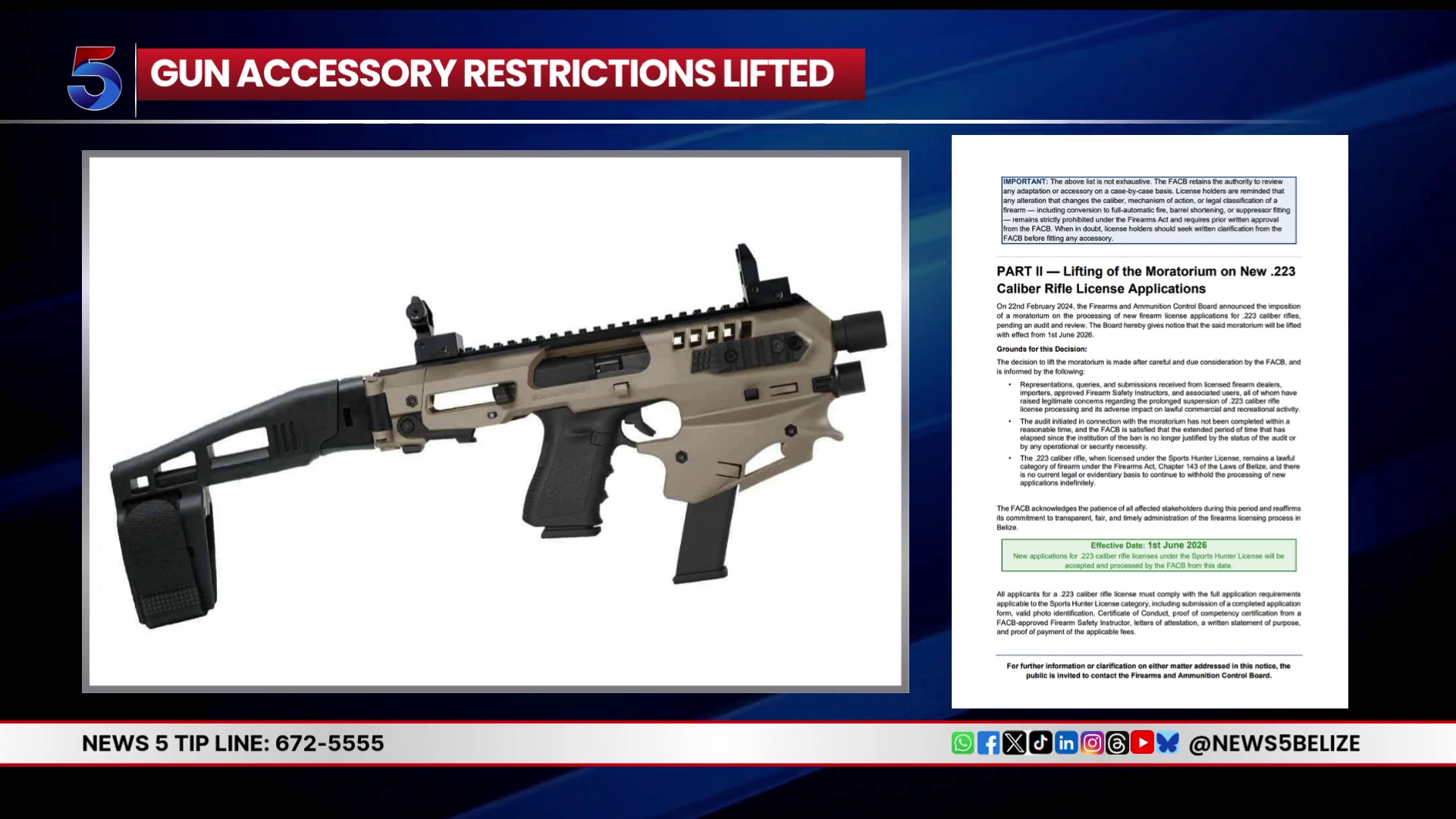
Scheduled to take effect on June 1, 2026, a sweeping overhaul of Belize’s gun licensing framework will bring mixed changes for firearm owners and dealers across the country. The Firearms and Ammunition Control Board (FACB), a newly convened body that first convened in December 2025, has unveiled a revised set of rules that eases certain long-standing restrictions while strengthening oversight, pre-application requirements, and public transparency around the licensing process.
After months of cross-stakeholder consultations with the general public, licensed firearm dealers, current gun owners, and agricultural industry groups, the board announced it will end a 28-month moratorium on new .223 caliber rifle licenses. The ban was initially implemented in February 2024 following a high-profile public incident involving a .223 rifle at a funeral, and was meant to allow time for a full audit of existing regulations governing the caliber. While that audit remains incomplete, FACB officials cite urgent pressure from Belize’s cattle industry as the key catalyst for lifting the restriction early.
Cattle ranchers operating in northern Belize and along the Guatemala border have faced a growing crisis: widespread coyote predation that is killing as many as two to three head of cattle per night for some operations, translating to thousands of dollars in lost income per week. According to Francis Usher, Chief Executive Officer of Belize’s Ministry of National Defense and Border Security, smaller-caliber weapons and shotguns are ineffective for managing the predator population, as coyotes’ strong sense of smell prevents hunters from getting close enough for a lethal shot. While the moratorium is being lifted, Usher emphasized that strict vetting criteria for .223 rifle licenses remain fully in place, and the change will also allow existing .223 owners to legally access regulated ammunition for their firearms.
Alongside the eased restrictions on .223 rifles, the board has updated its rules on permitted firearm accessories, eliminating the requirement for additional government approval for common modifications including scopes, red dot and green dot sights, weapon-mounted flashlights, lasers, and micro-conversion kits. The board draws a clear regulatory line between accessories that do not alter a weapon’s muzzle velocity or bullet discharge mechanics, and modifications that change a firearm’s core classification or lethality. Usher explained that since licensed firearm owners have already passed rigorous background and safety vetting, allowing approved accessories that improve shooting accuracy aligns with the board’s core goal of promoting safe, legal gun ownership.
To address a long-standing public complaint that clear information on the licensing process was not readily accessible, the board has published a full public outline of all application requirements, in an effort to crack down on unlicensed agents that exploit confused applicants. Usher stressed that no third-party agent is required to submit or process a firearm license application: applicants can submit all required documentation directly to the FACB office for full board deliberation.
The overhaul also introduces new, stricter accountability measures that shift more responsibility to licensed dealers and pre-licensing training. All new applicants will now be required to complete certified firearms training and pass a formal competency test at an approved firearm school before their application can be reviewed. Licensed dealers have broadly welcomed the new framework, noting that licensed firearm owners in Belize already maintain an extremely high compliance rate, with less than 1% of all crime involving legally licensed weapons.
Babil Abner, owner of local firearms retailer Locked and Loaded Guns and Ammo, commended the board for basing its new rules on empirical data rather than public panic. He noted that the revised framework balances increased accessibility for legitimate gun owners with strengthened public safety safeguards, a balance that aligns with the long-term public interest.
Overall, the FACB’s reform package frames gun ownership in Belize as a regulated privilege rather than an inherent right, and aims to strike a deliberate balance: easing unnecessary regulatory barriers for legitimate, vetted users while tightening oversight, transparency, and competency requirements to reduce public safety risk.