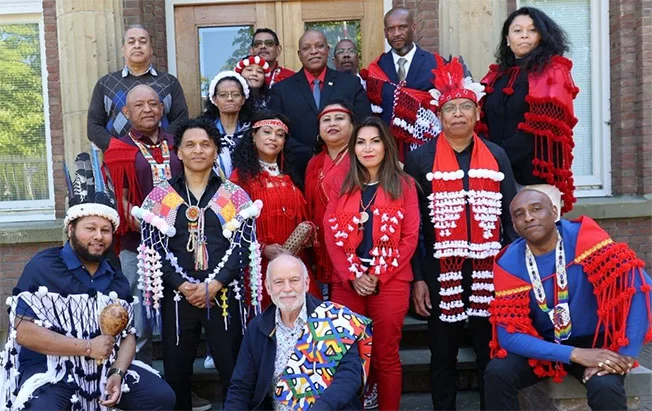
On April 21, 2026, a landmark first consultation convened at the Embassy of the Republic of Suriname in The Hague, bringing together embassy officials and a broad coalition of Indigenous organizations from the Surinamese diaspora. Sixteen representatives spanning multiple community groups and professional disciplines gathered to share unified perspectives, long-held concerns, and actionable policy proposals, marking an unprecedented moment: for the first time, the Indigenous diaspora has intentionally presented itself as a cohesive collective in formal dialogue with Suriname’s diplomatic mission.
The collective nature of the delegation emerged as a defining strength of the gathering, a point explicitly recognized by embassy leadership. Rejecting the historical pattern of separate, fragmented engagements, participating organizations deliberately chose to speak with one united voice. “The fact that you decided not to come individually, but as a collective, that is a powerful step forward,” embassy representatives noted during the opening session. This strategic choice reflects a growing shared awareness across the diaspora community: coordinated collaboration and aligned messaging are essential to driving meaningful policy influence.
A clear throughline ran through all contributions from the Indigenous delegation: after decades of centering demands for formal recognition, the community is now moving toward a new priority: tangible implementation of rights. The generations-long struggle for land rights was framed in clear historical context, with delegates emphasizing, “This fight has been ongoing for more than 50 years.” The collective message was unambiguous: formal recognition alone is no longer sufficient. The community now demands concrete policy action, binding legislation, and consistent enforcement of Indigenous rights.
Much of the discussion centered on the urgent, ongoing crisis unfolding in Suriname itself. Core topics included threatened land tenure, unregulated extractive concessions, and widespread environmental damage. Delegates highlighted the severe, immediate impacts of unregulated mining and industrial pollution as a top urgent priority, stressing, “This is not an Indigenous problem — this is a problem for all of Suriname.” The overlapping harms of environmental contamination, elevated public health risks, and limited legal protections have transformed what was once framed as a future risk into an active, ongoing crisis requiring immediate intervention.
Beyond legal and political demands, delegates also emphasized the foundational role of cultural preservation and intergenerational knowledge transfer. Multiple participating organizations already lead active work to protect and pass down Indigenous languages, traditional music, ceremonial practices, and ecological knowledge across both Suriname and the Netherlands. The diaspora plays a unique dual role in this work: as stewards of traditional knowledge, and as a bridging force connecting Indigenous communities in Suriname with global advocacy networks and resources.
The consultation opened with a traditional Indigenous ritual and a collective performance of the Surinamese national anthem, setting a tone distinct from standard bureaucratic negotiations: this was not only a policy meeting, but a cultural encounter rooted in mutual connection. Discussions unfolded in an atmosphere marked by radical openness, shared investment in the outcome, and reciprocal respect. The space made room for sharp substantive debate, as well as emotional reflection on centuries of struggle and displacement.
Embassy officials affirmed that these consultations are intended to create space for listening to and centering the perspectives of the diaspora community, while also echoing the delegation’s emphasis on unity and collaborative problem-solving. “We must nurture this solidarity and bring collective solutions to the table,” embassy representatives stated. The mission has committed to consolidating all input shared during the gathering and forwarding it to policymakers in Suriname, with the explicit goal of advancing concrete follow-up actions.
The first consultation included a diverse cross-section of Indigenous diaspora organizations and stakeholders, including Stichting Herdenking Slavernijverleden en Global Indigenous (SHS-GI), Nationale Reparatie Commissie Suriname (NRCS-NL), Platform Oorspronkelijke Rechten Suriname, Empowering Indigenous Suriname, Stichting Wasjikwa, Sociaal-Culturele Vereniging Masaraipono, Stichting Ma-Jong.net, Lottacam Studio – Indigenous music collective Yakua, Sambura-groep Anuana Maro, Arumjo Styling, and spiritual counselor Evert van der Bosch. Several additional groups, including Stichting Recht & Ontwikkeling Inheemsen (ROI), SCV Wajonong and IKC-I, shared written input ahead of the meeting, and their contributions were integrated into the collective agenda. Organizers note that the current participant list reflects only those able to join this initial gathering, and the broader Indigenous community includes many stakeholders not present for this first session.
As such, the meeting is explicitly framed as a first step in an open, ongoing process, with intentional space reserved for additional community members and organizations to join, contribute, and shape future efforts moving forward.
The core objectives of this initial gathering were to build introductions, share community perspectives, and lay a shared foundation for future collaboration between the Indigenous diaspora and the Surinamese embassy. Beyond the substantive exchange of policy priorities and concerns, the meeting delivered a clear signal of the diaspora community’s collective strength and shared commitment to collaboration.
Correspondingly, high expectations for follow-up have been articulated by participating Indigenous organizations. The community hopes this consultation will evolve into structured, ongoing coordination, concrete action on the issues discussed, and sustained inclusion of the diaspora in relevant policy processes, including governance, representation, and knowledge sharing. Proposed next steps include deepening the ongoing dialogue and exploring formal, structural frameworks for long-term collaboration.
Ultimately, the meeting marks not an endpoint, but a clear shift in the trajectory of Indigenous advocacy for Suriname. The Indigenous diaspora has now positioned itself as a visible, organized, and substantive stakeholder in national conversations about rights and policy. The question moving forward is no longer whether there will be follow-up to this historic gathering, but how this first step will translate into lasting collaboration and tangible, transformative change for Indigenous communities in Suriname and across the diaspora.