标签: Suriname

苏里南

  • Drie vuurwerkslachtoffers met oogletsel behandeld in SEH

    Drie vuurwerkslachtoffers met oogletsel behandeld in SEH

    Suriname’s health authorities have reported a concerning rise in fireworks-related injuries, with three confirmed cases requiring emergency medical attention as of Tuesday evening. All victims presented at the Academic Hospital Paramaribo’s Emergency Department with severe ocular trauma, highlighting a disturbing pattern of eye injuries during the holiday season.

    The most recent incidents include a 32-year-old male who sustained significant damage to both eyes and nasal structures from commercial-grade color and light display fireworks (KLS). In a separate case, a 6-year-old boy suffered left eye trauma from burning incense. Both patients received initial emergency treatment before being referred to ophthalmologists for specialized care.

    This medical emergency follows the first documented case on December 28th, when a 24-year-old man experienced similar ocular damage from fireworks. The consistent nature of these injuries—all involving serious eye trauma—has raised alarms among medical professionals about the dangers of improper fireworks handling.

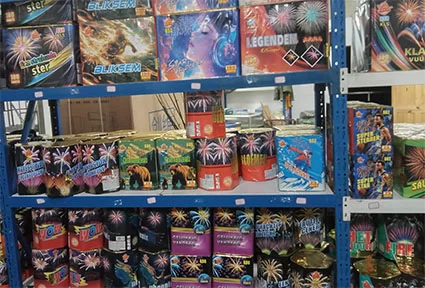
    With legal fireworks sales and usage permitted until midnight on January 1st, 2026, emergency personnel and Suriname’s Fire Brigade have issued urgent safety recommendations. Health officials are particularly emphasizing the critical need for adult supervision of children and adolescents to prevent additional incidents and potential permanent vision impairment. The medical community continues to monitor the situation as New Year’s celebrations approach their peak.

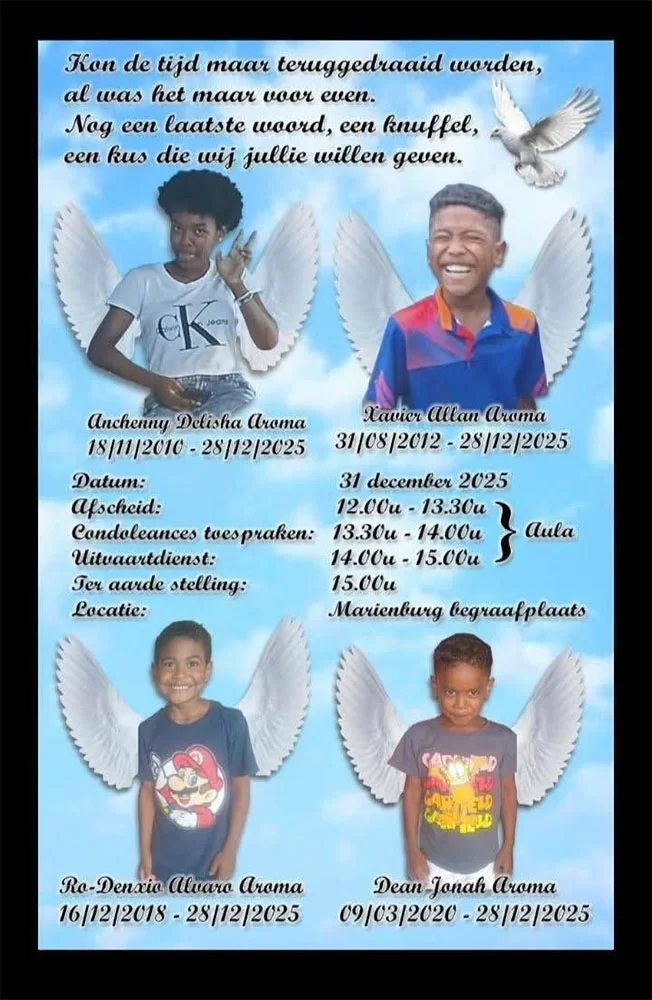
  • Vier kinderen Aroma in stilte begraven in Marienburg

    Vier kinderen Aroma in stilte begraven in Marienburg

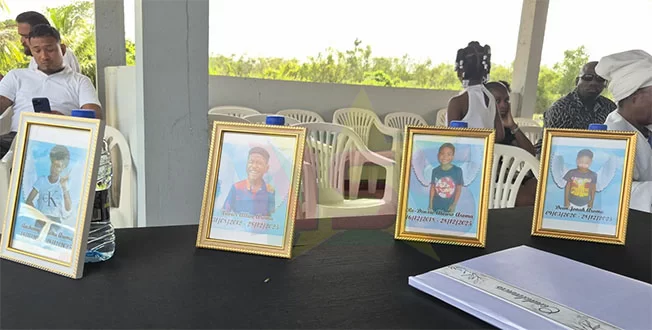
    Four young siblings from the Aroma family were laid to rest in a private funeral ceremony held in Mariënburg, Commewijne on Wednesday afternoon. The children—Anchenny (15), Xavier (13), Ro-Denxio (7), and Dean-Jonah (5)—were buried in solemn privacy at the request of their grieving mother.

    The tragic deaths occurred several days earlier when their father, Dennis Aroma, committed the horrific act of killing his four children before taking his own life while in police custody at the Keizerstraat station within 24 hours of the murders. The domestic violence incident claimed ten lives in total, including five additional victims beyond the immediate family.

    Mental health professionals from Suriname’s Psychiatric Center (PCS) and Psychosocial Care services provided continuous support to bereaved family members, having been involved since the first day of the tragedy. The intervention team also extended counseling services to classmates and schoolmates of the young victims.

    The funeral ceremony was attended by numerous political figures and government officials, including Assembly Member Ann Sadi, Vice President Gregory Rusland, and former President Chan Santokhi, who all offered condolences to the grieving family. PCS continues to provide psychological support to all affected families as preparations continue for the remaining victims’ funerals in the coming days.

  • China opent nieuwe hoofdstukken in grote-landendiplomatie op cruciaal moment

    China opent nieuwe hoofdstukken in grote-landendiplomatie op cruciaal moment

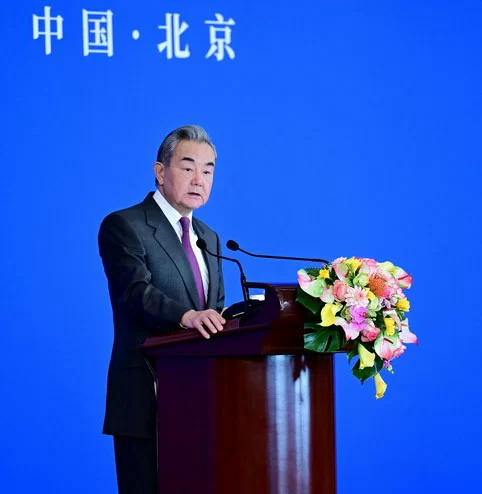
    In a comprehensive address at the Symposium on International Situation and China’s Foreign Relations, Chinese Foreign Minister Wang Yi articulated China’s strategic diplomatic direction for the coming years against the backdrop of profound global transformations. The speech delivered a moment of strategic reflection and forward-looking vision as the world navigates fundamental shifts in international order.

    Minister Wang characterized 2025 as a pivotal historical juncture where nations confronted critical choices between unilateral hegemony and emerging multipolarity, amid escalating geopolitical and economic tensions. Positioning China as a stabilizing force, Wang emphasized the nation’s commitment to peace, cooperation, and justice in international affairs.

    Under President Xi Jinping’s leadership, China is pursuing diplomacy with distinctive Chinese characteristics focused on building a shared future for humanity. The address highlighted China’s relationships with major global partners including the United States, Russia, European Union, and Global South nations. Wang specifically noted China’s active engagement in seeking peaceful resolutions to conflicts, including the Ukraine crisis.

    The Foreign Minister underscored China’s dedication to fostering positive relations with neighboring countries and across the Asia-Pacific region, emphasizing security, prosperity, and regional cooperation. China’s Belt and Road Initiative and international trade agreements were identified as central components of Beijing’s strategy to promote openness and economic development.

    Wang articulated China’s commitment to reforming global governance systems, advocating for enhanced justice, equality, and multilateralism in international relations. China aims to assume a leadership role in strengthening United Nations mechanisms and supporting developing nations.

    Regarding core national interests, Wang reiterated China’s unwavering position on sovereignty and territorial integrity, with particular emphasis on Taiwan. China firmly opposes any separatist activities and external interference, characterizing reunification with Taiwan as an irreversible historical mission.

    Looking toward 2026, Wang announced China’s plans to intensify diplomatic efforts across multiple fronts: providing strategic support for national development, deepening bilateral and multilateral relationships, promoting regional stability, and advancing global cooperation and openness.

    The address positions China as a confident and determined responsible major power committed to shaping a stable, peaceful, and just world order through proactive diplomatic engagement.

  • Oudejaarsdag in Commewijne: afscheid van kinderen Aroma

    Oudejaarsdag in Commewijne: afscheid van kinderen Aroma

    Suriname enters the new year under a cloud of profound grief as the nation mourns the devastating loss of five lives in a tragic incident that has shocked the community of Commewijne. On what should be a day of celebration and renewal, the country instead observes a solemn day of reflection following the death of Dennis Aroma (43) and his four children.

    The sequence of events began on Monday, December 29th, when Aroma was detained at approximately 1:30 AM and placed in a supervised observation cell at the Keizerstraat detention facility. The cell remained unlit throughout his confinement. During a routine check at 6:10 AM, guards discovered Aroma had died by suicide using an improvised ligature.

    According to official autopsy reports, Aroma’s death resulted from cerebral hypoxia caused by compression of neck vessels through hanging. Investigation reveals he repurposed bandaging material from a splint on his right lower leg, fashioning multiple loops attached to the cell’s bar structure positioned 180 centimeters above floor level. The bars themselves stood at approximately 150 centimeters in height, with only a green emergency blanket present in the spartan cell.

    Disturbing details emerged that rigor mortis had already set upon discovery, indicating significant time had elapsed since death occurred. Two staff members present during the incident have been questioned as part of an ongoing investigation into apparent supervisory failures.

    In response to the tragedy, the Surinamese government has announced it will cover all funeral expenses for the victims while providing ongoing support and counseling for bereaved family members. January 2nd has been officially designated a national day of mourning, allowing the nation to collectively process this profound loss.

    This incident has sparked serious questions about detention facility protocols and inmate welfare monitoring systems, particularly regarding vulnerable individuals in custody. As Suriname traditionally prepares for renewal and hope, the community now faces deep introspection about institutional responsibilities and preventive measures to avoid future tragedies.

  • China vuurt raketten af tijdens grootschalige militaire oefeningen rond Taiwan

    China vuurt raketten af tijdens grootschalige militaire oefeningen rond Taiwan

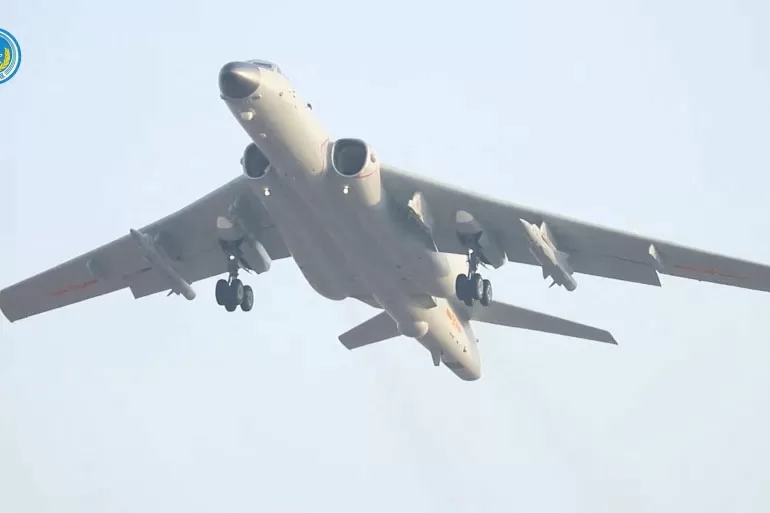
    China has escalated its military presence around Taiwan with large-scale exercises dubbed “Justice Mission 2025,” launching multiple missiles and simulating a full blockade of the self-governed island during the second day of operations. The drills involve live-fire exercises, naval and aerial patrols, precision strike simulations, and anti-submarine maneuvers across five designated maritime and air zones surrounding Taiwan.

    According to Taiwan’s Ministry of Defense, several artillery exercises occurred within Taiwan’s territorial waters, within 12 nautical miles (approximately 22 kilometers) of its coastline. The Taiwanese Coast Guard confirmed that seven missiles were fired within the first two exercise zones established by China.

    The exercises have significantly disrupted regional aviation, resulting in the cancellation of over 80 domestic flights—primarily serving Taiwan’s outlying islands—and potential delays for more than 300 international flights due to redirected air traffic routes, as reported by Taiwan’s Civil Aviation Authority.

    These maneuvers come in direct response to the United States’ announcement of its largest-ever arms deal with Taiwan, valued at $11.1 billion. Chinese Foreign Ministry spokesperson Lin Jian characterized the exercises as “punitive and deterrent actions against separatist forces seeking Taiwan independence through military buildup,” emphasizing the necessity of protecting China’s national sovereignty and territorial integrity.

    This marks the sixth instance of major Chinese military exercises around Taiwan since former U.S. House Speaker Nancy Pelosi’s 2022 visit. Analysts note that a primary objective is enhancing China’s “anti-access/area denial” capabilities, aimed at preventing Taiwan from receiving external support from allies like Japan and the U.S. during potential conflicts.

    The drills include simulated blockades of Taiwan’s key northern (Keelung) and southern (Kaohsiung) ports, along with control exercises over critical waterways such as the Bashi Channel and Miyako Strait, through which Taiwan imports substantial energy resources.

    China’s Eastern Theater Command released a poster titled ‘Hammer of Justice: Seal the Ports, Cut the Lines,’ depicting symbolic metal hammers striking Taiwan’s major ports. Taiwanese authorities reported monitoring 130 Chinese aircraft operations, 14 naval vessels, and eight official ships within a 24-hour period during the exercises.

    Observers warn that the escalating tensions increase the risk of open conflict between China and Taiwan.

  • Staatsolie behaalt doelen in 2025 en verstevigt basis voor offshore-toekomst

    Staatsolie behaalt doelen in 2025 en verstevigt basis voor offshore-toekomst

    Suriname’s state-owned oil company, Staatsolie Maatschappij Suriname N.V., concluded 2025 with exceptional financial and operational results, demonstrating robust performance across both onshore and emerging offshore sectors. The energy enterprise successfully met all production targets while laying foundations for sustainable growth in the nation’s burgeoning oil and gas industry.

    The company reported impressive financial metrics for the year, with projected revenues reaching approximately $802 million and pre-tax profits totaling $418 million. Production figures revealed 6.35 million barrels of oil extracted, exceeding established targets. The refinery operations outperformed expectations, generating 3.1 million barrels of diesel and gasoline combined. A significant milestone was achieved with the inaugural commercial production and subsequent delivery of sulfuric acid to Suralco.

    Through its subsidiary Staatsolie Power Company Suriname (SPCS), the corporation supplied approximately 1.37 million MWh of electricity, accounting for 69% of power distributed through the EPAR network to Paramaribo and surrounding districts. Infrastructure development continued with GOw2’s modernization initiative, which completed two upgraded pumping stations and established a new facility in Saramacca.

    Staatsolie’s contribution to national finances proved substantial, injecting an estimated $387 million into state coffers through taxes, dividends, and royalty payments. This represented approximately 32% of total government revenues and accounted for nearly 9% of Suriname’s gross domestic product.

    Offshore developments marked particularly significant progress throughout 2025. The GranMorgu project in Block 58 advanced according to schedule, achieving 25% overall completion with the floating production storage and offloading (FPSO) vessel halfway constructed. First oil production remains anticipated for 2028. Additionally, the company granted commercial approval for the Sloanea-1 gas field in Block 52, representing a crucial step toward offshore gas production pending final investment decision in 2026.

    To finance its 20% participation in the GranMorgu venture, Staatsolie secured over $2 billion through a successful bond issuance and international bank loan, demonstrating strong investor confidence in Suriname’s energy prospects.

    The corporation maintained its commitment to social responsibility, channeling $2.7 million into community projects through the Staatsolie Foundation supplemented by an additional $3 million allocation commemorating the company’s 45th anniversary.

    Despite global oil market uncertainties, Staatsolie approaches 2026 with confidence, supported by solid financial positioning, strategic partnerships, and continued dedication to creating lasting value for Suriname’s economy and society.

  • Nieuwe Raad van Commissarissen SWM aangetreden onder leiding van Ronald Rozenblad

    Nieuwe Raad van Commissarissen SWM aangetreden onder leiding van Ronald Rozenblad

    In a significant governmental reshuffle, Ronald Rozenblad has been appointed as the President-Commissioner of NV Surinaamsche Waterleiding Maatschappij (SWM), Suriname’s national water utility company. The appointment occurred during an extraordinary General Meeting of Shareholders convened on December 29 at the Ministry of Natural Resources.

    Minister David Abiamofo, representing the State of Suriname as sole shareholder, presided over the meeting alongside Water Director Gonda Asadang and SWM Deputy Financial Director Freddy Crisis. The newly constituted Board of Commissioners comprises seven members: Sacha Mertowirijo, Sharmaine Artist, Alice Amafo, Nigel Sloot, Keshian Joekoe, and Rudiwal Baarh alongside Chairman Rozenblad.

    This leadership transition follows a December 10 cabinet decision that terminated the previous board led by acting President-Commissioner Preshand Baldew. The new board received a five-year mandate beginning immediately.

    During the transfer ceremony, Minister Abiamofo emphasized the board’s dual responsibility: not only providing oversight but also serving as a crucial liaison between shareholders, management, and employees. Core responsibilities include safeguarding policy direction, maintaining operational quality, and ensuring corporate governance standards.

    The board’s immediate priority involves conducting a comprehensive operational assessment of SWM, with findings to be reported directly to the government. Additionally, the ministry plans to establish structured policy dialogue mechanisms between the shareholder and commissioners.

    Minister Abiamofo acknowledged the outgoing board’s contributions while noting the incoming team faces particular challenges in ensuring continuous delivery of clean drinking water amid complex operational conditions.

  • Uitspraak in strafzaak Danielle Veira uitgesteld

    Uitspraak in strafzaak Danielle Veira uitgesteld

    In a significant judicial development, the sentencing hearing for Danielle Veira, the former Director of National Security, has been formally postponed until January 30th. The scheduled proceedings were abruptly delayed after Veira’s legal representatives presented a medical certificate to the Court of Appeal, indicating her inability to attend today’s crucial session.

    Presiding Judge Cynthia Valstein-Montnor emphasized the judicial preference for the defendant’s physical presence during sentencing announcements. The court additionally requires extended deliberation time to thoroughly consider the appropriate verdict in this complex case.

    Veira faces multiple serious charges including complicity in the kidnapping of Rodney Cairo, unlawful entry, armed robbery participation, and unauthorized issuance of firearm permits. The Public Prosecutor has recommended a substantial nine-year prison sentence for the former intelligence chief.

    During last week’s emotional courtroom appearance, Veira expressed profound distress, stating she never anticipated facing criminal proceedings. “I have been mockingly portrayed as both suspect and delinquent,” she declared in her final statement, visibly overcome by the gravity of the situation.

    The case has drawn considerable public attention due to Veira’s former high-ranking position and the severity of the alleged offenses. Legal experts suggest the medical postponement could indicate strategic developments in the defense approach as the judicial process enters its final phase.

  • Bangladesh: Eerste vrouwelijke premier overleden

    Bangladesh: Eerste vrouwelijke premier overleden

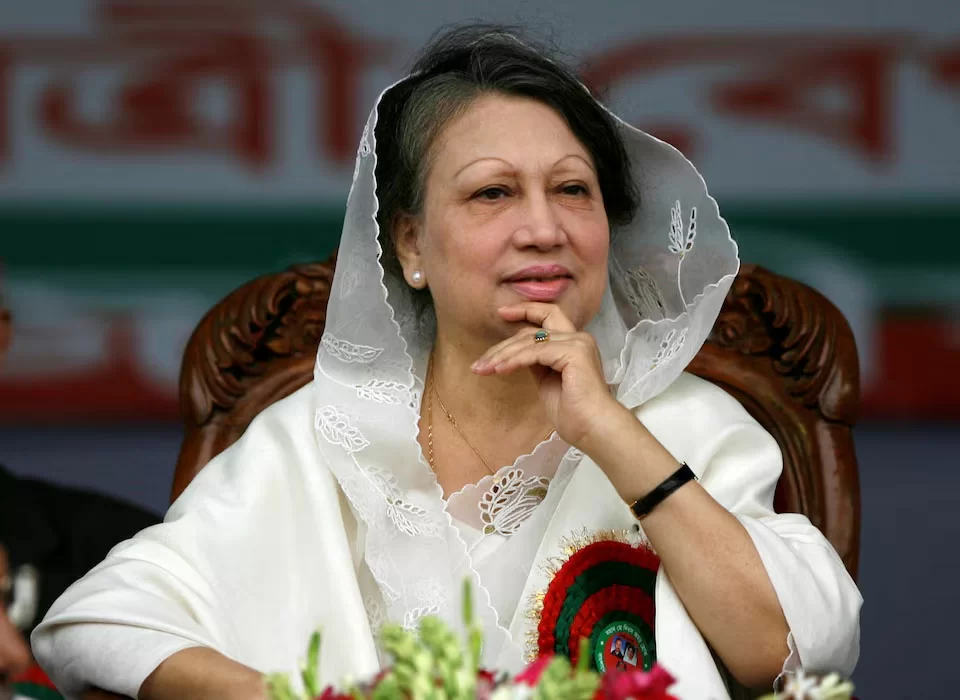
    Bangladesh’s political landscape has been permanently altered with the passing of Begum Khaleda Zia, the nation’s first female prime minister, who died Tuesday at age 80 after a prolonged illness. The opposition Bangladesh Nationalist Party (BNP) confirmed her death following an extended battle with advanced liver cirrhosis, arthritis, diabetes, and cardiovascular complications.

    Khaleda Zia’s political journey represents one of modern South Asia’s most compelling narratives. She initially rose to power in 1991 through a surprising electoral victory against her rival Sheikh Hasina, becoming only the second woman to lead a democratic government in a predominantly Muslim nation after Pakistan’s Benazir Bhutto.

    Her legacy is characterized by both groundbreaking achievements and intense political conflicts. During her tenure, she transformed Bangladesh’s governmental structure by replacing the presidential system with a parliamentary framework, relaxed restrictions on foreign investment, and implemented mandatory free basic education.

    The relationship between Khaleda Zia and Sheikh Hasina defined decades of Bangladeshi politics. Initially collaborators in the 1990 pro-democracy movement that ousted military ruler Hossain Mohammad Ershad, their alliance quickly dissolved into what became known as the “Battling Begums” rivalry—a reference to the Urdu honorific for prominent women.

    Their contrasting leadership styles became legendary: Khaleda, described as reserved, traditional, and carefully measured in speech; Hasina, markedly more outspoken and assertive. This personal and political dichotomy fueled a power struggle that would dominate the nation’s affairs for over three decades.

    Khaleda’s second term as prime minister (2001-2006) was marred by rising Islamic militancy and corruption allegations. The 2004 grenade attack on a Hasina rally, which killed over 20 people and injured 500, remains one of the most controversial events of this period, with Khaleda’s government and its Islamic allies widely blamed.

    The subsequent years saw Khaleda’s political fortunes decline dramatically. After a military-backed caretaker government assumed power in 2006, both she and Hasina faced approximately one year of imprisonment on corruption charges. Though released before the 2008 elections, Khaleda never regained power.

    Her later years were marked by legal battles and deteriorating health. In 2018, she was imprisoned on corruption charges related to embezzlement of orphanage funds—accusations she maintained were politically motivated attempts to exclude her family from politics. She was transferred to house arrest in March 2020 on humanitarian grounds as her health declined.

    The recent political upheaval in Bangladesh had created new dynamics for Khaleda’s legacy. Following student-led protests that ousted Hasina in August 2024, an interim government under Nobel Peace Prize winner Muhammad Yunus assumed control. Hasina herself was sentenced to death in absentia in November for her lethal suppression of student protests.

    Khaleda’s release from house arrest in August 2024 and subsequent court exonerations in early 2025—both in the corruption case that had imprisoned her and the 2004 grenade attack allegations against her son Tarique Rahman—marked significant late-life developments.

    The return of her son Tarique Rahman after nearly 17 years in self-exile last week, combined with the BNP’s position as favorite for February’s parliamentary elections, suggested a potential political resurgence that her death has now cut short.

    Khaleda Zia’s story began not as a politician but as a mother dedicated to raising her two sons. Her entry into politics came only after the 1981 assassination of her husband, military leader and president Ziaur Rahman, during a failed coup. Assuming leadership of his BNP party three years later, she vowed to continue his mission to “free Bangladesh from poverty and economic backwardness.”

    Her passing closes a monumental chapter in Bangladesh’s history while leaving unanswered questions about the nation’s political future and the resolution of the epic rivalry that shaped its democracy.
  • Politie: Aroma rond 01.30 uur ingesloten, om 06.10 uur levenloos aangetroffen in cel Keizerstraat

    Politie: Aroma rond 01.30 uur ingesloten, om 06.10 uur levenloos aangetroffen in cel Keizerstraat

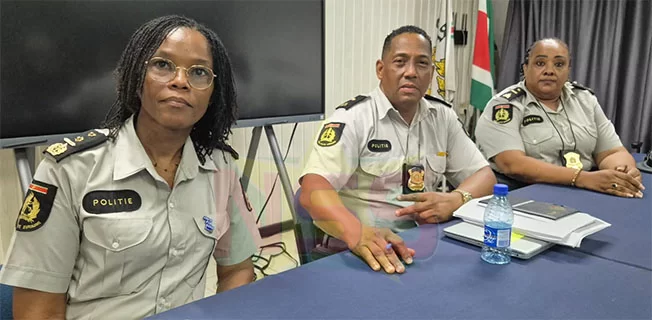
    Surinamese police authorities faced intense media scrutiny during a press conference addressing the controversial death of detainee Dennis Aroma, who was found deceased in a custody cell at the Central Police Station (Keizerstraat) on Monday morning. The incident has raised serious questions about detention protocols and inmate monitoring procedures.

    According to police spokesperson Michael Elskamp, Inspector Third Class and acting Head of Public Relations, Aroma had been transported to the station at approximately 1:30 AM on December 29 following his discharge from the Academic Hospital Paramaribo (AZP). The detainee was placed in an Observation and Temporary Stay (OTS) cell, where he was discovered lifeless during routine checks at 6:10 AM.

    Police Commissioner Rachel Deekman revealed that Aroma had initially received treatment at the Emergency Department for gunshot wounds sustained during his apprehension. Authorities emphasized that OTS cells are designed for isolated detention pending further judicial proceedings, not for continuous surveillance of high-risk individuals.

    The police force acknowledged contacting Suriname’s Psychiatric Center (PCS) to determine whether Aroma had documented mental health concerns, though no medical reports indicating psychological instability were available at the time of his transfer.

    While preliminary investigations suggest suicide using bandage materials from a splint applied to his right lower leg, officials declined to provide specific details pending completion of the autopsy and formal investigation. The Capital Crimes Division, assisted by Forensic Investigation and medical professionals, is conducting a comprehensive review of the circumstances.

    During the press conference, journalists criticized the lack of transparency regarding surveillance protocols, camera monitoring, and hospital discharge decision-making processes. Police representatives stated they had come forward provisionally to address public concern and curb speculation, but definitive answers would require completion of the ongoing investigation and receipt of the official autopsy report.