标签: Suriname

苏里南

  • Koning vraagt vergiffenis en spreekt met open hart over geschiedenis, heling en toekomst

    Koning vraagt vergiffenis en spreekt met open hart over geschiedenis, heling en toekomst

    In a remarkably personal address during Monday evening’s state banquet at Ballroom Prince, King Willem-Alexander of the Netherlands delivered an emotionally charged speech that transcended diplomatic formalities. The monarch’s visit to Suriname during its 50th anniversary of independence (Srefidensi) became a profound historical moment as he directly addressed the painful legacy of Dutch colonialism.

    The King, visibly moved, reflected on his family’s multi-generational connection to Suriname, noting how his grandparents had made the first state visit to the young republic. “Since then,” he observed, “much water has flowed through the Suriname River”—a poignant acknowledgment of turbulent political decades and enduring connections.

    Most significantly, Willem-Alexander built upon the Dutch government’s 2023 slavery apologies by personally requesting forgiveness for the historical failures of Dutch monarchs. “Your history bears the brand of slavery in the name of the Dutch state,” he stated. “The Dutch government has apologized for this, and personally I have added the request for forgiveness for the failure to act against this crime against humanity by stadholders and kings of the House of Orange-Nassau.”

    The King had previously repeated these apologies and personal requests for forgiveness during meetings with descendants of enslaved people and Indigenous communities, emphasizing that healing requires continuous generational truth recognition.

    Beyond historical reconciliation, Willem-Alexander praised Suriname’s resilience, describing the nation as a “beacon of humanity” in an increasingly polarized world. He specifically honored resistance heroes including the maroons who fiercely defended their hard-won freedom and legendary figures like Boni, whose moral authority inspired fights for dignified existence.

    The banquet also focused on future cooperation, with the King highlighting Suriname’s youth potential, rainforest conservation (noting the country absorbs more CO₂ than it emits), and responsible mineral resource management. He emphasized Dutch support would be offered “with due humility.”

    In a notable diplomatic gesture, the King announced the Dutch ambassador would lay a wreath at the December Murders monument during December 8th commemorations, acknowledging Suriname’s developing rule of law.

    The evening concluded with lighthearted moments as the King anticipated potential World Cup football rivalry between the nations in 2026, and a recitation of Dobru’s famous multicultural unity poem: “Wan Sranan, Someni wiwiri, Someni skin, Someni tongo, Wan pipel” (One Suriname, Many leaves, Many skins, Many tongues, One people).

  • Column: Koning, nooit meer oranje boven

    Column: Koning, nooit meer oranje boven

    In a strikingly candid address to visiting Dutch King Willem-Alexander, Surinamese commentator Nita Ramcharan delivered a powerful critique of contemporary Netherlands-Suriname relations during the monarch’s recent state visit. The article captures Suriname’s assertive national awakening fifty years after independence, challenging historical power dynamics and demanding equal partnership.

    The piece begins by acknowledging Suriname’s traditional hospitality while immediately establishing that formal politeness no longer masks unresolved tensions. Ramcharan references outdated colonial-era imagery of schoolchildren singing ‘orange above, long live the royal couple’ to highlight how far the nation has evolved into a digitally-connected modern society.

    King Willem-Alexander witnessed Suriname’s transformation firsthand—encountering tech-savvy youth who fact-check in real-time, engaging with traditional leaders, and receiving direct political messaging that ‘We walk beside you, not behind you’ in the National Assembly. This sets the stage for the central issue: visa policies that Surinamese citizens find deeply discriminatory.

    The author contrasts the seamless entry process for Dutch travelers to Suriname with the ‘theatrical tragedy’ Surinamese face when applying for Netherlands visas—requiring extensive documentation ‘as if leaking state secrets’ while subject to consular officials’ arbitrary decisions. Ramcharan dismisses potential Schengen Zone excuses, insisting the king possesses both platform and moral authority to address what she characterizes as institutional humiliation.

    Beyond visa grievances, the article outlines Suriname’s vision for truly balanced relations: trade without dependency, cooperation without paternalism, and ensuring future oil revenues benefit local generations. While acknowledging domestic challenges, Ramcharan emphasizes national resilience and self-determination.

    The powerful conclusion rejects orange symbolism entirely: ‘The shadow of orange lies behind us. The sun of Suriname lies before us.’ This encapsulates the piece’s core message—Suriname now stands beside its golden star symbol, on its own soil, as an equal partner rather than former colony.

  • Adhin: Koninklijk bezoek onderstreept nieuwe fase van democratische verdieping

    Adhin: Koninklijk bezoek onderstreept nieuwe fase van democratische verdieping

    The landmark visit of King Willem-Alexander and Queen Máxima to Suriname has been hailed by National Assembly Chairman Ashwin Adhin as a transformative moment in bilateral relations, marking a significant shift toward strengthened political responsibility and democratic development. During an extraordinary public assembly session, Adhin emphasized that the royal visit transcends ceremonial symbolism, representing instead a crucial opportunity for Suriname to redefine its democratic future with greater clarity.

    Coinciding with Suriname’s commemoration of fifty years of independence, the parliamentary leadership views the Dutch head of state’s visit as a powerful signal that bilateral relations can be substantially reinforced. This revitalized partnership, Adhin noted, would not focus on revisiting historical narratives but rather on collaboratively building a modern, equitable relationship framework.

    The Assembly Chairman asserted that the royal couple’s presence demonstrates the Netherlands’ genuine commitment to supporting parliamentary democracy and institutional development within Suriname. This diplomatic engagement creates an ideal platform for openly addressing contemporary challenges, reducing mutual misunderstandings, and exploring new cooperative opportunities spanning knowledge exchange to economic enhancement initiatives.

    Adhin characterized contemporary diplomacy as an essential instrument for building international trust, noting that the National Assembly considers this royal visit a catalyst for deeper cooperation and the strengthening of political institutions that form the foundation of liberty, justice, and stability. The parliamentary leader expressed hope that this visit would inspire both Surinamese and Dutch citizens to further deepen bilateral relations based on mutual respect, shared values, and a forward-looking vision that future generations could proudly build upon.

  • Nederland stelt 66 miljoen euro beschikbaar voor Surinames herstelprojecten

    Nederland stelt 66 miljoen euro beschikbaar voor Surinames herstelprojecten

    The Netherlands has pledged €66 million to fund social projects in Suriname aimed at addressing the legacy of colonialism and slavery. This allocation forms part of the broader €200 million Slavery Past Fund established by the Dutch government following King Willem-Alexander’s formal apology in July 2023.

    During a high-level dialogue at the Surinamese Presidential Cabinet, Dutch Foreign Minister David van Weel announced the commitment to representatives of Indigenous and tribal communities, descendants of enslaved Africans, and government officials. The meeting occurred as part of the Dutch royal couple’s official visit to Suriname.

    Minister van Weel emphasized that the royal apology marked not an endpoint but a beginning: “There is no period placed, but a comma. This fund is designed to support the process of restoration and healing,” he stated.

    Surinamese President Jennifer Simons expressed appreciation for the pledged resources while clarifying their intended purpose. “The €66 million is not reparations but rather a consciousness-raising fund for education and societal development,” she explained. President Simons indicated that discussions regarding proper reparations, aligned with the Caricom 10-point plan, would need to occur separately at a later stage.

    King Willem-Alexander reinforced the Netherlands’ commitment to listening and learning throughout the process. “This is a moment to hear what lives among you. I realize that the pain of the past continues through generations, and I feel responsible for my predecessors,” the monarch stated.

    Community representatives used the dialogue to request structural support. Granman Albert Aboikoni of the Saramaccaners called for increased consultation regarding “restitution and financial support” to address historical disadvantages. Wilgo Ommen of Fiti Makandra acknowledged the importance of apologies while emphasizing they shouldn’t represent the conclusion: “We look forward to a process after the comma.”

    Armand Zunder, Chairman of the Restoration and Reparation Commission, concluded contributions by requesting the establishment of a mandated commission specifically focused on healing and restoration within affected communities.

    President Simons confirmed the dialogue would lead to forming a joint team from both nations to advise on implementing the healing and restoration process. The meeting was chaired by Edgar Dikan, advisor to the Presidential Cabinet.

  • Bronto Somohardjo: Suriname loopt niet achter maar naast Nederland

    Bronto Somohardjo: Suriname loopt niet achter maar naast Nederland

    In an extraordinary public session of De Nationale Assemblée, Pertjajah Luhur faction leader Bronto Somohardjo delivered a remarkably personal address to King Willem-Alexander that redefined Suriname’s relationship with its former colonial ruler. The speech emphasized generational change, mutual equality, and Suriname’s sovereign right to determine its own future.

    Somohardjo opened with personal greetings to the king and Surinamese citizens in the Netherlands, revealing his own background as a former Dutch citizen after his family was forced to flee to the Netherlands decades ago. He acknowledged difficult historical periods marked by political turmoil and acknowledged that his father ‘didn’t make it easy for you either,’ referencing occupations, protests, and incidents broadcast live on Dutch television.

    Despite this contentious past, Somohardjo noted his family received fair treatment from the Netherlands and was naturalized by the king’s mother, Queen Beatrix, whom he described as ‘a warm and human woman remembered fondly by many here.’ He clarified that his voluntary exchange of a Dutch passport for a Surinamese one was ‘not out of ingratitude, but conviction’—wanting to be ‘buried in the same soil as my combaté.’

    Addressing Queen Máxima directly, Somohardjo humorously noted her South American background, suggesting ‘a South American woman deserves extra attention.’

    The core of his speech delivered a powerful message: ‘Suriname is not a paragraph in Dutch history. Suriname writes its own book.’ He described this ongoing narrative as being written by ‘Surinamese students in your cities, Dutch interns in my cities, and especially by families separated by thousands of kilometers yet remaining connected.’

    Adopting what he called ‘Dutch bluntness’ learned during his upbringing in the Netherlands, Somohardjo stated plainly: ‘You are not here because our sun shines so pleasantly. You are not here for our beautiful nature or that delicious Parbo beer you can now find in Albert Heijn. You are here because you are Dutch. And Dutch people see opportunities—especially in trade.’

    He issued a significant warning: ‘The generation your mother dealt with is not the generation facing you today. We are different. We dare more. We know our worth. And we will let no one—friend, partner, or country—take the cheese from our bread.’

    The central message called for a completely redefined relationship based on equality: ‘We, King, do not walk behind you. But walk beside you. And that must be the new chapter between Suriname and the Netherlands.’ He advocated for mutual rediscovery without subservience or confrontation: ‘Not with bowed heads. Not with clenched fists. But out of respect for each other.’

    Somohardjo concluded by welcoming the royal couple while firmly asserting Suriname’s self-determination: ‘Welcome to Suriname. The country that knows and acknowledges its history. But will write its own future.’

  • Diakonessenhuis ontvangt mozaïekkunstwerk op Wereld Aids Dag: symbool verbondenheid en strijd tegen stigma

    Diakonessenhuis ontvangt mozaïekkunstwerk op Wereld Aids Dag: symbool verbondenheid en strijd tegen stigma

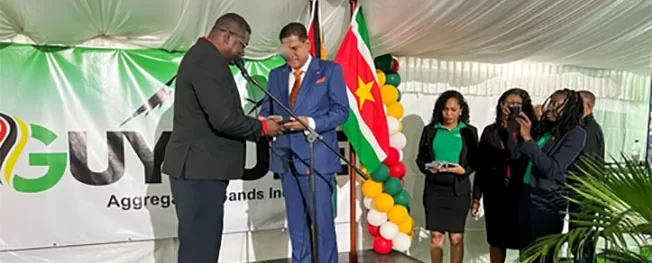
    In a poignant ceremony marking World AIDS Day 2025, the Diakonessen Hospital received a distinctive mosaic artwork created by individuals living with HIV. The collaborative piece, developed under the guidance of artist Ruth-Rachel Joeroeja, was presented to internist and HIV specialist Marja van Eer as a powerful symbol of solidarity, awareness, and stigma reduction.

    The artistic initiative emerged from the HIV Awareness Program led by Lianne Cremers of Vrije Universiteit Amsterdam, in partnership with Anton de Kom University, Paramaribo Academic Hospital, multiple researchers, and artist Joeroeja. The Raining Colors Foundation organized a creative workshop in Paramaribo where participants—all affected by HIV—first attended a motivational session facilitated by Erika Van Der Mark, followed by a painting workshop. Their individual artistic expressions were subsequently integrated into a unified collective artwork.

    During the presentation ceremony, Dr. Van Eer addressed the persistent challenges in achieving a world free of HIV-related complications. “Numerous setbacks mark the path toward eliminating HIV as a public health threat,” she stated. “The World Health Organization’s sustainable development goals for 2030 require that HIV/AIDS no longer constitutes a public health emergency.”

    She highlighted concerning trends, noting that diminishing international support for HIV prevention and treatment programs has complicated early detection of new infections. Simultaneously, stigma and discrimination continue to pose significant barriers to effective HIV management.

    The current epidemiological landscape in Suriname reveals alarming statistics: approximately 7,900 people are living with HIV, with only half aware of their status. Annual new infections approach 460 cases, representing 1.6% of the population. Disparities emerge across demographics: 0.9% among tested women compared to 2.4% among tested men, with many men presenting late with increased complication risks. Pregnant women show a 1.1% prevalence rate.

    Particularly vulnerable populations face dramatically elevated rates: men who have sex with men (31%), transgender individuals (26%), female sex workers (2.1%), and male sex workers (52%). Additionally, teenagers, adolescents, and young pregnant women are increasingly presenting with sexually transmitted infections including HIV, creating risks for both mothers and children.

    Dr. Van Eer emphasized the critical importance of accessibility, testing, and treatment: “Individuals with risks from unprotected sexual contact must have access to education, counseling, and testing. Modern HIV inhibitors enable people with HIV to lead healthy lives.” She issued a compelling call to action: “We must leave no one behind in our HIV response—this is our collective responsibility.”

    The Diakonessen Hospital, which has provided care and support for people living with HIV and their loved ones since 1995, expressed honor in granting the artwork a prominent permanent location within their facilities.

  • Brunswijk: Historisch besef belangrijk bij vormgeven relatie Suriname-Nederland

    Brunswijk: Historisch besef belangrijk bij vormgeven relatie Suriname-Nederland

    In an extraordinary parliamentary session attended by Dutch King Willem-Alexander, ABOP faction leader Ronnie Brunswijk delivered a powerful address emphasizing the necessity of acknowledging colonial history to build a mature partnership between Suriname and the Netherlands. Speaking directly to the government table where President Jennifer Simons sat alongside the Dutch monarch, Brunswijk—descendant of enslaved Africans and member of the Maroon community—highlighted the courage, struggle, and sacrifices made by his ancestors for freedom long before it was codified in law.

    The political leader asserted that recognizing the colonial past represents not an attempt to sow division but an essential step toward establishing a balanced relationship. ‘History contains painful aspects, but also moments of cooperation and shared values. This demands an honest and balanced approach to dealing with one another,’ Brunswijk stated during the special parliamentary gathering.

    While emphasizing Suriname’s forward-looking perspective, Brunswijk positioned the state visit as a potential starting point for a new phase of cooperation that must deliver concrete benefits for both nations. He expressed particular appreciation for the presence of the Dutch king and queen, interpreting their visit as demonstrating genuine willingness to strengthen bilateral relations.

    ‘Suriname welcomes you with pride, honesty, and dignity—as a people who know their history, acknowledge their pain, and look toward the future with confidence,’ declared Brunswijk, framing the occasion as symbolic of evolving diplomatic relations between the former colony and its former colonial power.

  • Gajaden: Staatsbezoek Nederlands koningspaar bevestigt bereidheid, bouwen aan nieuwe relatie

    Gajaden: Staatsbezoek Nederlands koningspaar bevestigt bereidheid, bouwen aan nieuwe relatie

    The historic visit of King Willem-Alexander and Queen Máxima to Suriname represents a significant milestone in bilateral relations, according to VHP parliamentary leader Asis Gajadien. In an extraordinary public parliamentary session, Gajadien emphasized that the royal visit demonstrates both nations’ commitment to building a relationship founded on mutual respect and equality.

    Gajadien recalled that plans for an official visit around Suriname’s 50th independence anniversary had been contemplated since 2021. The realization of this visit now stands as a powerful symbol of restored trust between the former colonizer and its former colony. The VHP faction leader highlighted his party’s consistent advocacy for mature and constructive cooperation with the Netherlands.

    The parliamentary leader outlined numerous areas for potential collaboration, including education, knowledge development, healthcare, energy sustainability, climate action, environmental management, and combating transnational crime. Gajadien particularly stressed the importance of acknowledging historical injustices, expressing appreciation for the Netherlands’ growing recognition of its colonial past.

    Gajadien asserted that appropriate forms of restorative justice remain crucial for strengthening trust within Surinamese society. The royal visit, occurring years after independence, marks a transformative moment in the complex relationship between the two nations, potentially paving the way for a partnership based on genuine equality and shared objectives rather than historical hierarchies.

  • Parmessar: Visumbeleid Nederland moet eerlijker in gelijkwaardige relatie

    Parmessar: Visumbeleid Nederland moet eerlijker in gelijkwaardige relatie

    During the extraordinary public session of the National Assembly convened for the state visit of King Willem-Alexander and Queen Máxima, opposition leader Rabin Parmessar of the National Democratic Party (NDP) articulated a vision for fundamentally transforming Suriname’s relationship with the Netherlands. The political leader emphasized the necessity of establishing a mature, business-oriented partnership characterized by mutual reinforcement rather than dependency.

    Parmessar presented a comprehensive framework for bilateral cooperation spanning multiple sectors including trade, investments, agriculture, healthcare, tourism, and sustainable energy. He asserted that Suriname stands prepared to actively leverage these opportunities through pragmatic collaboration that delivers economic and social advancement for both nations.

    The most pressing issue addressed was the Netherlands’ current visa policy toward Surinamese citizens. Parmessar characterized the existing application procedures as unnecessarily burdensome and frequently inhumane, calling for immediate revision. He argued that such practices contradict the fundamental principles of respect and equality that should define the bilateral relationship, presenting the royal visit as an opportune moment to address these concerns openly and concretely.

    The opposition leader reiterated his party’s consistent stance against external interference while emphasizing the protection of national interests. He maintained that Suriname must engage in international partnerships from a position of strength and self-confidence rather than dependency.

    Concluding his address, Parmessar advocated for using the state visit as catalyst for establishing tangible improvements rather than symbolic gestures—emphasizing fair procedures, business cooperation, and mutual respect as the foundation for a redefined relationship between the two nations.

  • Nederlandse koning: Wij komen om de relatie te verdiepen als gelijkwaardige partners

    Nederlandse koning: Wij komen om de relatie te verdiepen als gelijkwaardige partners

    In a landmark address to Suriname’s National Assembly on December 1st, King Willem-Alexander of the Netherlands delivered a powerful speech acknowledging the complex shared history between the two nations while advocating for strengthened cooperation as ‘equal partners.’

    The monarch, speaking from the parliamentary chamber in Paramaribo, emphasized the extraordinary nature of addressing lawmakers ‘7,500 kilometers from home’ in a shared language. He clarified the unique composition of the Kingdom of the Netherlands, noting that while geographically distant, it remains ‘partly European and partly Caribbean,’ making the nations ‘good neighbors in this region.’

    The King praised Suriname’s democratic institutions for their remarkable achievement in unifying an ethnically and culturally diverse population within a single democratic framework. ‘It inspires admiration how you manage to unite so many different population groups within one democratic system in this country,’ he stated, describing Suriname—which celebrated 50 years of independence this year—as ‘an inspiring example’ of successful integration.

    With deliberate candor, the Dutch head of state addressed the painful legacy of four centuries of colonial rule, slavery, and contract labor that characterized much of the bilateral history. ‘The stories of your ancestors are of essential significance to you, and also to us,’ he declared. ‘They must never be forgotten.’ He emphasized that listening to these intergenerationally transmitted narratives remains fundamental to deepening mutual understanding.

    Against the backdrop of global challenges to democracy, rule of law, and security, King Willem-Alexander identified opportunities for enhanced cooperation. ‘We want to work with you on resilience, also in social and economic terms,’ he proposed, outlining the visit’s objectives as listening, learning, and renewing bilateral ties.

    Concluding his address, the King expressed appreciation for Assembly members’ service to Suriname and their mission to guide the nation toward a strong future. ‘Know that the Kingdom of the Netherlands gladly continues to walk together with you and all Surinamese on the path that lies ahead,’ he affirmed, ending with the heartfelt Sranan Tongo expression: ‘Grantangi!’ (Thank you).