标签: Suriname

苏里南

  • Franse scholieren bezoeken Suriname Diplomaten Instituut

    Franse scholieren bezoeken Suriname Diplomaten Instituut

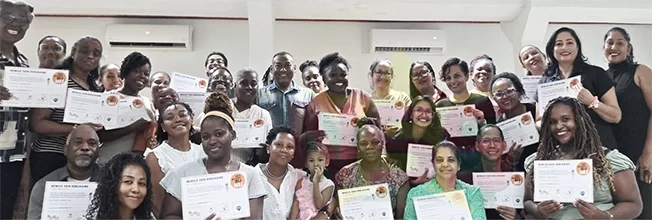
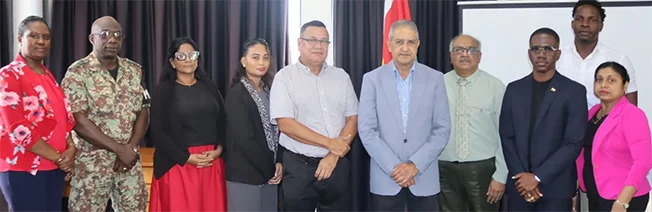
    A delegation of nineteen female students and two educators from Lycée Gaston Monnerville in Kourou, French Guiana, recently concluded an educational visit to the Suriname Diplomatic Institute (SDI) as part of their political science curriculum. The program, running from March 3-6, provided exceptional insights into international relations and governance structures.

    Ambassador Miriam Mac Intosh, Director of Foreign Affairs, formally welcomed the exclusively female delegation on Wednesday—a significant coincidence given the approaching International Women’s Day on March 8. The visit was further enhanced by the participation of French Ambassador Nicolas de Lacoste and diplomatic staff from the French Embassy.

    The educational program featured comprehensive presentations on Suriname’s historical background, cultural heritage, and distinctive characteristics by Ambassador Liselle Blankendal, former Surinamese ambassador to Guyana. Additionally, Ambassadors Angela Ramkisoen and Gilbêrt van Lierop, with respective service in Brazil and Belgium, shared practical expertise in diplomatic practice and international relations.

    Beyond the institutional visit, the students engaged in diverse cultural and educational activities throughout their stay. They participated in Phagwa festival celebrations, visited the National Assembly, and conducted an exchange program with students from Algemene Middelbare School (AMS) in collaboration with the Women Rights Center Suriname. These sessions focused on international conventions concerning women’s rights and their practical implementation.

    The program concluded with a collaborative session at Alliance Française Suriname, organized with French shipping company CMA CGM Suriname N.V., addressing women’s societal roles and career opportunities in both Surinamese and French contexts.

  • Langzamere groei centraal op Chinees Volkscongres

    Langzamere groei centraal op Chinees Volkscongres

    Beijing witnessed the commencement of the 14th National People’s Congress (NPC) on March 5, 2026, with President Xi Jinping and senior Chinese leadership presiding over the pivotal political gathering. The annual session unveiled China’s economic blueprint for the coming year, featuring a notably conservative GDP growth target of 4.5-5%—marking the first instance of sub-5% targeting in the nation’s recent economic history.

    This calibrated growth projection reflects China’s strategic response to persistent economic headwinds, predominantly driven by the collapse of its real estate sector which previously constituted 25-30% of GDP. Economic analyst Tianchen Xu from the Economist Intelligence Unit interprets this adjustment as signaling a fundamental policy shift: moving from quantitative expansion metrics toward qualitative growth indicators emphasizing household income elevation and enhanced public service accessibility.

    Concurrent with economic recalibration, China announced a 7% defense budget increase—the smallest increment in five years yet remaining regionally competitive. The nation continues its technological pivot with sustained state subsidies for strategic sectors including integrated circuits, aerospace, biomedicine, and drone application ecosystems termed the ‘low-altitude economy’.

    Social governance priorities featured prominently in congressional deliberations, with policies addressing demographic challenges through enhanced childcare support systems and elderly care services for China’s aging population. Environmental commitments reaffirmed the 2030 carbon emissions peak target while accelerating transition timelines toward renewable energy adoption.

    The parallel convening of the Chinese People’s Political Consultative Conference (CPPCC) complements NPC proceedings, collectively forming the ‘Two Sessions’ that shape China’s policy trajectory. A seminal outcome emerges through the presentation of the 15th Five-Year Plan (2026-2030), outlining medium-term development objectives targeting doubled per-capita GDP by 2035 relative to 2020 benchmarks.

  • De triasleer: Scheiding of spreiding der machten?

    De triasleer: Scheiding of spreiding der machten?

    A significant constitutional debate has emerged within Suriname’s National Assembly (DNA) regarding the fundamental relationship between legislative, executive, and judicial powers. This discussion gains particular relevance amid pending legislative proposals addressing the structure and compensation of judicial authorities, prompting a thorough reexamination of the traditional separation of powers doctrine.

    The current parliamentary deliberations focus substantially on the judicial branch’s position, including constitutional amendment proposals that would establish a third instance within the judicial organization. These developments have revitalized academic interest in the philosophical foundations of power distribution systems, particularly the theories of French jurist Montesquieu (1689-1755), traditionally credited with formulating the Trias Politica concept.

    Constitutional scholars increasingly emphasize that Montesquieu’s original vision centered not on absolute separation but rather on a system of checks and balances—a mechanism where “power checks power” to prevent despotism. Inspired by English philosopher John Locke, Montesquieu’s seminal work “De l’esprit des lois” (The Spirit of Laws) presented a normative framework for power equilibrium aimed at safeguarding civil liberties through preventing concentration of authority.

    Suriname’s constitutional reality, as articulated in Article 70, demonstrates the practical application of this principle: legislative power is jointly exercised by the National Assembly and the Government, indicating inherent interdependence rather than strict separation. The legislative process typically initiates with the executive branch, progresses through parliamentary deliberation and adoption, and culminates in presidential ratification—illustrating how governmental branches functionally complement and constrain one another.

    The judicial function has evolved significantly beyond Montesquieu’s characterization of judges as merely “la bouche de la loi” (the mouth of the law). As noted by former Court of Justice President John von Niesewand (2008), the judiciary has transformed into a guardian of constitutional integrity, exercising oversight over political organs even when they invoke political legitimacy. This evolution has prompted some observers to describe a transition from a “rechtsstaat” (rule of law state) toward a “rechtersstaat” (judges’ state), though this characterization remains debated.

    Contemporary constitutional scholars suggest that the terminology of “power distribution” or “power balance” more accurately reflects modern governance realities than “separation of powers.” The constitutional system operates not as hermetically sealed power blocks but as a dynamic equilibrium where governmental branches mutually influence, control, and delimit each other’s authority. This intricate balance constitutes the essential foundation of democratic constitutional governance.

  • Sri Lanka beschermt Iraans schip te midden van VS-Iran conflict

    Sri Lanka beschermt Iraans schip te midden van VS-Iran conflict

    Sri Lanka finds itself in a delicate diplomatic position as it attempts to mediate humanitarian concerns surrounding a second Iranian warship operating near its territorial waters. This development comes just one day after a U.S. submarine torpedoed and sank the Iranian frigate Iris Dena in international waters off the Sri Lankan coast, resulting in more than 80 casualties with dozens still missing.

    Cabinet spokesman Nalinda Jayatissa confirmed Thursday that Colombo is “making every effort to preserve lives” regarding the second vessel, which currently remains within Sri Lanka’s exclusive economic zone. The warship carries over 100 crew members and appears to be heading toward the same area where its companion vessel was destroyed, raising concerns about another potential attack.

    According to Al Jazeera correspondent Minelle Fernandez reporting from Colombo, the second ship likely belongs to a group of three Iranian naval vessels returning from an international maritime conference in India. The vessel has reportedly experienced mechanical difficulties and has formally requested permission to dock in Sri Lankan ports—a request that remains under consideration as communications continue.

    The situation places Sri Lanka in a precarious position as the expanding conflict between the United States, Israel and Iran creates ripple effects across the region and beyond. What began five days ago with American and Israeli airstrikes on Iran—which resulted in the death of Supreme Leader Ayatollah Ali Khamenei—has escalated into retaliatory attacks by Iranian-backed groups on U.S. and Israeli targets across Bahrain, Saudi Arabia, Qatar, UAE, Iraq and Cyprus.

    The geopolitical turmoil has already triggered significant disruptions to global energy markets, with oil and gas prices soaring worldwide. Shipping routes, particularly around the critical Strait of Hormuz, have experienced substantial interruptions. Qatar has temporarily suspended liquefied natural gas production following attacks on energy infrastructure.

    International observers warn that prolonged conflict could have severe consequences for regional stability and the global economy, while nations including China and Russia join growing worldwide calls for peaceful resolution through diplomatic channels.

  • Waarom de VS en Israël het conflict met Iran als een religieuze oorlog framen

    Waarom de VS en Israël het conflict met Iran als een religieuze oorlog framen

    As Middle East hostilities entered their fifth consecutive day, a concerning pattern of religiously-charged rhetoric has emerged from American and Israeli leadership, framing the military campaign against Iran within apocalyptic theological narratives. The Council on American-Islamic Relations (CAIR) has condemned this discourse as dangerously anti-Muslim, highlighting how both nations’ officials are increasingly employing biblical terminology to justify ongoing operations.

    Multiple reports confirm that U.S. military personnel received briefings characterizing the conflict as part of a divine plan to trigger biblical ‘Armageddon,’ with references to Book of Revelation prophecies about Christ’s return. This internal messaging parallels public statements from figures including Secretary of State Marco Rubio, who labeled Iranian leadership ‘religious fanatic crazies,’ and Pentagon spokesperson Pete Hegseth, who accused Iran of pursuing ‘prophetic Islamic delusions.’

    Israeli Prime Minister Netanyahu amplified this theological framing by invoking the Torah’s Amalekites—symbolizing pure evil in Jewish tradition—to justify military action against Iran. This rhetoric mirrors previously employed justification patterns during Gaza operations, according to civil rights organizations.

    Academic analysis reveals three strategic reasons for this religious framing: domestic mobilization through moral urgency, civilizational ‘us versus them’ narratives, and broader strategic meaning-making. The approach particularly resonates with American evangelical and Christian Zionist communities who interpret Middle East conflicts through end-times theology.

    Historical precedents exist, notably President George W. Bush’s initial ‘crusade’ terminology following 9/11, though such language was subsequently moderated to avoid perceptions of religious warfare. Israeli leadership has consistently incorporated biblical imagery into political discourse, embedding contemporary conflicts within historical and existential frameworks.

    While the underlying war remains geopolitical, experts warn that religious framing creates moral absolutism that complicates conflict resolution, elevates expectations, undermines diplomatic flexibility, and makes political compromises increasingly difficult to achieve.

  • Menke: Suriname vast in ‘mamio-politiek’, tijd voor overgangskabinet

    Menke: Suriname vast in ‘mamio-politiek’, tijd voor overgangskabinet

    Five decades after gaining independence, Suriname’s political system remains trapped in a self-perpetuating cycle of coalition governments lacking developmental vision, according to sociologist Jack Menke. His analysis reveals how the intricate entanglement of political power, state-owned enterprises, and economic interests has structurally hindered national progress.

    The country’s political democracy has sunk into what market vendors describe as a deep quagmire. As one vendor from Leiding 11A market noted: ‘The current NDP+ government consists of 7 governments: 6 coalition parties plus 1 opposition party. The previous VHP+ government consisted of 6 governments: 4 coalition parties and 2 opposition parties… It’s all the same pot with no difference between government and opposition who maintain each other.’ Since 1975, through 10 elections and 2 military regimes, no administration has successfully positioned Suriname on a sustainable development path.

    Unlike Western Europe where economic power historically served as the means to acquire state power, Suriname experienced the reverse phenomenon. Political figures utilized state power to accumulate wealth through three primary channels: Dutch development aid, revenues from foreign mining operations (particularly bauxite, gold, and oil), and state-owned enterprises. The number of state companies has exploded from approximately 90 in 1988 to over 150 mostly loss-making entities in 2026, with recent corruption scandals at SLM, Melkcentrale, SZF, and Grassalco representing merely the tip of the iceberg within a bankrupt political system.

    The concept of ‘mamio governments’—party-political coalitions without developmental vision—emerged even before independence in 1975. These arrangements created tension regarding the distribution of natural resources among party-political elites. An outdated short-term economic growth perspective managed through a cumbersome bureaucracy became the formula for political parties to win voter favor within a corrupted system of musical chairs.

    The redemocratization process during and after the military period led to unprecedented concentration of power within political parties and erosion of democratic institutions. This began with three legislative products that established political parties as dominant power factors in governance: the 1987 Constitution, the 1988 Law on Political Organizations, and the 2005 Law on Recall Rights. The 1987 Constitution formally granted political organizations exclusive rights to participate in elections, enabling major parties and their financial interest groups to gain increased control over state structures and profitable mineral resources.

    Public trust in democratic institutions has dramatically declined. In 2004, religious organizations enjoyed the highest trust at 41%, while the National Assembly (2%) and political parties (0.1%) scored lowest. A 2023 Americas Barometer study shows unchanged conditions. Meanwhile, the self-cleaning function of democracy through checks and balances within the three constitutional powers and other state institutions has reached critically low levels by 2026.

    Menke proposes a moral-technical transitional cabinet comprising independent experts as a potential solution to break this cycle of democratic decline. This administration would develop a political system with ‘development by design,’ requiring diplomatic tact to engage integrity-conscious elements from politics and society. With public goodwill typically lasting no more than one year, the current administration—now seated for 230 days—faces diminishing public support amid its first major crisis, making cooperation with transitional arrangements increasingly imperative.

  • Column: Harde realiteit

    Column: Harde realiteit

    Amid growing social media debates about national football team selection policies, columnist Mireille Hoepel has articulated a robust defense of opinion journalism’s role in stimulating meaningful public discourse. Hoepel emphasizes that columns inherently represent personal perspectives designed to provoke critical thinking rather than universal truths.

    The controversy centers on whether locally-trained footballers should receive preferential selection over foreign-developed players. Hoepel questions the logic of social media commentators who advocate for local players based on presumed rather than demonstrated capabilities, noting that multiple professional coaches—from Gorré to Menzo, Winter, and currently Ten Cate—have consistently identified quality deficiencies in domestically-developed talent.

    Historical exceptions like Emilio Limon and Sergio Aroepa demonstrate that exceptional local players have always earned selection through proven merit rather than geographical origin. Hoepel argues that current selection debates often overlook crucial performance details that determine match outcomes, prioritizing sentimental local preferences over objective quality assessments.

    The columnist expresses concern that national pride might prevent constructive learning from international expertise, emphasizing that professional scouts evaluate players based on demonstrated abilities rather than assumptions. Hoepel concludes that while diverse opinions enrich democratic discussion, social media frequently devolves into unproductive criticism rather than substantive solution-oriented dialogue.

  • Jones: Strafrecht geen middel om critici het zwijgen op te leggen

    Jones: Strafrecht geen middel om critici het zwijgen op te leggen

    A renewed debate over freedom of expression has emerged in Suriname following the recent arrests of Rishano Santokhi, son of former President Chan Santokhi, and citizen Stefanus Gerson. The detentions have drawn sharp criticism from National Assembly member Ebu Jones of the opposition NDP party, who argues that criminal law is being misused to suppress dissent.

    The arrests stem from provisions in Suriname’s Penal Code—commonly referred to as ‘gag laws’—that criminalize defamation, libel, and insult. Santokhi was detained following a November 2024 complaint by the Public Prosecutor’s Office regarding statements allegedly directed at Attorney General Garcia Paragsingh. Gerson faced similar charges for comments made on Facebook criticizing police authorities.

    Assemblyman Jones contends that the most troubling aspect of these arrests is the procedural pattern: citizens are frequently detained for their expressions, with substantive judicial review occurring days after incarceration or not at all. ‘Individuals are first arrested and sometimes held for several days before being released. Judicial review only comes afterward,’ Jones stated, emphasizing that independent assessment should precede any deprivation of liberty.

    Jones maintains that criminal law should serve as ‘ultimum remedium’—a last resort—rather than the primary instrument for addressing reputation-related conflicts. He advocates for civil litigation as the appropriate avenue for reputation disputes, allowing courts to determine whether unlawful expression occurred and whether damages are warranted.

    The opposition lawmaker warns that criminal provisions risk being weaponized as tools of intimidation. ‘Criminal law must not be used to silence people,’ he emphasized, noting that freedom of expression constitutes a fundamental pillar of constitutional democracy.

    Within the National Assembly, legislative proposals are underway to eliminate or revise the controversial gag laws. Jones, among the initiative’s sponsors, aims to strike a better balance between reputation protection and free speech rights. He simultaneously acknowledges that emerging technologies—including artificial intelligence and manipulated media—require new legal safeguards. ‘Mechanisms will need to be developed for these challenges,’ he conceded.

    The recent arrests have underscored the urgent need for clear boundaries regarding criminal law’s application to public discourse. As Jones concluded: ‘Freedom of expression is a foundation of the rule of law. Criminal law should not be the first instrument for words, but the last.’

  • Overleg Suriname en Cuba over inzet artsen en veiligheid studenten

    Overleg Suriname en Cuba over inzet artsen en veiligheid studenten

    In a significant diplomatic engagement, Suriname’s Minister of Health, Welfare, and Labor André Misiekaba convened with Cuban Ambassador Roberto Blanco Domínguez to address critical aspects of their bilateral healthcare cooperation. The high-level discussion, held on March 4th, focused on two pressing matters affecting the longstanding medical partnership between the nations.

    The dialogue primarily addressed the status of Cuban healthcare professionals currently residing in Suriname who have yet to be integrated into the local healthcare system. While these medical experts have expressed eagerness to contribute their specialized skills, Minister Misiekaba clarified that mandatory screening procedures and administrative protocols must be completed before their deployment within Suriname’s medical infrastructure.

    A second crucial agenda item involved addressing concerns of Surinamese medical students pursuing education in Cuba. Amid growing international tensions, several students have raised apprehensions regarding their safety and requested temporary repatriation. Ambassador Domínguez assured that Cuban authorities remain vigilant about protecting the welfare of international students, emphasizing the government’s commitment to their security.

    Minister Misiekaba reaffirmed Suriname’s appreciation for Cuba’s sustained collaboration in strengthening healthcare capabilities, highlighting the historical significance of this South-South cooperation model that has benefited both nations’ medical sectors for decades.

  • Impact én zelf geld verdienen met eigen visie en kennis over (gezondheids)zorg

    Impact én zelf geld verdienen met eigen visie en kennis over (gezondheids)zorg

    A groundbreaking report commissioned by the Dutch Ministry of Health, Welfare and Sport has formally documented the persistent physical, mental, and socio-economic consequences of slavery across generations. Titled “Health and Slavery: Final Report on Health Effects of Slavery” (November 2025), the research acknowledges what descendants of enslaved peoples have long understood: the transatlantic slave trade continues to impact health outcomes centuries later.

    The University of Amsterdam’s contribution highlights a critical paradox – while the recommendation for further research appears predictable, it simultaneously exposes systemic neglect. Indigenous communities and African descendants have maintained their own health remedies for generations, yet these solutions remain unrecognized within Western-dominated medical frameworks. The report notes that traditional healing knowledge has been systematically dismissed due to the predominance of Western perspectives in healthcare evaluation.

    Despite this historical oversight, the document represents significant progress in agenda-setting for culturally appropriate healthcare solutions. It advocates for meaningful recognition – both economic and financial – of existing indigenous knowledge systems. The research underscores concerns about academic studies using community funds to extract traditional knowledge, only to see resulting innovations commercialized without benefiting source communities.

    This pattern reflects imbalanced power dynamics favoring well-funded industries over traditional knowledge holders. The report proposes concrete pathways for Suriname, Caribbean nations, and African countries to leverage their extensive ethnomedical knowledge. By developing proprietary health industries and alternative medical networks, these regions could generate pharmaceutical revenue streams potentially exceeding extractive industries like mining.

    The implementation strategy emphasizes modern technological integration, suggesting artificial intelligence could systematically structure traditional knowledge databases. This approach would add value to scientific institutions while preserving intellectual property rights. International cooperation emerges as essential for developing capital-intensive industries and supply chains.

    Crucially, the report identifies patents as key value generators for Global South nations, as stored knowledge can be progressively monetized within economic systems. This represents a paradigm shift from knowledge extraction to knowledge sovereignty, offering sustainable economic development while addressing historical health disparities.