标签: Suriname

苏里南

  • Dorpen presenteren visie op ontwikkeling en grondenrechten aan president

    Dorpen presenteren visie op ontwikkeling en grondenrechten aan president

    In a landmark ceremony at the National Assembly building, President Jennifer Simons formally received comprehensive development plans from villages in Suriname’s Coeroenie and Matawai regions. These documents represent a significant step in regional decentralization, outlining community-driven priorities across social, economic, and ecological dimensions.

    The ceremony marked the culmination of an extensive eighteen-month participatory planning process conducted in collaboration with the Amazon Conservation Team (ACT), various government ministries, and non-governmental organizations. ACT Regional Director Minu Parahoe explained that methodologies were adapted from regional models to suit Suriname’s unique context, with villages establishing their development vision through traditional krutu consultations.

    President Simons praised the initiative as demonstrating village communities’ readiness to assume greater responsibility within regional development and decentralization processes. ‘We’re building a model where district residents can determine their own development direction,’ Simons stated. ‘Indigenous and tribal peoples have long practiced local governance, but this must now be structurally integrated into the national governance system.’

    The development plans also provide crucial input for ongoing land rights recognition efforts. Simons emphasized that collaboration with traditional authorities remains essential for achieving sustainable solutions, according to the Communication Service Suriname.

    Current progress indicates completed plans for approximately ten villages in the Upper Saramacca region within the Matawai area, while downstream communities are still determining their participation. In Southern Suriname, eight of nine indigenous villages have expressed interest, with five already possessing finalized documents. ACT anticipates further participation from tribal communities in coastal regions.

    These formally submitted plans now create expectation among communities that their priorities will be incorporated into the government’s national development policies, representing a transformative approach to inclusive governance in Suriname.

  • Van Lelydorp naar Recife

    Van Lelydorp naar Recife

    Dimitri ‘Dimi’ Amatjasir, a promising 15-year-old football talent from Suriname, has recently completed an intensive training period with Brazilian professional club Paysandu’s U-15 squad in Belém. The young athlete, who currently plays for Transvaal U-16 and the Surinamese national U-15 team, spent September training with the Brazilian club following a successful CONCACAF tournament in Curaçao.

    The opportunity arose through connections maintained by Dimi’s father, who formally requested the training stint with Paysandu. Under the guidance of experienced former professional players—all certified coaches through the Brazilian Football Confederation (CBF)—Dimi underwent daily sessions that significantly exceeded the intensity of his regular training regimen in Suriname. After an initial adaptation period, he successfully maintained the demanding pace.

    Dimi’s performance so impressed Paysandu’s coaching staff that the club extended an invitation for him to continue training beyond the holiday period and participate as a guest player in Brazil’s premier U-15 tournament, the Aldeia International Cup. Held from December 1-7 in Recife’s state-of-the-art sports complex, the competition featured major Brazilian clubs including Santos, Palmeiras, and Vasco da Gama.

    Critical to this opportunity was the coordination between Paysandu, Dimi’s school (Johannes Vrolijk Muloschool II in Lelydorp), and Suriname’s Ministry of Education. The club provided formal written requests to both institutions, ensuring arrangements were made for Dimi to continue his academic studies remotely while prioritizing his mulodiploma. His local club, Transvaal, also supported his temporary departure.

    Returning to Brazil in late October, Dimi made his first appearance for Paysandu at the COP 30 U-15 tournament in Belém, where he scored his inaugural goal for the club. The entire experience—from training at Brazil’s highest youth level to the tournament’s organization and atmosphere—provided him with profound learning opportunities and unforgettable memories.

    The article highlights how Suriname’s national team has recently galvanized public interest in football, creating unprecedented demand for match tickets. However, maintaining this enthusiasm requires developing youth players through intensive, modern training methods. While many talented players like Dimi exist within Suriname, few receive opportunities for international development.

    Given proximity, cost considerations, cultural factors, and existing bilateral relations, Brazil presents an ideal destination for nurturing Surinamese football talent. Well-trained players could enhance the appeal of domestic leagues and potentially strengthen the national team. The author calls upon the Surinamese Football Association, Ministry of Sports and Youth Affairs, and Ministry of Foreign Affairs to establish structured programs for youth player development abroad, extending opportunities to both players and coaches.

    Following his Brazilian experience, Dimi has been selected for Suriname’s U-17 national team, which will compete in February 2026 qualifiers for the following year’s U-17 World Cup. Expectations are high that his international exposure will significantly enhance his performance at both club and national levels.

  • Eerste STEM-conventie laat kinderen spelend ontdekken hoe wetenschap werkt

    Eerste STEM-conventie laat kinderen spelend ontdekken hoe wetenschap werkt

    Suriname’s educational landscape witnessed a transformative event as the inaugural STEM Convention for children aged 3-14 erupted with excitement at the Assuria Highrise this Monday. Hundreds of young participants immersed themselves in interactive experiments, engineering challenges, and technological demonstrations, marking a significant milestone in the nation’s educational development.

    Organized through a collaborative effort between Surinaams Knutselhoekje (HSKH) and Esport Suriname, the convention transformed the venue into a dynamic learning laboratory. Children engaged with diverse stations featuring homemade lava lamps using cooking oil and effervescent tablets, constructed electric propellers from scratch, and operated full-feature racing simulators with steering wheels and pedal systems. This hands-on approach provided tangible introductions to fundamental principles of Science, Technology, Engineering, and Mathematics.

    Leann Djohari of HSKH explained the pedagogical philosophy behind the event: “STEM education fundamentally revolves around experiential learning. Children achieve deeper conceptual understanding when they physically execute tasks themselves. They observe immediate consequences of their actions—performing A results in B—which reinforces knowledge retention and develops critical cause-effect reasoning skills.”

    The convention’s practical methodology manifested through multiple engaging zones. Under the guidance of young instructors and digital tutorials, participants assembled functional robots, programmed basic devices, and explored electrical engineering concepts. A chemistry laboratory attracted considerable attention with interactive experiments, while a dedicated virtual reality zone allowed children to experience immersive digital environments.

    Founded by Cherelys Dwarkasing, HSKH has spent five years democratizing STEM education throughout Suriname. The organization visits a different district each quarter to ensure nationwide accessibility. This year’s convention coincidentally aligned with HSKH’s anniversary, adding celebratory significance to the event.

    Djohari declared the initiative an overwhelming success: “We anticipated approximately 300 children, but attendance substantially exceeded our projections.” She emphasized that STEM education extends beyond technical skills: “It cultivates creativity, critical thinking, collaboration, and communication—abilities increasingly essential in our rapidly evolving technological landscape. Early exposure better prepares children for future challenges, embodying the principle that early learning establishes lasting foundations.”

    Buoyed by the enthusiastic response, organizers indicate this inaugural event will likely catalyze expanded STEM initiatives throughout Suriname. HSKH aims to foster scientific and technical proficiency at a pace matching the boundless curiosity of children who exclaimed “Waaw!” throughout Monday’s groundbreaking convention.

  • Door VS onderschept ‘Guyanees’ vlaggend schip niet in Guyana geregistreerd

    Door VS onderschept ‘Guyanees’ vlaggend schip niet in Guyana geregistreerd

    The United States has escalated regional tensions through the dramatic seizure of oil tanker Skipper in international waters near Venezuela. American forces, utilizing helicopters, coast guard vessels, and marines, boarded the vessel on Wednesday in what marks the latest confrontation in ongoing geopolitical struggles over sanctioned oil shipments.

    According to U.S. authorities, the Skipper—previously known as Adisa—has been under American sanctions since 2022 for its involvement in oil trading operations benefiting Iran and Lebanese movement Hezbollah. Intelligence indicates the vessel had recently loaded approximately 1.1 million barrels of heavy Merey crude from Venezuela’s José port prior to its interception, based on data from TankerTrackers and sources within PDVSA.

    The operation has drawn fierce condemnation from Venezuela’s Maduro government, which characterized the seizure as ‘international piracy.’ Caracas accuses Washington of targeting Venezuela’s oil reserves, which remain barred from global markets due to U.S. sanctions. Venezuelan officials assert this action forms part of a broader American strategy to further isolate the country economically and increase political pressure.

    U.S. Attorney General Pam Bondi confirmed the seizure via social media, stating the operation was conducted ‘safely and responsibly’ against a vessel involved in transporting sanctioned oil from Iran and Venezuela. President Donald Trump notably described the captured tanker as ‘the largest ever seized by the United States.’

    The incident occurs amid significant U.S. military buildup in the Caribbean region, where tens of thousands of American troops are currently deployed alongside an aircraft carrier with combat jets. Shortly before the seizure, two U.S. fighter jets conducted flights lasting over thirty minutes in the Gulf of Venezuela—notably close to the Venezuelan mainland, though American officials described this as a ‘routine training flight.’

    Since September, the U.S. has conducted dozens of armed operations against suspected drug transports in the Caribbean and eastern Pacific, resulting in at least 90 casualties according to American figures.

    Complicating the situation, Guyana’s Maritime Administration (MARAD) has confirmed that although the Skipper sailed under the Guyanese flag, the vessel was not properly registered in the country. This represents another case of illegal flag usage, a practice that Guyana says it’s increasingly detecting. MARAD officials emphasized their collaboration with international partners to detect and prevent ship fraud, highlighting the vulnerability of smaller maritime states to identity abuse at sea.

  • Regering zet eerste SRD 20 miljoen in Woningbouwfonds

    Regering zet eerste SRD 20 miljoen in Woningbouwfonds

    Suriname has officially activated its National Housing Fund following a presidential decree by President Jennifer Simons, marking a significant advancement in the nation’s social development agenda. The initiative, established under the National Housing Fund Act (S.B. 2019 no. 142), became operational on December 10, 2025, with an initial capital injection of SRD 20 million.

    The fund represents the government’s central financial mechanism for affordable housing construction, renovation programs, and sustainable housing projects. Although the legislation was originally passed by the National Assembly on November 21, 2019, its implementation had been pending until now. This delay-free activation finally provides Suriname with a consolidated and sustainable financing framework for its housing sector.

    Key operational aspects of the fund include:
    – Establishment of transparent governance structures and management protocols
    – Consolidation of public and private financial resources
    – Provision of long-term financing options for housing development projects
    – Implementation of rigorous accountability measures for fund allocation and expenditure

    The initial SRD 20 million allocation serves as seed capital for a multi-year program, with a larger second infusion planned for 2026. This strategic approach aims to revitalize the national housing policy while expanding access to affordable, quality housing. Additionally, the fund will facilitate renovation of aging residential facilities and specifically target improvement of living conditions in vulnerable neighborhoods.

    Administrative responsibility has been assigned to the Minister of Finance & Planning and the Minister of Social Affairs and Public Housing. These officials will oversee the fund’s operationalization, develop implementation regulations, and ensure transparent financial management.

    This formalization represents a crucial step in modernizing Suriname’s housing policy, creating a structural investment mechanism during a period of increasing housing affordability challenges and growing renovation needs across the nation.

  • Voetganger dodelijk aangereden aan de Verlengde Gemenelandsweg

    Voetganger dodelijk aangereden aan de Verlengde Gemenelandsweg

    A tragic traffic incident resulted in a pedestrian fatality on Thursday morning at the intersection of Verlengde Gemenelandsweg and Benjaminsstraat in Paramaribo. Emergency services responded to a severe collision involving a motor vehicle and a male pedestrian who succumbed to his injuries at the scene despite medical intervention.

    Law enforcement authorities have cordoned off the affected area as forensic teams conduct a comprehensive investigation into the circumstances surrounding the fatal accident. Preliminary reports indicate the victim’s identity remains undisclosed pending formal identification and family notification procedures.

    Multiple police units are currently engaged in evidence collection and witness testimony gathering to reconstruct the sequence of events leading to the collision. Traffic safety officials have implemented temporary diversions to facilitate uninterrupted investigative operations while maintaining public safety protocols.

    The Suriname Police Force has issued a public appeal for any witnesses or individuals with relevant information to come forward assisting their ongoing investigation. This incident marks another somber reminder of road safety vulnerabilities affecting pedestrian communities in urban intersections.

  • Uitbreiding  Alihusains onderzoek toont verschuivende profielen sinds 1949

    Uitbreiding Alihusains onderzoek toont verschuivende profielen sinds 1949

    Political scientist Rudie Alihusain has expanded his seminal 2019 publication with comprehensive data from the 2020 and 2025 election cycles, creating a definitive study of Suriname’s parliamentary representation spanning 76 years. The updated work, released on December 9, 2025, offers unprecedented insights into the demographic and professional evolution of the nation’s lawmakers.

    Since 1949, Suriname has conducted eighteen general elections across urban, rural, and interior regions, resulting in 735 individuals elected to parliamentary positions. The data reveals a significant gender disparity: 633 male representatives compared to 102 female representatives. Women first entered the then-Staten van Suriname in 1963, with their numbers gradually increasing to the current total.

    The research identifies consistent patterns in age distribution, with the 41-50 age cohort forming the largest demographic group throughout the period, followed closely by the 51-60 age bracket. This indicates Surinamese voters’ persistent preference for candidates balancing youthfulness with experience and maturity.

    Academic qualifications among representatives show that while university-educated individuals have consistently served in the National Assembly, they have never constituted a majority. Across the entire period, 236 male and 24 female academics were elected, representing approximately 35% of all parliamentarians.

    Alihusain’s analysis delivers a critical assessment of intellectual engagement in Surinamese politics. Despite highly educated individuals demonstrating willingness to contribute to national development between 1949-2025, the political system has systematically failed to integrate expertise into governance structures. Professional matters frequently succumb to partisan political considerations rather than expert judgment.

    The study draws compelling parallels with historical discussions in former Eastern European countries, where party leadership employed the ‘window metaphor’ – only opening to new ideas when convenient and shutting abruptly when criticism became too pointed. Alihusain identifies similar dynamics in Suriname, resulting in intellectual marginalization and withdrawal from political participation.

    This expanded publication represents a monumental contribution to Suriname’s political historiography, documenting not merely who represented the nation but how political culture, social relationships, and the role of expertise have transformed across decades of democratic development.

  • Wisselvallig weer met buien

    Wisselvallig weer met buien

    Suriname is experiencing variable weather conditions with locally intense rainfall and thunderstorms developing primarily during morning and early afternoon hours. The day commenced with widespread cloud cover across most regions, accompanied by scattered showers along the coastal stretch from Nickerie to Albina. Morning temperatures ranged between 24-26°C (75-79°F).

    In central and inland regions, substantial cloud formations began developing from late morning onward. These meteorological conditions are expected to evolve into organized lines of showers progressing eastward and southward. Particular areas including Para, Brokopondo and Sipaliwini districts face potential short but intense thunderstorm activity. These systems may produce gusty winds around early afternoon.

    Coastal areas will experience partial cloud reduction during afternoon hours, though isolated showers remain possible. Daytime highs will reach 31-33°C (88-91°F) combined with elevated humidity levels creating uncomfortable conditions.

    The evening forecast indicates predominantly dry conditions along coastal regions with temperatures around 27°C (81°F). Interior regions will maintain cloud coverage for extended periods with late showers remaining possible throughout the evening hours.

  • In Memoriam – Motilall ‘Baba en Mai’ Marhé

    In Memoriam – Motilall ‘Baba en Mai’ Marhé

    The cultural and linguistic landscape of Suriname has lost one of its most dedicated advocates with the passing of Ramon Motilall Marhé, affectionately known as Moti, who died on December 5, 2025, in The Hague at age 82. Marhé, whose honorary titles ‘Baba en Mai’ symbolized his commitment to cultural identity and heritage, emerged as the foremost champion for the Sarnámi language—much like linguist Hein Eersel was for Sranan—despite spending much of his life in the Netherlands.

    Born in Suriname, Marhé began his career as a headteacher with qualifications in English and multiple Hindi diplomas before relocating to the Netherlands in 1969. There, he pursued studies in Dutch language and literature at Leiden University, with Hindi as a secondary subject. His academic journey took him to India in 1976 and 1978, where he conducted research to better understand the linguistic and cultural evolution of Surinamese Hindustanis. This work positioned him as a pioneering force in advocating for Sarnámi as a vehicle for social change.

    Marhé’s advocacy extended beyond academia into public policy. He argued that the term ‘Surinamese’ should not be exclusive to one language or culture, insisting that all Surinamese languages be recognized as national languages with corresponding policy measures. He also advocated for the inclusion of these languages in geographic naming and government communications.

    In 1985, he published ‘Sarnámi Byākaran,’ an elementary grammar of Sarnámi, marking his first major contribution to the language’s formal recognition. His dedication never waned, even as health challenges emerged in his later years. Despite a muscle disease that robbed him of the ability to write, Marhé continued to voice his ideas through collaborators, publishing articles on linguistic equality until shortly before his death.

    His final public appearances included receiving an award at the Milan Festival in The Hague in summer 2023, celebrating 150 years of Hindustani immigration. Until the end, Marhé remained a critical voice urging the Surinamese government to implement the long-delayed Language Law based on recommendations from the Hein Eersel committee—a cause that now becomes part of his enduring legacy.

  • Nieuwe initiatiefwet moet criminelen financieel volledig kaalplukken

    Nieuwe initiatiefwet moet criminelen financieel volledig kaalplukken

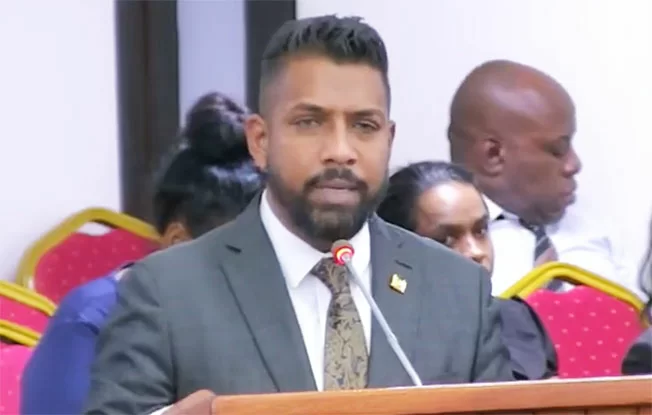
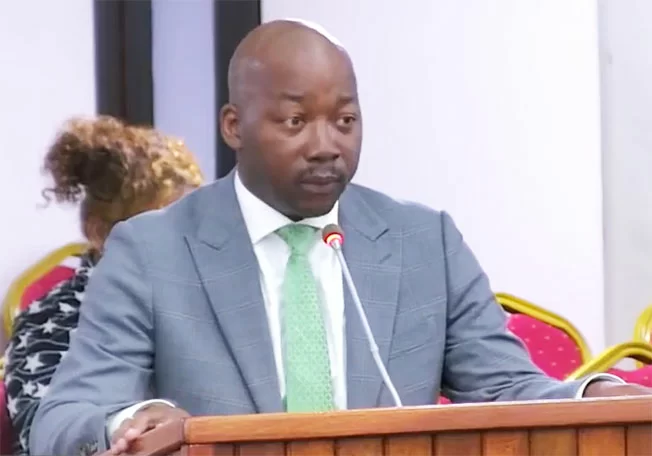
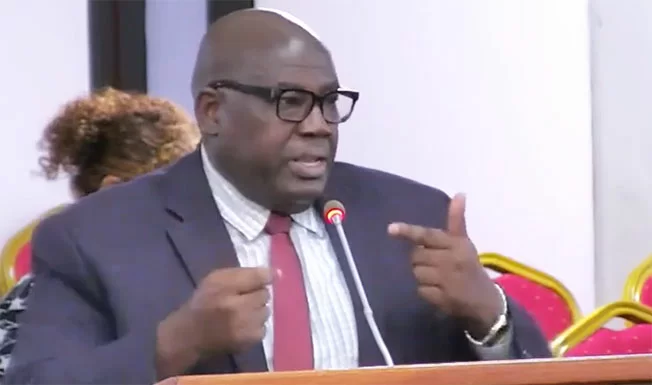
    In a significant move against organized crime, Surinamese legislators Ebu Jones (NDP) and Ivanildo Plein (NPS) have introduced groundbreaking legislation enabling authorities to fully confiscate illegally obtained assets from convicted criminals. The proposed Confiscation of Illegally Obtained Profits Act—colloquially termed the ‘Bare Plucking Law’—represents a paradigm shift in the nation’s approach to criminal justice by targeting the financial foundations of unlawful activities.

    The initiative specifically addresses Suriname’s escalating challenges with organized crime, corruption, drug trafficking, money laundering, fraud, human trafficking, and financial-economic offenses. Assembly member Jones emphasized that conventional law enforcement methods have proven insufficient when focusing solely on incarceration rather than asset recovery. “The state frequently loses millions while convicted individuals return to society after serving prison sentences with their criminal proceeds intact. This constitutes a double injustice for citizens,” Jones stated during the parliamentary session.

    Current legislation within Suriname’s Penal Code and Code of Criminal Procedure is deemed fragmented and outdated, particularly regarding modern wealth forms including cryptocurrencies, digital wallets, and complex corporate structures. The proposed framework establishes a lex specialis—a specialized legal regime—that operates alongside existing criminal statutes, enabling proportional and effective seizure of both directly and indirectly obtained criminal assets regardless of their location.

    Key objectives of the new legislation include:
    – Disrupting the financial infrastructure supporting criminal enterprises
    – Enhancing the integrity of Suriname’s financial-economic system
    – Increasing transparency in asset flows across jurisdictions
    – Strengthening judicial authorities’ information-gathering capabilities
    – Fostering structured collaboration with financial institutions
    – Restoring public confidence in the rule of law

    Jones concluded that comprehensive asset recovery is essential for reestablishing societal trust: “Retrieving criminal profits is crucial for restoring legal consciousness and demonstrating that crime will never again be profitable.”