标签: Suriname

苏里南

  • China’s oliebelangen in Venezuela: grote investeerder en belangrijke afnemer

    China’s oliebelangen in Venezuela: grote investeerder en belangrijke afnemer

    Amidst Venezuela’s political turmoil following the U.S.-led military intervention that ousted President Nicolás Maduro in January 2026, China has emerged as a critical economic lifeline and strategic partner for the South American nation’s crippled oil industry. Despite Washington’s efforts to reshape Venezuela’s political landscape and control its energy resources, Beijing maintains substantial leverage through both oil purchases and infrastructure investments.

    Venezuela’s oil production has experienced a dramatic collapse, plummeting from approximately 3.5 million barrels per day in the 1990s to just 1.1 million barrels daily in 2025. This decline stems from chronic mismanagement, insufficient investment, and stringent U.S. sanctions that have crippled the country’s primary economic engine.

    China has become Venezuela’s most significant oil customer, with Vortexa energy data indicating imports of approximately 470,000 barrels per day in 2025—representing about 4.5% of China’s total seaborne crude imports. Much of this oil flows to independent Chinese refineries known as ‘teapots,’ which capitalize on discounted prices. Additionally, portions of these shipments serve as repayment for Venezuela’s estimated $10 billion debt to China.

    Chinese state-owned enterprises maintain dominant positions in Venezuela’s energy sector. Sinopec and CNPC control the largest oil entitlement reserves among foreign companies, holding 2.8 billion and 1.6 billion barrels respectively. Since 2016, Chinese firms have invested approximately $2.1 billion in Venezuela’s oil infrastructure despite mounting political risks.

    Although CNPC ceased direct oil imports from Venezuela in 2019 due to sanctions, it continues production operations through the Sinovensa joint venture with Venezuela’s state oil company PDVSA. Similarly, Sinopec maintains significant oil reserves through its joint venture arrangements. Several private Chinese companies—including China Concord Resources Corp., Kerui Petroleum, and Anhui Erhuan Petroleum Group—also hold oil production and service contracts, though their current operational status remains unclear.

    The geopolitical implications extend far beyond energy markets. China’s deepening involvement in Venezuela represents a strategic challenge to U.S. influence in Latin America. While the Trump administration pursued regime change to reorient Venezuela’s political alignment, China has positioned itself as a stabilizing force committed to respecting Venezuela’s sovereignty and international law.

    Beijing’s investments form part of a broader strategy to secure access to vital energy resources while expanding economic influence in regions traditionally dominated by Western powers. These partnerships simultaneously bolster Venezuela’s resilience against American sanctions and political pressure.

    The post-intervention landscape remains highly volatile, with uncertainty surrounding Venezuela’s political future and China’s ability to maintain its economic interests amid escalating U.S.-China tensions. Despite Chinese investments, Venezuela’s oil industry continues to grapple with infrastructure deficiencies and economic instability, suggesting that recovery will require more than foreign investment alone.

  • Nicolás Maduro verschijnt kalm in rechtbank New York; pleit onschuldig

    Nicolás Maduro verschijnt kalm in rechtbank New York; pleit onschuldig

    In a dramatic courtroom appearance at Manhattan Federal Court, deposed Venezuelan leader Nicolás Maduro defiantly proclaimed his innocence against serious U.S. charges of narco-terrorism and weapons possession. The proceeding marked an unprecedented legal confrontation between the United States and a former head of state accused of orchestrating international drug trafficking operations.

    Maduro, dressed in a striking blue and bright orange shirt with hands shackled, delivered an impassioned declaration in Spanish asserting his legitimate presidential status and characterizing his detention as an unlawful kidnapping. Throughout the brief but symbolically charged hearing, the ousted leader maintained detailed notes and engaged directly with the court proceedings despite judicial attempts to limit political commentary.

    The session witnessed several tense moments, including when Maduro addressed the packed courtroom instead of simply confirming his identity as requested. “I am the president of Venezuela who has been kidnapped,” he stated calmly. “I was captured in my home in Caracas.” The presiding judge intervened, reminding Maduro that there would be more appropriate times and venues for such political statements.

    Emotional intensity peaked when a spectator launched accusations against Maduro, prompting his self-identification as both “kidnapped president” and “prisoner of war” before court security removed the protester. Meanwhile, defense attorneys for Maduro’s wife, Cilia Flores, indicated she showed signs of possible mistreatment during her arrest.

    Outside the courthouse, polarized demonstrations unfolded with competing chants and banners. Supporters displayed messages reading “USA, hands off Venezuela” while opponents expressed gratitude to President Trump for pursuing legal action.

    The four-count indictment alleges Maduro and his associates collaborated with drug cartels for decades to smuggle thousands of tons of cocaine into the United States while possessing illegal machine guns and heavy weaponry. Legal experts anticipate defense teams will invoke head-of-state immunity arguments, though such defenses have rarely succeeded in comparable historical cases.

    The case represents one of the most significant and complex prosecutions ever brought against a former national leader. With the next hearing scheduled for March 17th, the proceedings have ignited diplomatic tensions as Venezuela’s interim government and China call for sovereignty respect while the United States maintains its commitment to judicial process.

  • President installeert nieuwe Deviezencommissie voor versterking economisch beleid

    President installeert nieuwe Deviezencommissie voor versterking economisch beleid

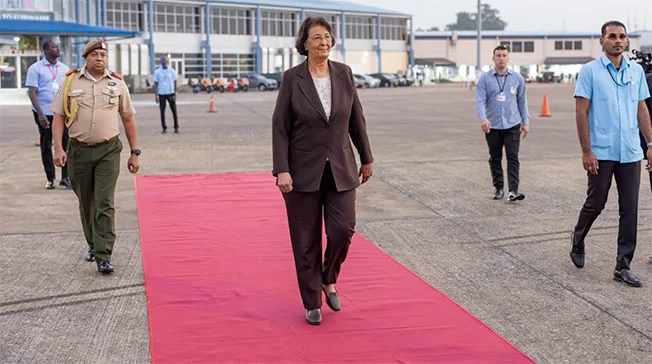
    Surinamese President Jennifer Simons has officially inaugurated the nation’s new Foreign Exchange Commission during a cabinet ceremony, marking a significant advancement in the government’s efforts to overhaul and reinforce financial-economic policies. The establishment of this specialized body represents a strategic move to address critical monetary challenges and enhance Suriname’s international economic standing.

    Chaired by Robin Huiswoud, the commission comprises distinguished members Ireen Parbhoe, Dorothy Emanuelson-Hellings, Roy Smit, Ismanto Adna, Cathleen Kejansi, and Ravin Soerdjbalie. During the installation proceedings, Finance and Planning Minister Adelien Wijnerman expressed strong confidence in the committee’s expertise and operational independence, emphasizing its vital advisory role to the government, presidency, and her ministry.

    Minister Wijnerman articulated that robust and well-considered foreign exchange policy serves as the cornerstone for sustainable economic development. “Given recent economic developments and challenges, installing a new Foreign Exchange Commission became imperative,” she stated, highlighting the necessity of this institutional response to contemporary financial pressures.

    The commission’s mandate encompasses comprehensive analysis of export-related matters, foreign currency generation mechanisms, and strategies to fortify Suriname’s global economic position. Core responsibilities include examining necessary adjustments to existing legislative frameworks while evaluating current procedures, implemented exchange policies, and overarching strategic vision. This systematic review aims to identify structural improvements within Suriname’s financial governance architecture.

  • Afgezette Venezolaanse president Maduro voor Amerikaanse rechtbank

    Afgezette Venezolaanse president Maduro voor Amerikaanse rechtbank

    In a landmark legal proceeding, deposed Venezuelan President Nicolás Maduro made his inaugural appearance before a United States federal court in Manhattan today. The embattled leader, accompanied by his wife Cilia Flores, faces serious charges of narco-terrorism that previously justified his extraordinary arrest and extradition to New York during the Trump administration.

    The high-profile defendants arrived under intense security measures following an elaborate transport operation from Brooklyn’s detention facility. Surveillance footage captured Maduro displaying a noticeable limp as he transferred from a helicopter to an armored vehicle for final transport to the courthouse.

    This preliminary hearing initiates what promises to be an extended legal confrontation regarding jurisdictional authority over a sovereign leader. Maduro’s defense team is anticipated to invoke diplomatic immunity protections, mirroring unsuccessful arguments previously employed by Panamanian strongman Manuel Noriega during his 1990 U.S. prosecution.

    The American government maintains its non-recognition of Maduro’s controversial 2024 re-election legitimacy. Interim President Delcy Rodríguez has simultaneously demanded his repatriation while adopting unexpectedly conciliatory tones through social media channels, even extending cooperation invitations to Washington.

    Federal prosecutors allege systematic collaboration between Maduro’s administration and international drug cartels, accusing the Venezuelan leadership of facilitating thousands of tons of cocaine shipments to American soil. The indictment further encompasses grave accusations including kidnappings, torture, and targeted eliminations of drug trade competitors.

    Saturday’s military operation that secured Maduro’s capture primarily targeted regime criminal enterprises according to U.S. officials. Secretary of State Marco Rubio clarified temporary control objectives focused predominantly on enforcing petroleum embargo measures.

    President Trump concurrently articulated expansionist ambitions within the Western Hemisphere, launching verbal assaults against Colombian leader Gustavo Petro whom he accused of cocaine trade involvement.

    The comprehensive charges against Maduro, his spouse, and numerous Venezuelan officials span narcotics trafficking, weapons violations, and criminal conspiracy. Notably, while accusations involve the notorious Tren de Aragua criminal syndicate, U.S. intelligence assessments previously found no definitive government-gang collaboration.

    Additional corruption allegations detail bribery acceptance schemes wherein Maduro and Flores allegedly protected and facilitated drug traffickers operations for financial gain.

  • Telting: Geen ruimte voor politieke benoemingen, deskundigheid centraal bij SLM

    Telting: Geen ruimte voor politieke benoemingen, deskundigheid centraal bij SLM

    Surinam Airways (SLM) has experienced substantial international interest in its executive vacancies, particularly for the position of Deputy Director Operations. The state-owned carrier’s initial recruitment phase has drawn numerous applications, including from Canadian aviation specialist Tomas Chlumecky, who professionally brands himself as the ‘Aviation Doctor’ and seeks to lead the airline’s transformation.

    President-Commissioner Telting emphasized that selection will follow rigorous merit-based protocols. ‘We’re implementing a comprehensive application matrix where the highest-scoring candidates will receive invitations. There’s no need for personal appeals—qualified applicants must simply apply through proper channels,’ Telting stated, underscoring the company’s commitment to transparent hiring practices.

    The recruitment process will include detailed background checks for former employees seeking reinstatement. Telting noted the importance of examining previous roles and departure circumstances, adding that ‘reinstating failed previous systems will not be permitted under any circumstances.’

    The successful candidate for Deputy Director Operations will simultaneously serve as Accountable Manager, bearing dual responsibility for all operational and safety standards while acting as primary liaison for aviation authorities. While newly appointed director Johan Sandie maintains ultimate executive responsibility, the deputy director will oversee critical functions including operational department leadership, policy development, compliance with international aviation standards, and strategic advisory to the board.

  • Interim-leider Venezuela zoekt samenwerking met VS na arrestatie Maduro

    Interim-leider Venezuela zoekt samenwerking met VS na arrestatie Maduro

    In a dramatic diplomatic reversal, Venezuela’s interim President Delcy Rodríguez has signaled willingness to collaborate with the United States regarding her nation’s future, despite previously condemning the military operation that captured Nicolás Maduro as “an atrocity violating international law.

    Rodríguez, appointed interim leader by Venezuela’s Supreme Court shortly after Maduro’s capture by U.S. special forces, communicated via Telegram on Sunday that establishing “a balanced and respectful relationship between the U.S. and Venezuela” now represents a priority. Her statement marked a significant departure from her Saturday television address where she declared Maduro the “only legitimate president” and characterized the Trump administration as “extremists.

    The capture operation—described as one of America’s most perilous military actions since the 2011 Osama bin Laden raid—resulted in Maduro and his wife Cilia Flores facing federal charges in New York including narcoterrorism, cocaine trafficking, and weapons offenses. Maduro is scheduled to appear before a Manhattan federal court on Monday.

    President Trump’s response evolved throughout the crisis. Initially suggesting productive dialogue with Rodríguez, he subsequently threatened severe consequences following her criticism and warned of potential additional military interventions, including ground troops, asserting American dominance in Venezuela.

    Simultaneously, Rodríguez established a commission led by Foreign Minister Yvan Gil and her brother Jorge Rodríguez, head of the National Assembly, dedicated to securing Maduro and Flores’s release from U.S. detention. Observers have drawn parallels between Maduro’s situation and that of former Panamanian leader Manuel Noriega, arrested by U.S. forces in 1990 and convicted on drug-related charges.

    U.S. officials frame Maduro’s capture as judicial enforcement regarding 2020 indictments, while Trump additionally cited concerns over Venezuelan migration flows and nationalization of American oil assets as operation motivations.

  • Wie is ‘tsarina’ Delcy Rodriguez, de waarnemend president van Venezuela?

    Wie is ‘tsarina’ Delcy Rodriguez, de waarnemend president van Venezuela?

    Delcy Rodriguez has ascended to Venezuela’s interim presidency following the arrest of Nicolás Maduro by U.S. forces, positioning herself as one of the most formidable figures in the nation’s political landscape. The 56-year-old lawyer, known for her economic orthodoxy and luxury brand preferences, has earned the moniker ‘the tsarina’ through a decade of accumulating significant influence in Venezuelan public life.

    Maduro famously refers to Rodriguez as his ‘tigress’ for her unwavering defense of his socialist administration—a government plagued by severe economic crisis, allegations of torture, arbitrary detentions, and the exodus of approximately 8 million migrants. Her political journey includes serving as vice president since 2018 while simultaneously holding the portfolios of Finance Minister and Oil Minister. Previously, she led the Communications Ministry, Foreign Ministry, and presided over the government-aligned legislative body.

    The Rodriguez political dynasty traces back to their father, Jorge Antonio Rodriguez, a leftist guerrilla founder of the revolutionary Socialist League who died in police custody under circumstances his family attributes to torture. Maduro has celebrated him as a hero of Venezuela’s leftist movement.

    Educated in labor law with nine years spent in France and England for postgraduate studies, Rodriguez maintains an unusually public profile for a Venezuelan official. She frequently participates in table tennis matches with her brother Jorge Rodriguez, current president of the National Assembly, sharing their matches on social media platforms.

    As vice president, Rodriguez implemented orthodox economic policies that successfully reduced hyperinflation from over 100% through government spending cuts, credit restrictions, and a fixed dollar-bolivar exchange rate. Her stewardship maintained Venezuela’s oil production at approximately 1.1 million barrels per day throughout last year, fostering close relationships with international energy companies including Chevron.

    Described by industry leaders as a ‘workaholic,’ Rodriguez actively engages with the private sector—a marked departure from other government officials’ approaches. She represents Venezuela’s most frequent diplomatic traveler to allied nations including China, Russia, and Turkey, reinforcing strategic international partnerships during a period of unprecedented domestic challenges.

  • Column: Hoop en verbondenheid in een onzekere wereld

    Column: Hoop en verbondenheid in een onzekere wereld

    As 2025 commenced, citizens worldwide embraced diverse resolutions encompassing both material aspirations and profound personal growth objectives. These ambitions ranged from revitalizing neglected relationships and fostering community connections to finally dedicating time to long-pending literary works and planning well-deserved vacations. Many sought the courage to pursue authentic life paths beyond societal expectations.

    The retrospective assessment of 2025 reveals a tapestry of human experience marked by both celebratory milestones and profound grief. Nations collectively mourned the passing of prominent societal figures while individuals faced personal losses of parents, siblings, children, and partners. The year proved particularly unforgiving to children caught in unprecedented humanitarian crises, reminding populations that life rarely unfolds according to predetermined plans.

    Amid these challenges, beacons of hope emerged through academic achievements, marital unions, newborn arrivals, and meaningful anniversaries. New professional and emotional bonds formed across communities, though these connections often went undervalued amidst daily pressures. Despite geographical dispersion, global citizens share celestial observations of the same sun and moon, albeit at different intervals, while exchanging thoughts through mechanisms that frequently defy full comprehension.

    National highlights included democratic elections, the 50th anniversary of Srefidensi celebrations, and the diplomatic visit of the Dutch royal couple. However, the dawn of 2026 presents formidable challenges following the seismic impact of American military actions in Venezuela that reverberated throughout Latin America, the Caribbean, and ultimately the global community.

    Economic interests continue driving both individual and national behaviors, with expansionist ambitions emerging from these financial imperatives. Worldwide tensions escalate as non-participating nations face coercive pressures, while international regulations suffer systematic violations. The global community seeks equitable responses to these developments, recognizing that interconnectedness, solidarity, and unified purpose among nations, organizations, and communities constitute our strongest defense against aggression.

    This new era demands heightened awareness of individual and collective responsibilities. Addressing contemporary challenges requires not merely political or diplomatic solutions but strengthened social cohesion. During periods of uncertainty and division, mutual support, active listening, and collaborative action become paramount.

    Critical questions emerge from these reflections: What lessons has 2025 imparted? How do we approach 2026 with clarity and purpose? In what manner do we perceive our fellow citizens and our shared national identity? What expectations define our collective vision, and most importantly, what concerted actions will we undertake to improve our shared existence?

    The new year presents an opportunity to pursue not only personal objectives but also to reinforce our collective future. Ultimately, it is through people connected by mutual respect and solidarity that meaningful change emerges.

  • OPEC houdt productie voorlopig gelijk na spanningen rond Venezuela

    OPEC houdt productie voorlopig gelijk na spanningen rond Venezuela

    The Organization of Petroleum Exporting Countries (OPEC) has resolved to maintain current oil production levels, extending its existing output freeze policy in response to ongoing market volatility. This decision emerged from intensive consultations among member states and reflects deepening concerns about market stability following recent geopolitical developments involving Venezuela.

    Global oil markets entered 2025 in a precarious state following a tumultuous 2024 that witnessed worldwide oil producers generating substantial surplus beyond market absorption capacity. This oversupply situation triggered an approximate 18% price decline throughout last year—the most severe contraction since the pandemic-induced crash of 2020. To counteract further price erosion, OPEC members initially implemented production restraints late last year, a strategy now being prolonged.

    While recent U.S. military actions against Venezuela and resultant geopolitical tensions have created market nervousness, analysts confirm these events haven’t yet disrupted global supply chains. Venezuela possesses the world’s largest proven oil reserves, yet its operational output remains severely constrained by international sanctions, aging infrastructure, and chronic underinvestment.

    OPEC leadership expresses particular concern that abrupt policy changes could destabilize the delicate market equilibrium. The cartel aims to prevent additional supply from exacerbating price pressures, especially given uncertain global economic prospects. Market experts note that even if the United States succeeds in revitalizing Venezuela’s oil industry, the process would require massive international investment and several years before the country could resume significant market presence.

    Analysts project moderately volatile pricing patterns throughout 2025, with geopolitical flashpoints potentially causing temporary fluctuations. However, sustained price rallies remain unlikely while production constraints persist and global demand shows only limited growth. The organization continues monitoring market indicators closely, prepared to adjust strategies should fundamental conditions shift substantially.

  • Maduro zit vast in Amerikaanse hechtenis, terwijl zijn aanhangers verzet zweren

    Maduro zit vast in Amerikaanse hechtenis, terwijl zijn aanhangers verzet zweren

    In an unprecedented military operation, former Venezuelan President Nicolás Maduro has been taken into custody at a New York detention facility awaiting trial on narcotics charges. The dramatic arrest, ordered directly by President Donald Trump, represents the most significant U.S. intervention in Latin America since the Panama invasion 37 years ago.

    Security footage showed the 63-year-old Maduro, blindfolded and handcuffed, being escorted through DEA headquarters in New York City. Despite his restrained condition, Maduro reportedly wished his captors “Happy New Year” upon arrival. He is scheduled to appear Monday before a federal court in Manhattan.

    The operation has triggered international consternation, with many world leaders expressing alarm at the extraordinary capture of a foreign head of state. Memories of recent U.S. interventions in Iraq and Afghanistan have heightened global concerns about the legal and geopolitical implications.

    In Venezuela, Maduro’s allies maintain control and have condemned the operation as an “imperialist kidnapping” aimed at seizing the country’s vast oil reserves. The streets of Caracas and other cities remained unusually quiet as citizens grappled with uncertainty, with many choosing to stay indoors amid the tense atmosphere.

    President Trump announced that the U.S. would assume temporary governance of the South American nation, which holds the world’s largest proven oil reserves. “We will run the country until we can ensure a safe, correct and wise transition,” Trump stated during a press conference at Mar-a-Lago, praising the operation that extracted Maduro from a secure location.

    In a surprising move, Trump dismissed the possibility of opposition leader María Corina Machado assuming presidency, citing insufficient support. This decision disappointed many in the Venezuelan diaspora who had hoped the Nobel laureate would lead a transitional government.

    The Venezuelan economy, once among Latin America’s most prosperous, has collapsed under Maduro’s leadership, triggering one of the largest migration crises in modern history. Approximately one-fifth of the population has fled the country.

    While many exiled Venezuelans expressed joy at Maduro’s removal, questions emerged about the legality of arresting a foreign leader and the practicalities of U.S. administration. Trump suggested American oil companies would return to rebuild Venezuela’s damaged energy infrastructure, though experts warn this could take years.

    The UN Security Council is scheduled to convene Monday to discuss the operation, which Secretary-General António Guterres described as “a dangerous precedent.” Russia and China, both key Venezuelan allies, strongly condemned the U.S. action, with Beijing demanding Maduro’s immediate release.

    Pope Francis expressed following events with “a concerned heart” and called for Venezuela to maintain independence while respecting human rights. “The welfare of the beloved Venezuelan people must prevail over any other consideration,” the pontiff stated.

    Back in Venezuela, security measures appeared somewhat relaxed despite the nervous atmosphere, with some businesses remaining open and residents continuing Sunday routines. The U.S. lifted Caribbean airspace restrictions that had canceled hundreds of flights following the operation.

    The long-term U.S. strategy remains unclear, with Trump’s comments about indefinite military presence echoing rhetoric from previous interventions that ultimately resulted in costly withdrawals after years of occupation.