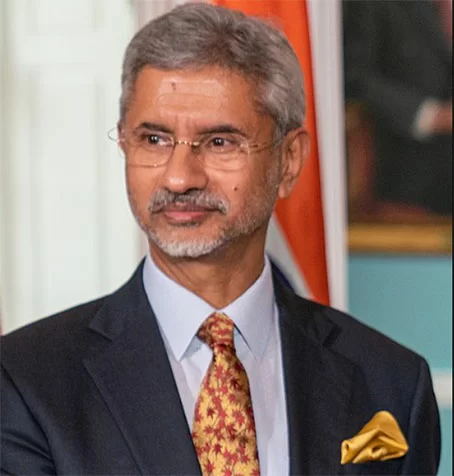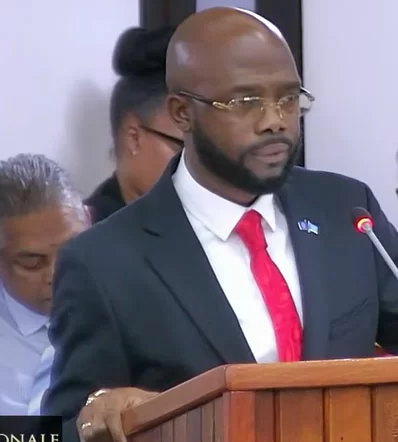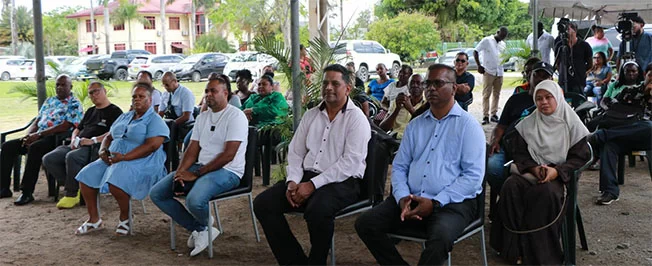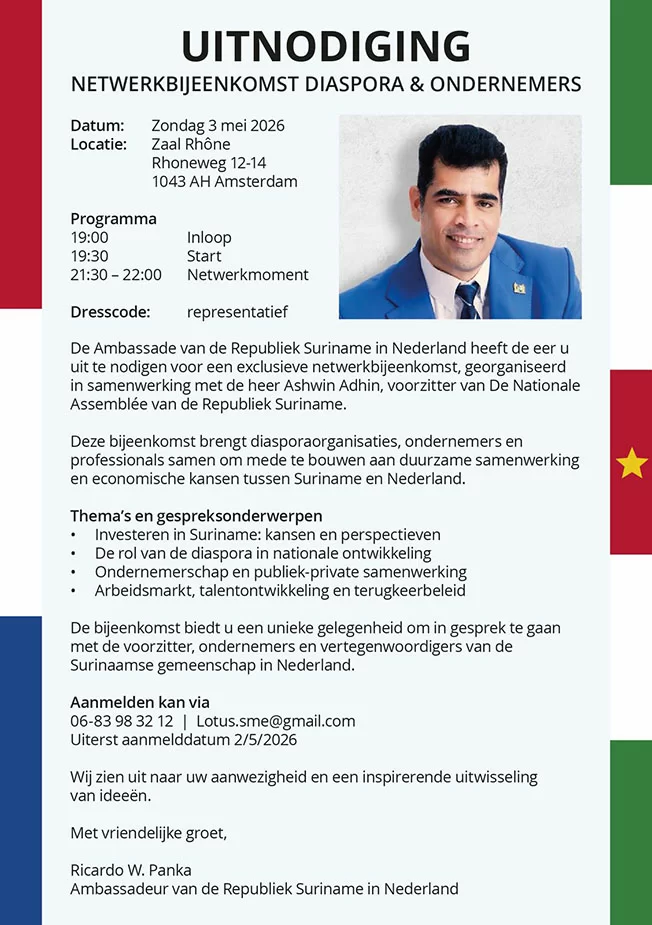
During an extraordinary meeting of the National Assembly (DNA) on November 25, Speaker Ashwin Adhin emphasized the need for national reflection and the reinforcement of Suriname’s state foundations. Addressing government officials, parliament members, international guests, and the public in the Congress Hall, Adhin highlighted the importance of evaluating the nation’s progress since its independence 50 years ago. He expressed gratitude to delegations from neighboring countries, partner states, and the broader international community, noting the presence of representatives from the Netherlands, India, China, Indonesia, and the Asantehene of the Ashanti Kingdom as a testament to Suriname’s historical, cultural, and diplomatic ties. Adhin identified four critical structural challenges facing Suriname: financial stability, autonomous long-term planning, organizational strength of the state and society, and political culture. He warned that without addressing these issues, the next 50 years could mirror the past. Adhin called for a renewed commitment to sovereignty, responsibility, and leadership, asserting that true independence is not just a date but an attitude. He urged citizens, leaders, and institutions to embrace discipline, better organization, system strengthening, and integrity to fulfill the promise of 1975.
标签: Suriname
苏里南
-

Massale viering van 50 jaar Srefidensi op Onafhankelijkheidsplein
Suriname marked its 50th anniversary of independence, known as Srefidensi, with a series of vibrant celebrations centered around Independence Square. The event was a testament to national pride and unity, despite a minor incident during the festivities. A parachutist descending with a massive Surinamese flag captivated the audience, who erupted in cheers upon his safe landing. Earlier in the day, another parachutist carrying the SLM flag had a mishap, landing incorrectly. The crowd, visibly concerned, breathed a sigh of relief and applauded warmly as he was taken to an ambulance, signaling the resilience and spirit of the occasion. The parade and military display were highlights of the day, with President Jennifer Simons, also the Commander-in-Chief, receiving enthusiastic greetings as she inspected the troops. Notably, the presence of numerous women in leadership roles within the armed forces drew appreciative cheers and applause from the audience. The event also featured the introduction of new police uniforms and a parachute show, which, despite a rough landing by one participant, concluded successfully, leaving the crowd in high spirits. In her address at the presidential palace, President Simons emphasized the importance of unity, dignity, and mutual respect in building a prosperous future for Suriname. She called on the nation to work together over the next fifty years to create a thriving country for future generations.
-

A20: Suriname staat klaar voor een nieuw Jubeljaar
On November 25, 1975, Suriname boldly chose its own path, marking the beginning of a journey towards independence. Development aid served as a starting point, not a permanent crutch. Now, fifty years later, the nation stands at a pivotal crossroads. Its future is no longer dictated by donors but by its own strength, resources, and commitment to forging a sustainable economic path. This year not only commemorates a historic milestone but also what Steven Reyme, party chairman and representative, aptly termed ‘Suriname’s Jubilee Year’—a time for reflection, recovery, and renewal, echoing the biblical Jubilee’s themes of freedom, forgiveness, and rectifying inequality. This symbolism aligns seamlessly with the narrative of Suriname’s fifty years of independence.
Suriname’s journey has been marked by growth and setbacks, hopeful moments and challenging periods. Through it all, its leaders—despite their imperfections—have consistently passed the baton to the next generation, a legacy worth honoring on this historic day. Like the biblical Jubilee, Suriname has experienced times of recovery, course correction, and renewal. Fifty years of independence demand the same introspection: What do we restore? What do we leave behind? Where do we begin anew? And what does our future hold?
Today, Suriname stands on the brink of a transformative era:
– Developing its own energy sources to create economic opportunities.
– Diversifying its economy to reduce vulnerability.
– Building better governance, transparency, and credibility.
– Addressing the rightful demands of its youth for genuine opportunities and prospects.The Jubilee Year calls for justice:
– No child left without education.
– No district without basic services.
– No citizen left marginalized.Suriname’s natural wealth becomes truly valuable when wisely invested in education, infrastructure, healthcare, technology, sports, and local economies. Looking ahead, Suriname envisions a future where:
– Highly educated Surinamese earn global respect.
– Sports fields, cultural centers, and talent programs nurture youth in every district.
– Diversification in agriculture, tourism, technology, industry, and energy becomes a reality.
– Every Surinamese has access to safe and affordable housing.
– The diaspora actively contributes to national progress.
– Unity prevails over division: We are Surinamese. Period.In the spirit of the Jubilee, a new beginning means breaking old patterns, restoring trust, creating stability, and addressing inequality. This is not an unfounded dream but an achievable choice.
On this fiftieth Independence Day, A20 calls on the nation to embrace action and progress. This Jubilee Year is an opportunity to free Suriname from outdated habits and focus on justice, integrity, and sustainable development. The next fifty years belong to us. Let us fill them with policy, discipline, dreams, and deeds. It can be different. It must be different. Tra fas dé!
-

Koning Willem-Alexander opent Surinamemuseum in Amsterdam
On Srefidensi Dey, King Willem-Alexander officially inaugurated the Surinamemuseum in Amsterdam, a project spearheaded by the Vereniging Ons Suriname. The event was attended by Amsterdam’s Mayor Femke Halsema, who praised the initiative, emphasizing the museum’s role in bridging the historical and cultural ties between the Netherlands and Suriname. “Understanding Amsterdam is impossible without acknowledging Suriname’s story,” Halsema remarked, pointing to landmarks like the Palace on the Dam and the warehouses of the West India Company as reminders of the city’s colonial past and its involvement in slavery. She highlighted the museum’s significance in providing a space for the history of enslaved Surinamese and their descendants, a narrative long overlooked in Dutch society.
King Willem-Alexander, who received a guided tour from museum director Jan Gerards, congratulated Suriname on its 50th anniversary of independence. He expressed his enthusiasm for an upcoming state visit to Suriname with Queen Máxima, stating, “We would have liked to visit much earlier, but now we can focus on building mature and equal bilateral relations rooted in our shared history.”
The Surinamemuseum, housed in the 19th-century Hugo Olijfveldhuis on Zeeburgerdijk, offers visitors an immersive experience. The entrance features a recreation of the Surinamese rainforest, complete with taxidermied birds, animals, and reptiles, while large screens showcase the country’s natural landscapes. Subsequent rooms delve into the history and culture of Suriname’s diverse population, with significant attention given to the era of slavery, including life on plantations and the struggles of freedom fighters like Boni and Anton de Kom. The latter is honored with a striking installation by artist Ken Doorson. The museum’s top floor provides an overview of Suriname’s past 50 years, covering its turbulent post-independence era and the enduring influence of Surinamese immigrants on Dutch music, art, and sports.
-

President: De viering is voor vandaag; vanaf morgen bouwen we aan onze roadmap
In a landmark address during the extraordinary session of the National Assembly commemorating Suriname’s 50th anniversary of independence, President Jennifer Simons urged the nation to embark on a new phase of collective development. Speaking to a diverse audience, the President emphasized the need for unity beyond political and ethnic divides, advocating for the creation of a long-awaited national roadmap.
Reflecting on the historical significance of November 25, 1975, President Simons acknowledged the challenges Suriname faced in its early years, including internal tensions and political struggles, which hindered the establishment of a unified national vision. “Fifty years later, the time has come to finally achieve this,” she declared.
The President highlighted the importance of serious reflection, evaluation, and shared responsibility in shaping Suriname’s future. She called on all citizens, regardless of political affiliation, origin, or residence, to participate in crafting a vision centered on social justice and well-being. While recognizing the country’s economic potential, she cautioned about the need to navigate global power dynamics realistically.
President Simons stressed that the true work begins now, urging Surinamers to focus on a shared future where everyone can thrive. She reminded the nation of its inherited responsibility to build a socially just society that prioritizes the welfare of its people.
The President outlined three pillars of independence—political, economic, and psychological—that Suriname must strive to achieve. She introduced the concept of ‘Srefidenki,’ a collective awareness necessary to transform today’s opportunities into benefits for all citizens.
Concluding her speech, President Simons delivered a powerful message: “The struggle is not against others. It is against everything that hinders us from achieving our goals—within ourselves and in our society. By confronting these challenges and bringing out the best in ourselves, we can develop this nation.”
-

Arbeid als Kompas voor de Toekomst van Suriname
Fifty years ago, Suriname chose to stand on its own feet, embarking on a journey marked by progress, setbacks, pride, struggle, growth, and disappointment. Today, on November 25, the nation not only celebrates its golden jubilee but also reflects deeply on its past and future. At the heart of Suriname’s resilience through every era has been one constant force: labor. It is the workers, craftsmen, nurses, farmers, entrepreneurs, teachers, youth, and elders who have formed the backbone of the economy, sustaining the nation even when policies and circumstances were unfavorable. Labor must once again take center stage in Suriname’s development, demanding strength, learning, discipline, tolerance, and unity. Progress is never automatic; it requires a working community that continually evolves and supports one another. The labor movement, too, deserves recognition for its pivotal role in the nation’s history. As Suriname celebrates 50 years as a republic, the labor movement must remain vigilant, ensuring that labor remains protected, strengthened, and just, even in times of growth. Suriname has made mistakes—sometimes due to inexperience, division, or short-term interests—but these errors need not be obstacles. They can serve as fertile ground for growth, transforming past missteps into wisdom for the future. Suriname, though small in size, is a nation of immense diversity, resilience, and character. A new Surinamese identity is needed—one that unites the courage of the Indigenous, the discipline of the Javanese, the pride of the Creoles, the determination of the Hindustanis, the creativity of the Maroons, the flexibility of the Chinese, and the hospitality of the Boeroes. These traits are not contradictions but the building blocks of a unified Surinamese character. To become a model of a small yet well-functioning nation, Suriname must embrace unity in vision, responsibility, and the belief that this country belongs to all its people. The power lies within the people, in their work, attitude, and willingness to do better than yesterday. On this 50th anniversary, the Surinamese Party of Labor (SPA) calls for cherishing and strengthening the good, honestly acknowledging and learning from the wrong, placing labor at the core of progress, building a national identity on the strengths of all cultures, and choosing a future where Suriname not only exists but thrives. Suriname can be a nation that transcends itself, determines its own course, and achieves greatness in its actions, regardless of its size. Together, with labor, unity, and pride, Suriname will continue to build its future.
-

Column: Hier is míjn bijdrage – en nu die van ons allemaal
Fifty years ago, the phrase ‘Here is my contribution’ echoed across Suriname as Prime Minister Henck Arron urged every citizen to help build a prosperous nation. The posters were not mere decorations but a mandate. Now, as Suriname marks 50 years of independence (Srefidensi), that mandate rings louder than ever. Despite decades of dialogue, the task of nation-building remains incomplete. Streets are swept, flags are raised, and celebrations abound, but a clean street does not equate to a renewed state. The real question is not how grandly we celebrate but what we will do differently starting tomorrow. In my chapter in the anthology ‘Independent: 50 Writers on 50 Years of Srefidensi,’ I recount how Suriname feverishly established a constitution, a flag, a government, development aid, and UN membership in 1975. Yet, statehood did not guarantee stability. Coups, war, censorship, corruption, fear, and devaluations followed. Independence, it became clear, is not a destination but a responsibility—one often left to leaders who failed to uphold it. Despite systemic failures, Suriname endured, not because of systems but in spite of them. Surinamers supported one another, but resilience is not a strategy; it is a survival mechanism. A nation cannot survive forever; it must develop. The VSB panel discussion recently held up a mirror to these long-avoided truths. Over the past 50 years, Suriname has remained a resource-dependent nation, reliant on bauxite, gold, and now oil. It fluctuates with global prices, lacking buffers, strong institutions, or sustainable value creation. The message was blunt: continuing on the same path means another 50 years of stagnation. Suriname cannot build on hollowed-out institutions, short-term politics, or a culture of unaccountability. It needs a legally anchored long-term vision, a trustworthy government, and a civil society that acts before crises erupt. Leaders must deliver actions, not just speeches. We already know this. Every congress, committee, and report says the same. Yet, the gap between diagnosis and discipline remains wide. We talk progress to death. Now, with oil and gas on the horizon, the opportunity for transformation—or failure—looms. Without transparency and strict rules, oil will not be salvation but repetition, leaving Suriname precisely where Arron sought to protect it: a seemingly rich nation with impoverished people. Thus, his phrase is not a historical echo but a mandate. The government must create conditions for development, as outlined in Article 6 of the Constitution. Institutions must function independently. Businesses must diversify and create value. Labor unions must guide productivity and justice. Citizens must demand discipline, transparency, and accountability. Journalists must reclaim their role as watchdogs, not spectators. ‘Here is my contribution’ is not a phrase from 1975; it is the question of 2025: What will each of us contribute to the next 50 years? Suriname needs a mental shift: less complaining, more oversight; less promising, more action; less ethnic calculation, more national unity; less giving away, more building. Srefidensi is not just a celebration; it is a test: Are we finally ready to mature as a republic? The time for talk is over. Now, the work begins.
-

CCK roept op tot dankbaarheid, gerechtigheid en gezamenlijke inzet
As Suriname marks its 50th anniversary of independence, the Committee of Christian Churches (CCK) has issued a heartfelt call to the nation. Emphasizing gratitude, courage, and discipline, the CCK urges citizens to reflect on the past and work collectively toward a more just and prosperous future. Drawing inspiration from Psalm 34, the committee highlights the importance of both introspection and responsibility in shaping the nation’s destiny.
In its message, the CCK acknowledges the complexities of Suriname’s history, including tensions, missed opportunities, and societal challenges since gaining independence in 1975. While recognizing the sorrow over past struggles and the diaspora of Surinamese citizens worldwide, the committee also expresses pride in the nation’s resilience and cultural richness.
The CCK underscores the transformative power of gratitude, particularly in difficult times. It points to Suriname’s abundant natural resources, cultural heritage, and the resilience of its people as reasons for thankfulness. The committee also notes the nation’s fortunate avoidance of severe natural disasters that have afflicted other regions. Gratitude, the CCK asserts, fosters resilience, creativity, and a deeper spiritual connection.
Looking ahead, the CCK calls for positive action to address pressing issues such as education, healthcare, employment, and sustainable economic development. It emphasizes the need for discipline, unity, and courageous decision-making to build a society rooted in justice and prosperity. The committee concludes with a prayer for divine blessings over Suriname and its people, as well as those connected to the nation through bonds of friendship.
-

Abdoel registreert zich als eerste bij Anti-Corruptie Commissie
In a significant move to combat corruption, Amzad Abdoel, Vice-Chairman of the State Council and a member of the National Democratic Party (NDP), has officially registered with the Anti-Corruption Commission. This makes him one of the first public officials to take this step. Abdoel revealed that he had previously formalized his income and assets with notary Olff before initiating the registration process with the commission.
-

Onafhankelijk: 50 schrijvers over 50 jaar Srefidensi gepresenteerd
Suriname marked a significant milestone in its history with the launch of the commemorative book ‘Onafhankelijk: 50 schrijvers over 50 jaar Srefidensi’ on Saturday at Spice Quest. The event brought together writers, guests, and enthusiasts to celebrate fifty years of Surinamese independence through this literary project. The initiative, conceived in September 2023 by editor Kevin Headley and publisher Menno Hartman (Uitgeverij Van Oorschot), builds on the success of the 2022 anthology ‘Prakseri,’ which exclusively featured Surinamese authors. The positive reception of ‘Prakseri,’ which provided writers with book contracts and visibility in Surinamese and Dutch media, inspired this more ambitious follow-up. ‘Onafhankelijk’ features fifty authors reflecting on five decades of independence through stories, essays, and opinion pieces, each offering a unique perspective. Headley, alongside Sylva Koemar of Schrijversgroep ’77, curated the contributions and oversaw the production process. During the launch, Headley emphasized the importance of amplifying Surinamese voices: ‘Suriname is often talked about, but rarely with Surinamese people. This anthology gives space to our own stories, insights, and visions for the future.’ The evening included presentations by five authors—Jerry Egger, Maggie Schmeitz, Nita Ramcharan, Audry Wajwakana, and Marciano Zalman—and concluded with a poem by Stefanie Parisius. The first copy of the book was presented to Dutch Ambassador Walter Oostelbos. ‘Onafhankelijk’ is a collaborative effort by Stichting Skrifi, Uitgeverij Van Oorschot, the editorial team, the writers, and all contributors, supported by the Dutch Literary Fund and the Dutch Embassy in Suriname. The book is now available in bookstores across the Netherlands and at Atlantis Books and More in Suriname.