标签: Suriname

苏里南

  • President Simons ontvangt koning Willem-Alexander en koningin Máxima

    President Simons ontvangt koning Willem-Alexander en koningin Máxima

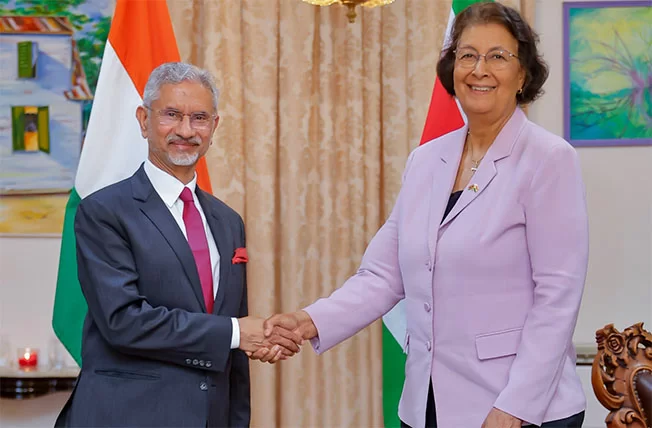
    PARAMARIBO – In a significant diplomatic engagement, King Willem-Alexander and Queen Máxima of the Netherlands were formally received by Surinamese President Jennifer Geerlings-Simons at the Presidential Palace on Monday morning. The royal visit, which marks a new chapter in bilateral relations, included an extensive Dutch delegation comprising four ministers and senior officials.

    The arrival ceremony featured a full military honor guard, with both the Dutch and Surinamese national anthems performed—a symbolic gesture underscoring mutual respect between the two nations. Following protocol, schoolchildren presented ceremonial greetings to the distinguished guests, after which official photographs were captured on the palace steps.

    A private meeting ensued between President Simons, her spouse Glenn Geerlings, and the Dutch royal couple. This was followed by a traditional exchange of gifts and the signing of the Republic of Suriname’s guestbook by the Dutch delegation.

    The discussions centered on enhancing bilateral cooperation, with several agreements scheduled for formal signing later in the day. Both delegations are expected to issue a joint press statement outlining the concrete outcomes of these diplomatic talks, which aim to foster deeper political and economic collaboration between Suriname and the Netherlands.

  • Caribische vastberadenheid op Wereld Aids Dag: ‘We gaan niet terug’

    Caribische vastberadenheid op Wereld Aids Dag: ‘We gaan niet terug’

    On World AIDS Day (December 1), Caribbean health authorities have issued a resolute declaration that the region’s battle against HIV and AIDS will persist despite growing global financial instability. Under the theme “Overcoming disruption, transforming the AIDS response,” the Pan Caribbean Partnership against HIV and AIDS (Pancap) has emphatically stated that regression is not an option.

    Wendy Telgt-Emanuelson, Director of Pancap’s Coordination Unit, delivered a powerful address highlighting that Caribbean nations have reached a critical juncture where international funding cuts threaten hard-won progress achieved over recent decades. “Our advancements face pressure, but our determination remains unshaken,” Emanuelson asserted. “We will confront these challenges, continue innovating, and maintain our course toward an AIDS-free Caribbean.”

    The financial constraints particularly impact medication programs, prevention initiatives, and educational campaigns—essential components for many countries to achieve the 95-95-95 targets (95% of people living with HIV knowing their status, 95% receiving treatment, and 95% achieving viral suppression). Despite these setbacks, Emanuelson emphasized the region’s historical resilience as a guiding force moving forward.

    Notable successes include several Caribbean nations eliminating mother-to-child HIV transmission—achievements resulting from collaborative efforts between governments, healthcare providers, community organizations, and people living with HIV. “We will not allow this foundation to crumble,” Emanuelson pledged.

    Pancap’s strategic focus for coming years will center on strengthening community structures, optimizing logistical systems, and creating more sustainable HIV response frameworks. Both regional and international partner support remains indispensable to these efforts. Emanuelson extended reassurance to frontline workers, advocates, and people living with HIV: “You are not alone in this struggle.”

    Concluding with determined optimism, Emanuelson stated: “We will not retreat. We will not abandon what we have painstakingly accomplished. The path may grow steeper, but our destination remains unchanged. Together, we will overcome these challenges and build an AIDS-free future for generations to come.”

  • Maduro hekelt uitspraak Trump: ‘Kolonialistisch dreigement’ tegen Venezuela

    Maduro hekelt uitspraak Trump: ‘Kolonialistisch dreigement’ tegen Venezuela

    Venezuela has issued a forceful response to U.S. President Donald Trump’s recent declaration that the airspace above and around Venezuela should be considered entirely \”closed.\” The government of Nicolás Maduro characterizes this move as an unlawful infringement on national sovereignty—a \”colonial threat\” that violates international law.\n\nIn an official statement, the Venezuelan government condemned Trump’s message as not only \”excessive and unilateral\” but also an \”unprecedented aggression\” against the Venezuelan people. \”We reject this colonialist threat that seeks to undermine the sovereignty of our airspace,\” the statement read.\n\nCaracas emphasized that no foreign head of state holds the authority to close another nation’s airspace, labeling the U.S. position a breach of international legal standards and therefore unacceptable.\n\nThe declaration comes amid escalating tensions and increased U.S. pressure on the Maduro administration. Washington recently conducted several military operations against alleged drug smugglers in Caribbean waters, which Venezuela interprets as part of a broader strategy to legitimize foreign intervention.\n\nIn response to Trump’s statement, multiple international airlines that had suspended flights to Venezuela have now lost their flight rights. Additionally, Venezuela has announced the suspension of repatriation and migration flights, urging the international community to respect its sovereign airspace.\n\nWith the U.S. hinting at potential future military actions \”on land\” in Venezuela, concerns are mounting regarding regional stability, aviation safety, migration, and the integrity of international law. Caracas warns that any foreign interference will be met with national defense measures.

  • Column: De ketens van onderdanigheid

    Column: De ketens van onderdanigheid

    The state visit of King Willem-Alexander and Queen Máxima to Suriname has evolved beyond ceremonial formalities into a profound examination of the complex historical relationship between the Netherlands and its former colony. While theoretically representing an opportunity to open a new chapter in bilateral relations, the visit has instead highlighted enduring tensions through its stringent protocol requirements.

    Surinamese media outlets have received official instructions mandating specific royal address protocols, including the use of ‘Her Excellency’ and ‘Their Majesties King and Queen,’ while being discouraged from publishing speculative or unverified reporting. All publications and broadcasts must reflect the dignity of the state visit—requirements notably more rigid than those enforced in the Netherlands itself.

    These protocol directives have sparked intense national introspection about Suriname’s cultural identity and historical consciousness. Many question why the nation remains bound to ceremonial practices that echo colonial subservience and slavery-era power dynamics. The symbolic weight of bowing to these royal protocols, critics argue, demonstrates that Suriname has not fully transcended its colonial past, with the Orange family—once rulers over ancestors—still maintaining invisible chains around the nation’s neck.

    The visit has consequently become a catalyst for deeper reflection about national dignity and historical reconciliation. True progress, commentators suggest, will emerge not through adherence to protocols that perpetuate historical power imbalances, but through breaking the chains that bind Suriname to a past that must be confronted and overcome. Only through such liberation can Suriname truly advance as a proud, free, and equal nation in its relationship with the Netherlands.

  • Nederlandse koning reist met delegatie van 15 bedrijven voor versterking samenwerking

    Nederlandse koning reist met delegatie van 15 bedrijven voor versterking samenwerking

    King Willem-Alexander and Queen Máxima of the Netherlands arrived in Suriname on Sunday evening, accompanied by a substantial Dutch business delegation comprising 15 prominent companies and institutions. This high-profile state visit signals a robust commitment to enhancing economic cooperation between the two nations across multiple sectors including water management, infrastructure, health technology, logistics, agriculture, and innovation.

    The delegation, coordinated by VNO-NCW—the Netherlands’ largest employers’ organization—and led by Mr. Maarten Schuurman, represents a strategic effort to deepen sustainable economic relations. The composition of the delegation reflects the key pillars of the Dutch economy while identifying specific collaboration opportunities with Suriname.

    Water and infrastructure form a central focus, with world-leading companies such as Boskalis, De Boer (Dutch Dredging), Fugro, Royal HaskoningDHV, and research institute Deltares participating. These organizations bring expertise in climate adaptation, coastal protection, dredging, geodata, river management, and sustainable infrastructure. During the visit, an agreement will be signed with Suriname’s Ministry of Public Works and Spatial Planning for dredging the Suriname River, supported by a donation exceeding 50 million euros.

    A second cluster includes companies active in energy, industry, and transport: Koole Group (liquid storage and logistics), Janson Bridging (modular bridges and emergency infrastructure), Royal Van Lent Shipyard (Feadship, shipbuilding), and KLM (strengthening air connectivity). Their involvement indicates interest in modernizing transport chains, maritime cooperation, and improving regional connectivity.

    Invest International plays a pivotal role in financing international projects utilizing Dutch expertise, demonstrating openness to co-financing initiatives in water, infrastructure, climate, energy, and innovation.

    The delegation also features technology and innovation partners like Philips and TNO (through geodata overlap with Fugro), bringing expertise in medical technology, research innovation, digitalization, energy innovation, and strengthening public services. This highlights cooperation beyond traditional sectors.

    Trade and agriculture are represented by Koppert Cress (innovative horticulture) and Jacaranda Trading (heavy equipment international trade), emphasizing opportunities for entrepreneurship, agro-innovation, and smaller-scale trade.

    The diversity of the delegation underscores the Netherlands’ comprehensive approach to strengthening economic relations, knowledge exchange, sustainable infrastructure, innovation, maritime and air connectivity, agriculture, trade, and development-oriented project financing.

  • Moiwana 39 jaar later: druk op waarheidsvinding neemt toe

    Moiwana 39 jaar later: druk op waarheidsvinding neemt toe

    Suriname commemorated the 39th anniversary of the Moiwana village massacre this Saturday, with three Western diplomatic missions demonstrating sustained international support for justice in the decades-old case. The solemn ceremony honored at least 39 unarmed civilians—primarily women and children—who were killed by military forces on November 29, 1986, during Suriname’s internal conflict.

    Ambassadors from France, the United States, and the Netherlands attended the memorial alongside survivors, civil society representatives, and victims’ families. French Ambassador Nicolas de Lacoste emphasized his nation’s continuous solidarity, noting France had hosted thousands of refugees during Suriname’s civil war—a historical detail he stated often goes unrecognized in contemporary political discourse.

    American Ambassador Robert Faucher personally laid a wreath at the memorial monument while reinforcing Washington’s commitment to truth-seeking processes. Dutch diplomat Michiel Bierkens articulated the Netherlands’ human rights policy priorities, stating: “Combating impunity remains central to our human rights agenda. Strengthening the international legal order constitutes a fundamental pillar of our foreign policy.”

    Sunil Oemrawsingh, chairman of the Foundation December 8, 1982, acknowledged the ongoing criminal investigation’s challenging progress while highlighting a significant development: a judge-commissioner has now taken personal charge of examining the facts. Oemrawsingh simultaneously defended judicial independence against political attacks, asserting: “Justice isn’t only good when rulings favor us. For atrocities like those committed here, no grace can be granted.”

    Notably, ABOP leader Ronnie Brunswijk—former Jungle Commando commander—made a brief helicopter visit to pay respects, particularly thanking the three ambassadors for their persistent engagement throughout the years.

    The collective calls during the memorial emphasized full implementation of the Inter-American Court of Human Rights’ ruling, including: continuing criminal investigations, shielding judiciary institutions from political pressure, and ensuring lasting recognition and reparations for victims and their families.

  • Delegatie koning Willem-Alexander aangekomen te Zanderij

    Delegatie koning Willem-Alexander aangekomen te Zanderij

    King Willem-Alexander of the Netherlands, accompanied by Queen Máxima, has commenced a significant three-day state visit to Suriname, arriving at Johan Adolf Pengel International Airport with a substantial governmental and business delegation. The royal contingent, which includes four cabinet ministers and representatives from fifteen leading Dutch corporations, signifies the comprehensive nature of this diplomatic mission.

    Upon arrival, the delegation was formally received by Suriname’s Minister of Foreign Affairs, International Trade, and International Cooperation, Melvin Bouva, alongside Dutch Ambassador Walter Oostelbos. Minister Bouva characterized the visit as a pivotal moment in the bilateral relationship between the two nations, emphasizing its potential to deepen cooperation across multiple sectors.

    The agenda focuses on enhancing collaboration in economic development, water management, climate change initiatives, healthcare innovation, and mutual cultural understanding. The participation of multiple ministers and business leaders underscores the mission’s broad scope, with at least three formal cooperation agreements scheduled for signing during the visit. This diplomatic engagement represents one of the most substantial bilateral exchanges between the Netherlands and Suriname in recent years, highlighting ongoing efforts to strengthen historical ties through contemporary partnerships.

  • Menzo stapt per direct op: Suriname zonder bondscoach richting cruciale WK-play-offs

    Menzo stapt per direct op: Suriname zonder bondscoach richting cruciale WK-play-offs

    In a surprising development that has sent shockwaves through Caribbean football, Stanley Menzo has abruptly stepped down as head coach of Suriname’s national team just three months before critical World Cup qualifying playoffs. The Surinamese Football Association (SVB) confirmed his immediate departure following an evaluation of recent international matches and consultations with general manager Brian Tevreden.

    The timing presents a significant challenge for Suriname’s national team, known as Natio, which faces the most important matches in its modern football history this March. These playoffs represent Suriname’s opportunity to potentially secure its first-ever World Cup qualification.

    In a personal statement, Menzo described his decision as difficult but deliberate: ‘After thorough evaluation and consultation with Brian Tevreden, I have decided to resign from my position. In March, Natio faces an extremely important international period. I am immensely proud of what we have achieved together, but this is the right moment for me to step back.’

    Menzo’s tenure marked one of the most successful periods in Surinamese football history. Under his leadership, Natio achieved remarkable milestones including reaching the quarterfinals of the 2024 Concacaf Nations League, qualifying for the Concacaf Gold Cup finals, executing a strong World Cup qualifying campaign throughout 2024, and securing a place in the March 2025 World Cup playoffs.

    The SVB acknowledged Menzo’s exceptional contributions, stating: ‘Menzo has achieved outstanding results and elevated the national men’s selection to a higher level. We respect his decision and thank him for his dedication and professional commitment.’

    The sudden departure creates a leadership vacuum at a critical juncture when intensive preparation is essential. The football association has promised to initiate a careful transition process and inform the public about next steps promptly. With approximately three months until the decisive matches, the SVB faces mounting pressure to quickly appoint a new head coach capable of guiding the team through the final qualifying phase.

  • Zijin investeert US$ 30 miljoen in nieuw zonnepark voor groene goudwinning

    Zijin investeert US$ 30 miljoen in nieuw zonnepark voor groene goudwinning

    Zijin Rosebel Gold Mines has officially inaugurated its second solar park, marking a significant advancement in its commitment to sustainable mining operations. The newly activated facility, boasting a capacity of 25 megawatts, represents a strategic effort to reduce dependency on fossil fuels and minimize harmful emissions. This initiative aligns with the company’s broader environmental goals, following the August introduction of seven fully electric 90-ton mining trucks—the first of their kind in the region.

    Suriname’s Minister of Public Works, Stephen Tsang, praised the investment as a powerful signal to the international community. In an interview with Starnieuws, he emphasized that multinational corporations like Zijin are not obligated to pursue sustainable development but are choosing to lead by example. He noted that the solar park enhances energy independence in an eco-friendly manner and serves as a model for other major enterprises and the state-owned energy company EBS. Minister Tsang connected the project to Suriname’s national ambition for a green policy, supported by the country’s 92% forest coverage.

    Construction of the solar farm, spanning 20 hectares and equipped with 40,572 solar panels, converters, and storage batteries, was completed in eight months. According to Karel Abinie, Electrical Superintendent at Rosebel, and Jerry Huangfu of Zijin Longking Clean Energy, the installation will supply approximately 17% of the mine’s annual energy demand. Currently, 5 MW of energy is stored in batteries, with plans to expand storage capacity to improve energy security.

    The project required a total investment of over $30 million USD and is expected to pay for itself within a decade. The inauguration ceremony was attended by Jerry Huangfu, Minister Tsang (representing President Jenny Simons), Xian Jian Guo—CEO of Zijin Gold International—and Liu Zhenhua from the Chinese Embassy. Officials highlighted the growing cooperation between Suriname and China, particularly in sustainable and green development initiatives.

  • De koning komt

    De koning komt

    Surinamese parliament member Michael S. Marengo has expressed profound concerns regarding the Dutch king’s upcoming state visit to Suriname, questioning the official itinerary’s failure to acknowledge regions most impacted by colonial exploitation and slavery.

    The visit, scheduled to commemorate 50 years of Surinamese independence (Srefidensi) and the unique historical ties between the Netherlands and its former colony, arrives at a moment of heightened sensitivity surrounding colonial reckoning. Marengo contends that while symbolically significant, the planned program demonstrates a troubling lack of recognition for the nation’s painful past.

    Central to the criticism is the omission of the district of Para from the royal itinerary. Marengo emphasizes that Para represents far more than just a geographic region; it serves as the cultural heartland for a substantial portion of Suriname’s Indigenous communities—the original inhabitants of the land. Furthermore, it remains home to the highest concentration of descendants of enslaved Africans and contains the majority of surviving plantations from the colonial era.

    The lawmaker finds it “extremely inappropriate and disappointing” that these historically burdened places, emblematic of both immense suffering and remarkable resilience, are excluded from the king’s agenda. This oversight, he argues, signals a deficiency in acknowledging those communities most devastated by historical systems, particularly the trans-Atlantic slave trade.

    Adding to the consternation, the king’s schedule includes stops at former plantations currently operated by, among others, foreign Dutch nationals. Marengo suggests this choice prioritizes the perspective of those who continue to benefit from historical structures of power, rather than centering the voices of descendants who bear the lasting scars and burdens of that era.

    Marengo asserts that a visit to Para would constitute a powerful gesture of respect and moral responsibility. Engaging directly with Indigenous villages and communities of Maroon descendants would demonstrate the Kingdom of the Netherlands’ willingness to confront the painful chapters of shared history, moving beyond superficial ceremony.

    The parliamentarian calls for genuine appreciation and visible recognition for all groups central to Suriname’s history and identity, urging that the royal visit transcend a mere half-hour symbolic meeting. He frames this as a historical responsibility born from centuries of domination, injustice, and economic exploitation, concluding that Suriname—and particularly the groups still experiencing the legacy of 500 years of oppression—deserves nothing less than dignified, sincere, and tangible recognition.