标签: Suriname

苏里南

  • Voormalig Assembleelid Mohamedsafiek Gowrie (45) overleden

    Voormalig Assembleelid Mohamedsafiek Gowrie (45) overleden

    Suriname’s political community mourns the loss of former National Assembly member Mohamedsafiek Gowrie, who passed away at age 45 on December 2nd. The confirmation came from Asis Gajadien, parliamentary leader of Gowrie’s VHP party, in an official statement to local media outlet Starnieuws.

    Gowrie served as an elected representative in Suriname’s parliament from 2020 through 2025, during which period he developed serious health complications. Despite undergoing extensive medical treatments, he maintained his commitment to legislative duties, continuing to contribute to parliamentary proceedings throughout his illness.

    “He demonstrated remarkable courage throughout his health challenges,” stated Gajadien, highlighting Gowrie’s dedication to public service. “Gowrie was a disciplined individual who approached his responsibilities with unwavering commitment, persevering even under the most difficult circumstances. Ultimately, he was forced to surrender his brave fight.”

    The VHP party leadership extended heartfelt condolences to Gowrie’s family members and loved ones. Gajadien expressed the party’s collective sympathy while offering strength and support to the grieving family during this profoundly difficult time. The passing of the young parliamentarian has created a void in Suriname’s political landscape, with colleagues remembering him as a dedicated public servant who remained active in governance until his final days.

  • Reyme: Staatsbezoek moet leiden tot helende samenwerking en perspectief samenleving

    Reyme: Staatsbezoek moet leiden tot helende samenwerking en perspectief samenleving

    In a landmark address during the extraordinary parliamentary session marking the state visit of King Willem-Alexander and Queen Máxima, A20 faction leader Steven Reyme articulated a compelling vision for transforming Suriname-Netherlands relations. The Monday session became a platform for Reyme to outline principles of mutual respect, equality, and future-oriented cooperation that should define bilateral ties.

    Reyme emphasized the symbolic significance of the royal visit occurring exactly fifty years after Suriname’s independence, noting the historical parallel between the former Queen and Prime Minister who witnessed independence and today’s female President and King. This chronological symmetry, he suggested, creates an ideal moment to inaugurate a new chapter in relations where historical acknowledgment progresses alongside societal development and perspective.

    The parliamentarian highlighted the crucial role of the Surinamese diaspora in the Netherlands, numbering over 360,000 individuals, whom he described as “living bridges between our nations.” Reyme praised their contributions to Dutch society while maintaining strong connections to Suriname, seeing this dual allegiance as embodying the strength of shared history, culture, and future aspirations.

    Addressing Suriname’s contemporary challenges, Reyme noted the nation stands at the threshold of significant transformations: youth demanding opportunities, an economy requiring diversification, and communities seeking stability and development. He expressed openness to cooperation facilitating knowledge transfer, trade, investments, education, security, sports, and culture—but emphasized this must occur “without dependency, through mutual respect.”

    The faction leader acknowledged and appreciated recent Dutch steps toward recognition and apologies, stating that “the path of healing cooperation, historical acknowledgment, and shared responsibility must continue to be pursued.” Reyme expressed hope that this state visit might initiate a new period of respectful collaboration focused on peace, development, justice, and mutual understanding between the two nations.

  • Nog honderden vermist na overstromingen in Indonesië, Sri Lanka en Thailand

    Nog honderden vermist na overstromingen in Indonesië, Sri Lanka en Thailand

    A catastrophic flooding event across Southeast Asia has left rescue teams searching for more than 800 missing persons while the confirmed death toll has surpassed 1,000 across Indonesia, Sri Lanka, and Thailand. The devastating natural disaster has triggered urgent calls for enhanced climate action from regional leaders.

    According to latest official reports, Indonesia has suffered the most severe impact with 442 confirmed fatalities and 402 individuals still unaccounted for, primarily on the island of Sumatra. Sri Lankan authorities report 334 deaths with approximately 400 people missing in the aftermath of Cyclone Ditwah. Thailand has recorded 176 fatalities, mostly concentrated in the southern Songkhla province where the city of Hat Yai experienced its most intense rainfall in three centuries.

    The humanitarian crisis has affected over four million residents across the region. Indonesia’s National Disaster Management Agency reports 290,700 people displaced across North Sumatra, West Sumatra, and Aceh provinces. In Sri Lanka, nearly one million people have been impacted by the disaster with approximately 200,000 evacuated to temporary shelters.

    Indonesian President Prabowo Subianto visited affected areas, pledging to rebuild damaged infrastructure while highlighting accessibility challenges due to severed communication lines and destroyed road networks. Relief operations depend heavily on aerial support with eleven helicopters and four naval vessels deployed to reach isolated communities. Reports of looting in some areas have prompted additional police deployments.

    President Subianto emphasized the climate connection during a press briefing: ‘We must effectively address climate change. Local governments must play a crucial role in environmental protection and preparing for extreme weather conditions resulting from future climate change.’

    Thai authorities have initiated a 239 million baht (approximately $7.4 million) compensation package for 26,000 affected citizens while working to restore critical infrastructure including water and electricity systems in southern regions. In Sri Lanka, the collapse of the Mavil Aru dam has necessitated large-scale military rescue operations amid widespread destruction.

    Emergency response teams continue to face significant challenges as all three nations intensify efforts to support affected populations and limit further damage from one of the region’s most severe flooding events in recent history.

  • Simons tijdens staatsbanket: Dit is het moment om Suriname te laten schitteren

    Simons tijdens staatsbanket: Dit is het moment om Suriname te laten schitteren

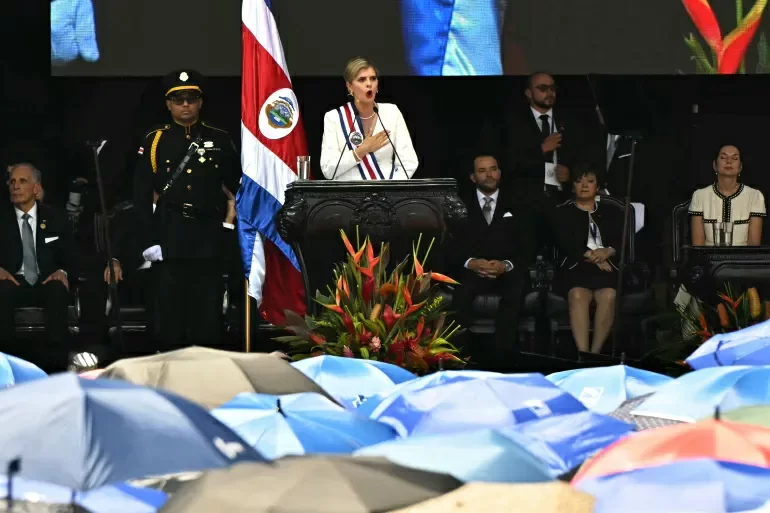
    In a ceremonious evening at the Prince Ballroom, President Jennifer Simons extended a warm welcome to Dutch King Willem-Alexander and Queen Máxima during their inaugural state visit to Suriname. The historic occasion coincides precisely with the nation’s fiftieth independence anniversary, a symbolic convergence that the president emphasized as profoundly significant.

    President Simons reflected on the 1975 independence celebrations attended by then-Crown Princess Beatrix and Prince Claus, noting that this royal visit “reaffirms the enduring friendship and deep connection between Suriname and the Netherlands that transcends generations.”

    Looking beyond commemorative reflections, Simons articulated Suriname’s forward-looking vision encapsulated in the theme “Srefidensi is Srefidenki” (Independence is Self-Reliance). She unveiled the ambitious “Make Suriname Shine” initiative, positioning it as a global invitation to rediscover the nation’s potential. The president outlined plans to leverage Suriname’s natural resources, creativity, human capital, and cultural diversity to establish the country as a paradigm of sustainable development and international cooperation.

    In one of her speech’s most poignant segments, Simons defined Suriname’s national identity through its unique composition of cultures, languages, and religions. “Suriname is diversity,” she declared, “and precisely therein lies our strength. Our differences don’t form obstacles but rather a source of inspiration and resilience.”

    The president announced enhanced preservation efforts for Suriname’s rich heritage, including UNESCO monuments in Paramaribo, with an extensive heritage month scheduled for 2026. Additionally, she highlighted the government’s commitment to developing youth through sports, culture, and community engagement programs in collaboration with international partners.

    Simons characterized the bilateral relationship as extending beyond diplomatic formalities to encompass deep personal and familial bonds strengthened through migration and shared history. She envisioned the royal visit as an opportunity to deepen partnership based on equality, mutual respect, and shared ambitions.

    Concluding her address, the president acknowledged Surinamese and Dutch institutions that facilitated the state visit and invited attendees to toast renewed cooperation, lasting friendship between both nations, and the health of the Dutch royal family.

  • Asabina: Slavernij verleden roept nog altijd emoties op

    Asabina: Slavernij verleden roept nog altijd emoties op

    In a landmark address during the extraordinary public assembly attended by Dutch King Willem-Alexander and Queen Máxima, BEP faction leader Ronny Asabina emphasized the profound emotional resonance of colonial history in contemporary Surinamese-Dutch relations. The high-profile meeting, marking the first visit by a Dutch head of state in 47 years, served as a pivotal platform for addressing historical grievances and forging new bilateral frameworks.

    Asabina characterized the royal visit as an unprecedented opportunity to deepen Netherlands-Suriname relations through mutual respect, awareness building, and sustainable cooperation. He advocated for mature and prominent treatment of colonial history within educational systems, asserting that comprehensive historical knowledge contributes significantly to identity formation, citizenship development, and national integration.

    A central concern raised by the parliamentarian involves access to historical archives. “We seek to understand and learn about historical connections and their contemporary manifestations,” Asabina stated, invoking the liberating power of historical truth. The BEP faction perceives the state visit as a catalyst for embracing new relational dynamics and developing future-oriented visions that prioritize human dignity and sustainable development.

    The political leader framed this diplomatic engagement as transcending mere intellectual understanding, encouraging bilateral relations to be experienced with emotional authenticity and heartfelt connection. This approach, he suggested, would transform historical baggage into constructive pathways for mutual understanding and progressive collaboration between the former colonizer and formerly colonized nation.

  • Hoge Raad ook ‘sceptisch’ over Constitutioneel Hof

    Hoge Raad ook ‘sceptisch’ over Constitutioneel Hof

    A significant judicial debate has emerged regarding the establishment of constitutional courts in both Suriname and the Netherlands, revealing critical concerns about political interference in judicial systems. Legal expert Gerold Sewcharan, attorney and chairman of the Foundation for the Legal Order in Suriname (SRiS), has highlighted striking parallels between both nations’ constitutional court discussions.

    In a May 2024 article titled “No Constitutional Court for Suriname,” Sewcharan concluded that such an institution offered no substantive added value to Suriname’s legal framework, noting that existing systems already adequately addressed all relevant judicial needs. His analysis suggested that a constitutional court would contribute neither to legal development, political stability, nor legislative enhancement.

    The debate gained renewed relevance when a September 2025 publication in the Dutch Jurists Journal (NJB) revealed that the Netherlands’ highest judicial authorities—including the Supreme Court, the Administrative Jurisdiction Division of the Council of State, and the Trade and Industry Appeals Tribunal—expressed significant skepticism about establishing a constitutional court. The NJB article characterized such an institution as “an alien element in the Dutch legal system” that carried substantial risks of political influence in both judicial appointments and verdicts.

    Sewcharan notes that Suriname’s legal system derives directly from the Dutch model, making the Dutch judicial authorities’ reservations particularly relevant. Despite this shared heritage, Suriname incorporated constitutional court provisions into its 1975 and 1987 constitutions without thorough public discourse or justification regarding its necessity.

    The expert now calls for Surinamese legal professionals to urgently re-examine this constitutional question. Sewcharan has previously proposed establishing a third judicial instance for Suriname that would safeguard legal uniformity within the nation’s jurisdiction—a suggestion that gains renewed importance in light of the ongoing regional debate about judicial independence and constitutional review mechanisms.

  • NPS-fractieleider Pawiroredjo: Gelijkwaardigheid begint bij menswaardige visumbehandeling

    NPS-fractieleider Pawiroredjo: Gelijkwaardigheid begint bij menswaardige visumbehandeling

    Suriname’s National Party of Suriname (NPS) faction leader Jerrel Pawiroredjo has issued a forceful critique of the Netherlands’ visa policies toward Surinamese citizens, characterizing the current treatment as a persistent diplomatic concern that strains bilateral relations. The remarks were delivered Monday during an extraordinary public assembly attended by the Dutch royal couple.

    Pawiroredjo commenced his address by warmly welcoming King Willem-Alexander and Queen Máxima, acknowledging the profound linguistic and historical ties binding the two nations through a colonial history spanning over three centuries. While recognizing this shared past contains dark chapters, the parliamentarian noted it had ‘unintentionally laid the foundation for Suriname’s beautiful, diverse contemporary society.’

    The statesman then pivoted to what he described as matters requiring concrete action rather than rhetorical diplomacy: mutual respect and equality. ‘The treatment of our citizens during visa application procedures remains an enduring concern,’ Pawiroredjo asserted. He detailed how Surinamese applicants face exhaustive questioning while Dutch financial guarantors must disclose comprehensive personal financial information—a contrast he found particularly striking compared to larger South American nations whose citizens enjoy visa-free travel despite lacking historical ties with the Netherlands.

    The NPS leader simultaneously acknowledged decades of Dutch support across multiple sectors, specifically highlighting collaborative efforts in education, healthcare innovation, climate change mitigation, water management systems, and agricultural technology as areas ripe for continued partnership development. Pawiroredjo also expressed appreciation for the Netherlands’ formal apologies for historical slavery, suggesting the relationship should now progress forward-looking. ‘Let a positive vision for the future become our shared compass,’ he concluded, expressing hope that bilateral relations would deepen further for ‘the glory of both living communities.’

  • Koning vraagt vergiffenis en spreekt met open hart over geschiedenis, heling en toekomst

    Koning vraagt vergiffenis en spreekt met open hart over geschiedenis, heling en toekomst

    In a remarkably personal address during Monday evening’s state banquet at Ballroom Prince, King Willem-Alexander of the Netherlands delivered an emotionally charged speech that transcended diplomatic formalities. The monarch’s visit to Suriname during its 50th anniversary of independence (Srefidensi) became a profound historical moment as he directly addressed the painful legacy of Dutch colonialism.

    The King, visibly moved, reflected on his family’s multi-generational connection to Suriname, noting how his grandparents had made the first state visit to the young republic. “Since then,” he observed, “much water has flowed through the Suriname River”—a poignant acknowledgment of turbulent political decades and enduring connections.

    Most significantly, Willem-Alexander built upon the Dutch government’s 2023 slavery apologies by personally requesting forgiveness for the historical failures of Dutch monarchs. “Your history bears the brand of slavery in the name of the Dutch state,” he stated. “The Dutch government has apologized for this, and personally I have added the request for forgiveness for the failure to act against this crime against humanity by stadholders and kings of the House of Orange-Nassau.”

    The King had previously repeated these apologies and personal requests for forgiveness during meetings with descendants of enslaved people and Indigenous communities, emphasizing that healing requires continuous generational truth recognition.

    Beyond historical reconciliation, Willem-Alexander praised Suriname’s resilience, describing the nation as a “beacon of humanity” in an increasingly polarized world. He specifically honored resistance heroes including the maroons who fiercely defended their hard-won freedom and legendary figures like Boni, whose moral authority inspired fights for dignified existence.

    The banquet also focused on future cooperation, with the King highlighting Suriname’s youth potential, rainforest conservation (noting the country absorbs more CO₂ than it emits), and responsible mineral resource management. He emphasized Dutch support would be offered “with due humility.”

    In a notable diplomatic gesture, the King announced the Dutch ambassador would lay a wreath at the December Murders monument during December 8th commemorations, acknowledging Suriname’s developing rule of law.

    The evening concluded with lighthearted moments as the King anticipated potential World Cup football rivalry between the nations in 2026, and a recitation of Dobru’s famous multicultural unity poem: “Wan Sranan, Someni wiwiri, Someni skin, Someni tongo, Wan pipel” (One Suriname, Many leaves, Many skins, Many tongues, One people).

  • Column: Koning, nooit meer oranje boven

    Column: Koning, nooit meer oranje boven

    In a strikingly candid address to visiting Dutch King Willem-Alexander, Surinamese commentator Nita Ramcharan delivered a powerful critique of contemporary Netherlands-Suriname relations during the monarch’s recent state visit. The article captures Suriname’s assertive national awakening fifty years after independence, challenging historical power dynamics and demanding equal partnership.

    The piece begins by acknowledging Suriname’s traditional hospitality while immediately establishing that formal politeness no longer masks unresolved tensions. Ramcharan references outdated colonial-era imagery of schoolchildren singing ‘orange above, long live the royal couple’ to highlight how far the nation has evolved into a digitally-connected modern society.

    King Willem-Alexander witnessed Suriname’s transformation firsthand—encountering tech-savvy youth who fact-check in real-time, engaging with traditional leaders, and receiving direct political messaging that ‘We walk beside you, not behind you’ in the National Assembly. This sets the stage for the central issue: visa policies that Surinamese citizens find deeply discriminatory.

    The author contrasts the seamless entry process for Dutch travelers to Suriname with the ‘theatrical tragedy’ Surinamese face when applying for Netherlands visas—requiring extensive documentation ‘as if leaking state secrets’ while subject to consular officials’ arbitrary decisions. Ramcharan dismisses potential Schengen Zone excuses, insisting the king possesses both platform and moral authority to address what she characterizes as institutional humiliation.

    Beyond visa grievances, the article outlines Suriname’s vision for truly balanced relations: trade without dependency, cooperation without paternalism, and ensuring future oil revenues benefit local generations. While acknowledging domestic challenges, Ramcharan emphasizes national resilience and self-determination.

    The powerful conclusion rejects orange symbolism entirely: ‘The shadow of orange lies behind us. The sun of Suriname lies before us.’ This encapsulates the piece’s core message—Suriname now stands beside its golden star symbol, on its own soil, as an equal partner rather than former colony.

  • Adhin: Koninklijk bezoek onderstreept nieuwe fase van democratische verdieping

    Adhin: Koninklijk bezoek onderstreept nieuwe fase van democratische verdieping

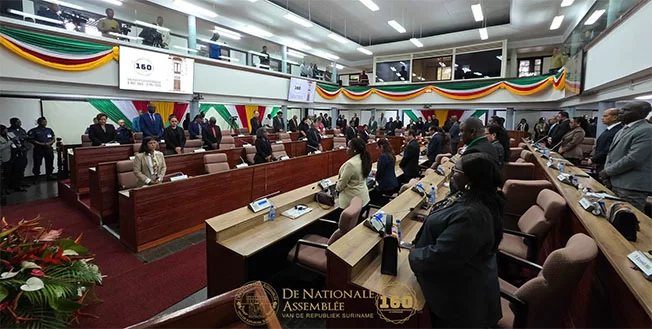
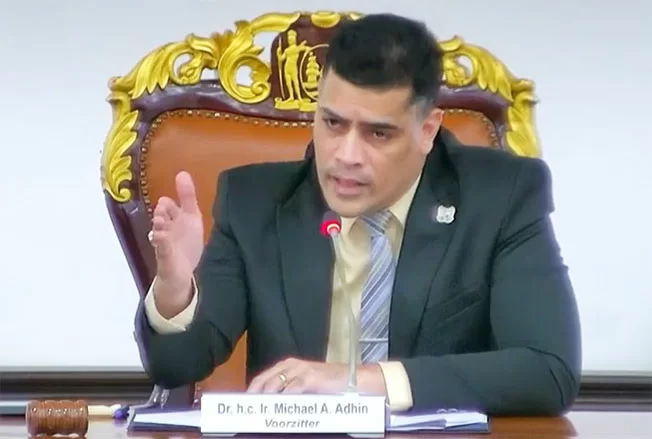
    The landmark visit of King Willem-Alexander and Queen Máxima to Suriname has been hailed by National Assembly Chairman Ashwin Adhin as a transformative moment in bilateral relations, marking a significant shift toward strengthened political responsibility and democratic development. During an extraordinary public assembly session, Adhin emphasized that the royal visit transcends ceremonial symbolism, representing instead a crucial opportunity for Suriname to redefine its democratic future with greater clarity.

    Coinciding with Suriname’s commemoration of fifty years of independence, the parliamentary leadership views the Dutch head of state’s visit as a powerful signal that bilateral relations can be substantially reinforced. This revitalized partnership, Adhin noted, would not focus on revisiting historical narratives but rather on collaboratively building a modern, equitable relationship framework.

    The Assembly Chairman asserted that the royal couple’s presence demonstrates the Netherlands’ genuine commitment to supporting parliamentary democracy and institutional development within Suriname. This diplomatic engagement creates an ideal platform for openly addressing contemporary challenges, reducing mutual misunderstandings, and exploring new cooperative opportunities spanning knowledge exchange to economic enhancement initiatives.

    Adhin characterized contemporary diplomacy as an essential instrument for building international trust, noting that the National Assembly considers this royal visit a catalyst for deeper cooperation and the strengthening of political institutions that form the foundation of liberty, justice, and stability. The parliamentary leader expressed hope that this visit would inspire both Surinamese and Dutch citizens to further deepen bilateral relations based on mutual respect, shared values, and a forward-looking vision that future generations could proudly build upon.