标签: Suriname

苏里南

  • Bijna 90% begroting Openbaar Ministerie gaat op aan personeelskosten

    Bijna 90% begroting Openbaar Ministerie gaat op aan personeelskosten

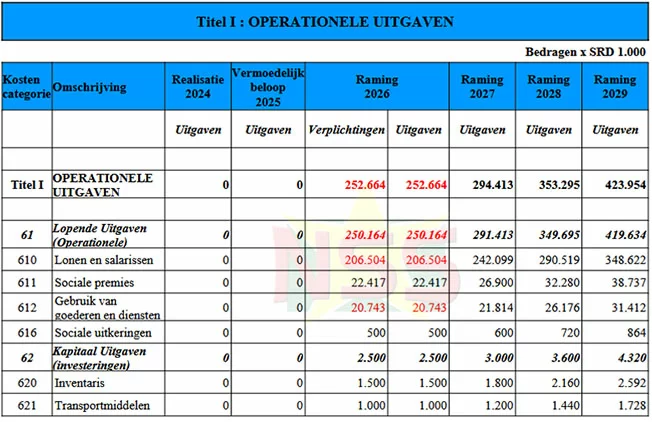
    On June 8, newly released 2026 budget documents submitted to the Surinamese Council of State via a government amendment reveal that the Public Prosecution Service (Openbaar Ministerie, OM) will receive a total annual budget of more than 256.7 million Surinamese dollars (SRD) for the 2026 fiscal year. Of this total allocation, nearly 89% is earmarked for personnel-related expenditures, leaving only a small fraction of funding for core operational activities, infrastructure investment and organizational professionalization.

    Breaking down the personnel budget line, 206.9 million SRD goes directly to employee wages and salaries, with an additional 22.4 million SRD allocated to cover social security contributions. Combined, these two cost centers add up to more than 229.3 million SRD, accounting for the vast majority of the OM’s total 2026 budget. Within the salary allocation, fixed base salaries make up the largest single line item at 156.6 million SRD, with remaining funds set aside for holiday pay, overtime compensation, performance bonuses and gratuities, personal allowances, acting position allowances, representation allowances and transportation stipends. For social contributions, the OM budgets 10 million SRD for employer pension contributions and 12.4 million SRD for contributions to the State Health Fund.

    The budget framework confirms that the OM is planning to expand its total workforce in 2026, noting that the agency is still in a phase of institutional growth and requires additional specialized staff to fulfill its legally mandated core duties. The expansion of personnel, however, is the primary driver behind the heavy weighting of personnel costs in the overall budget.

    For goods and services that support daily operational work, the OM has allocated just 20.7 million SRD. The largest expenditures in this category include 3 million SRD for building and land rental, 1.5 million SRD for office supplies, 1.5 million SRD for electricity costs, 1 million SRD for building maintenance, and 750,000 SRD each for vehicle maintenance, international work travel, and telecommunications services. According to budget documentation, these funds are critical to supporting criminal investigations, prosecution proceedings, administrative processes, and the daily functioning of the prosecution agency.

    Capital investment receives an even smaller allocation of only 2.5 million SRD total. Of this limited investment budget, 1.5 million SRD is earmarked for new equipment and inventory, including computers, office fittings and furniture, while 1 million SRD is reserved to purchase a new bus for personnel and prisoner transport. The OM notes that workforce growth and expanded operational activities make upgrades to equipment and transport capacity necessary, but the budget leaves little room for large-scale modernization.

    Beyond regular operational and capital spending, the OM has set aside 1.575 million SRD for organizational development programs. The vast majority of this allocation, 1.5 million SRD, goes toward professionalizing the prosecution service, including specialized training for criminal investigation and policy development work. A 75,000 SRD awareness-raising project is also included, with additional support from UNICEF.

    On the revenue side, the OM projects total 2026 income of 29.3 million SRD to offset expenditures. The largest revenue streams are 14.3 million SRD from fines and prosecution-related cost recovery, 14.25 million SRD from miscellaneous fines and transactions, and a 500,000 SRD UNICEF donation earmarked for the awareness project.

    The budget structure underscores the Public Prosecution Service’s identity as a heavily labor-intensive organization. While the total budget is substantial in absolute terms, nine out of every ten SRD allocated goes to payroll and related social costs. This leaves only a relatively small share of total funding available for investment, modernization, skills training and other institutional development initiatives – even as the OM acknowledges that continued professionalization is essential to effectively address the growing complexity of modern crime and prosecution work.

  • Iran vuurt raketten af op Israël na aanval op Beiroet

    Iran vuurt raketten af op Israël na aanval op Beiroet

    On the evening of June 8, 2026 local time, Iran launched a wave of rocket attacks targeting Israel, a direct retaliation for Israeli airstrikes on the southern suburbs of Beirut that came despite a recently brokered ceasefire between Israel and Lebanon. According to Iran’s Islamic Revolutionary Guard Corps (IRGC), the assault was issued as a formal warning to Israel over its ongoing military blockade and operations in Lebanon.

    The Israel Defense Forces (IDF) confirmed that multiple projectiles were fired into Israeli territory starting at approximately 10:00 PM local time, triggering air raid sirens across multiple regions of the country. Israeli military command stated that all incoming Iranian rockets had been intercepted successfully as of the latest updates. Roughly an hour after the initial alert, Israeli civil defense authorities issued an all-clear notice, allowing residents to exit bomb shelters.

    The IRGC confirmed that one of its primary targets was Ramat David Airbase, located in northern Israel. The group justified the operation as retribution for “widespread killing and forced displacement of oppressed populations in the Tyre and Nabatiyeh regions of southern Lebanon.” In an official statement, the IRGC emphasized: “This operation is a warning. If Israeli aggression continues, our response will be expanded to include all American and Zionist targets across the region.”

    Mohsen Rezaee, a senior military advisor to Iran’s Supreme Leader, reiterated the country’s stance via social media platform X, stressing that Iran will not tolerate any violations of the Lebanese ceasefire, and the rocket strike was a clear caution to Israeli leadership. “Any new hostile action will be met with a far heavier and more devastating response,” Rezaee added.

    The strike comes in the wake of Israeli airstrikes carried out against Dahiyeh, the densely populated southern suburb of Beirut, earlier the same day. Those airstrikes left at least two people dead and 11 others injured in a residential neighborhood. Israeli Prime Minister Benjamin Netanyahu and Defense Minister Israel Katz claimed the attack targeted a command center operated by Hezbollah, the Lebanese militant group backed by Iran.

    The IRGC described the Israeli strikes on Dahiyeh as a crossing of “all red lines” that could not go unanswered. Iranian Parliament Speaker and lead nuclear negotiator Mohammad Bagher Ghalibaf issued a further warning, stating that Iran will not only suspend ongoing negotiations with international parties but also enter into direct confrontation with Israel if it continues to violate the Lebanese ceasefire.

    U.S. President Donald Trump has publicly come out against any Israeli retaliatory strike against Iran. He confirmed he will call Prime Minister Netanyahu to urge him against launching a counterattack, in a bid to prevent further regional escalation. Trump noted that a new agreement with Iran is close to being finalized, and further open conflict would put this progress at serious risk. However, anonymous sources familiar with the matter note it remains unclear whether the U.S. government would fully back Israel if it chooses to proceed with an attack on Iran.

    Israeli officials had earlier stated on Sunday that the country was considering a “powerful response” to the Iranian rocket barrage. Tensions have been mounting for weeks as Iran issued repeated warnings demanding Israel end its military operations in southern Lebanon. Since March 2 of this year, more than 3,500 people have been killed in Israeli strikes across Lebanon, pushing the region’s fragile ceasefire and broader stability to the breaking point.

  • Column: Feest van voetbal, schaduw van oorlog

    Column: Feest van voetbal, schaduw van oorlog

    As the global community counts down to the 2026 FIFA World Cup, the world’s most-watched sporting spectacle, a far grimmer, less-reported narrative is unfolding alongside the excitement. The stark divide between the celebratory joy of elite football and the brutal reality of ongoing war, displacement and humanitarian crisis has never been more visible than in the lead-up to this year’s tournament.

    At the center of this tension is Iran’s national team, which has overcome significant barriers to secure its place at the competition. Even amid a bitter geopolitical conflict with the United States – one of the 2026 World Cup’s host nations – and crippling international sanctions that have gutted daily life for ordinary Iranians, the squad has pushed through visa obstacles and political friction to take the field. For the Iranian people, this tournament is far more than a series of football matches: it is a quiet fight to preserve national identity, dignity and collective hope in the face of widespread chaos and instability. Millions of Iranians are pinning their pride and aspirations on their players, who carry the resilience of a nation that has refused to be broken onto the global stage.

    Half a world away, in the South American nation of Suriname, the local football side fell just short of qualifying for the 2026 tournament in the final round of qualifying. While the national campaign ultimately ended in disappointment, it united the Surinamese people in shared pride for their home team. Now, with the tournament just days away, local fans have turned their support to global fan favorites: many back neighboring giants Brazil or Argentina, while others cheer for the Netherlands or Germany. In the coming weeks of the tournament, local employers across Suriname have already signaled they will turn a blind eye to late arrivals after late-night matches, a small reflection of the country’s contagious excitement for the global game.

    But this air of joyful anticipation is not shared across every corner of the globe. While fans in stable, peaceful nations prepare to gather around televisions to cheer on their favorite teams, active conflicts and humanitarian emergencies continue to threaten the lives of millions across the world. Unrest and human suffering across large swathes of Africa, Asia and the Middle East will not pause for the roars of football fans.

    For hungry and vulnerable communities in Sudan and Somalia, nations that have been torn apart by years of persistent violence and grinding poverty, the World Cup will remain a distant, irrelevant event. Their daily fight is not for goals and trophies, but for scarce food supplies and basic survival. In other nations impacted by escalating tensions between the U.S. and Iran, including Afghanistan and Sri Lanka, daily life is defined by fear, food insecurity and an uncertain future that overshadows any dream of sporting celebration.

    This sharp contrast between the world’s biggest football celebration and the overlapping crises unfolding simultaneously on the global stage serves as a sharp reminder of the deep divides that continue to separate our world. While the World Cup is often celebrated as a unifying force that brings people of all nations together, these ongoing crises reveal how far the global community remains from achieving universal peace and justice for all.

    Yet even amid this stark divide, there remains room for hope. It is precisely in this tension that sport’s unique power shines through: its ability to build bridges across conflict lines, and to center human stories that transcend borders and political divides. The 2026 World Cup will no doubt be a celebration of elite athletic talent and global competition, but it also reminds us of our shared humanity, and our collective responsibility to work toward a world where every person can live in safety and freedom.

    As the tournament kicks off this Thursday, the author urges audiences to engage with the event not just as casual spectators, but as global citizens: to enjoy the skill and drama on the pitch, while also acknowledging the lives and struggles unfolding far beyond the stadium walls. Behind every player, every national flag and every goal lies a human story – sometimes one of hope, and often one of quiet, unyielding struggle. It is up to us as global audiences to see the whole picture, as we celebrate the beautiful game.

  • Regering in lastige positie bij zoeken oplossing asfalteringsproject Van ’t Hogerhuysstraat

    Regering in lastige positie bij zoeken oplossing asfalteringsproject Van ’t Hogerhuysstraat

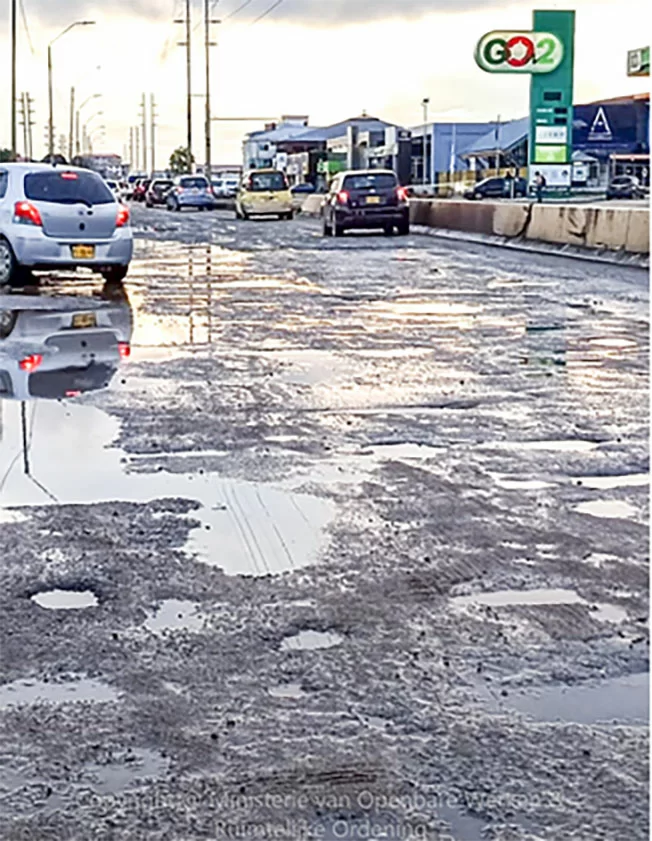
    A months-long legal impasse over a stalled Surinamese road asphalt project has moved into a new phase, with government representatives and contractor Baitali N.V. launching constructive negotiations to find a mutually workable solution, according to Baitali CEO Farsi Khudabaks.

    The conflict centers on the asphalt project for Van ’t Hogerhuysstraat and Slangenhoutstraat, part of a larger infrastructure initiative fully funded by the Inter-American Development Bank (IDB). After the government awarded the construction contract to rival firm Kuldipsingh N.V., Baitali launched legal action, arguing it had been wrongfully disqualified from the original tender process.

    The cantonal court ultimately ruled in Baitali’s favor, ordering the government to withdraw the existing award, re-evaluate Baitali’s bid, and re-run the tender process in line with judicial standards. The ruling did not order the contract to be automatically reissued to Baitali, but it did invalidate the unsubstantiated grounds used to exclude the firm from consideration initially. What followed, however, was an unexpected standoff: the IDB has threatened to pull all funding for the project if the government complies with the court’s order, putting the administration in an impossible bind between upholding judicial rulings and retaining critical infrastructure financing.

    To ramp up pressure on the government to enforce the original ruling, Baitali launched a new summary proceeding, asking the court to increase the daily astreinte (conditional fine) for non-compliance from SRD 5,000 to SRD 1 million. No ruling has been issued in this second case yet, but for the first time since the dispute began, both sides are now talking outside the courtroom.

    Khudabaks confirmed that while no binding resolution has been put forward yet – including no agreement to withdraw Baitali’s latest legal claim, though that remains on the table as a possible outcome of talks – the shift to negotiation is a marked improvement after years of confrontation solely through legal channels. “The government has acknowledged mistakes were made in the original tender process, and both sides are now working to identify a path that corrects the unfair outcome for Baitali without triggering the IDB’s funding withdrawal,” Khudabaks explained in a statement.

    He emphasized that the dispute is not with Kuldipsingh N.V., which secured the contract through the contested process. “We have never had any issue with Kuldipsingh. This conflict is about the integrity of the tender process and compliance with judicial orders, not any dispute with the current awarded contractor,” he said.

    Still, key questions remain unresolved, particularly the IDB’s conflicting stance on the impasse. While the IDB’s president has publicly stated the organization respects national judicial process, the threat to pull funding if the ruling is implemented remains in place, continuing to complicate government negotiations.

    Khudabaks stressed that a fast resolution is critical for the public. The project can only move forward during the upcoming dry season, so all parties need to reach a deal quickly to avoid further delays. “At the end of the day, the only people who lose from this standoff are local residents and commuters who rely on these badly upgraded roads every day,” he noted. “That’s why urgent clarity and a resolution are so important.” For now, he called the resumption of talks “an important breakthrough” after a long period of deadlock.

  • Derde helft WK 2026: Van ‘groep des doods’ tot verrassingen

    Derde helft WK 2026: Van ‘groep des doods’ tot verrassingen

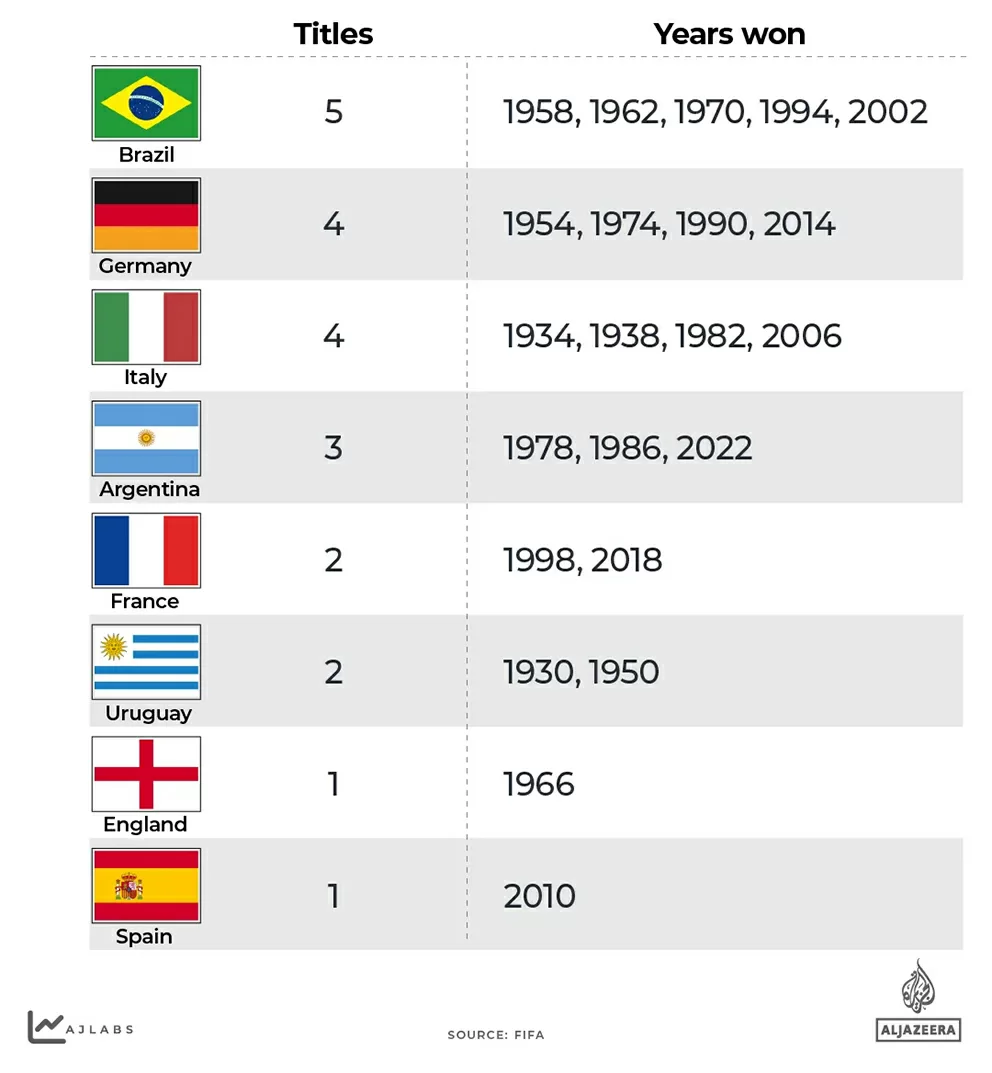
    Since the inaugural men’s FIFA World Cup kicked off in 1930, only eight distinct national sides have lifted the sport’s most coveted global trophy. In just days, the 2026 edition will make history as the first expanded tournament to feature a record-breaking 48 competing nations, bringing a brand-new competition format to the world’s biggest sporting event.

    Under the restructured rules, the group stage will be split into 12 separate groups of four teams apiece. Twelve seeded teams, including three co-host nations and eight top-ranked sides, have already been distributed across the draw. The tournament’s four highest-ranked seeded teams—Spain, Argentina, France, and England—have each been placed in separate quadrants of the new tournament draw structure, a format adapted from professional tennis competition.

    FIFA confirmed that if the top four seeded sides all win their respective groups, they will not face each other until the semi-final stage of the knockout bracket. After the round-robin group play concludes, the top two teams from each group will automatically advance to the expanded 32-team knockout round. They will be joined by the eight highest-ranked third-place finishers from across all groups, creating more pathways for underdog sides to make a deep run than in previous tournaments.

    Ahead of the tournament’s opening kickoff, football analysts have ranked all 12 groups from the toughest to easiest draw, and named two early favorites expected to secure automatic knockout qualification from each pool. While pre-tournament favorites are a longstanding tradition, the unpredictable nature of football always leaves room for stunning upsets.

    ### Group I: France, Senegal, Iraq, Norway
    Widely labeled this tournament’s “Group of Death,” Group I boasts the highest average FIFA ranking across all 12 pools, making it the most competitive opening stage draw. France enters the tournament as one of the overall title favorites, aiming to reach its third consecutive World Cup final after back-to-back final appearances in 2018 and 2022. Senegal remains one of the most formidable sides on the African continent, bringing depth and experience to the group. Erling Haaland’s Norway is widely viewed as a potential dark horse capable of upsetting the top seeds, while Iraq, which navigated a longer qualification path than most sides, will prove no easy out for any opponent in this tough pool. Analysts name France and Senegal as the early favorites to claim automatic knockout spots.

    ### Group F: Netherlands, Japan, Sweden, Tunisia
    With an average global ranking of 26, this group poses a significant challenge for all sides, led by the Netherlands sitting 7th in global rankings. Japan was the first nation to secure qualification for the 2026 tournament, and recently pulled off a major friendly upset over England at Wembley Stadium. Sweden boasts an elite attacking duo of Alexander Isak and Viktor Gyökeres, who will test even the sturdiest defenses. Tunisia qualified for the tournament without conceding a single goal during its qualification campaign, and is aiming to reach the knockout round for the first time in its World Cup history. The Netherlands and Japan are picked as the most likely sides to claim automatic qualification.

    ### Group L: England, Croatia, Ghana, Panama
    Croatia has reached the final and semi-final in its last two World Cup appearances, and is gunning for another deep run in 2026. It will open its tournament with a highly anticipated clash against England, where manager Thomas Tuchel will make his first major tournament debut in charge of the English national side. Veteran manager Carlos Queiroz will lean on his extensive experience to lead Ghana past the group stage, while Panama enters the tournament as the highest-ranked side from Central America. While England and Croatia are the favorites to advance, analysts note that neither side will have an easy path to the knockout round. Analysts pick England and Croatia to take the two automatic spots.

    ### Group C: Brazil, Morocco, Haiti, Scotland
    This pool features two sides ranked in the global top 10, promising a fiercely competitive round-robin. While Brazil is no longer the dominant global force it was for decades, the side led by legendary manager Carlo Ancelotti remains the favorite to top the group. Morocco, the reigning African Cup of Nations champion, is looking to repeat its stunning 2022 World Cup semi-final run, and enters as Brazil’s biggest challenger for the top spot. Scotland and Haiti are widely expected to battle for third place, but both have the talent to pull off unexpected upsets against the higher-ranked sides. Brazil and Morocco are named as the favorites for automatic qualification.

    ### Group K: Portugal, DR Congo, Uzbekistan, Colombia
    Portugal and Colombia enter as the clear top favorites, but analysts warn against underestimating play-off winners DR Congo and first-time World Cup qualifier Uzbekistan. Legendary Italian defender Fabio Cannavaro leads Uzbekistan in its World Cup debut, with a squad that includes Manchester City rising star Abdukodir Khusanov. Colombia reached its first Copa America final in more than 20 years in 2024, and will challenge Cristiano Ronaldo-led Portugal for the group’s top spot. Portugal and Colombia are picked to claim the two automatic knockout spots.

    ### Group H: Spain, Cape Verde, Saudi Arabia, Uruguay
    Spain enters the 2026 World Cup as one of the overall title favorites, fresh off its victory at Euro 2024. The group stage’s marquee matchup will pit Spain against veteran manager Marcelo Bielsa’s Uruguay, with the two sides widely expected to battle for first place in the pool. Saudi Arabia proved its ability to pull off upsets at the 2022 Qatar World Cup, and is expected to fight Cape Verde for the third place spot that could still earn a knockout berth. Analysts name Spain and Uruguay as the favorites for automatic qualification.

    ### Group E: Germany, Curaçao, Ivory Coast, Ecuador
    While this group has the second-lowest average FIFA ranking across the entire tournament, it still promises plenty of competitive drama. Germany enters the tournament in strong form, hungry to advance past the group stage after early exits in its last two World Cup appearances. Ecuador secured second place in South American qualification and boasts Chelsea star Moises Caicedo in its squad, looking to turn heads on the global stage. Ivory Coast comes into the tournament fresh off an African Cup of Nations title and a friendly upset over France, while first-time qualifier Curaçao remains a complete wild card for opposing sides. Germany and Ecuador are named as the most likely to advance automatically.

    ### Group J: Argentina, Algeria, Austria, Jordan
    Reigning 2022 champion Argentina earned a favorable draw and enters as the overwhelming favorite to top the group. Austria and Algeria are closely matched in global FIFA rankings, and their head-to-head matchup will almost certainly decide which side claims the second automatic qualification spot. While Jordan is making its World Cup debut, it is no pushover: the side finished as 2023 Asian Cup runners-up, scored 32 goals during qualification, and finished undefeated in home matches. Argentina and Austria are picked as the favorites to advance.

    ### Group A: Mexico, South Africa, South Korea, Czech Republic
    This group is ranked as one of the easiest of the tournament, with an average FIFA ranking of 35. Co-host Mexico is looking to capitalize on home-field advantage to secure a top-two finish. South Korea finished undefeated during Asian qualification, and will battle 74-year-old manager Miroslav Koubek’s Czech side for the second automatic spot. South Africa has never advanced past the group stage in World Cup history, but can still qualify for the knockout round as one of the top eight third-place finishers. Mexico and South Korea are named as the favorites for automatic qualification.

    ### Group G: Belgium, Egypt, Iran, New Zealand
    This draw looks like a comfortable path to the knockout round for Belgium, even though its iconic “Golden Generation” of talent has passed. None of Belgium’s opponents in this group have ever advanced past the World Cup group stage, leaving manager Rudi Garcia’s side as the clear favorite to top the pool. Egypt, led by Liverpool star Mohamed Salah, has never won a World Cup match, but holds a strong chance to pick up results against Iran and New Zealand to claim second place. Iran’s pre-tournament preparation has been disrupted by geopolitical instability linked to the conflict between Israel and the United States, leaving its form unpredictable. New Zealand enters as the lowest-ranked side in the group, and faces an uphill battle for qualification. Belgium and Egypt are picked to claim the two automatic spots.

    ### Group D: United States, Paraguay, Turkey, Australia
    Despite having the third-highest average FIFA ranking across all groups, this is considered one of the easier draws, particularly for co-host the United States. The US sits 16th in global rankings, and manager Mauricio Pochettino is counting on star attacker Christian Pulisic to lead the side out of the group. There are no true elite powerhouses in this pool, but play-off qualifier Turkey holds the best chance to join the US in the knockout round. Lower-ranked Paraguay and Australia will both be fighting to claim an upset spot in the round of 32. The United States and Turkey are named as the favorites for automatic qualification.

    ### Group B: Canada, Bosnia and Herzegovina, Qatar, Switzerland
    This group has the lowest average FIFA ranking of the entire tournament at 42, but still promises a tightly contested battle for the top two spots. Switzerland is the highest-ranked side in the pool and has a proven track record of advancing to the knockout round in recent World Cups. Co-host Canada has a disappointing historic World Cup record, but is hoping home advantage under manager Jesse Marsch will deliver a first-ever knockout stage appearance. Bosnia and Herzegovina pulled off a massive play-off upset to eliminate four-time champion Italy, and is targeting an automatic qualification spot, while Asian champion Qatar is also hoping to spring an upset. Switzerland and Canada are picked as the favorites to claim the two automatic knockout spots.

  • Begroting DNA stijgt met 53%; SRD 125 miljoen extra voor nieuwe vergaderzaal

    Begroting DNA stijgt met 53%; SRD 125 miljoen extra voor nieuwe vergaderzaal

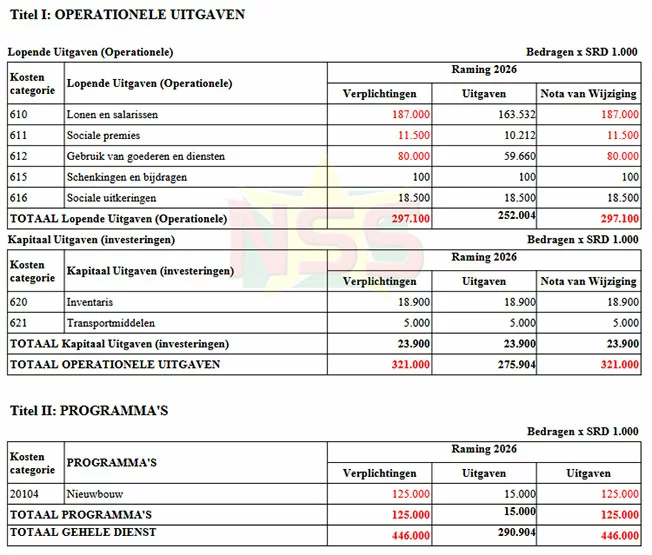
    Suriname’s National Assembly (De Nationale Assemblee, DNA) has greenlit a dramatic budget increase for its 2026 operating and capital expenditures, according to recently released amended budget documents. The legislative body’s total annual budget will jump from an initial projection of 290.9 million Surinamese dollars (SRD) to a revised 446 million SRD, representing a net increase of more than 155 million SRD, or a 53% growth from the original proposal. Budget analysts confirm the overwhelming majority of this additional funding is earmarked to advance the multi-year construction project of a new parliamentary meeting chamber, which has faced repeated delays over the past two years.

  • Woning Robijnstraat in vlammen opgegaan: bedlegerige man naar SEH afgevoerd

    Woning Robijnstraat in vlammen opgegaan: bedlegerige man naar SEH afgevoerd

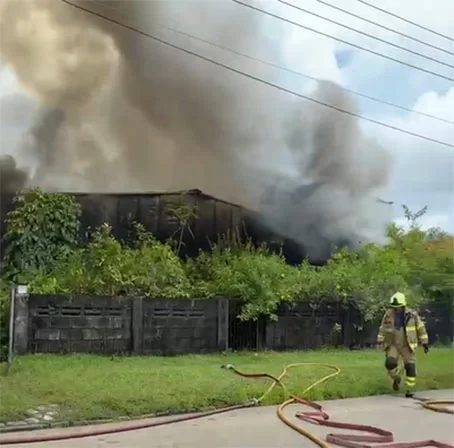
    A residential property located on Robijnstraat was completely engulfed in flames in the early hours of this morning, leaving the entire structure reduced to ruin after the intense blaze caused catastrophic damage to the building.

    Thankfully, emergency responders managed to safely evacuate a bedridden resident from the burning property before the fire spread further, according to initial information obtained from local authorities.

    The evacuated resident suffered breathing complications after inhaling thick toxic smoke produced during the fire. After receiving on-site first aid from emergency medical teams, the individual was transported via ambulance to the local emergency department for urgent and ongoing medical assessment and treatment.

    Local fire crews arrived at the scene within minutes of the emergency call being placed. Their rapid, coordinated response successfully contained the blaze, stopping it from jumping to adjacent nearby homes and preventing a far larger disaster that would have impacted more local residents. Despite the swift and determined efforts of emergency services, the original residential property was too severely damaged to be saved.

    As of the latest update, investigators have not yet confirmed the exact cause of the fire. Local police have launched a formal investigation to map out the sequence of events that led to the incident and determine what sparked the blaze.

  • Kinderen leren over de gevolgen van illegale visserij

    Kinderen leren over de gevolgen van illegale visserij

    On the occasion of the International Day Against Illegal Fishing, Suriname’s fisheries authorities have launched a unique outreach initiative that targets young learners, aiming to build early awareness of the threats of unregulated fishing and the critical need for sustainable practices to protect local marine resources. The core message of the activity is that introducing children to the harms of illegal fishing from an early age creates a foundation for long-term stewardship of Suriname’s aquatic ecosystems and the future of the national fishing sector.

    Illegal fishing, which includes fishing without valid permits, operating in restricted protected waters, and using banned gear that damages marine habitats, is a leading driver of overfishing and severe declines in wild fish populations. To keep fish stocks viable for decades to come, sustainable, rule-compliant fishing is non-negotiable. When fishermen adhere to established regulations and permit requirements, fish populations have adequate time and space to reproduce and replenish, ensuring that future generations can continue to benefit from the rich marine resources found in Suriname’s waters.

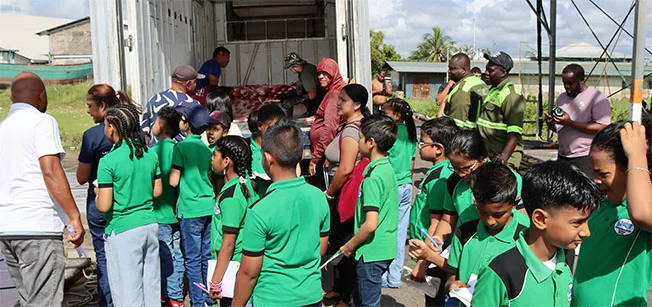
    This public education message was delivered to students from Sharroyschool by Ranjit Soekhradj, a representative from the Fisheries Directorate of Suriname’s Ministry of Agriculture, Livestock and Fisheries (LVV). On Friday, the group of schoolchildren visited the Central Fishermen’s Harbors of Suriname (Cevihas) as part of the International Day commemoration. Staff from both LVV and Cevihas collaborated closely to host the students, leading guided tours of the facility and walking young attendees through the far-reaching consequences of unregulated fishing.

    During the educational excursion, students gained hands-on insight into multiple facets of Suriname’s fishing industry. They received detailed explanations of daily operations at the fishing harbor, vessel maintenance protocols, post-catch fish processing procedures, and the significant role the sector plays in driving Suriname’s national economy. Beyond classroom-style explanations, the students got an up-close look at large commercial fishing vessels, learned how fresh catches are unloaded and stored, had the opportunity to ask industry experts pressing questions about fisheries management, and toured the local Small Scale Fisheries Center to learn about small-scale artisanal fishing operations.

    For Larissa Kodjama, a teacher at Sharroyschool, the off-site excursion was an invaluable complement to standard geography lessons taught in the classroom. After the tour, students were assigned to compile their observations and takeaways into formal written reports and class presentations. Kodjama emphasized that hands-on, practical learning helps students absorb and retain information far more effectively than learning exclusively from textbooks.

    Through this youth-focused activity, LVV and Cevihas have marked the International Day Against Illegal Fishing in a meaningful, long-term oriented way. By investing in youth awareness and education, the organizations have drawn national attention to the urgency of sustainable fishing practices and the ongoing work needed to protect and preserve Suriname’s valuable wild fish stocks for current and future communities.

  • Een verdiende herwaardering van Ramsewak Shankar

    Een verdiende herwaardering van Ramsewak Shankar

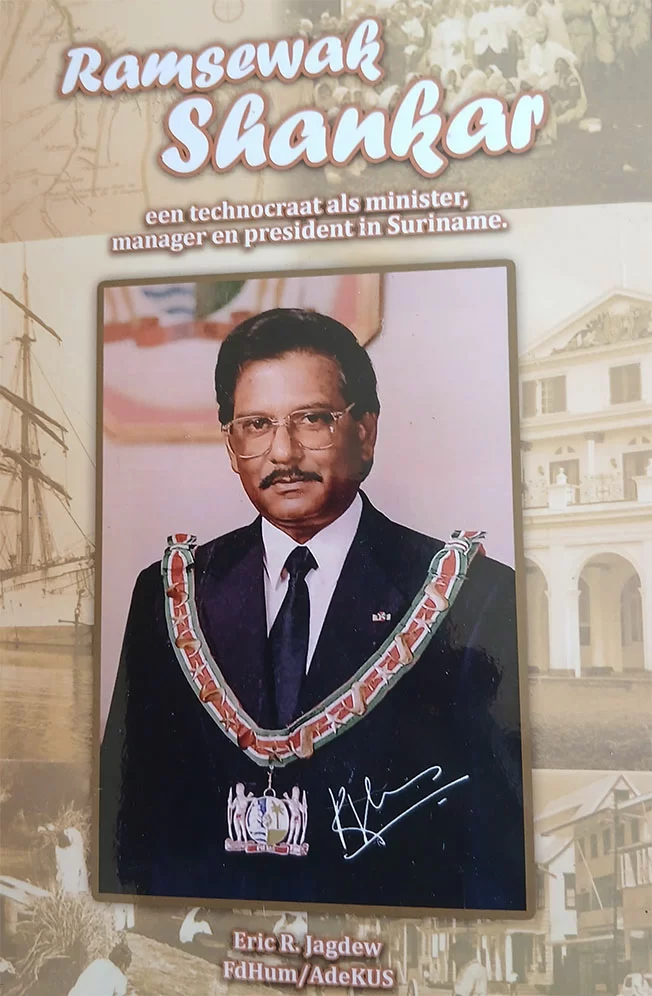
    A recently published biography of Ramsewak Shankar, Suriname’s former president, has emerged as a landmark contribution to the documentation of Suriname’s modern national history, written by historian Eric Jagdew. Titled *Ramsewak Shankar: een technocraat als minister, manager en president in Suriname* (Ramsewak Shankar: A Technocrat as Minister, Manager and President in Suriname) and carrying the International Standard Book Number 978-99914-2-032-5, the work does far more than chronicle the public and private life of one of Suriname’s most underrecognized leaders. It also contextualizes Shankar’s policy decisions and leadership within the tangled political and social upheaval that defined 1980s and early 1990s Suriname.

    Reviewer Asha Remesan notes that Jagdew has crafted a nuanced, balanced portrait of a leader widely remembered for his unwavering integrity, humble demeanor, and deep sense of public duty. What makes this biography particularly vital, Remesan argues, is its focus on a historical period and a head of state that have long received insufficient acknowledgment in official and popular Surinamese national history. Shankar assumed office at an exceptionally fragile moment for Suriname’s young democracy, stepping in to steer a nation still recovering from years of crippling political instability. Unlike many leaders motivated by personal ambition or the pursuit of public fame, Shankar’s tenure was rooted in a profound sense of accountability to the Surinamese people and the future of his country.

    Jagdew avoids the common biographical pitfall of framing his subject as an infallible icon. Instead, he presents Shankar as a fallible, ordinary person forced to make high-stakes choices under extraordinarily difficult circumstances – a choice that only adds to the book’s credibility, according to the review. Drawing on years of extensive original research, the text offers readers rare, valuable insight into the root causes and context of many defining events in modern Surinamese history.

    Perhaps the biography’s greatest strength, Remesan observes, is its depiction of Shankar’s enduring humility despite holding the nation’s highest office. In an era where political leaders are often judged on their public image and self-promotion, Shankar’s life story serves as a timely reminder that solid governance, integrity, and selfless public service remain irreplaceable leadership qualities.

    This publication deserves a wide readership, Remesan concludes. It stands both as a fitting tribute to Ramsewak Shankar’s legacy and a testament to Eric Jagdew’s meticulous work to preserve a critical, long-overlooked chapter of Suriname’s national history. Ultimately, it is a valuable and much-needed volume that advances a more balanced, fair assessment of both Shankar the man and his enduring impact on Suriname.

  • Nieuw Directoraat Burgerzaken krijgt begroting van ruim SRD 361 miljoen

    Nieuw Directoraat Burgerzaken krijgt begroting van ruim SRD 361 miljoen

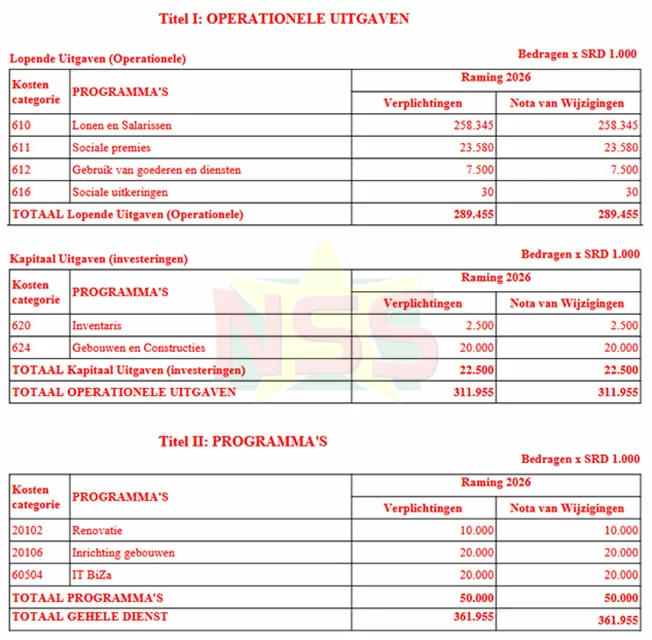
    In a structural administrative overhaul aimed at streamlining public services, Suriname’s Ministry of Internal Affairs has granted the Central Bureau for Civil Affairs (CBB) greater operational autonomy by establishing a standalone Directorate for Civil Affairs. A total allocation of more than 361 million Surinamese dollars (SRD) has been earmarked for the newly formed body in the amended 2026 draft national budget, according to official budget documents.

    Under the restructuring, the new directorate will take over all civil affairs functions that previously fell under the broader Ministry of Internal Affairs directorate. Government officials have emphasized that the reform will not expand the size of the country’s civil service, framing the change as a budget-neutral administrative reorganization. All existing staff and resources currently assigned to the CBB will simply be transferred administratively to the new independent directorate, with no new hires planned as part of this restructuring.

    A breakdown of the budget allocation reveals that the largest share, SRD 258.3 million, is dedicated to employee wages and salaries, while an additional SRD 23.6 million is reserved for social security contributions. Officials confirm these line items exclusively cover personnel already employed by the CBB, with all salary costs drawn entirely from existing budget lines previously assigned to the Ministry of Internal Affairs. A further SRD 7.5 million has been budgeted for goods and services to support daily operations across the CBB headquarters and its regional branch offices, covering recurring expenses including office supplies, printed materials, communication infrastructure, fuel for official vehicles, facility maintenance, and building rent for civil affairs service locations.

    Another SRD 30 million is allocated for social benefits, specifically earmarked for medical care for former CBB executive members and their family members. Of this allocation, SRD 20 million will cover inpatient and nursing care costs, while the remaining SRD 10 million will fund outpatient polyclinic services.

    A core priority of the new directorate’s 2026 budget is advancing long-delayed modernization of civil affairs services. An SRD 2.5 million allocation for equipment will enable the purchase of 210 desktop computers and 65 network printers for the CBB and its branches. This investment is designed to drive the digitization and automation of civil records that are still managed manually, with the end goal of rolling out a fully integrated digital civil registration system. The reform also expands the implementation of the “One Window Service” model, which allows residents to complete multiple civil affairs transactions through a single service point to reduce wait times and improve accessibility.

    Budget documentation notes that multiple modernization projects have faced delays in recent years, as previously approved initiatives failed to receive timely funding disbursement. The new dedicated budget aims to address this bottleneck and move long-planned upgrades forward.

    In addition to digital upgrades, SRD 20 million has been allocated for capital works and infrastructure projects, with a key focus on advancing plans for a new CBB headquarters. Officials are currently re-evaluating original construction plans that were first approved between 2008 and 2010, and a full assessment of that earlier proposed project is one of the leading options currently under consideration for the new headquarters development.