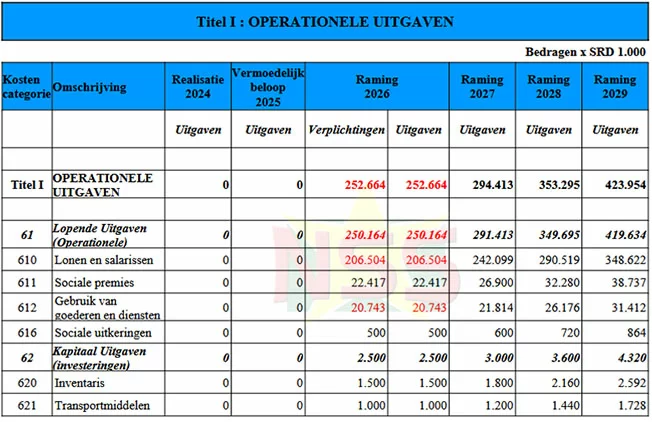
On June 8, newly released 2026 budget documents submitted to the Surinamese Council of State via a government amendment reveal that the Public Prosecution Service (Openbaar Ministerie, OM) will receive a total annual budget of more than 256.7 million Surinamese dollars (SRD) for the 2026 fiscal year. Of this total allocation, nearly 89% is earmarked for personnel-related expenditures, leaving only a small fraction of funding for core operational activities, infrastructure investment and organizational professionalization.
Breaking down the personnel budget line, 206.9 million SRD goes directly to employee wages and salaries, with an additional 22.4 million SRD allocated to cover social security contributions. Combined, these two cost centers add up to more than 229.3 million SRD, accounting for the vast majority of the OM’s total 2026 budget. Within the salary allocation, fixed base salaries make up the largest single line item at 156.6 million SRD, with remaining funds set aside for holiday pay, overtime compensation, performance bonuses and gratuities, personal allowances, acting position allowances, representation allowances and transportation stipends. For social contributions, the OM budgets 10 million SRD for employer pension contributions and 12.4 million SRD for contributions to the State Health Fund.
The budget framework confirms that the OM is planning to expand its total workforce in 2026, noting that the agency is still in a phase of institutional growth and requires additional specialized staff to fulfill its legally mandated core duties. The expansion of personnel, however, is the primary driver behind the heavy weighting of personnel costs in the overall budget.
For goods and services that support daily operational work, the OM has allocated just 20.7 million SRD. The largest expenditures in this category include 3 million SRD for building and land rental, 1.5 million SRD for office supplies, 1.5 million SRD for electricity costs, 1 million SRD for building maintenance, and 750,000 SRD each for vehicle maintenance, international work travel, and telecommunications services. According to budget documentation, these funds are critical to supporting criminal investigations, prosecution proceedings, administrative processes, and the daily functioning of the prosecution agency.
Capital investment receives an even smaller allocation of only 2.5 million SRD total. Of this limited investment budget, 1.5 million SRD is earmarked for new equipment and inventory, including computers, office fittings and furniture, while 1 million SRD is reserved to purchase a new bus for personnel and prisoner transport. The OM notes that workforce growth and expanded operational activities make upgrades to equipment and transport capacity necessary, but the budget leaves little room for large-scale modernization.
Beyond regular operational and capital spending, the OM has set aside 1.575 million SRD for organizational development programs. The vast majority of this allocation, 1.5 million SRD, goes toward professionalizing the prosecution service, including specialized training for criminal investigation and policy development work. A 75,000 SRD awareness-raising project is also included, with additional support from UNICEF.
On the revenue side, the OM projects total 2026 income of 29.3 million SRD to offset expenditures. The largest revenue streams are 14.3 million SRD from fines and prosecution-related cost recovery, 14.25 million SRD from miscellaneous fines and transactions, and a 500,000 SRD UNICEF donation earmarked for the awareness project.
The budget structure underscores the Public Prosecution Service’s identity as a heavily labor-intensive organization. While the total budget is substantial in absolute terms, nine out of every ten SRD allocated goes to payroll and related social costs. This leaves only a relatively small share of total funding available for investment, modernization, skills training and other institutional development initiatives – even as the OM acknowledges that continued professionalization is essential to effectively address the growing complexity of modern crime and prosecution work.