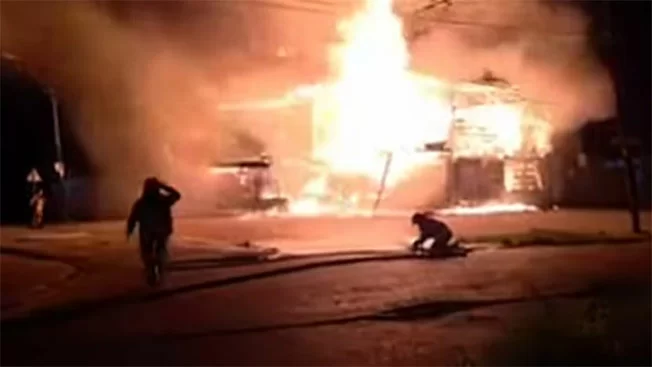
A tragic accident occurred this afternoon on Bronsweg, between the first and second bridges, resulting in the death of a scooter rider. Initial reports from the police indicate that the incident involved a collision between a van and a scooter. The impact caused the scooter to catch fire and become completely engulfed in flames. The identity of the victim remains unknown at this time. Upon receiving the report, police and a medical examiner promptly arrived at the scene. The medical examiner officially confirmed the death of the scooter rider, after which the body was taken into custody for further investigation. The incident has raised concerns about road safety in the area, with authorities expected to conduct a thorough review of the circumstances leading to the collision.
标签: Suriname
苏里南
-

Sanae Takaichi schrijft geschiedenis als eerste vrouwelijke premier van Japan
Sanae Takaichi has been elected as Japan’s first female prime minister, marking a historic milestone in the nation’s political landscape. The 63-year-old conservative hardliner secured her position through a decisive vote within the ruling Liberal Democratic Party (LDP), which holds a majority in parliament. Takaichi, a former Minister of Internal Affairs and Communications and a close ally of the late Shinzo Abe, is renowned for her staunch advocacy of national security, traditional family values, and economic revitalization through technological innovation. In her inaugural address, Takaichi emphasized a vision of ‘continuity with reform,’ pledging to bolster Japan’s defense capabilities amid escalating tensions with China and North Korea. Simultaneously, she vowed to prioritize economic issues such as purchasing power, digital transformation, and family support in a nation grappling with aging demographics and declining birth rates. Her election shatters Japan’s long-criticized male-dominated power structure, with Takaichi asserting that ‘women in leadership should not be an exception but the norm.’
-

Voormalig Franse president Sarkozy begint 5-jarige gevangenisstraf
Former French President Nicolas Sarkozy has commenced a five-year prison sentence today after being found guilty of criminal conspiracy related to the financing of his 2007 presidential campaign through funds from Libya. Sarkozy, 70, who served as France’s president from 2007 to 2012, becomes the first former head of state in modern French legal history to actually serve a prison term. Sarkozy arrived at La Santé prison in Paris, where he is expected to be held in isolation for security reasons. He maintains that his prosecution is politically motivated and denies any wrongdoing. Sarkozy has indicated his intention to appeal the verdict, but the judge has ruled that imprisonment will proceed despite the appeal. This conviction sends a clear message: even high-ranking politicians are not above the law.
-

Divali ver van huis: Licht en hoop in een vreemde stad
This Diwali, I found myself thousands of miles away from home, celebrating alone in Beijing. Despite the physical distance, the warmth of the festival and the connections with friends and colleagues from Bangladesh, India, Afghanistan, Pakistan, and Sri Lanka made the day special. Although my plans for the festival were disrupted by a busy schedule, I embraced the solitude and reflected on the lives of those who face unimaginable hardships. Sending Diwali blessings to friends like Tanzil, Vignesh, Mahdi, Danish, and Sumudu, I hoped for brighter days ahead for them. The festival fell a day earlier in Beijing due to the time difference, but the spirit of Diwali transcended borders. My colleague Marlon and I ventured out to explore the city, braving the cold autumn weather. We indulged in shopping for warm clothes and discovered affordable deals in the bustling malls. In the afternoon, we opted for a traditional Chinese massage, choosing to cycle through Beijing’s streets. The city, once known as the ‘bicycle capital of the world,’ has seen a resurgence in cycling culture, driven by sustainability and efforts to reduce pollution. Despite the chaotic traffic, we navigated the streets with ease, using shared bikes unlocked via a mobile app. A mishap with my phone mid-ride reminded me of its indispensability in daily life here. After the massage, we cycled back through the chilly evening, marveling at the city’s vibrant lights. As the thousands of lights of Beijing continued to shine, I realized that light and hope are universal, even when far from home.
-

Parmessar: Suriname bewijst dat humanitaire waarden in de praktijk kunnen bestaan
At the 151st General Assembly of the Inter-Parliamentary Union (IPU) in Geneva, Rabin Parmessar, an Assembly member and leader of the NDP faction, highlighted Suriname as a nation that not only advocates for humanitarian values but actively embodies them. Parmessar emphasized the unique social harmony in Suriname, where diverse religions and ethnic groups have coexisted peacefully for decades. He described the country as ‘a United Nations in miniature,’ underscoring its strength in diversity, inclusion, and human dignity.
Parmessar pointed to the coexistence of a mosque and synagogue in Paramaribo and the pivotal role of the Interreligious Council in maintaining societal stability as tangible examples of this harmony. He also marked two significant milestones: the 50th anniversary of Suriname’s independence on November 25, 2025, and the election of Jennifer Simons, the nation’s first female president, as a symbol of progress in equality and inclusive leadership.
Looking ahead, Parmessar outlined Suriname’s economic transformation, particularly its planned offshore oil production starting in 2028. He stressed the importance of transparency, local involvement, and maintaining the country’s carbon-negative status. Protecting the rainforest, he argued, is not an economic advantage but a global responsibility.
Parmessar called on parliaments worldwide to ensure humanitarian principles are reflected in governance, legislation, and crisis response. He urged lawmakers to uphold the rule of law, social protection, and impartial emergency aid, stating, ‘Parliamentarians are not just legislators but leaders with moral responsibility. No voice should go unheard, and no one should be left behind.’
-

Bewolking, zon en lokale buien
The day began with warm and humid conditions across much of Suriname, particularly in coastal regions such as Paramaribo, Wanica, and Commewijne. Early morning temperatures hovered around 24 degrees Celsius, accompanied by light cloud cover and a stifling atmosphere due to high humidity and weak winds. As the morning progressed, cumulus clouds began to form, and by midday, temperatures rose to 32-33 degrees Celsius, with inland areas like Brokopondo and Sipaliwini feeling even warmer. Despite regular sunshine, the oppressive air persisted. In the afternoon, the likelihood of rain and thunderstorms increased, particularly in Para, Saramacca, Marowijne, and later Nickerie. These showers, though brief, could be intense, potentially bringing wind gusts and temporary flooding in low-lying areas. Coastal regions may clear up by early evening. The night into Wednesday remained warm and muggy, with temperatures around 23 degrees Celsius and light easterly winds.
-

Kinderen in Gaza keren terug ‘naar school’ te midden van ruïne en trauma
After more than two years of suspended education in Gaza due to war and destruction, thousands of children have begun returning to classrooms—or what remains of them. According to the United Nations Relief and Works Agency (UNRWA), approximately 300,000 students and 8,000 teaching teams are resuming education. However, the situation remains precarious, with over 85% of school buildings reportedly damaged or destroyed. Many children are returning to makeshift learning spaces, such as tents, remote shelters, or emergency government facilities, transforming the traditional classroom setting into improvised environments. For many, this return marks the beginning of recovery—restoring routine, hope, and a sense of childhood that was stripped away. Yet, the scars of war persist, with widespread trauma, hunger, malnutrition, and the loss of parents or educators. The resumption of schooling is seen as an act of resilience and a critical step toward rebuilding. Education is not merely about lessons; it represents safety, normalcy, and the promise of a future.
-

Column: Etnische zuivering is geen vraag; het is taal van oorlog
On Monday, Suriname celebrated Diwali, a festival symbolizing light, harmony, and spiritual purity. The nation prides itself on being a “mini United Nations,” yet ethnic tensions persist, particularly in politics. Suriname’s strength lies in its diversity, where no single group dominates another. However, during a recent government press conference, President Jennifer Simons faced a contentious question: whether the removal of individuals from key positions appointed by the previous administration amounted to “ethnic cleansing.” The president responded sharply, emphasizing that such terminology is inappropriate in a democracy, especially in a nation nearing 50 years of independence and celebrated for its ethnic coexistence. She clarified that Suriname’s governance is built on reality, not ethnic chess games. Her pointed question to the journalist—”Did you understand my answer?”—highlighted the need for responsible language in public discourse. A free press is essential, but critical questions must not devolve into misleading narratives. No political party in Suriname represents a single ethnic group. The country is a mosaic of minorities, and suggesting otherwise undermines its foundation. The real issue is not “Whose people are these?” but “How do we design a system where state positions are not seen as personal property?” As Suriname approaches its 50th anniversary of independence, it must move beyond ethnic politics. Those who stoke ethnic tensions in a nation built on peace are playing with fire.
-

STVS-directeur Abisoina ontkracht miskenning Frits Pengel
Raoul Abisoina, the director of the Surinamese Television Foundation (STVS), has responded to claims that Frits Pengel, the founder of STVS, was not invited to the 60th anniversary celebration of television in Suriname. Abisoina expressed surprise at the allegations, emphasizing that the organization deliberately chose not to hold a festive event due to current challenges. ‘From the beginning, it was clear that we would keep it modest. There was no celebration at all. That’s why I didn’t invite any former directors or retirees, including Mr. Pengel,’ Abisoina told Starnieuws.
Abisoina clarified that all retirees, including Pengel, were financially acknowledged. ‘An amount was deposited into his account in recognition of 60 years of STVS. He was personally informed by the secretariat that there would be no celebration.’ The director also highlighted that he had increased Pengel’s pension twice out of respect since taking office. ‘The son who wrote this article knows this personally. I met him along with his father. That contact has paused in recent months for other reasons—out of decency, I’ll leave it at that for now.’
Abisoina noted that during the previous major celebration—the 55th anniversary—Pengel was officially invited and honored with a Grantangi Award. ‘At that time, there was a festive celebration, and it was appropriate. Now, that’s not the case.’ He concluded, ‘I find it misplaced that my name is being dragged into a false narrative. Anyone who knows the full story understands that this is not about disrespect but a deliberate choice for modesty.’
-

Tsang: Strijd tegen corruptie is ook een strijd van licht tegen duisternis
During the Divali celebration at the Kwatta Sports Complex, Minister Stephen Tsang of Public Works & Spatial Planning delivered a powerful message on behalf of President Jennifer Simons, emphasizing the government’s unwavering resolve to eradicate the ‘darkness of corruption and fraud.’ Drawing parallels between the festival’s symbolism of light overcoming darkness and the administration’s fight for justice and transparency, Tsang declared, ‘We will dispel this darkness with the bright light of accountability.’
The event, marked by vibrant festivities, included two Divali processions along the Kwattaweg, culminating at the sports complex. Attendees were treated to spectacular fireworks, live music, and a vegetarian feast, creating a festive atmosphere. Tsang underscored the broader significance of Divali, stating that its light could illuminate not only homes but also national governance, provided there is collective political and societal will.
Addressing the deep-rooted issue of corruption, Tsang acknowledged the government’s relentless efforts to revitalize the economy, public services, and state institutions. However, he stressed that success hinges on the active participation of every Surinamese citizen, calling for responsibility and love for the country. He also issued a cautionary note on the fragility of national unity, warning against the rising polarization in the multi-ethnic, multicultural, and multi-religious society.
Concluding his speech, Tsang invoked a quote from former minister Soewarto Moestadja: ‘It is time to move from unity in diversity to diversity in unity,’ urging a collective commitment to harmony and progress.