标签: Suriname

苏里南

  • Oprichter en leadzanger van The Merrymen overleden

    Oprichter en leadzanger van The Merrymen overleden

    Barbadian music icon Sir Charles Emile Straker, the founder and creative core of internationally celebrated Caribbean band The Merrymen, passed away on Friday, June 19, 2026, at his beloved Caribbean home island at the age of 90. Knighted for his contributions to culture in 2019, Straker leaves behind a decades-long legacy that reshaped global perceptions of Caribbean music, even amid longstanding industry controversy over his work.

    Straker launched his professional music career in 1961 in Canada. Just one year later, he returned to his native Barbados and co-founded The Merrymen alongside Robin Hunte, who played tenor guitar and electric mandolin, Stephen Fields on guitar and vocals, and Chris Gibbs on bass and vocals. Straker himself took on guitar and steelpan duties, serving as the band’s lead vocalist with his iconic golden voice and signature whistling, while also emerging as a prolific songwriter for the group. Shortly after the band’s founding, drummer Robert Foster joined to complete the original lineup. Today, only Stephen Fields survives from the 1962 founding roster, and he currently lives with dementia.

    As part of a generation of Caribbean artists bringing regional genres like calypso and soca to global audiences, The Merrymen faced sharp criticism from Black Caribbean musicians, who framed the group’s take on these Afro-Caribbean styles as too “white,” dismissing the band as so-called “wannabe calypsonians.”

    The most prominent critic was legendary Trinidadian calypsonian The Mighty Sparrow, who publicly condemned the global success The Merrymen found with their lighter, more accessible style of “white calypso” at a time when he and other Black calypsonians struggled to break through to international audiences. In 1967, Sparrow released his album *Spicy Sparrow*, which included a satirical track mocking The Merrymen’s take on calypso. Originally titled *Bajan Dolphus* (a reference to the demonym for Barbadians, which also describes the island’s local culture and language), the track was renamed *Sing Dolphus Sing* for its official release, with lyrics mocking the band’s popularity and credibility in the calypso space.

    Despite this controversy, The Merrymen racked up one international hit after another through the 1960s and 1970s, particularly in the United States. The band also earned a particularly devoted fanbase in Suriname, where generations of older listeners grew up hearing their tracks played repeatedly on national radio. Beloved hits that still remain cultural touchstones across the Caribbean and global diaspora include *Ring Ting Ting*, *Big Bamboo*, *Sugar Bum Bum*, *Archie*, and the fan-favorite melancholic standard *Yellow Bird*. The band developed a distinct sound they dubbed “Caribeat,” and toured across more than 100 countries, turning Barbados into a household name for music fans around the world.

    In a statement shared by the *Jamaica Observer* following Straker’s death, Barbadian Prime Minister Mia Mottley paid tribute to the legendary musician’s far-reaching impact. “He helped put Barbados on the map far beyond our shores,” Mottley said. “Long before hashtags, marketing campaigns, and global social platforms, Sir Emile and The Merrymen brought our island to the world: on hotel stages, in concert halls, on records that tourists carried home with them, and in the hearts of people who kept returning to Barbados because his music made them feel they already belonged here.”

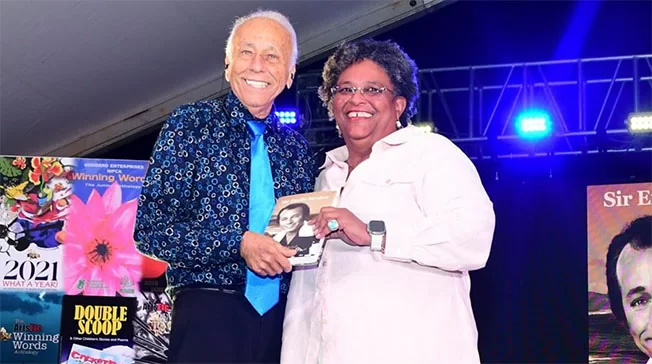
    Late in his career, in November 2023, Straker released his autobiography *My Island and Me*, edited by John Roett. The project was supported by the Barbados National Cultural Foundation and Prime Minister Mottley’s office, with Straker handing over the first published copy of the memoir to Mottley shortly after its completion.
  • Benoeming Steve Meye leidt tot debat over Surinames positie over Palestina

    Benoeming Steve Meye leidt tot debat over Surinames positie over Palestina

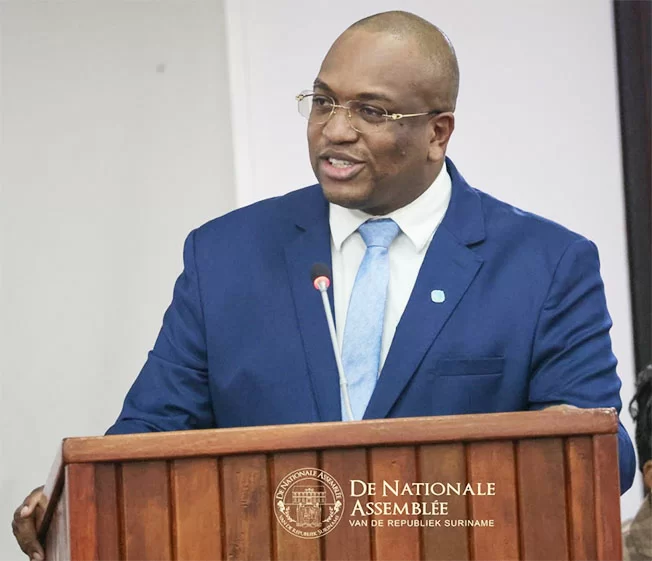
    A heated and extensive debate has erupted in Suriname’s National Assembly over the recent appointment of Steve Meye as Suriname’s non-resident ambassador to Israel, with opposition lawmakers raising pressing questions over how the decision aligns with the South American nation’s longstanding support for Palestinian statehood amid growing international concern over the humanitarian crisis in Gaza.

    The discussion, held during Monday’s budget deliberations, drew scrutiny from lawmakers across three major opposition parties: the National Democratic Party (NDP), the National Party of Suriname (NPS) and Pertjajah Luhur (PL), all of whom demanded clarity from the government on the timing and implications of the appointment.

    NDP lawmaker Ann Sadi argued that the nomination comes at an extraordinarily sensitive moment, as violent tensions continue to escalate across the Middle East. She noted that the issue resonates deeply across Suriname’s diverse society, questioning why the government chose to push forward with the appointment at this specific juncture. Sadi also pressed the administration to explain how the decision fits within Suriname’s established foreign policy framework, against a backdrop of mounting global alarm over civilian casualties in Gaza.

    Jerrel Pawiroredjo, leader of the NPS parliamentary caucus, echoed those concerns, pointing to ongoing human rights disputes in the region. He emphasized that as a multicultural nation, Suriname has a responsibility to approach global issues tied to equality, justice and human rights with extreme care, avoiding any actions that could send mixed signals about the country’s core principles.

    Bronto Somohardjo, PL’s caucus leader, reminded the chamber that Suriname officially recognized Palestine as an independent sovereign state back in 2011. He called on Foreign Affairs Minister Melvin Bouva — who heads the ministry also responsible for international business and international cooperation — to explicitly confirm that appointing an ambassador to Israel does not represent a softening of that longheld principled position. “Maintaining diplomatic relations is one matter, but Suriname must never give the impression that it will stay silent when civilian lives are lost, or when serious allegations of violations of international law are made,” Somohardjo stated.

    Not all lawmakers voiced opposition, however. NDP legislator Ebu Jones offered a more nuanced perspective, noting that multiple member states of the Caribbean Community (Caricom) already maintain formal diplomatic ties with Israel while simultaneously supporting United Nations resolutions calling for a ceasefire in Gaza and affirming Palestine’s right to sovereign statehood. Jones argued that appointing a non-resident ambassador does not need to conflict with Suriname’s existing commitments. “It is precisely through diplomatic relations that we can clearly communicate our positions on human rights and the international legal order,” Jones explained.

    In his response to parliament, Minister Bouva sought to ease all lingering concerns, stressing repeatedly that Meye’s appointment does not signal any shift in Suriname’s core foreign policy positions. Bouva clarified that Suriname has maintained diplomatic relations with Israel for decades, with ongoing bilateral cooperation projects spanning key sectors including agriculture, education and healthcare. “There is an existing diplomatic relationship with Israel, and nothing has changed in that relationship,” Bouva told the chamber.

    The minister went on to reaffirm that Suriname’s stance on Palestine also remains completely unaltered. “Nothing has changed about our recognition of Palestine. Suriname has unwaveringly stood by that position since 2011, and this current administration maintains that policy,” he confirmed.

    Bouva also added context about the non-resident nature of the ambassadorial post, noting that Suriname has increasingly relied on this model of diplomatic representation to manage international partnerships without incurring the high costs of maintaining a permanent full-time diplomatic mission in every country.

    By the end of the debate, Bouva’s core message was clear: Meye’s appointment fits squarely within Suriname’s existing diplomatic framework, and does not mark any change of course in the nation’s longstanding approach to the Israeli-Palestinian conflict.

  • Pakistan: Landelijk alarm wegens dreiging zware regenval en overstromingen

    Pakistan: Landelijk alarm wegens dreiging zware regenval en overstromingen

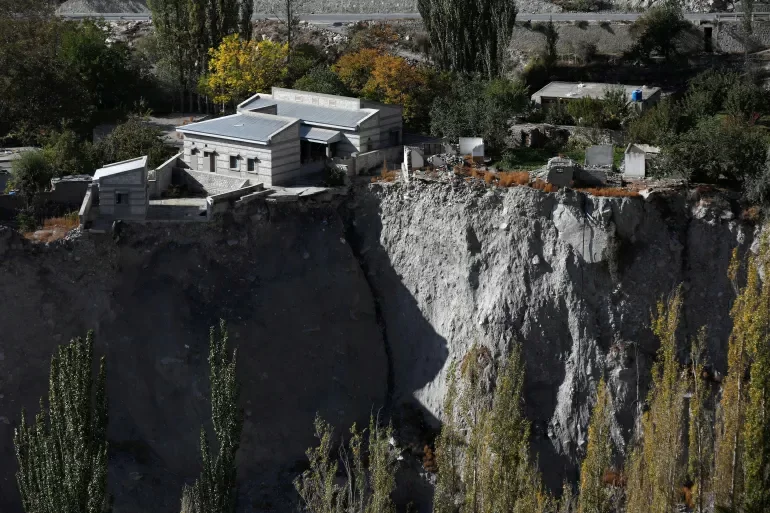
    Pakistan is bracing for what could become its fourth straight year of extreme monsoon rainfall, a pattern that has raised catastrophic flood risks across large swathes of the South Asian nation. On Sunday, the country’s National Disaster Management Authority (NDMA) issued a nationwide alert warning of approaching thunderstorms, intense downpours, urban flooding, and an elevated threat of Glacial Lake Outburst Floods (GLOFs) in Pakistan’s northern high-altitude regions.

    High-risk areas have been identified as the mountainous Hunza and Skardu districts of Gilgit-Baltistan, as well as much of the Khyber Pakhtunkhwa province. Even the capital Islamabad and its neighboring major city Rawalpindi, alongside other major urban centers, have been placed on high preparedness alert. Local and provincial government agencies have been ordered to clear all drainage networks in advance to minimize waterlogging and flood-related damage.

    The urgent alert comes as climate scientists and disaster officials widely forecast that this year’s monsoon season, set to begin later in June, will bring another round of extreme precipitation. For nearly a decade, Pakistan has faced increasingly destructive annual rainfall and flood events that have claimed thousands of lives and displaced millions of residents across the country.

    The escalating crisis is deeply tied to the accelerating global climate emergency, a burden Pakistan bears disproportionately despite its minimal contribution to global greenhouse gas emissions. Responsible for less than 1% of the world’s total historical carbon dioxide emissions, Pakistan ranks among the top five countries most severely impacted by human-caused climate change. The 2022 floods stand as a stark reminder of this vulnerability: that year, extreme rainfall and accelerated glacial melt inundated nearly one-third of the country, killing more than 1,700 people and displacing over 30 million residents.

    This year, record-breaking heat has amplified glacial melt risk in the north. Temperatures in the Gilgit-Baltistan region hit an unprecedented 48.5 degrees Celsius in 2026, speeding up the melt of ancient glaciers and fueling the rapid formation of thousands of new glacial lakes. When these lakes breach their natural debris dams, they trigger GLOFs – catastrophic flash floods that can destroy entire remote mountain villages in just a few hours.

    Pakistan is home to roughly 13,000 glaciers, more than any other country outside the polar regions. United Nations data identifies more than 3,000 of these newly formed glacial lakes as potential flood hazards, with 33 classified as extremely high-risk. An estimated 7.1 million Pakistanis live within danger zones near these unstable glacial formations.

    Despite growing risks, the country’s ability to respond to the threat remains severely constrained. In 2017, Pakistan launched a GLOF risk reduction project with support from the United Nations Development Programme, but current early warning systems only cover a small fraction of high-risk areas. Some of the most vulnerable districts, including Ghizer, Diamer, and parts of Hunza, have no functional early warning infrastructure at all.

    The 2022 disaster also exposed deep gaps in long-term recovery and resilience funding. At an international donor conference held in Geneva in 2023, donors pledged approximately $11 billion in recovery and adaptation aid for Pakistan. As of mid-2025, only around $4.5 billion of that pledged funding has actually been disbursed to the country.

    Climate and disaster experts warn that persistent gaps in funding, limited access to adaptation technology, and slow progress on building local response capacity leave Pakistan acutely vulnerable to escalating climate disasters. Compounding these challenges, fragmented institutional oversight and poor inter-agency coordination further undermine the country’s ability to prepare for and respond to catastrophic flood events. As the 2026 monsoon approaches, communities across Pakistan stand waiting for a storm that has become an all-too-frequent annual threat.

  • Derde helft WK 2026: Algerije toont veerkracht en zet achterstand om in winst tegen Jordanië

    Derde helft WK 2026: Algerije toont veerkracht en zet achterstand om in winst tegen Jordanië

    In a thrilling Group J clash at the 2026 FIFA World Cup hosted at Los Angeles’ SoFi Stadium, Algeria pulled off a dramatic second-half comeback to secure a crucial 2-1 victory over World Cup debutants Jordan on Wednesday night. The result keeps Algeria’s knockout stage qualification hopes alive, while Jordan was left heartbroken after falling short of what would have been a historic debut win against one of Africa’s top football nations. The match unfolded as two distinct halves, with Jordan dominating the first 45 minutes before Algeria flipped the script after the break to claim all three points.

    Thousands of Jordanian fans in attendance got exactly the start they dreamed of in the opening period. Though Algeria controlled most of the possession, Jordan executed a disciplined defensive game plan and posed constant danger on rapid counterattacks. Their tactical discipline paid off in the 36th minute, when a lightning-quick transition ended with Mousa Al-Tamari finding teammate Nizar Al-Rashdan, who coolly converted his chance to put the underdog debutants up 1-0. The goal sparked wild celebrations among the Jordanian fanbase, and for the rest of the first half, a massive Group C upset looked increasingly likely. Just before halftime, Algerian midfielder Ramiz Zerrouki picked up a yellow card, a tangible marker of the growing frustration building for the North African side.

    Whatever Algeria’s manager said in the locker room at halftime worked. The North African side emerged a completely different team after the break, immediately upping their tempo and pinning Jordan deep inside their own half. As pressure mounted, Jordan was forced into repeated desperate fouls to break up Algerian attacks, with H. Abu Dahab picking up a yellow card for a hard challenge in the 64th minute.

    Algeria’s sustained pressure eventually produced an equalizer in the 69th minute. Captain Riyad Mahrez created the chance with clever build-up play, setting up Nabil Benbouali to slot home the leveling goal. The equalizer not only restored parity on the scoreboard, but also shifted the psychological momentum firmly in Algeria’s favor.

    As fatigue began to set in for Jordan, who had put in a relentless defensive shift in the first half, Algeria kept pushing forward for a winner. It came in the 82nd minute, when striker Amine Gouiri produced a clinical finish to put Algeria ahead for the first time in the match, making the score 2-1.

    Jordan pushed hard for a late equalizer in stoppage time to salvage a draw, but Algeria’s defense held firm to see out the result. When the final whistle blew, Algeria’s players were able to breathe a collective sigh of relief after securing the vital three points.

    The win comes at a make-or-break moment for Algeria, who suffered an opening defeat to Argentina and could ill afford another loss. With three points from two matches, Algeria’s fight for a knockout stage spot in Group J remains wide open going into the final group round. For Jordan, the result is a devastating disappointment: the debutants held a lead for nearly 50 minutes and came within 10 minutes of a stunning historic win, only to fall victim to Algeria’s second-half pressure, highlighting how fine the margins are at the world’s biggest football tournament.

    Even in defeat, Jordan can still take pride in their performance as they continue their historic first World Cup campaign. The side proved they can compete with seasoned top-tier opposition, writing a new chapter for football in their country. For Algeria, the comeback win reinforced their reputation as one of Africa’s strongest football nations. With elite talent like Mahrez, Gouiri and Benbouali, the side demonstrated the quality required to turn around matches even when facing adverse conditions.

  • Column: Rij voor Tulip een spiegel voor het land

    Column: Rij voor Tulip een spiegel voor het land

    In Suriname, there is a common saying that a single supermarket reveals more about a nation’s true condition than any formal budget debate. That saying has been put into stark relief over the past week, after dozens of job seekers lined up Saturday to apply for openings at a brand-new Tulip Supermarket branch located on Verlengde Gemenelandsweg. The overwhelming public interest in these entry-level retail positions was so pronounced that photos and videos of the long queue quickly spread virally across social media platforms, sparking a national conversation that has even reached the country’s parliament.

    On first glance, the opening of a new business and the creation of new jobs looks like unqualified good news for any economy. What made this queue newsworthy was not the vacancies themselves, but the extraordinary scale of the response: within days, the viral hiring call became a core topic of debate in Suriname’s National Assembly, with multiple cabinet ministers referencing the long line of applicants in official proceedings.

    Among those ministers was Dirk Currie, the country’s Minister of Education, Science and Culture, who called the situation “sad” after confirming that practicing, active schoolteachers were among the job seekers lining up for retail work at the supermarket. Currie’s comment struck a raw, sensitive nerve across Surinamese society, because the queue ultimately is not a story about Tulip Supermarket—it is a story about purchasing power, public sector worker appreciation, and how Suriname supports the professionals that fill its most critical social roles.

    To put the situation in context, Tulip Supermarket is offering new hires net monthly salaries that range between 19,800 Surinamese dollars (SRD) and 21,600 SRD. This is by no means an exploitative pay range; on the contrary, any private employer that offers staff a decent living wage deserves public recognition. The issue that the queue brought into sharp focus is that most active teachers in Suriname earn barely 15,000 SRD per month in their full-time public roles. The problem is not that retail workers are paid too well—it is that the educators shaping the nation’s children are paid far too little.

    This reality is not new for Suriname’s teaching workforce. Many educators have not worked exclusively as teachers for years: most hold their daytime classroom positions, then take second shifts in call centers, retail shops, or other informal sectors to top up their insufficient salaries. Many are forced to juggle multiple jobs just to cover basic household expenses for their families. This has been a quiet alarm bell for Surinamese society for far too long.

    A teacher who puts in a full day of instruction then reports to a second job for extra income cannot show up rested and prepared to lead a classroom the next morning. This is not a failure of the teacher’s commitment to their work—it is a failure of policy that leaves educators with no other viable financial option. Even so, public officials routinely repeat the empty mantra that education is the key to national development.

    During recent parliamentary budget debates, officials again highlighted the urgent need for education reform, workforce capacity building, and preparation for future economic opportunities from the country’s emerging oil and gas sector. But words alone cannot educate a generation of young people. Meaningful education reform requires motivated, supported teachers—and teachers must be able to earn a living wage from their core profession.

    A closer look at the 2026 national budget underscores the scale of the underinvestment. Suriname has allocated roughly 7.48 billion SRD to education out of a total national budget of 77.4 billion SRD. That adds up to just 9.7% of total government spending, a share far lower than most peer nations in the Caribbean region. Across neighboring Caribbean countries, public education investment accounts for between 15% and 21% of total government expenditure, meaning Suriname lags far behind regional benchmarks.

    This conversation around resource allocation does not exist in a vacuum. During the same budget debates, Minister of Home Affairs Marinus Bee noted that Suriname currently employs around 51,000 civil servants, warning that the long-standing practice of hiring new political supporters after every change in government is no longer fiscally sustainable. Bee called for an end to this patronage system and a push to restructure the public sector to be more efficient.

    Bee’s comment is directly connected to the viral queue for the Tulip Supermarket. Both debates circle back to the same core question: how should Suriname use its limited public resources? Will the country continue to allocate funding to a bloated, expanding public bureaucracy, or will it redirect more investment to the educators, healthcare workers, and other frontline professionals who lay the foundational groundwork for long-term national development?

    The long line of job seekers at the new supermarket has forced a hard, unflinching truth into public view: the issue is not that there are too few jobs in Suriname. It is that a growing share of Surinamese citizens feel that hard work alone is no longer enough to make a decent living. That may be the most important lesson to emerge from this hiring round. A nation that pins its economic hopes on future oil revenue, but watches its most critical public workers leave for higher-paying entry-level retail and call center jobs, must stop and ask itself: where does a nation’s true wealth really lie?

  • Veerverbinding Albina-St-Laurent blijft beperkt; nieuwe veerboot pas in september operationeel

    Veerverbinding Albina-St-Laurent blijft beperkt; nieuwe veerboot pas in september operationeel

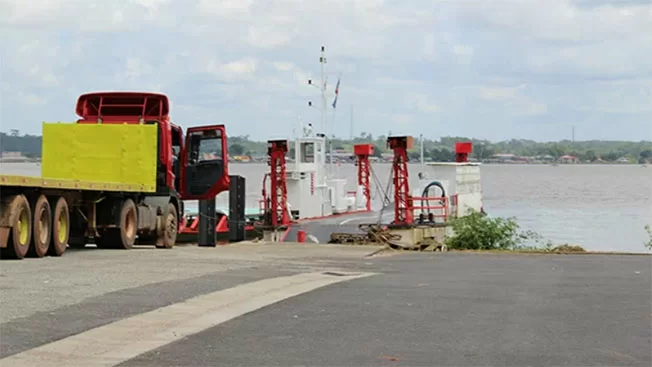
    One of the most vital cross-border connections linking Suriname and French Guiana is facing severe and prolonged service disruptions, joint authorities from both nations have confirmed in a shared update on cross-river transit across the Marowijne River. The key ferry route connecting Albina, Suriname, and Saint-Laurent-du-Maroni, French Guiana, has been grounded since June 18 after the only active ferry La Gabrielle suffered a critical hydraulic pump failure. Compounding the mechanical outage, Suriname’s port authority has declared the floating docking pier on the Albina side of the river structurally degraded to the point that it can no longer be operated safely, forcing a full suspension of all regular cross-river sailings indefinitely.

    Authorities are currently evaluating options to resume a limited version of the service before the end of the month. If the partial restart moves forward, sailings will operate on a reservation-only basis for approximately three hours per day during low tide, and only light passenger vehicles will be permitted to cross. Heavy goods and cargo transport will remain barred from the route even under the limited service model.

    In their joint statement, officials from both France and Suriname openly acknowledged that even a limited resumption would fall far short of meeting existing demand for cross-border travel and trade. To address the gap, multiple long-term and short-term alternative solutions are under active review, including emergency temporary repairs to the damaged Albina docking pier, modifications to existing mooring spots, and the temporary deployment of pontoons and smaller auxiliary vessels to handle excess traffic.

    Officials have pinned their long-term hopes for restoring full service on a second ferry, the Malani, which is currently undergoing scheduled maintenance and final technical preparations ahead of its launch. Before the vessel enters official operation, it will complete a roughly one-month-long pilot testing phase, with a full commercial launch targeted for early September 2026.

    Infrastructure upgrades for docking facilities on both the French and Surinamese sides of the Marowijne River have already been completed since February 2026. Under the current configuration, however, the Malani will only be able to operate at full capacity during high tide. Additional construction work is scheduled to wrap up by March 2027, which will allow the ferry service to operate continuously regardless of tide levels.

    The Albina-Saint-Laurent-du-Maroni ferry link serves as a core economic and social artery connecting Suriname and the French overseas department of French Guiana. Hundreds of travelers, commercial traders, and transport operators rely on the crossing daily for work, family visits, and cross-border trade. To keep stakeholders updated and advance restoration efforts, French and Surinamese authorities have agreed to hold regular coordination meetings to track the progress of infrastructure repairs and service improvements. Both sides have reaffirmed their shared commitment to significantly boosting the long-term reliability of this critical cross-border connection.

  • Derde helft WK 2026: Noorwegen overleeft Senegalese storm in zinderende WK-thriller

    Derde helft WK 2026: Noorwegen overleeft Senegalese storm in zinderende WK-thriller

    The 2026 FIFA World Cup delivered one of its most enthralling matches to date on Monday night, as Norway edged out Senegal 3-2 in a nerve-wracking, edge-of-your-seat encounter at the sold-out MetLife Stadium in East Rutherford, New Jersey. The result leaves Norway on the cusp of qualification for the knockout round, while Senegal faces an early tournament exit despite a heroic second-half fightback that had fans on their feet for the full 90 minutes.

    Both sides came out of the gates with relentless intensity, determined to claim three critical points in Group D. Norway’s attack revolved around the creative magic of playmaker Martin Ødegaard, who constantly probed for link-ups with star striker Erling Haaland, who entered the match as one of the tournament’s top performing forwards. On the Senegal side, manager’s tactics relied on the blistering pace of winger Ismaïla Sarr and the veteran leadership of forward Sadio Mané to unlock Norway’s defense. For most of the first half, both backlines held firm, repelling every attacking threat, but Norway broke the deadlock just before halftime. Right-back Marcus Holmgren Pedersen capitalized on a rare lapse in concentration from Senegal’s defensive unit to slot home the opening goal, sending Norway into the break with a 1-0 advantage.

    Less than five minutes after the restart, Norway extended their lead, delivering a seeming knockout blow to the African side. As has been the case repeatedly through this World Cup, Haaland found himself in exactly the right place at the right time. The prolific Norwegian goalscoring machine pounced on a loose ball in the box to double his side’s lead, putting Norway 2-0 up and putting the result seemingly out of reach.

    But Senegal refused to fold. Where many top international sides would have dropped their heads after conceding two early second-half goals, the African champions threw all caution to the wind and threw themselves forward in search of a comeback. Their aggression paid off quickly when Sarr found the back of the net to cut the deficit in half, injecting new life into the Senegalese side and turning the entire tide of the match. Suddenly, Norway was pinned deep in its own half as Senegal won more duels, claimed second balls consistently, and bombarded the Norwegian penalty area with wave after wave of attack.

    Just as Senegal looked set to grab an equalizer, Norway struck on the counterattack, and once again Haaland was at the center of the action. He played a key role in the build-up to Norway’s third goal, restoring the Scandinavian side’s two-goal advantage and appearing to seal all three points. But even then, the drama was far from over. Senegal rallied once again, scoring a second to bring the deficit back to one goal, and threw every outfield player forward in stoppage time for a last-ditch push for an equalizer. Norway survived multiple scares in the final minutes, holding on to claim the full three points when the final whistle blew.

    With this victory, Norway sits on six points from two group stage matches, level with France, who defeated Iraq 3-0 earlier on Monday. The two group leaders will face off in their final group match, a clash that will almost certainly decide who claims the group’s top spot heading into the round of 16. For Senegal, the path to qualification is now all but closed: after back-to-back defeats to France and Norway, the side remains stuck on zero points with just one match remaining. Despite the disappointing result, the fighting spirit the side displayed on Monday night proved why the country remains one of the most respected football powerhouses on the African continent.

    For Norway, this 2026 World Cup marks a long-awaited return to the game’s biggest stage, with the nation qualifying for the first time since 1998. Led by a golden generation of talent including Haaland, Ødegaard, and Alexander Sørloth, the Scandinavian nation is openly dreaming of a deep, historic run in the tournament. For neutral fans, Monday’s clash will go down as one of the most memorable group stage matches in recent World Cup history, a game that blended end-to-end attacking football, nonstop tension, raw emotion, and relentless fight from both sides. Even for Norway, the match made clear that every step of a World Cup run requires a full battle, even against an opponent that enters the knockout round with its back against the wall.

  • Derde helft WK 2026: Frankrijk boekt overtuigende 3-0 zege op Irak, plek in knock-outfase

    Derde helft WK 2026: Frankrijk boekt overtuigende 3-0 zege op Irak, plek in knock-outfase

    The 2026 FIFA World Cup Group I qualifying campaign delivered a dramatic, rain-soaked fixture at Philadelphia Stadium on June 22, where France secured a dominant 3-0 victory over Iraq that strengthens their push for a top-two group finish and leaves Iraq on the brink of elimination. The night was defined by two key storylines: Kylian Mbappé’s continued chase of the all-time World Cup scoring record, and a nearly two-and-a-half hour weather delay that tested the patience of players and fans alike.

    From the opening whistle, Les Bleus seized total control of the tempo. Just two minutes into the match, a sharp through ball from Manu Kone put Mbappé in a dangerous position, with only a last-ditch defensive intervention denying France an early opener. The French attacking trio of Mbappé, Jules Koundé and Michael Olise carved through Iraq’s backline with quick, fluid combinations, putting the Asian side under constant pressure. In the sixth minute, Iraq defender Amir Al Ammari picked up an early yellow card for a hard tackle on Mbappé, a clear sign of how difficult the French star was to contain.

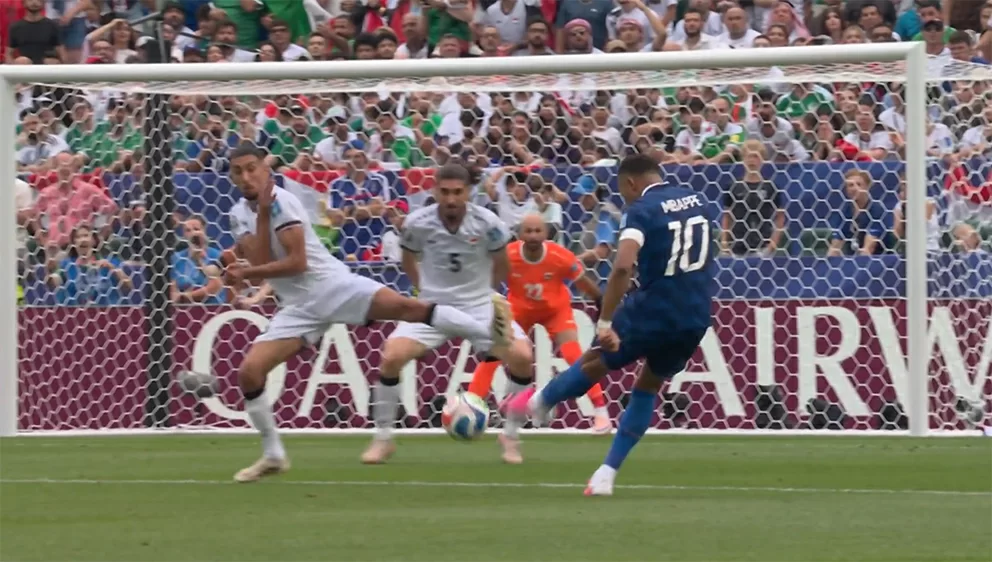
    That pressure eventually paid off in the 14th minute, when Mbappé turned past a defender on the edge of the penalty area and struck a stunning volley into the far corner of the net. The goal marked Mbappé’s 15th World Cup goal, moving him one step closer to breaking Lionel Messi’s all-time record of 13 World Cup knockout stage goals and the overall tournament scoring record held by Miroslav Klose.

    France continued to dominate possession after the opening goal, but Iraq refused to drop completely deep and managed a handful of threatening counter-attacks. However, the match was brought to an abrupt halt in the 37th minute, when a severe thunderstorm rolled over the stadium. With lightning striking in close proximity, the referee suspended play to protect players and fans, prompting spectators to either don rain ponchos or evacuate the stands for shelter. For nearly two and a half hours, the fixture was paused while storm crews cleared standing water from the pitch and waited for the dangerous weather to pass.

    When the all-clear was finally given, fans filed back into their seats, and the damp crowd quickly shifted from anxiety to celebration. Play resumed with France picking up exactly where they left off, maintaining their high intensity against a tiring Iraqi side. In the 56th minute, Mbappé capitalized on a catastrophic error from Iraqi goalkeeper Ahmed Basil, who misread a rushed backpass from Ahmed Qasem. Ousmane Dembélé played a clever square pass to the French captain, who tapped the ball into an empty net for his second of the night, putting France up 2-0.

    Les Bleus kept pushing for more, and in the 67th minute, Olise — who had already hit the crossbar with a curling effort earlier in the half — produced a clever assist to set up Dembélé for his first ever World Cup goal, stretching the lead to 3-0. The soaked crowd celebrated wildly, dancing in their rain ponchos as the French attack continued to create chances.

    Even with a three-goal deficit, Iraq fought hard until the final whistle, and came close to grabbing a consolation goal through forward Ali Al Hamadi, but could not find a way past French goalkeeper. In stoppage time, a visibly disappointed Mbappé — who had missed two late chances to complete a hat-trick — was substituted off for Marcus Thuram, ending his night two goals closer to history.

    The result leaves France on the cusp of qualifying for the Round of 32, while Iraq’s tournament hopes hang by a thread. The battle for the top two spots in Group I remains tightly contested, with Norway and Senegal still in the hunt for qualifying places alongside France.

  • Curaçao biedt Suriname expertise aan voor ontwikkeling olie- en gassector

    Curaçao biedt Suriname expertise aan voor ontwikkeling olie- en gassector

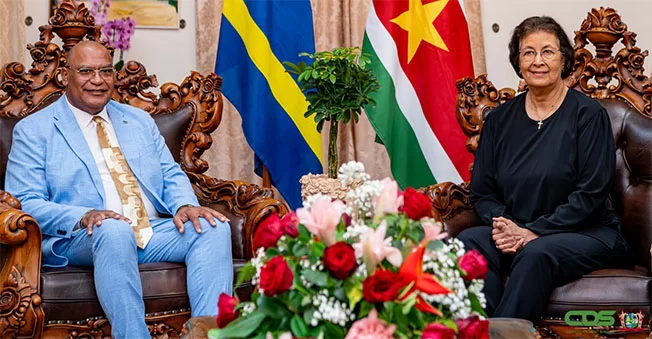
    On the sidelines of the 2026 Suriname Energy, Oil & Gas Summit (SEOGS), a high-level meeting between top officials from Curaçao and Suriname has laid the groundwork for deepened cross-border cooperation across energy, economic, and knowledge-sharing sectors. The meeting, held at the Presidential Palace in Paramaribo, brought together Curaçao’s Second Deputy Prime Minister Charles Cooper and Suriname’s President Jennifer Simons, as confirmed by Suriname’s Communication Service.

    Suriname is currently preparing to unlock its untapped offshore oil and gas reserves, a development that is set to reshape the small South American nation’s economic trajectory. To support this transition, Curaçao has offered to share its decades of accumulated expertise in the global oil industry, a sector that has formed the backbone of Curaçao’s economy for generations.

    President Simons opened the discussions by reaffirming a long-held joint commitment to strengthening bilateral economic ties, first laid out in earlier talks between the two governments. She highlighted that the two neighboring Caribbean nations share multiple untapped opportunities for collaboration beyond energy, spanning tourism, transport, and regional integration. Of particular importance, Simons emphasized, is advancing improved regional connectivity, especially through enhanced maritime shipping links. She also underlined that coordinated action on regulatory framework development, maritime security, environmental protection, and workforce capacity building will be critical as Suriname scales its emerging oil and gas sector.

    For his part, Cooper made clear that Curaçao’s decades of specialized experience in oil product processing, storage, and logistics positions the island nation as an ideal strategic partner for Suriname at this pivotal moment. “We share a common history and belong to the same region,” Cooper noted during the meeting. “It is essential that we move forward together.”

    Cooper added that the two sides have agreed to move forward with the formation of joint technical working groups, tasked with fleshing out the details of potential collaborative projects. These groups will allow Curaçao to provide targeted support in areas where it has built decades of institutional and industry expertise.

    Beyond economic and energy cooperation, the meeting also centered on the deep historical and social ties that bind the two nations. Cooper pointed out that Surinamese communities make a significant, lasting contribution to Curaçao’s society, noting that these shared cultural and historical bonds create a solid foundation for expanding bilateral cooperation moving forward.

    Both officials concluded the meeting by expressing shared optimism that bilateral contacts will continue to intensify in the coming months, aligned with the fast pace of growing economic development across the Caribbean and South American region. The planned partnership comes as global energy markets increasingly turn to new offshore production hubs, putting Suriname’s emerging sector in the regional spotlight.

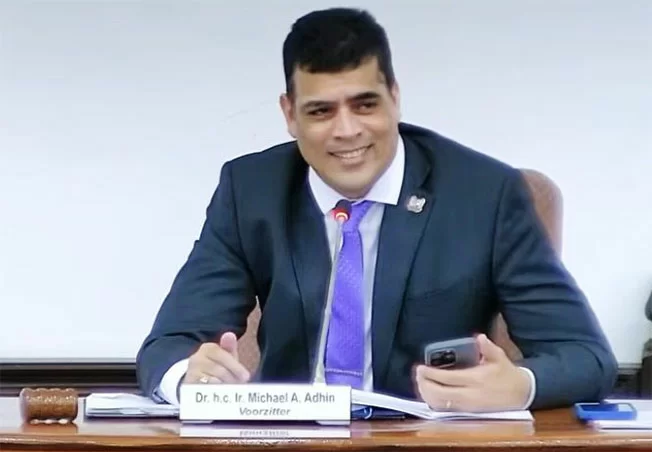
  • Adhin: Begrotingsvergadering volledig rechtsgeldig verlopen ondanks VHP-bezwaar

    Adhin: Begrotingsvergadering volledig rechtsgeldig verlopen ondanks VHP-bezwaar

    On June 22, a procedural dispute erupted in Suriname’s National Assembly over the opening of a public budget session, pitting Assembly Speaker Ashwin Adhin against the largest opposition faction VHP over the legal validity of the sitting.

    The VHP faction raised formal objections during the ongoing budget treatment proceedings, arguing that the session’s opening was procedurally invalid because Adhin had not signed the attendance register before gavelin the meeting in. The opposition claimed this omission cast legal doubt on the entire sitting’s legitimacy.

    Adhin pushed back firmly against the claims in a written statement, noting that the body’s Rules of Order provide no legal basis for the opposition’s conclusion. He cited Article 31 of the rulebook, which explicitly states that the secretary-general must hand the attendance register over to the speaker once at least 26 members — the required quorum — have signed the document. At that point, the speaker is mandated to open the meeting immediately. The speaker confirmed that this core requirement was fully met when he called the session to order.

    “The speaker opened the meeting at the exact moment the required number of members were present and had signed the register,” Adhin’s statement read. He emphasized that the attendance register functions primarily as an administrative tool to confirm quorum and for meeting record-keeping, not as a foundational requirement for the speaker’s authority to open or lead a sitting.

    Adhin later added his signature to the attendance register during the session, pointing out that the same Article 31 allows the register to remain with the secretary-general throughout the sitting for late-arriving members to sign after the meeting has begun. According to the speaker, this means there was no procedural gap that could undermine the sitting’s legal validity.

    He also rejected the opposition’s proposal to adjourn the current session and reopen the meeting from scratch. Adhin explained that such a step would legally invalidate all actions already completed during the sitting, including the opening address delivered by the Minister of Foreign Affairs on behalf of the government during the first stage of budget negotiations.

    “That conclusion lacks any legal foundation,” the speaker stated. He added that identical procedural scenarios have occurred in previous assembly terms without any challenges to the legitimacy of the resulting sittings, noting that the handling of the situation aligns fully with long-standing parliamentary precedent in Suriname.

    While Adhin acknowledged that every assembly member — including the speaker himself — is required by Article 31 to sign the attendance register, he clarified that this obligation is separate from the speaker’s legal duty and authority to open a meeting as soon as the required 26-member quorum is reached.

    In response to Adhin’s defense, the VHP faction confirmed it will maintain its formal objections to the procedure but has agreed to continue participating in the ongoing budget treatment rather than boycotting the proceedings.