标签: Suriname

苏里南

  • Economie moet versneld transformeren naar ‘Suriname 3.0’

    Economie moet versneld transformeren naar ‘Suriname 3.0’

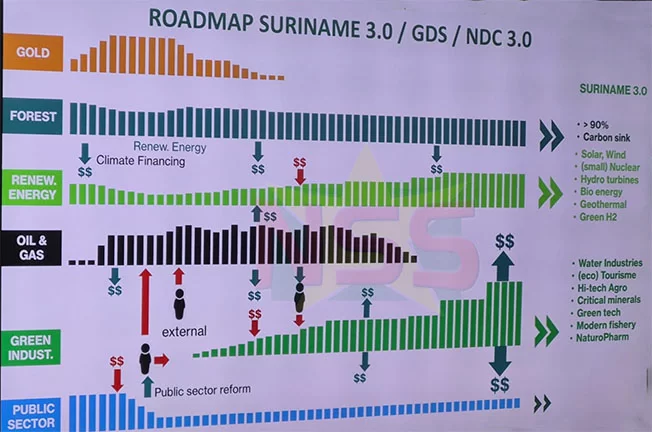
    Suriname stands on the brink of a historic economic transformation as its offshore oil and gas sector accelerates development, according to Oil, Gas & Environment Minister Patrick Brunings. The government has announced plans for a comprehensive national conference in April 2026 that will bring together government entities, private sector representatives, academic institutions, and international partners to establish a detailed roadmap for ‘Suriname 3.0’ – the nation’s transition to a modern, diversified, and sustainable economy.

    Minister Brunings, who comes from an oil industry background himself, emphasized the urgency of preparation: “We must make a structural leap. The offshore developments are real, investments are coming, and we must be ready.” The future oil and gas revenues are specifically intended not to maintain the status quo but to fundamentally reshape Suriname’s economic structure.

    The proposed roadmap outlines a strategic shift away from the gold sector toward multiple new revenue streams supported by oil income. Key development areas include water and climate industries, eco-tourism, high-tech agriculture, critical minerals, green technology, modern fisheries, natural pharmaceuticals, and renewable energy as a second economic pillar. Suriname aims to maintain and even expand its status as a >90% carbon sink nation through investments in solar, wind, hydro, bioenergy, geothermal, green hydrogen, and small-scale nuclear power.

    A crucial component involves reforming the government apparatus, with plans to gradually reduce the size of the public sector. Part of the civil service workforce will be retrained for positions in the oil, gas, and green industries. “The government cannot keep growing. Future jobs will emerge primarily in the productive sector. We must prepare personnel for that,” Brunings stated.

    The transformation faces significant challenges, particularly regarding local content capacity. A masterclass organized by Staatsolie highlighted growing gaps between industry requirements and current market capabilities. International companies operating in Suriname need local goods and services, technically specialized personnel, and supporting sectors including legal, financial, hospitality, logistics, and medical services.

    Despite evident motivation and potential among Surinamese businesses, substantial deficiencies remain – including shortages of well-trained technical staff, insufficient HSE and quality standards, lack of certifications, and inadequate training facilities. The Kuldipsingh Port Facility demonstrates both the rapid pace of offshore development and Suriname’s potential competitiveness, as major international players now operate locally rather than diverting to Trinidad & Tobago or Guyana.

    However, government preparedness lags behind market developments, particularly in policy formulation, regulations, local content requirements, and data collection. Without accelerated action, local small and medium enterprises risk exclusion from emerging opportunities. The April 2026 conference will establish foundations for a national oil and gas development plan, green economy investment strategy, public administration reform, robust local content agreements, and a long-term roadmap for Suriname’s economic future.
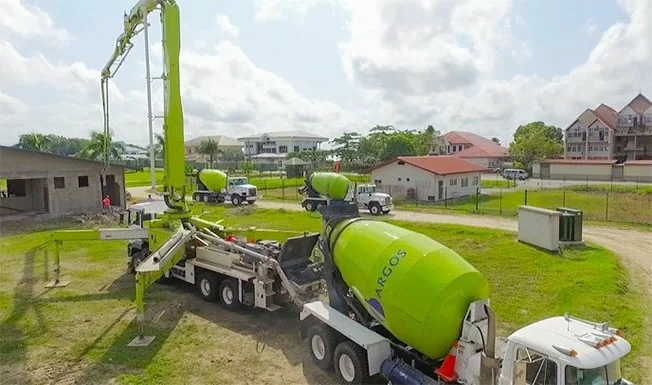

  • Cementpartnerschap Argos–Kersten bereikt 15-jarig jubileum

    Cementpartnerschap Argos–Kersten bereikt 15-jarig jubileum

    In a significant milestone for Suriname’s construction sector, Argos and Kersten Group today commemorate 15 years of strategic partnership that has fundamentally transformed the nation’s infrastructure landscape. This alliance represents a powerful fusion of international expertise and local legacy that has delivered exceptional value to Suriname’s development trajectory.

    The collaboration brings together Argos’s nine decades of pan-American construction expertise with Kersten Group’s remarkable 255-year heritage in Suriname. This unique synergy has enabled consistent delivery of premium cement solutions, comprehensive technical support, and reliable supply chain management even during global material shortages that have challenged construction industries worldwide.

    Melvin Ong A Kwie, Director of Massive and Industrial Business at Argos Suriname, emphasized the partnership’s significance: “Reaching this 15-year milestone fills us with immense pride. Our collaboration with Kersten has substantially enhanced our capacity to support Suriname’s growth while maintaining deep connections with the communities we serve.”

    Beyond their commercial operations, both companies have demonstrated profound commitment to social responsibility. The partnership has generated substantial local employment opportunities, supported numerous environmental initiatives, and funded community development projects that align with Suriname’s sustainable development goals.

    Imani Van Klaveren, CFO of Kersten Group, highlighted the partnership’s foundational principles: “These fifteen years demonstrate the immense value of a collaboration rooted in innovation, sustainability, and shared developmental vision. By combining Kersten’s local legacy with Argos’s technical expertise, we have significantly strengthened Suriname’s infrastructure sector and remain confident in our enduring positive impact.”

    Looking forward, both organizations have reaffirmed their commitment to continuing this transformative partnership. Their shared ambition remains unwavering: to continue building a stronger, more sustainable, and prosperous Suriname through innovative construction solutions and community-focused development initiatives.

  • Jongeren weg van sociale media: Meta verwijdert massaal accounts van kinderen onder 16 jaar

    Jongeren weg van sociale media: Meta verwijdert massaal accounts van kinderen onder 16 jaar

    Australia has positioned itself as the first nation worldwide to implement a comprehensive social media prohibition for users under 16 years old. Technology conglomerate Meta has proactively initiated the removal of minor accounts across Instagram, Facebook, and Threads platforms this week, anticipating the official enforcement of groundbreaking legislation scheduled for December 10th.

    Meta had previously issued warnings to users aged 13-15 regarding account deactivation commencing December 4th. The sweeping measure affects approximately 150,000 Facebook accounts and 350,000 Instagram profiles, with Threads—being integrally linked to Instagram—similarly falling under the regulatory scope.

    The pioneering Australian mandate legally obligates social media corporations to prevent account creation by children below 16 years. Non-compliant companies face severe financial penalties reaching AU$49.5 million (approximately US$33 million). This regulatory framework extends beyond Meta to encompass diverse platforms including YouTube, TikTok, Snapchat, X (formerly Twitter), Twitch, Reddit, and Kick.

    Government officials defend this unprecedented action as essential for safeguarding minors from harmful digital content, cyberbullying risks, and potential grooming by adults. Official research reveals 96% of Australian children aged 10-15 actively use social platforms, with significant exposure to detrimental materials including violent imagery, misogynistic content, and media promoting eating disorders or self-harm behaviors. Survey data indicates over half of young users report experiencing cyberbullying, while one in seven acknowledges encountering grooming-like approaches.

    While Meta commits to regulatory compliance, the corporation advocates for alternative verification methodologies—specifically proposing that app stores should implement age verification during download processes rather than requiring repeated age confirmation within individual applications.

    Affected adolescents believing their accounts were erroneously removed may request official review by submitting government-issued identification or video selfies for age verification.

    Communications Minister Anika Wells vehemently supports the policy, characterizing it as vital for protecting ‘Generation Alpha’ from what she describes as ‘predatory algorithms’ fostering addictive behaviors. However, substantial opposition exists from organizations warning about potential isolation for youth dependent on digital communities for social connection and support. Critics additionally fear migration toward less-regulated alternative platforms.

    YouTube has publicly criticized the legislation as ‘precipitous,’ arguing that elimination of parentally supervised accounts might ultimately decrease child safety. As the international community closely monitors this pioneering digital policy experiment, multiple nations are reportedly evaluating the feasibility and desirability of implementing analogous restrictions.

  • President: Onderwijs speerpunt nationale ontwikkeling; grote conferentie gepland in maart

    President: Onderwijs speerpunt nationale ontwikkeling; grote conferentie gepland in maart

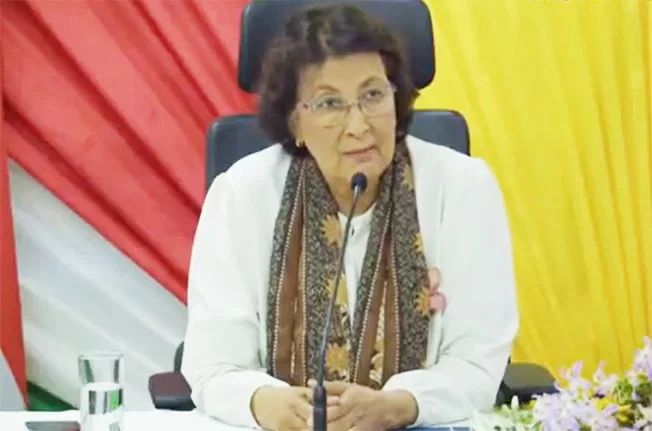
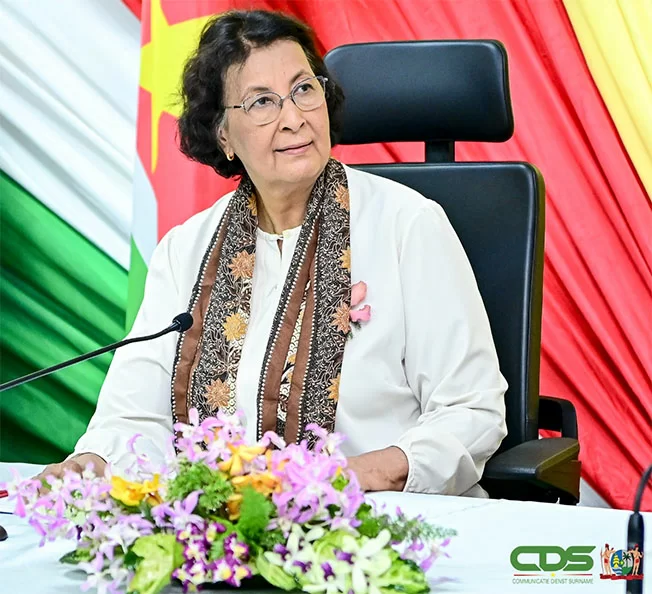
    Surinamese President Jennifer Simons has declared education the fundamental pillar of national development, announcing sweeping reforms to decolonize the country’s educational system and foster psychological independence. Speaking at a Wednesday press conference in Commewijne, Simons emphasized that true sovereignty requires transforming colonial-era structures and mindsets within classrooms.

    “We cannot claim independence while educating our children with colonial frameworks,” stated President Simons. “Decolonization begins in how we teach our history, culture, and identity. Our youth must become critical thinkers and confident citizens equipped for a rapidly evolving global economy.”

    The government will convene a landmark National Education Conference in March, gathering educators, policymakers, universities, vocational institutions, parents, and civil society organizations. This action-oriented summit aims to establish concrete policies across six key areas: curriculum modernization, teacher professional development, digital infrastructure upgrades, technical education enhancement, equitable access for urban and rural students, and integration of Surinamese heritage into learning materials.

    In a strategic shift in international cooperation, Suriname is prioritizing vocational education exchanges with Dutch institutions. While maintaining existing university partnerships, the focus now centers on creating reciprocal vocational training programs that position Suriname as an equal knowledge partner rather than merely an importer of European educational models.

    The education overhaul extends beyond academics to encompass youth development through cultural education, sports programs, leadership training, and enhanced community libraries. President Simons envisions this comprehensive approach as essential for building both economic competitiveness and national unity.

    “Education becomes the engine of our future,” Simons concluded. “Without education that makes our people stronger, smarter, and freer, we cannot achieve economic growth, technological advancement, or true national cohesion.”

  • Simons: Alleen onafhankelijke rechter kan oordeel vellen over Nederlandse AOW-uitkering

    Simons: Alleen onafhankelijke rechter kan oordeel vellen over Nederlandse AOW-uitkering

    Surinamese President Jennifer Simons has declared that only an independent judicial authority can resolve the longstanding controversy surrounding the Dutch General Old Age Pensions Act (AOW) and its exclusion of Surinamese citizens. During a Wednesday press conference, Simons characterized the Netherlands’ one-time €5,000 payment to Dutch residents as a “legal omission” requiring reassessment.

    The President emphasized that Suriname cannot demand equivalent payments for its citizens, stating that solely judicial proceedings can determine appropriate resolution. This response came following inquiries from Dennis Belfor, who is challenging the matter both politically and legally within Dutch systems.

    This complex legal dispute traces back to the 1956 legislation that originally granted AOW rights throughout the Kingdom of the Netherlands. The Dutch government subsequently issued a unilateral memorandum that effectively excluded Surinamese individuals—both in Suriname and the Netherlands—from receiving full or partial pension benefits.

    In 2023, the Netherlands offered a compensatory gesture: a single €5,000 payment to elderly Surinamese individuals who chose to retain Dutch citizenship before independence and relocated to the Netherlands. However, strict eligibility criteria have rendered many claimants ineligible. Requirements include residence in the Netherlands by November 25, 1975, being at least eighteen years old at time of relocation, and having lived in the Netherlands for minimum 25 years by July 1, 2024.

    These conditions have created what is now termed the “AOW gap,” disproportionately affecting those who were part of the Dutch Kingdom before independence as outlined in the original 1956 law. President Simons and many others contend that the Netherlands committed a judicial error that has systematically excluded thousands of pre-independence Dutch nationals from rightful pension benefits.

    Simons directly addressed Belfor during the conference: “Only legal proceedings can resolve this. If we were part of the Kingdom initially, we must pursue legal channels. However, the Dutch system has not ruled in your favor to date.”

  • Geen akkoord na vredesgesprek: oorlog in Oekraïne blijft voortduren

    Geen akkoord na vredesgesprek: oorlog in Oekraïne blijft voortduren

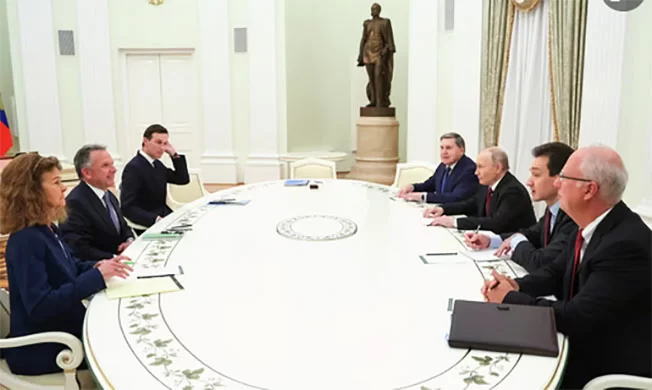
    High-stakes diplomatic negotiations between a high-level American delegation and Russian President Vladimir Putin concluded after five hours of intensive discussions without achieving a breakthrough on ending the conflict in Ukraine. The Kremlin confirmed the lack of substantive progress following the meeting.

    According to Russian officials, while certain American proposals were deemed ‘acceptable,’ critical elements concerning territorial disputes were firmly rejected. The talks centered on a Western-backed peace initiative and security guarantees for Ukraine’s future status.

    The most significant obstacles emerged regarding Ukraine’s potential membership in military alliances and international recognition of Russian-controlled territories. Moscow maintained its unwavering position against making concessions on regions it considers strategically vital.

    Despite diplomats characterizing the discussions as ‘constructive,’ they acknowledged ‘substantial work remains’ before any concrete agreement could materialize. The absence of immediate resolutions highlights the profound complexity of the geopolitical divide.

    Military analysts caution that without resolving these fundamental conflicts—particularly those involving territorial sovereignty and political status—the prospect of sustainable peace remains distant. The ongoing conflict continues unabated despite these diplomatic efforts.

  • Visumprocedure moet menselijker, ticketprijzen moeten omlaag

    Visumprocedure moet menselijker, ticketprijzen moeten omlaag

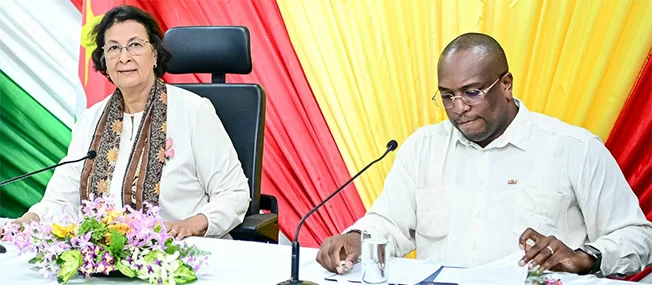
    Surinamese President Jennifer Simons and Foreign Minister Melvin Bouva have declared the resolution of visa restrictions and exorbitant flight tariffs as urgent national priorities in bilateral relations with the Netherlands. The announcement came during a presidential press conference held Wednesday at the Commewijne district commissioner’s office.

    President Simons revealed that the recent Dutch state visit to Suriname highlighted the severe hardships faced by Surinamese citizens navigating the current visa application process. “The prolonged waiting periods, poor physical conditions at application centers, and documentational ambiguity are fundamentally inhumane and require immediate reform,” Simons stated.

    The administration identified two primary pressure points: short-term emergency visas (for medical emergencies, bereavement, or urgent family matters) and regular visa applications. President Simons confirmed that Suriname will formally submit a visa liberalization request to the European Commission—a move that could eventually grant Surinamese citizens visa-free travel to Europe’s Schengen area. The Netherlands has committed to diplomatically supporting this initiative in Brussels.

    Concurrently, both nations are collaborating on procedural improvements including enhanced information dissemination, reduced processing times, and more dignified treatment of applicants.

    Foreign Minister Bouva addressed the parallel issue of escalating airfares on the Paramaribo-Amsterdam route, dominated by KLM Royal Dutch Airlines. He characterized the prices as “prohibitively expensive for most Surinamese citizens” and attributed the problem to insufficient market competition and unfavorable peak-season pricing mechanisms.

    “We are actively negotiating with multiple airlines to break the current market monopoly,” Bouva announced. “Surinamese people deserve affordable connections to maintain family ties and business relationships.”

    President Simons framed these dual challenges as matters of human dignity and national sovereignty: “When visa applications become demeaning and air travel becomes unaffordable, it strikes at the heart of families, impedes cultural exchange, and restricts economic development. We approach these discussions as equals seeking partnership, not dependency, but the freedom of movement for our citizens must be respected.”

    Immediate next steps include:
    – Formal submission of visa liberalization request to European Commission
    – Diplomatic support from Netherlands in Brussels negotiations
    – Market diversification talks with alternative airlines
    – Enhanced guidance for visa applicants regarding documentation requirements
    – Short-term improvements in humane treatment during visa processing

    The government emphasized that resolution of these issues remains critical for maintaining cultural connectivity and economic cooperation between the two nations.

  • Column: Reorganisatie damesvoetbal

    Column: Reorganisatie damesvoetbal

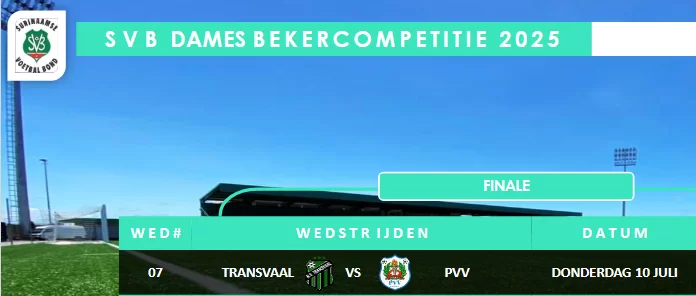
    The absence of domestic women’s football competitions since July’s cup final has exposed systemic failures within the national sporting structure. When the national team coach announced preliminary selections on October 20th, local leagues had been dormant for over three months, resulting in zero representatives from domestic clubs making the cut.

    This development highlights a recurring pattern where athletes from local clubs consistently underperform in regional competitions, with lack of match fitness and rhythm routinely cited as contributing factors. Despite these persistent issues, no club has publicly expressed concern about continuously subjecting athletes to humiliating defeats, nor has there been any indication of strategic changes to improve preparedness.

    The introduction of professional sport passports has accelerated the transition toward fully professional women’s selections. What began as a combination of local amateurs and professionals has now become exclusively professional, completely excluding domestic amateur players. Local clubs failed to advocate for necessary structural reforms, including realigning domestic competitions with regional calendars and establishing a professional women’s league to better prepare athletes for international competition.

    Administrative inertia has reached critical levels, with the governing body spending thousands of dollars on delegations while maintaining a laissez-faire approach that has left athletes fundamentally unprepared. The current trajectory suggests women’s football has reached an impasse, with the sport facing existential threats if policies remain unchanged.

    The core issue lies not with professionally licensed players but with the fundamental approach to sports development. Had domestic sports cultivation reached higher standards, local players would undoubtedly have secured places in the national selection. This situation demands immediate structural overhaul before the entire women’s football program becomes unsustainable.

  • Suriname in actie met 110 sporters bij IGS 2025 in Guyana

    Suriname in actie met 110 sporters bij IGS 2025 in Guyana

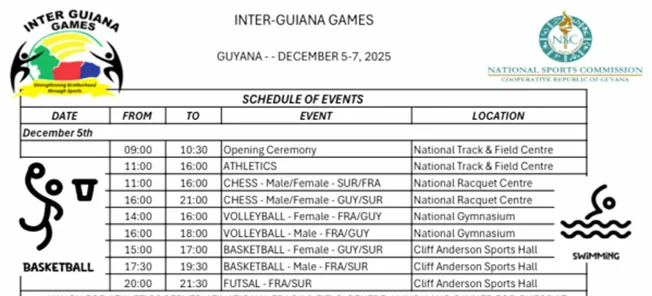
    Suriname is dispatching a 110-strong athletic delegation to compete in the Inter-Guiana Games (IGG) hosted by Guyana from December 5-7. This annual multi-sport event fosters regional camaraderie and athletic excellence among youth from Suriname, Guyana, and French Guiana. The contingent will embark on a road journey to Guyana on Wednesday morning.

    The athlete roster, comprising competitors aged 14-18, will be accompanied by coaches, trainers, and officials from the Foundation School Sport Federation Suriname (SSFS). These young talents will showcase their skills across six competitive disciplines: athletics, swimming, basketball, volleyball, futsal, and chess.

    Following months of intensive training regimens, the Surinamese delegation is widely regarded as exceptionally well-prepared and highly competitive. While podium finishes remain an objective, the mission equally emphasizes cultivating team spirit, demonstrating discipline, and representing the nation with pride.

    As the operational arm of Suriname’s Ministry of Youth Development and Sport, SSFS has orchestrated all logistical and competitive preparations for the games. Looking ahead to 2026, Suriname plans to build on this momentum through participation in additional international youth tournaments, further solidifying its commitment to regional sports development and athletic diplomacy.

  • President over relatie Nederland: Gelijkwaardig en psychologisch zelfstandig

    President over relatie Nederland: Gelijkwaardig en psychologisch zelfstandig

    Surinamese President Jennifer Simons has declared that King Willem-Alexander’s state visit to Suriname has inaugurated a transformative phase in bilateral relations between the two nations. Speaking at a press conference in Commewijne, Simons emphasized that future ties must be founded upon principles of equality, mutual respect, and psychological independence rather than historical dependencies.

    The three-day royal visit, which concluded recently, demonstrated Suriname’s confident trajectory in shaping its national future while signaling the Netherlands’ recognition that it must adopt a fundamentally new approach toward its former colony. President Simons articulated that while the 1975 independence granted constitutional sovereignty, the nation must now pursue ‘psychological independence’—liberating itself from patronage mentality, dependency thinking, and historical sensitivities that have long strained bilateral relations.

    ‘Suriname stands on its own feet, with its distinct identity and unique challenges. The Netherlands must respect this reality, while Suriname must project this self-assurance confidently,’ Simons stated during the address.

    The president characterized the state visit as both a symbolic and practical reboot, describing how both nations ‘unpacked a new package’ that establishes framework for a mature relationship moving forward. ‘We progress as two friends with a shared history, but with a future where we support each other as equal partners,’ she explained, noting that both countries must learn to operate within this redefined dynamic.

    While welcoming cooperation in education, culture, economic development, river management, and infrastructure, Simons clarified that such collaboration must exclusively occur through modalities that strengthen Suriname’s autonomy. The signed cooperation documents between ministerial departments and the presence of a substantial Dutch business delegation during the visit were cited as concrete steps toward this new partnership model.

    A particularly symbolic moment occurred along the Suriname River, where both nations metaphorically ‘laid the burdens of the past upon the waters,’ followed by calls for pragmatic, businesslike cooperation without guilt or inferiority complexes from either side.

    Looking ahead, Suriname plans to continue discussions with the Netherlands in coming months regarding visa procedure reforms and humane treatment of applicants, educational exchanges at vocational and university levels, cultural collaboration and heritage preservation, economic development opportunities, and improved flight connectivity with reasonable pricing.