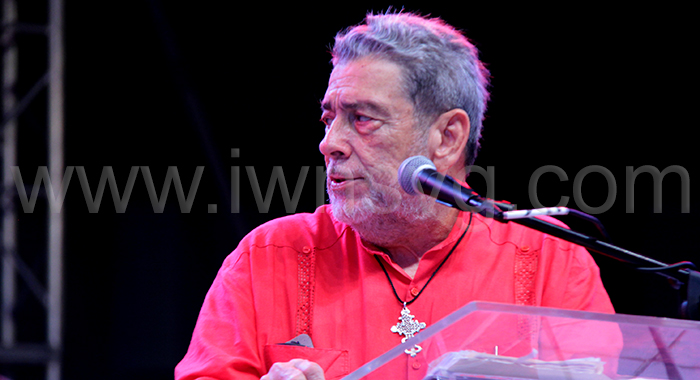
KINGSTOWN, St. Vincent — Prime Minister Ralph Gonsalves has raised concerns over the presence of eight Trinidadian lawyers and activists in St. Vincent, accusing them of attempting to interfere in the upcoming general election. Gonsalves, leader of the ruling Unity Labour Party (ULP), made these allegations during a youth rally, emphasizing that the opposition New Democratic Party (NDP) had brought these individuals to influence the electoral process. He warned that their activities could undermine the nation’s democratic integrity. Gonsalves highlighted that these lawyers must obtain proper work permits or CARICOM Skills National Certificates to operate legally in St. Vincent, labeling their current involvement as a criminal offense. He further criticized the NDP for what he described as ‘low-down worthlessness’ and attempts to disrupt the ULP’s campaign efforts. Gonsalves also expressed gratitude to Trinidad and Tobago’s Prime Minister Kamla Persad-Bissessar for clarifying that her party had not sanctioned any involvement in St. Vincent’s elections. However, he speculated that UNC financiers might be seeking to ‘buy this election’ for their own interests. The ULP, which has held power since 2001, is aiming for a sixth consecutive term in the December 1 poll.
标签: Saint Vincent and the Grenadines
圣文森特和格林纳丁斯
-

SVG’s political circus
As St. Vincent and the Grenadines approaches another election, the nation’s political culture has devolved into a spectacle of noise, distraction, and emotional manipulation. What should be a time for serious national reflection has been overshadowed by a festival of hype, handouts, and showmanship. The transformation of politics into entertainment has not only cheapened the electoral process but also jeopardized the country’s future.
-

A crippled police force
In a poignant reflection on the state of law enforcement in St. Vincent and the Grenadines (SVG), a police officer has voiced deep concerns about the systemic failures crippling the Royal St. Vincent and the Grenadines Police Force. As the nation prepares for upcoming elections, the officer highlights the urgent need for accountability and reform to address the chronic issues plaguing the police force. The officer, who remains anonymous, describes a system marred by political interference, inadequate resources, and a lack of actionable policies. Despite the dedication of officers, the force is left underequipped, with police stations lacking functional vehicles and essential tools to combat crime effectively. The officer emphasizes that the failure to address these issues has left both law enforcement and citizens vulnerable, with criminals often staying one step ahead. The government’s inaction, described as both deliberate and cynical, has exacerbated the crisis, leaving the police force without the necessary support to fulfill its mandate of crime prevention and detection. As voters head to the polls, the officer urges them to prioritize public safety by demanding a clear, funded plan to restructure and resource the police force. The call for reform is not just about improving law enforcement but about ensuring the safety and security of all Vincentians. The officer concludes with a plea for voters to reject complacency and choose leaders who will take decisive action to address the challenges facing the police force and the nation as a whole.
-
No to kings!
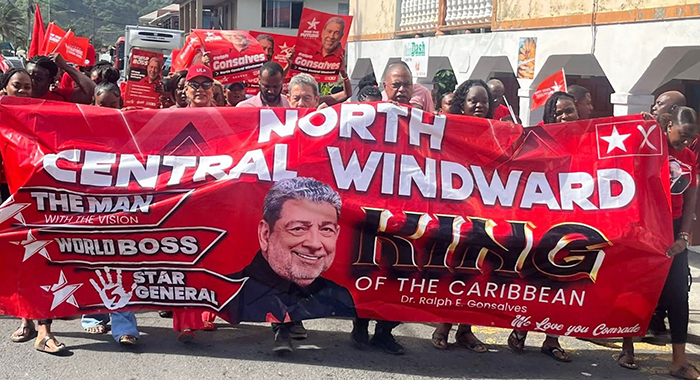
In 2001, the United Labour Party (ULP) ascended to power in St. Vincent and the Grenadines, promising governance but accused of ruling with an iron fist. Led by Ralph Gonsalves, a figure often described as power-hungry and Marxist, the ULP’s rise was marked by what critics call the ‘Roadblock Revolution,’ a manufactured crisis that propelled them into office. Over the past 24 years, Gonsalves has entrenched himself as a dominant figure, consolidating power through strategic maneuvers and alliances, including the merger of the St. Vincent Labour Party (SVLP) with his Movement for National Unity (MNU) to form the ULP. Critics argue that his leadership mirrors the allegorical ‘Animal Farm,’ where promises of equality gave way to authoritarian control. Gonsalves’ tenure has been characterized by accusations of nepotism, corruption, and the creation of a subservient electorate dependent on state handouts like Poor Relief, food vouchers, and home appliances. These tactics, critics claim, are designed to secure loyalty and perpetuate his rule. As the nation heads to the polls, many Vincentians express a desire for genuine governance—a leader who prioritizes the interests of all citizens, transcending political affiliations. The upcoming election presents an opportunity for change, with the New Democratic Party (NDP) positioning itself as an alternative to the ULP’s entrenched regime. The outcome will determine whether St. Vincent and the Grenadines continues under Gonsalves’ rule or embarks on a new path of inclusive governance.
-

NOTICE: A VOTE FOR DWIGHT FITZGERALD BRAMBLE IS A WASTED VOTE
In a heated political development, the candidacy of Dwight Fitzgerald Bramble, the New Democratic Party’s representative for East Kingstown, has come under intense scrutiny. Critics argue that Bramble is constitutionally ineligible to serve as a Member of Parliament due to his Canadian citizenship. According to Section 26 (1) of the Constitution of Saint Vincent and the Grenadines, individuals who voluntarily acknowledge allegiance to a foreign power are disqualified from holding parliamentary office. Bramble, who holds Canadian citizenship and a Canadian passport, is accused of violating this provision. His nomination was formally challenged by East Kingstown electors on November 10, 2025, raising questions about the validity of his candidacy. Opponents urge voters to reconsider their support, labeling a vote for Bramble as ‘wasted’ given the legal uncertainties surrounding his eligibility. The case is expected to be a focal point in the upcoming election, with potential implications for the political landscape of Saint Vincent and the Grenadines.
-
Constitutional crises not a fallacy
A constitutional crisis is brewing in St. Vincent and the Grenadines (SVG) over the interpretation of sections 25 and 26 of the nation’s Constitution, which govern the eligibility of Commonwealth citizens to contest elections. Section 25 outlines the basic qualifications for election candidates, including being at least 21 years old, residing in SVG for 12 months before nomination, and demonstrating proficiency in English. However, Section 26 introduces a critical litmus test: candidates must not, by their own act, acknowledge allegiance, adherence, or obedience to a foreign power or state. The crux of the debate is whether a Commonwealth member state qualifies as a ‘foreign power or state’ under Section 26. Dr. A Linton Lewis, PhD, argues that Commonwealth countries, including Canada, are indeed foreign states relative to SVG, a position that contradicts Dr. Jason Haynes’ interpretation. Dr. Haynes contends that Section 25 explicitly permits Commonwealth citizens to contest elections, making it contradictory to disqualify them under Section 26. Dr. Lewis counters that the Constitution’s drafters clearly distinguished between SVG citizens and Commonwealth citizens, emphasizing that the latter must reside in SVG for seven years to apply for citizenship, underscoring their foreign status. He further asserts that the purpose of Section 26 is to prevent split loyalties, ensuring that elected representatives are fully committed to SVG. The looming crisis stems from the potential disqualification of Commonwealth citizens who may hold allegiance to their home countries, raising questions about the Constitution’s intent and the practical implications for SVG’s political landscape. As the debate intensifies, the issue remains unresolved, with the possibility of a constitutional challenge on the horizon.
-

Her next round of ‘breaking’ and ‘resetting’
During a recent youth rally, a ‘special guest’ took the stage to address the audience on behalf of the United Labour Party (ULP). However, her speech was less an endorsement and more a plea for assistance, a pattern familiar to those who know her well. Even Candyman, who introduced her, has previously noted this tendency after prolonged interactions. While I have been a lifelong supporter of Labour, my current uncertainty stems not from anger at the opposition New Democratic Party (NDP) but from dissatisfaction with how the ULP has managed key issues over the past five years, including the controversial vaccine mandate. Her speech did little to strengthen my allegiance to the ULP; instead, it deepened my reflection on Mike Browne’s commentary, pushing me toward abstaining from voting in the upcoming election. Her intelligence, eloquence, and confidence are undeniable, but she may not be what the ULP needs now. Her past remarks, such as labeling Curtis King a ‘disgrace’ and dismissing Keisal Peters as merely a ‘wardrobe and a hair salon,’ raise questions about her alignment with the party. Despite her criticisms of the NDP, their leadership remained silent, perhaps recognizing the underlying motivations behind her outbursts. As the ULP welcomes her into a visible role, internal warnings are emerging publicly, urging caution. Will the party heed these concerns, or will history repeat itself?
-

A product of the Education Revolution — and the lessons it taught me
As a beneficiary of what is often celebrated as the ‘educational revolution,’ I find myself reflecting on my journey with a mix of gratitude and realism. My opportunity came through a government-backed loan, but it was my father who shouldered the interest payments while I pursued my degree. For that, I am deeply thankful—both to the government and to my dad. Upon returning home, I was committed to contributing to my country’s human resource pool. I applied repeatedly for teaching positions in the public sector, but no doors opened. Undeterred, I pressed on. I found work in the private sector, worked diligently, and remained ambitious, even as I continued to pay off my student loan. When I became pregnant, my employer saw it as a burden rather than a natural part of life. I was eventually made redundant, left jobless with a baby in my arms and a loan still due every month. Yet, I continued paying, using the redundancy payout. Accountability mattered to me. At my second job, I again applied to teach—still no response. I sought stability, wanting to provide for my son. Eventually, I found myself working within a statutory body, where I witnessed inefficiencies and leadership driven by fear rather than inspiration. Skills were misaligned with roles, and decisions were made based on approval, appearance, and proximity to power rather than merit. Despite financial struggles, I kept paying my loan, even consolidating it into my mortgage to build a home for my child. Ambition drove me forward. I noticed a stark contrast: while some of us paid faithfully, others who benefited from the same educational opportunities did not. They lived freely, while those of us taking responsibility were weighed down by the system. I began to question whether I should have borrowed more—enough for school and a home—because life seemed designed to keep us repaying institutions until retirement. The turning point came when I realized I was no longer growing—emotionally, professionally, or financially—in my environment. I refused to beg politicians for favors, compromise my integrity, or believe that advancement should come through connections rather than qualifications. So, I made the hardest decision of my life: I left my country, SVG, the workforce I once hoped to strengthen, and the opportunities I never received. I left a system whose direction no longer aligned with my ideals. Ironically, I now teach in another nation’s classroom, shaping another nation’s children, while the classrooms of my birth country remain untouched by my hands. This is not a call to rebellion but a reminder that loyalty does not mean silence, and gratitude does not mean blindness. We have the right to question, grow, and choose. As Thomas Jefferson said, ‘When the people fear the government, there is tyranny; when the government fears the people, there is liberty.’ I once feared speaking out because of my job, but I no longer live with that fear. Today, I write to encourage reflection—not rebellion; awareness—not allegiance. Your vote is your power. Use it.
-

‘Passport can’t eat’
The Citizenship by Investment (CBI) programme, a transformative model of foreign direct investment, has become a cornerstone of economic growth across most Organisation of Eastern Caribbean States (OECS) nations. However, in St. Vincent and the Grenadines (SVG), this proven initiative is often overshadowed by political rhetoric, leaving citizens misinformed about its potential benefits. While neighbouring countries like St. Kitts and Nevis, Antigua and Barbuda, Grenada, Dominica, and St. Lucia have harnessed CBI to fuel their economies, SVG lags behind, missing out on decades of prosperity. CBI, also known as economic citizenship, allows individuals to obtain citizenship by investing significantly in the host country. Despite having a passport ranked similarly to its neighbours in global visa-free access, SVG continues to dismiss the programme entirely. The Eastern Caribbean Central Bank, through Governor Timothy Antoine’s proposed regulatory framework, has emphasized the importance of CBI to the region’s economic stability and advancement. Neighbouring islands have reaped tangible benefits from CBI, including modern infrastructure, luxury developments, and higher GDP per capita. For instance, St. Kitts and Nevis boasts well-maintained highways, double salary bonuses for public servants, and upscale hotels, all funded by CBI revenues. Similarly, Dominica is constructing a new international airport with CBI funding. These outcomes highlight the programme’s potential to uplift entire nations. As SVG reflects on its leadership and policy direction, it is crucial to move beyond outdated rhetoric and embrace innovative economic strategies. The nation deserves policies that elevate all citizens, ensuring a rising tide lifts every ship.
-

Choosing a government is a life-and-death decision
In St. Vincent and the Grenadines (SVG), many aspects of our daily lives are often taken for granted. Born into a system of established privileges, we seldom recognize the sacrifices that made these freedoms possible. This complacency poses a significant threat, as people rarely value or defend what they perceive as ‘free.’ Voting, a cornerstone of democracy, is one such privilege that demands our attention and responsibility. While it may seem freely accessible today, its foundation was built on the struggles of past generations who endured hardships to secure a better future for their descendants. As we approach the 2025 elections, it is crucial to reflect on the legacy we are leaving for future Vincentians. Democracy thrives on participation, and abstaining from voting effectively hands power to the incumbent government by default. The consequences of not voting are profound, impacting everything from economic policies to public health decisions. The COVID-19 pandemic underscored the gravity of governmental decisions, as frontline workers were mandated to take vaccines—a decision made by elected officials. This highlights the symbiotic relationship between voters and their representatives: by casting a vote, citizens grant authority to leaders whose decisions can shape—or even endanger—their lives. Voting is not merely a right but a shared responsibility to ensure that elected officials prioritize the prosperity and well-being of all citizens. Vincentians must move beyond blind party loyalty and critically evaluate whether their leaders are truly working for the people or merely preserving their own interests. The recent electoral trends in neighboring Caribbean nations, such as Barbados, Grenada, and St. Lucia, demonstrate the power of an informed electorate to hold leaders accountable. As SVG heads to the polls, the question remains: Who can be trusted to make decisions in the best interest of the people? The answer lies in active participation and a commitment to safeguarding democracy for generations to come.