标签: Haiti

海地

  • Ancestors’ Day : The Nation bows before the memory of its founding heroes (video)…

    Ancestors’ Day : The Nation bows before the memory of its founding heroes (video)…

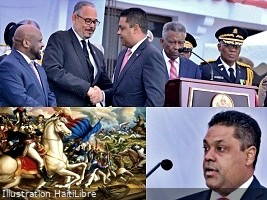
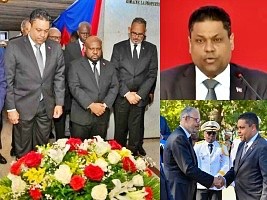
    Port-au-Prince, Haiti – January 2, 2026: In a powerful display of national reverence, Haiti’s transitional government leadership gathered at the Museum of the Haitian National Pantheon (MUPANAH) to commemorate Ancestors’ Day, honoring the revolutionary figures who secured the nation’s independence 222 years ago.

    Prime Minister Alix Didier Fils-Aimé led the solemn wreath-laying ceremony alongside Laurent Saint-Cyr, President pro tempore and Coordinator of the Transitional Council, accompanied by presidential advisors Smith Augustin, Frinel Joseph, Edgard Leblanc Fils, and Emmanuel Vertilaire. The event drew prominent military and civil officials including Lieutenant General Derby Guerrier, Commander-in-Chief of the Armed Forces, and Vladimir Paraison, Acting Director General of the Haitian National Police.

    The ceremony represented more than symbolic remembrance—it served as a reaffirmation of Haiti’s foundational principles of liberty, sovereignty, and historical continuity. In his address, Prime Minister Fils-Aimé characterized the event as “a political act of remembrance” that demonstrates the state’s “unwavering commitment to the cardinal values of liberty, national sovereignty, justice, and human dignity.”

    A significant development in this year’s commemoration was the unprecedented recognition of female independence fighters. Laurent Saint-Cyr specifically highlighted women’s contributions to the liberation struggle, marking the first official January 2nd tribute to heroines including Abdaraya Toya (Victoria Montou), Sanite Bélair, Catherine Flon, Suzanne Simone Baptiste Louverture, and Marie-Jeanne Lamartinière. This initiative, championed by Secretary General Marie Élisabeth Régine Joseph Haddad, reflects the administration’s commitment to advancing women’s leadership roles.

    The ceremony transitioned to Villa d’Accueil for formal honors, featuring culturally significant performances and photographic exhibitions showcasing emblematic figures of Haiti’s emancipation struggle. Minister of National Education Antoine Augustin provided historical context, detailing the achievements of both celebrated and lesser-known independence heroes.

    Against the backdrop of contemporary challenges, the government framed this tribute as both a moral compass and a call to collective action, urging citizens to draw inspiration from their ancestors’ sacrifice for national reconstruction and a more prosperous future.

  • Politic : Haiti moves towards elections while Women’s participation remains limited

    Politic : Haiti moves towards elections while Women’s participation remains limited

    Haiti’s political transition, initiated in July 2021, is advancing toward scheduled 2026 elections under a newly established electoral calendar. While this marks procedural progress, the nation continues to grapple with significant gender disparities in political representation.

    Current data reveals substantial underrepresentation of women across Haiti’s governance structures. Female participation remains notably below the constitutional mandate of 30%, with women occupying merely 22.22% of government positions and a minimal 11.11% within the Presidential Transitional Council (CPT), where they hold observer status without voting rights. At departmental and municipal electoral levels (BED/BEC), representation marginally improves to 27%, still falling short of constitutional requirements.

    Despite the suspension of constitutional review processes by transitional authorities, advocacy efforts led by the Ministry of Women’s Affairs and UN Women have yielded significant provisions in the draft electoral decree. Article 138 mandates rejection of any electoral list containing fewer than 30% women candidates, while Article 138.1 establishes additional funding incentives for political parties that exceed 50% female representation.

    In response to these developments, the Provisional Electoral Council (CEP) and UN Women jointly launched a comprehensive national campaign based in Port-au-Prince. The initiative gathered approximately 150 participants from all ten Haitian departments, including 63 women from regions outside the capital. This campaign aims to mobilize female political participation while raising awareness among political parties and the general public about women’s transformative potential in governance.

    Supplementing these efforts, government-supported departmental consultations and the National Conference on Women’s Political Participation have facilitated strategic dialogue. A pivotal outcome emerged through the adoption of the Declaration of Haitian Women for Active and Effective Participation, which embodies women’s commitment to shaping Haiti’s democratic future and asserts their right to decisive political involvement.

  • 222nd anniversary of Independence : Vibrant speech by the Ambassador of Haiti to the Dominican Rep.

    222nd anniversary of Independence : Vibrant speech by the Ambassador of Haiti to the Dominican Rep.

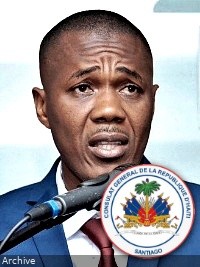
    In a profound address marking Haiti’s 222nd independence anniversary, Ambassador Emmanuel Fritz Longchamp delivered a stirring critique of the nation’s historical trajectory while calling for radical political transformation. The Haitian envoy to the Dominican Republic spoke on January 1st, 2026, commemorating the 1804 revolution that established the world’s first black republic.

    Longchamp characterized Haiti’s independence as both a glorious legacy and an ongoing political challenge, noting that the revolution represented not merely military victory but an anthropological and philosophical breakthrough that challenged fundamental concepts of human dignity. He quoted founding father Jean-Jacques Dessalines’ historic proclamation: ‘Let’s swear to renounce France forever and to die rather than live under its domination.’

    The ambassador presented a stark assessment of Haiti’s contemporary reality, describing the current institutional collapse as the product of ‘chronic misgovernance, systematic social exclusion, and a profound rupture between the state and society.’ He framed mass migration to the Dominican Republic not as cultural preference but as a survival strategy for people deprived of prospects in their homeland.

    Longchamp proposed a biopolitical approach to rebuilding the Haitian state—one prioritizing security, dignity, health, education, and the value of human life as central to public action. He emphasized that true independence requires moving beyond ‘sterile divisions and narrow calculations’ toward collective awakening and national solidarity.

    The ambassador concluded with tributes to Haitian officials and diplomatic staff while praising the resilience of the Haitian people, expressing hope that 2026 would bring ‘peace, stability, and renewal’ to the nation founded on revolutionary ideals of freedom and human dignity.

  • National Day : Official ceremony for the 222nd anniversary of independence (video)

    National Day : Official ceremony for the 222nd anniversary of independence (video)

    Port-au-Prince, Haiti – The nation commemorated its 222nd independence anniversary on January 1st, 2026, with a solemn ceremony at Villa d’Accueil that brought together Haiti’s highest leadership. Prime Minister Alix Didier Fils-Aimé presided over the event alongside Laurent Saint Cyr, the acting President and Coordinator of the Transitional Council (CPT), signaling a unified front during a period of significant political transition.

    The gathering represented a powerful convergence of Haiti’s governing institutions, with attendance from cabinet members, military leadership led by Lieutenant General Derby Guerrier, police command under Acting Director General Vladimir Paraison, judicial authorities headed by Court of Cassation President Jean-Joseph Lebrun, and diplomatic representatives.

    Prime Minister Fils-Aimé delivered an emotionally charged address reflecting on Haiti’s historic achievement as the first nation to successfully overthrow slavery. ‘On this day in 1804, our ancestors achieved an unprecedented victory against oppression, establishing forever the dignity and freedom of an oppressed people,’ he stated. ‘Their courage remains a universal symbol of resilience that continues to inspire our nation.’

    The Prime Minister framed contemporary challenges through the lens of historical legacy, emphasizing that ‘security, peace, stability, and democratic elections constitute our essential pathways toward a better future.’ He called for national solidarity, urging citizens to transcend divisions and embrace collective responsibility. Fils-Aimé specifically invoked the nation’s founding principles – ‘liberty, unity, security, stability, and hope’ – as guiding values for all Haitians both domestically and abroad.

    Laurent Saint Cyr echoed these themes while paying particular tribute to Jean-Jacques Dessalines, Haiti’s founding father, and other independence heroes. The transitional leader issued a solemn appeal for dialogue and responsibility from all sectors of society, noting that political discourse serves as an accountability mechanism. His remarks carried particular significance given the approaching February 7, 2026 deadline marking the expiration of the CPT’s mandate, a moment that could determine Haiti’s political trajectory.

    The ceremony ultimately served as both a historical remembrance and a contemporary call to action, emphasizing that the same courage that secured independence must now be channeled toward overcoming modern challenges through unity and democratic renewal.

  • 2026 : New Year’s Message from the Gang Supression Force

    2026 : New Year’s Message from the Gang Supression Force

    PORT-AU-PRINCE, Haiti – The Gang Suppression Force (GSF) issued a comprehensive New Year’s address on January 1, 2026, outlining significant security achievements and reaffirming its commitment to restoring stability in the crisis-ravaged Caribbean nation.

    The multinational security coalition, operating under UN Security Council Resolution 2793 adopted September 30, 2025, reported substantial progress in combating gang violence that has plagued Haiti for years. The resolution authorized the transformation of previous security missions into the specialized GSF, mandating intelligence-driven operations to neutralize criminal networks, secure critical infrastructure, and isolate gangs from their support systems.

    Throughout the latter half of 2025, GSF personnel working alongside Haitian National Police (HNP) and Forces Armées d’Haïti (FAd’H) achieved measurable security improvements. Joint operations resulted in numerous arrests, recovery of illegal weapons, and the liberation of territories previously under gang control. Enhanced day and night patrols throughout Port-au-Prince and beyond have facilitated the reopening of major transit routes long rendered impassable by violence.

    The mission has prioritized protection of vital national infrastructure including Toussaint Louverture International Airport, seaport facilities, and communication installations to ensure uninterrupted operational continuity. Strategically positioned Forward Operating Bases in gang-affected zones have significantly improved patrol coverage and response times.

    The GSF acknowledged international support mechanisms, including the recent appointment of a Special Representative for the force and successful troop contribution conferences in New York, demonstrating global determination for sustainable Haitian stability.
    In its message, the force specifically recognized the courage of personnel from Bahamas, El Salvador, Guatemala, Jamaica, and Kenya, while applauding Haitian leadership and citizens for their continued faith in the mission. The statement also highlighted the crucial role of local media in providing balanced coverage of security developments.

    As operations continue into 2026, the GSF maintains its focused mandate: dismantling criminal networks, restoring public security, and establishing foundations for lasting peace and democratic governance. The message concluded with optimistic aspirations for a future where Haiti achieves enduring peace, stability, and prosperity.

  • National Day : 222nd anniversary of Haiti’s independence, first messages

    National Day : 222nd anniversary of Haiti’s independence, first messages

    As Haiti commemorated the 222nd anniversary of its independence on January 1, 2026, diplomatic messages from international partners and diaspora consulates highlighted both the nation’s historic resilience and contemporary struggles. The occasion marked the world’s first independent Black republic, established in 1804 after a successful slave rebellion.

    U.S. Secretary of State Marco Rubio conveyed America’s continued commitment to supporting Haiti’s security and democratic processes. “We stand with the people of Haiti on your Independence Day,” Rubio stated, emphasizing ongoing efforts to establish a Gang Suppression Force to combat violent groups designated as Foreign Terrorist Organizations by the U.S. government. The Secretary also acknowledged progress by Haiti’s transitional government toward conducting the country’s first national elections in a decade.

    Across the Haitian diaspora, consular officials struck a balance between celebration and solemn reflection. The Consulate General in Chicago evoked the legacy of revolutionary leaders Jean-Jacques Dessalines and the Indigenous Army, calling for national unity amid ongoing challenges. “Building a stable and prosperous Haiti is a daily endeavor that demands the patriotism and commitment of each and every one of us,” their message read.

    From Montreal, consular officials emphasized that “peace remains the essential condition for building a prosperous and sustainable future,” while the Santiago Consulate in the Dominican Republic highlighted how Haiti’s national identity was “built on the rejection of injustice and arbitrary rule.”

    The messages collectively acknowledged Haiti’s profound historical significance while addressing current security concerns and governance challenges. Despite political instability and security crises, the international community reaffirmed its support for Haiti’s sovereignty and democratic development as the nation enters its 223rd year of independence.

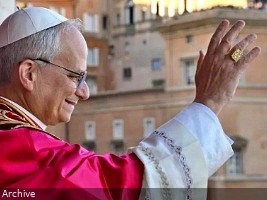
  • Religion : Pope Leo XIV’s message of peace rekindles hope in Haiti

    Religion : Pope Leo XIV’s message of peace rekindles hope in Haiti

    In a profound address marking World Peace Day, Pope Leo XIV has issued a resonant call for a “disarmed and disarming peace” specifically addressing the protracted crisis in Haiti. This theological framework presents a dual approach to resolving the nation’s violent turmoil, offering a spiritual counterpoint to ongoing security preparations.

    Bishop Gontrand Décoste of Jérémie provided authoritative interpretation of the papal message, clarifying its practical implications for the Caribbean nation. He explained that “disarmed peace” necessitates the total elimination of firearms and complete cessation of armed hostilities across Haitian territory. Simultaneously, “disarming peace” represents a diplomatic process encouraging armed factions to voluntarily relinquish weapons, thereby facilitating the restoration of state authority and national security infrastructure.

    The pontiff’s intervention arrives amid escalating gang dominance that continues to paralyze Haiti’s economy through systematic road blockades and regional narcotics trafficking. Bishop Décoste condemned how certain entities “profit from insecurity and ammunition sales while the population endures abject poverty,” highlighting the economic dimensions of the security crisis.

    Despite these challenges, the Haitian church demonstrates remarkable resilience. Four decades after Pope John Paul II’s historic visitation, the prophetic declaration that “Haiti will live” continues to inspire spiritual resistance through Marian pilgrimages in Port-au-Prince. These processions have evolved into acts of collective faith against overwhelming darkness, embodying the conviction that “evil will not prevail” as emphasized in Leo XIV’s message.

    For marginalized communities bearing the brunt of violence, this papal communication reaffirms that the current crisis represents a conquerable challenge rather than an inevitable fate, emphasizing unity and faith as foundational to national recovery. The spiritual appeal coincides with practical preparations for the anticipated April 2026 deployment of an international security force aimed at suppressing gang operations.

  • FLASH : Assassination of Inspector Jean Sterlin Hold in Fort-Jacques : what we know

    FLASH : Assassination of Inspector Jean Sterlin Hold in Fort-Jacques : what we know

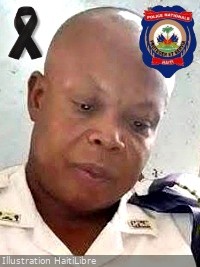
    Haiti’s deepening security crisis has been tragically underscored by the targeted assassination of Chief Inspector Jean Sterlin Hold, a dedicated law enforcement officer known by his aliases ‘Blan’ and ‘San Souci.’ The incident occurred on the evening of December 30, 2025, in Fort-Jacques within the Kenscoff commune, where Inspector Hold commanded the Lotin sub-police station in the Fermathe area.

    The fatal shooting transpired approximately at 7:00 p.m. outside the ‘Sheeshee’s Food’ Club. According to official reports from the Haitian National Police (PNH), Inspector Hold sustained two gunshot wounds. While his bulletproof vest intercepted one projectile, the second proved lethal.

    Preliminary investigations conducted by PNH have identified Louis Marcus, alias ’50,’ proprietor of the establishment where the attack occurred, as the prime suspect. Law enforcement operations resulted in the apprehension of Johnny Roseus, believed to be Marcus’s brother-in-law, during coordinated searches at both the suspect’s residence and the club. Critical evidence, including surveillance footage, has been secured for forensic examination.

    The General Directorate of PNH has mandated the Inspector General’s Office (IGPNH) and the Central Directorate of Judicial Police (DCPJ) to conduct an exhaustive investigation aimed at apprehending all individuals complicit in this homicide and ensuring their prosecution.

    Inspector Hold, a native of Jérémie, had earned recognition for his unwavering opposition to the notorious ‘Kraze Baryè’ criminal faction and his protective stance toward Fort-Jacques residents. His career exemplified professional dedication and selfless community service.

    Official responses to the tragedy have been swift and unanimous. The PNH expressed profound condolences to Inspector Hold’s family, colleagues, and associates while reaffirming their determination to pursue justice. The Presidential Transitional Council (CPT) honored the inspector as a ‘valiant servant of the State’ and pledged continued institutional support for national security operations. Kenscoff Municipal Authority, led by Mayor Jean Massillon, condemned the killing as an assault on republican values and civic safety, extending sympathies to the entire community grieving this significant loss.

  • FLASH : Major seizure of weapons and ammunition in Bel-Air

    FLASH : Major seizure of weapons and ammunition in Bel-Air

    In a decisive blow against organized crime, Haitian National Police (PNH) forces conducted a major tactical operation in the Bel-Air neighborhood on December 30, 2025. The targeted raid focused on the stronghold of notorious gang leader Jamesley, resulting in the neutralization of multiple armed combatants and the confiscation of a substantial weapons cache. Despite these successes, authorities confirmed that Jamesley himself evaded capture during the operation.

    The seized contraband included sophisticated military-grade equipment: a Mavic surveillance drone, multiple handguns (9mm and .22mm pistols), high-caliber assault weapons including an M16 rifle, Kalashnikov rifle, and 9mm submachine guns, complemented by three 12-gauge shotguns. Law enforcement also recovered critical logistical support equipment including weapon magazines, communication radios, power batteries, and various bladed weapons such as machetes and axes.

    Most notably, the operation intercepted a massive ammunition stockpile totaling several thousand rounds. The haul included 4,094 rounds of 5.56mm caliber and 867 rounds of 7.62mm caliber ammunition, indicating substantial offensive capabilities. All confiscated materials underwent formal registration and certification by the Weapons Service of the PNH’s Logistics Directorate.

    The operation marks a strategic victory for Haitian authorities, with specialized units successfully degrading the armed group’s logistical infrastructure. While Jamesley remains at large, police officials emphasized that his operational capacity has been severely compromised through the equipment seizure. In a symbolic conclusion, PNH’s heavy equipment unit completely demolished Jamesley’s residential compound.

    PNH leadership reaffirmed their unwavering commitment to pursuing, dismantling, and permanently eradicating criminal enterprises to restore national security, public order, and state authority for the benefit of all Haitian citizens.

  • FLASH : Haitian Consul in Santiago dismissed, victim of political reprisals ?

    FLASH : Haitian Consul in Santiago dismissed, victim of political reprisals ?

    In a controversial diplomatic development, Stephen Junior Cherenfant has been abruptly removed from his position as Acting Head of Mission at Haiti’s Consulate General in Santiago, Dominican Republic. The dismissal occurred merely three months after his appointment on September 26, 2025, sparking allegations of political retaliation.

    The core dispute centers on Cherenfant’s refusal to authorize consular funds for covering personal expenses of Emmanuel Vertilaire’s family during their stay in the Dominican Republic. Vertilaire, representing the radical political party ‘Pitit Desalin,’ allegedly pressured the consul to use official budgets for hotel accommodations and personal needs of his wife and children.

    Cherenfant defended his position by citing public accounting regulations and principles of good governance, maintaining that state resources should not finance private expenditures of government officials’ relatives.

    The Haitian government has maintained administrative silence regarding the dismissal. Neither the Presidential Transitional Council (CPT) nor the Ministry of Foreign Affairs has provided substantive explanations, merely referencing ‘operational reasons’ and ‘restructuring of Haitian diplomacy’ as justification. Notably, Vertilaire has not denied the allegations raised against him.

    The absence of official transparency has drawn sharp criticism from anti-corruption organizations and diaspora associations, who interpret the silence as implicit acknowledgment of wrongdoing. Many observers view the timing and circumstances of the dismissal as reinforcing theories of political retaliation rather than legitimate personnel evaluation.