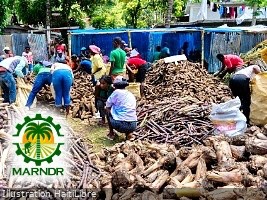
Scheduled across four days from April 7 to 10 2026, the annual Limbé agroforestry fair, hosted at twin venues in Camp-Coq and Acul Jeannot, has fully met all pre-event expectations, emerging as a key milestone for Haiti’s national push to cut household food insecurity and strengthen smallholder agricultural productivity.
The second day of the event drew a high-profile guest of honor: Aubourg Marcelin, Haiti’s Minister of Agriculture, Natural Resources, and Rural Development, whose presence underscored the Haitian government’s commitment to advancing rural development across the country’s northern and northeastern regions. Opening his remarks at the Camp-Coq venue, Minister Marcelin paid public tribute to small-scale agricultural producers across Limbé and Camp-Coq, framing them as core collaborative partners for the Ministry in advancing national food security goals.
This public-private partnership between the state and local farming communities takes tangible form on two fronts: the government provides targeted support to registered smallholders, including subsidized agricultural inputs and on-the-ground technical guidance, while local producers have turned out in high numbers and with clear enthusiasm to engage with the fair’s programming. Unlike many top-down agricultural initiatives, this event puts choice directly in the hands of farmers: beneficiaries can select their preferred inputs from a roster of 12 independent local suppliers operating at the venue.
Initial turnout data from the fair’s opening day confirms strong community buy-in, with roughly 250 registered farmers traveling to Camp-Coq to collect inputs allocated based on the size of their working farm plots. Under the current allocation scheme, a farmer working a 0.5-hectare plot is eligible to receive 500 yam seedlings, 400 banana suckers, and 250 sugarcane cuttings. Across the full four-day event, organizers project 1,093 registered beneficiaries will access subsidized inputs across both venues. For Camp-Coq participants alone, that adds up to a total distribution of 8,500 yam tubers, 3,500 banana suckers, and 4,000 sugarcane cuttings, sourced from 49 verified local agricultural suppliers. All inputs are reserved for pre-registered smallholders who hold active agricultural land to plant the received materials.
Beyond distributing critical growing materials, Minister Marcelin used the event to articulate the government’s core vision for the initiative: encouraging smallholders to ramp up production both to meet their own household food needs and to generate surplus for commercial sale, building long-term economic stability for rural families across the region. This aligned directly with the Haitian government’s official national mission to reduce widespread household food insecurity across the country.
The fair also served as a platform to highlight broader ongoing rural development work under the government’s Program to Support Agricultural and Fisheries Productivity and the Improvement of Rural Infrastructure for Market Access (PAPAIR), a multi-component initiative designed to remove systemic barriers to smallholder success. One of PAPAIR’s flagship projects is the rehabilitation of 75 kilometers of rural roads across Haiti’s North and Northeast departments, which will dramatically improve smallholders’ ability to transport harvested crops to regional markets in Limbé municipality. Currently, construction work on the road network is ongoing under the oversight of the United Nations Office for Project Services (UNOPS), with full project funding provided by the Inter-American Development Bank (IDB).
Marcelin also outlined two additional critical components of the PAPAIR program targeted at reducing systemic waste and boosting year-round productivity. The initiative is currently addressing widespread post-harvest losses, which the Ministry estimates reach 25% of total annual production across the region, as well as persistent gaps in consistent food stock availability after harvest seasons. To tackle these challenges, the government is already rolling out targeted support including the distribution of crop drying racks to help farmers preserve harvests, as well as water pumps to expand reliable irrigation for commercial plantations.
As the fair concludes, organizers and government officials report that the event has delivered on all its core commitments, providing tangible support to smallholders while advancing long-term goals for Haitian agricultural development and food security.