标签: Haiti

海地

  • Politic : 2026 Priorities, Strategic Retreat of the Ministry for the Status of Women

    Politic : 2026 Priorities, Strategic Retreat of the Ministry for the Status of Women

    In a significant move to advance gender equality, Haiti’s Ministry for the Status of Women and Women’s Rights (MCFDF) convened a three-day strategic retreat commencing January 17 at Pétion-ville’s Montana Hotel. The high-level gathering brought together senior ministry officials to formulate their 2026 Annual Work Plan (AWP) with particular focus on women’s political participation during Haiti’s upcoming electoral cycle.

    The retreat centered on four pivotal objectives: validating the 2026 AWP, ensuring strategic alignment with the National Action Plan derived from recent National Consultations, strengthening institutional capacities of MCFDF entities, and developing an administrative roadmap for implementing new organic decrees.

    Minister Pedrica Saint Jean emphasized the critical timing of this initiative, stating that strengthening MCFDF is ‘essential to guaranteeing effective, inclusive, and sustainable public policies.’ The ministry specifically outlined strategies to enhance women’s political representation, combat gender-based violence during elections, and advocate for equitable representation in decision-making bodies.

    The initiative received endorsement from UN Women, with Resident Representative Marie Goretti Nduwayo acknowledging the ministry’s efforts while expressing concern about persistent violence against women and social inaction. Nduwayo reaffirmed UN Women’s commitment to maintaining collaborative support for Haitian women’s empowerment.

    Minister Saint Jean characterized the retreat as a ‘consolidation mission’ aimed at establishing shared understanding of organizational frameworks and developing realistic implementation strategies rather than merely a routine meeting.


  • Environment : Historic Renewal of the Management Mandate for Grand Bois National Park

    Environment : Historic Renewal of the Management Mandate for Grand Bois National Park

    In a landmark decision for environmental conservation, Haiti’s National Agency for Protected Areas (ANAP) has formally extended the management agreement for Grand Bois National Park for an additional five-year term. The consortium comprising Haiti National Trust (HNT) and the Audubon Society of Haiti (SAH) will continue their stewardship of this critical biodiversity zone until 2030.

    The contract renewal, finalized last week between ANAP Director General Dr. Jean-François Thomas and prominent philanthropist Philippe Bayard representing HNT/SAH, reinforces a collaborative partnership established in 2020. This endorsement reflects the Haitian government’s sustained confidence in a governance model prioritizing scientific methodology, operational transparency, and meaningful community engagement.

    Notably, HNT and SAH maintain their unique status as the sole organizations in Haiti to both receive and successfully renew a delegated management mandate for a nationally protected area, signaling progressive evolution in the country’s environmental governance approaches.

    Ecological Transformation Achieved:
    Situated within the Massif de la Hotte region, Grand Bois National Park represents a globally significant reservoir of biodiversity, sheltering numerous critically endangered plant and amphibian species found nowhere else on Earth.

    Since commencing interventions in 2015 and formalizing management in 2020, the HNT/SAH alliance has orchestrated remarkable ecological recovery. Their comprehensive restoration initiative has resulted in the planting of over 321,800 indigenous trees and rehabilitation of more than 84 hectares of forest cover—approximately 23% of the park’s total area. Through strategic management of invasive species and promotion of natural regeneration processes, the ecosystem is progressively reclaiming its biological equilibrium, emerging as a crucial sanctuary for threatened wildlife.

    Community-Centric Conservation Model:
    The park’s management framework deeply integrates local populations, with resident-hired forest rangers conducting daily surveillance to combat deforestation and illegal grazing while simultaneously supporting restoration operations.

    Peterson Désir, a Sevré community member, attested to the transformative impact: ‘Thanks to restoration efforts, rainwater no longer erodes our trails. We’ve ceased tree cutting because we recognize the park reciprocally protects us.’

    The initiative demonstrates strong gender inclusion, with women constituting 40% of the workforce engaged in nursery operations and ecological rehabilitation activities.

    Strategic Vision 2026-2030:
    The renewed mandate outlines three primary objectives for the upcoming term:
    • Geographical expansion of restoration initiatives into newly identified priority zones
    • Enhanced professional development for forestry personnel and strengthened scientific research programs
    • Development of sustainable economic alternatives to benefit surrounding communities

  • LHF Playoff D1 : Matchday 2 Results and Matchday 3 Schedule

    LHF Playoff D1 : Matchday 2 Results and Matchday 3 Schedule

    The Haitian LHF Playoff Division 1 championship entered its second matchday with heightened intensity as teams battled for supremacy in both Northern and Southern conferences. The playoff landscape continues to evolve with dramatic results that could determine the ultimate championship contenders.

    In Northern Conference action, Baltimore SC emerged victorious with a hard-fought 1-0 win against Ouanaminthe FC at Park Notre Dame. The decisive moment arrived in the 33rd minute when Alexandre Rempart found the back of the net, securing three critical points for Baltimore and establishing their position as serious playoff contenders.

    The second Northern matchup between AS Capoise and Racing FC concluded in a tense stalemate, with neither team able to break the deadlock at Park Levelt. The goalless draw leaves both teams seeking offensive solutions as the playoffs progress.

    Southern Conference proceedings delivered equal drama as Cavaly AS and Racing CH battled to a 1-1 draw at Park G. Christophe. Cavaly AS initially seized control when Marc Antonio converted a spectacular free kick in the 16th minute. However, Racing CH demonstrated resilience with James Jean equalizing in the 77th minute, salvaging a valuable point for his squad.

    The final Southern encounter saw Juventus FC and Violette AC engage in a tactical stalemate, resulting in another 0-0 draw at Land Des Gabions. Both defensive units demonstrated exceptional organization throughout the match.

    Attention now turns to Matchday 3 scheduled for Sunday, January 18, 2026, with all matches commencing simultaneously at 3:00 PM local time. The Northern Conference will feature AS Capoise versus Ouanaminthe FC at Parc Saint-Victor, while Racing FC faces Baltimore SC at Parc Vincent. Southern matchups include Violette AC against Racing CH at Parc Sainte-Thérèse and Juventus FC versus Cavaly AS at Land des Gabions.

  • Technology : Construction of a major solar power plant in Jacmel

    Technology : Construction of a major solar power plant in Jacmel

    In a landmark move for Haiti’s renewable energy transition, the Ministry of Public Works, Transport and Communications (MTPTC) has formally initiated construction of a major solar power facility in Jacmel through a signed agreement with international firm ESD Engineering Services S.R.L. The January 15, 2026 signing ceremony witnessed Minister Raphaël Hosty and ESD CEO Sang Min Choi formalizing the partnership, with key energy sector officials including leadership from Électricité d’Haïti (EDH) in attendance.

    Funded by a US$7 million World Bank allocation through the Scaling Up Renewable Energy (SREP) program, the comprehensive project represents a technological leap forward for Haiti’s energy infrastructure. The Mont-Fleuri located facility will feature a 4 MW photovoltaic solar array with minimum guaranteed output of 3.35 MW, complemented by a sophisticated 6 MWh lithium-ion battery energy storage system (BESS). The initiative further includes substantial grid enhancements comprising approximately 4 kilometers of low-voltage and 7 kilometers of medium-voltage (23 kV) transmission lines.

    The installation’s advanced grid-forming technology ensures continuous electrical stability regardless of sunlight availability or potential shutdowns of existing thermal generation facilities. Managed under close supervision by the MTPTC’s Energy Unit, this project serves as a demonstration model intended to validate renewable energy viability throughout Haiti with potential for nationwide replication.

    This partnership marks a strategic government effort to diminish fossil fuel dependency while promising enhanced electricity reliability for Jacmel residents. The project symbolizes Haiti’s commitment to sustainable economic development through innovative energy solutions.

  • Finance : «Haiti doesn’t suffer from a lack of capital» (video)

    Finance : «Haiti doesn’t suffer from a lack of capital» (video)

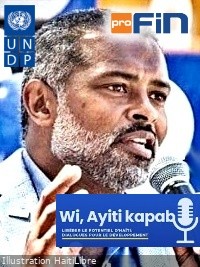
    In a recent installment of the United Nations Development Programme’s (UNDP) series “Wi, Ayiti Kapab” (Yes, Haiti is Capable), financial expert Robert Jr. Paret presented a paradigm-shifting analysis of Haiti’s economic challenges. As CEO of ProFin Group and founder of Haiti’s inaugural licensed investment bank, Paret contends that the nation’s fundamental issue isn’t capital deficiency but rather capital fragmentation.

    Paret’s assessment reveals that Haiti receives over $4 billion in diaspora remittances annually alongside substantial domestic savings. However, the country lacks the necessary infrastructure to effectively consolidate, intermediate, and productively deploy these financial resources. “This isn’t a problem of resources,” Paret emphasized. “It’s a problem of market design.”

    The financial expert outlined four critical strategies for addressing Haiti’s capital utilization challenges: transforming frequent remittances into patient, long-term capital; designing investment vehicles that connect diaspora wealth with local opportunities; reducing entrepreneurial risks through structured capital allocation; and building institutional trust within frontier markets.

    ProFin Group serves as a practical case study in bridging the gap between capital sources and users within complex operational environments. Rather than offering theoretical solutions, Paret provides concrete methodologies for constructing financial markets from foundational levels.

    The UNDP’s “Wi, Ayiti Kapab” series continues to showcase innovative approaches to Haiti’s development challenges, with this episode focusing specifically on financial system restructuring as a pathway to sustainable economic growth.

  • Politic : The decree on freedom of expression is «a tool of political repression» says FJKL

    Politic : The decree on freedom of expression is «a tool of political repression» says FJKL

    In a striking development for civil liberties in the Caribbean nation, the Haitian human rights organization Fondation Je Klere (FJKL) has issued a forceful condemnation of newly enacted legislation governing freedom of expression. The presidential decree, formally adopted by Haiti’s Transitional Presidential Council (CPT) on December 18, 2025, and officially gazetted on December 31, has sparked immediate concerns about democratic backsliding.

    The FJKL’s comprehensive analysis, published January 15, 2026, characterizes the measure as fundamentally repressive and incompatible with constitutional governance. The organization asserts that the CPT has overstepped its authority by legislating in domains constitutionally reserved for Parliament, thereby violating both domestic law and international human rights commitments.

    Legal experts examining the decree identify particularly problematic provisions in Articles 4 and 5, where nebulous terminology regarding ‘public order’ and ‘national security’ creates significant potential for arbitrary enforcement. These vaguely defined concepts could enable authorities to suppress legitimate political opposition under the guise of maintaining stability.

    While ostensibly designed to protect journalists, the legislation instead establishes mechanisms that facilitate their detention based on either flagrancy allegations or simple complaints, with inadequate procedural safeguards. The definition of defamation has been expanded to such an extent that it effectively criminalizes standard journalistic criticism, while simultaneously removing truth as a valid defense against charges.

    The penal provisions introduce severe sentencing guidelines, including prison terms of up to three years for defamation and forced labor sentences extending to two decades for insulting national symbols. Additionally, the statute of limitations for these offenses has been extended to five years.

    Perhaps most alarmingly, Article 18 mandates that digital platforms retain and surrender identifying information of users accused of publishing ‘illegal content,’ directly contravening constitutional protections for source confidentiality. The FJKL concludes that these measures collectively represent a return to the most oppressive periods in Haiti’s political history, constituting a deliberate instrument of political repression rather than good-faith regulation.

  • Politic : Inauguration of the new premises of the Chancellery

    Politic : Inauguration of the new premises of the Chancellery

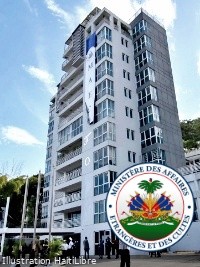
    Haiti’s Ministry of Foreign Affairs has officially relocated to a modern 12-story facility in Pétion-Ville, marking a significant upgrade in the nation’s diplomatic infrastructure. The newly acquired Gala Tower at 15 Rue Mangonès, previously owned by a senior ministry official, now serves as the central hub for Haiti’s international relations operations.

    The inauguration ceremony on January 15, 2026, gathered Haiti’s highest-ranking officials including Prime Minister Alix Didier Fils-Aimé, Chancellor Jean-Victor Harvel Jean-Baptiste, and members of the Presidential Transitional Council. The event also drew former ministers, senior civil servants, and representatives from the diplomatic corps, creating a solemn atmosphere befitting the occasion.

    Laurent Saint-Cyr, President pro tempore and Coordinator of the Transitional Council, delivered a keynote address emphasizing the institutional significance of the new chancellery. He articulated a vision for transforming the space into a strategic decision-making center operating on principles of ethics, performance, and national interest. Saint-Cyr called for a revitalized Haitian diplomacy characterized by proactive engagement, inclusivity, and sharper focus on national priorities. He further advocated for strengthened international partnerships and greater inclusion of women and young professionals in diplomatic service.

    The property acquisition, whose financial details remain undisclosed, provides the ministry with facilities that meet international embassy standards. This upgrade enables Haiti to host foreign dignitaries and government officials in appropriate settings while offering improved service delivery to citizens requiring consular assistance.

  • Education : Installation of members of the Council of Higher Education and Scientific Research

    Education : Installation of members of the Council of Higher Education and Scientific Research

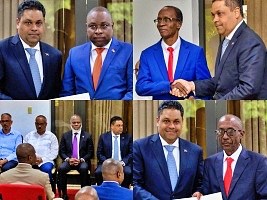
    In a significant move to revitalize Haiti’s education system, the Presidential Transitional Council (CPT) formally installed members of the Council of Higher Education and Scientific Research on January 14, 2026. The inauguration ceremony, held at the Villa d’Accueil, marked a pivotal moment in the nation’s ongoing educational reform efforts.

    The event was attended by Prime Minister Alix Didier Fils-Aimé, government officials, and representatives from the diplomatic and consular corps, underscoring the importance of this initiative to Haiti’s development agenda.

    Laurent Saint-Cyr, President pro tempore and Coordinator of the Transition Council, delivered a keynote address emphasizing the transformative potential of this new governing body. He characterized the establishment of the National Agency for Higher Education and Scientific Research (ANESRS) as a fundamental commitment by the state to provide quality education that creates tangible opportunities for Haitian youth while advancing national progress.

    Saint-Cyr articulated the Council’s primary mission: to enhance the recognition, quality, and prestige of Haitian academic credentials internationally. This strategic focus aims to create improved integration pathways, mobility options, and excellence standards for students, simultaneously strengthening Haiti’s position within global academic and scientific communities.

    The Council’s formation represents Haiti’s deliberate strategic decision to center intelligence, scientific knowledge, and research within its national development framework. Members were reminded of their responsibility as guardians of academic excellence, particularly in an era where science, innovation, and education serve as critical drivers of economic, social, and institutional advancement.

    The newly installed Council leadership includes Dr. Hérold Toussaint as President, Dr. Jean Fénol Métellus as Vice-President, and Dr. Jacques Abraham as High Commissioner for Higher Education and Scientific Research. Additional members comprise Dr. Jean Judson Joseph as Secretary General, along with Dr. Evens Emmanuel, Dr. Kitty Balthazard-Accou, and Dr. Serge Philippe Pierre as Council members.

  • Politic : Two new directors installed at the Ministry of Women’s Affairs

    Politic : Two new directors installed at the Ministry of Women’s Affairs

    In a significant administrative reshuffle, Haiti’s Ministry of Women’s Affairs and Women’s Rights has officially installed two new directors to lead critical divisions within the institution. The ceremony, presided over by Minister Pedrica Saint Jean on January 14, 2026, marks a strategic move to enhance the ministry’s operational effectiveness.

    The installation proceedings witnessed the participation of key officials including Acting General Director Eugénie Lybéral, members of the minister’s cabinet, and Acting Human Resources Director Evelyne Bien-Aimé, underscoring the importance of these appointments within the governmental structure.

    Ronique Paul Jean, previously serving as West Departmental Director, has been appointed to lead the Directorate for Combating Violence Against Women and Girls. In her inaugural address, Jean emphasized her commitment to implementing “committed, rigorous and results-oriented leadership” focused on institutional enhancement and intensifying efforts against gender-based violence.

    Concurrently, Marie Carline Laurenceau transitions from her previous role leading the violence prevention directorate to assume command of the Departmental Directorate Coordination Unit. Laurenceau pledged to leverage her expertise to foster knowledge sharing, team collaboration, and capacity building among departmental directorates, aiming to improve service quality across Haiti’s territories.

    These strategic personnel changes reflect the ministry’s comprehensive reform initiative to establish a more robust, coherent institutional framework better equipped to address the practical realities facing Haitian women and advance their rights through more effective public policy implementation.

  • FLASH : Mgr. Dumas withdraws from the mediation process and explains his decision

    FLASH : Mgr. Dumas withdraws from the mediation process and explains his decision

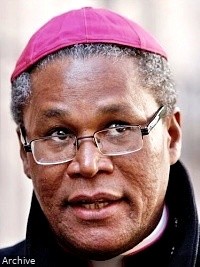
    In a significant development within Haiti’s ongoing political crisis, Bishop Pierre-André Dumas of Anse-à-Veau and Miragoâne has formally withdrawn from his potential role as national mediator. The announcement came through an extensive statement released on social media platforms on January 14, 2025.

    The bishop, who also serves as Vice-President of the Haitian Episcopal Conference, clarified that his initial involvement stemmed from external requests by political coalitions, civil society organizations, and international figures rather than personal ambition. He emphasized that his participation was always conceived within a strictly pastoral context, aligned with Church teachings but not as an official representative of Haiti’s Conference of Bishops.

    Bishop Dumas articulated his philosophical approach to conflict resolution, referencing the Church’s ‘culture of encounter’ principle that emphasizes inclusive listening and dialogue without condemnation. His vision centered on creating spaces where constructive conversation could replace violence, though he explicitly denied any intention to develop political solutions directly.

    However, recent developments including misinformation campaigns, misinterpretations of his role, and apparent political manipulation have compelled his withdrawal. After consulting with advisors and engaging in spiritual reflection, the bishop determined that continued operational involvement would be counterproductive to the peace process.

    Notably, Bishop Dumas referenced personal physical scars from past violence as symbolic of Haiti’s broader wounds from internal divisions and fratricidal conflicts. Despite his withdrawal from formal mediation, he reaffirmed his unwavering belief in Haiti’s potential for renewal and called for authentic Haitian-led solutions faithful to the nation’s founding ideals of liberty, equality, and fraternity.

    The bishop’s statement concludes with a powerful call to honor Haitian sovereignty while choosing responsibility and hope, maintaining his commitment to supporting dialogue and national reconstruction through spiritual rather than political channels.