
标签: Haiti

海地

  • World Environment Day 2026 : Green Jobs and Citizen Action

    World Environment Day 2026 : Green Jobs and Citizen Action

    To mark 2026 World Environment Day, Haiti’s Ministry of the Environment oversaw a sweeping national series of public engagement, education, and conservation activities across all 10 of the country’s departmental jurisdictions on June 5, 2026. The nationwide campaign highlighted the critical role of grassroots citizen action and green economic opportunity in building a more sustainable future for the Caribbean nation.

    In the northern department, outreach teams brought environmental education programming to more than 1,200 secondary and primary students across multiple municipalities including Cap-Haïtien, Acul-du-Nord, and Plaine-du-Nord. Event organizers hosted interactive panel discussions, community awareness walks, and completed a large-scale native energy forest restoration project in Mapou, Plaisance. Moving east to the Northeast department, 500 area schoolchildren learned about the devastating impacts of plastic pollution and the urgency of ecosystem restoration, capped off by a community tree planting drive in Morne-Casse and a cross-school public awareness campaign.

    In Haiti’s Northwest, pre-event preparations centered on upskilling local journalists and educators to accurately communicate climate change science, facilitate cross-stakeholder dialogue, and lead consistent community outreach. On World Environment Day itself, the department hosted a public awareness march, a full beach cleanup operation in Haut-Fourneau, the planting of 500 coconut saplings, and guided educational activities in the region’s critical coastal mangrove ecosystems out of Port-de-Paix.

    The Artibonite department continued its long-running work to mobilize local communities around natural resource conservation and improvements to public living conditions through targeted outreach. In the Centre department, activities centered on youth engagement, watershed protection, and widespread adoption of eco-friendly daily practices. The West Department intensified school-focused outreach, holding a public tree planting event at the Canapé-Vert Urban Nature Park and launching a large awareness campaign across multiple schools in the Delmas and Pétion-ville districts.

    In Nippes, more than 1,500 students and teachers from 15 schools across five departmental municipalities participated in organized activities, with the department’s 2026 Eco-Genius environmental competition serving as a centerpiece of the day’s celebrations. The southern department reached nearly 3,000 students through a multi-municipality education campaign focused on waste management, natural resource protection, and climate change adaptation, with sustained community mobilization and additional tree planting wrapping up the day’s events.

    The Southeast department broke new ground by hosting the region’s first ever Departmental Forum on Climate Change, an extension of the ongoing “Environmental Fridays” and national Eco-Genius public education programs. Beyond the forum, local organizers distributed clean, energy-efficient eco-stoves to households in Belle-Anse, hosted targeted climate and energy professional training sessions, held a public environmental fair, and organized a public awareness parade through the coastal town of Jacmel. In Grand’Anse, planning centered on cross-institutional collaboration and partner mobilization, with a specific focus on protecting the Clément Spring, a critical source of drinking water for the city of Jérémie.

    At the national level, the Ministry of the Environment hosted a flagship open house event at the Karibe Hotel in Pétion-ville, themed “Green Jobs Serving a Sustainable Haiti”. Held under the official patronage of Haiti’s Prime Minister, the gathering brought together a diverse cross-section of stakeholders: technical teams from across the Ministry, leadership from the National Agency for Protected Areas (ANAP), the National Solid Waste Management Service (SNGRS), and the Bureau of Mines and Energy (BME), private environmental enterprises, local recycling artisans, academic researchers, international technical and financial partners, and hundreds of participating students and young activists.

    The national event featured three interconnected exhibition zones showcasing institutional environmental initiatives, artisanal upcycled goods, and green small business innovations. Organizers also held public conferences exploring green job growth and the potential of Haiti’s blue economy, hands-on educational activities for young attendees, and an official opening ceremony that included the public reading of student letters outlining collective visions for a healthy, sustainable Haitian environment by 2050.

  • 2026 World Cup Preparation : In a friendly match, Haiti loses [2-1] against Peru (video)

    2026 World Cup Preparation : In a friendly match, Haiti loses [2-1] against Peru (video)

    With the 2026 FIFA World Cup just days away, Haiti’s national men’s football team, nicknamed the Grenadiers, suffered a heart-wrenching 2-1 defeat to Peru in their final pre-tournament friendly on Friday, June 5, hosted at DRV PNK Stadium in Miami, Florida. The result marked a disappointing end to Haiti’s warm-up campaign, just one week after the side delivered a dominant 4-0 rout of New Zealand in their first preparation match.

    Ranked 82nd in the FIFA global rankings, Haiti entered the match as the underdog against 51st-ranked Peru, but head coach Sébastien Migné, a French tactician, shuffled his lineup to test depth ahead of the tournament. Making four changes to the starting XI that defeated New Zealand, Migné gave starts to Hannes Delcroix, Jeanricner Bellegarde, Louicius Deedson and Frantzdy Pierrot, rounding out a starting roster that featured players plying their trade across top leagues in Europe, North America and South America. Johnny Placide started in goal, with Carlens Arcus, Martin Expérience, Ricardo Adé and Delcroix forming the defensive line. Jean-Jacques Danley and Bellegarde anchored the midfield, while Deedson, Ruben Providence, Wilson Isidor and Pierrot made up Haiti’s attacking unit.

    The match unfolded as a stunning display of resilience from Haiti through 75 minutes, with the underdog side taking an early lead. In the 16th minute, Deedson set up Isidor for a clinical finish that put Haiti up 1-0, a lead the Grenadiers protected for more than an hour of play. As the second half wore on, both teams rotated their squads heavily to test depth: Haiti made eight substitutions between the 59th and 85th minutes, swapping out every starting outfield player to give reserve players critical pre-tournament minutes.

    But in a dramatic late turnaround, Peru struck twice in just three minutes to steal the win. Renzo Garcés netted the equalizer for Peru in the 81st minute, leveling the score at 1-1, before Jairo Vélez put Peru ahead just three minutes later. No further goals followed, locking in a 2-1 victory for the South American side. The match also saw six yellow cards issued, with four going to Peru players (Alfonso Barco, André Carrillo, Erick Noriega, Adrián Ugarriza) and one to Haiti substitute Wilguens Paugain.

    Haiti is set to make its World Cup appearance in Group C, with all three of its group stage matches hosted on U.S. soil. The Grenadiers will kick off their tournament campaign against Scotland on June 13 at Boston’s Gillette Stadium, before facing five-time world champions Brazil at Philadelphia’s Lincoln Financial Field on June 19. The side will wrap up group play against Morocco, the 2022 World Cup semi-finalists and current top-ranked African nation, at Atlanta’s Mercedes-Benz Stadium on June 24. The tough group pits Haiti against three of international football’s most consistent sides, testing the underdog Grenadiers as they make their run in the 2026 tournament.

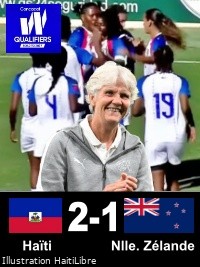
  • Brazil 2027 Preparation : Victory for the Grenadières [2-1] against New Zealand (video)

    Brazil 2027 Preparation : Victory for the Grenadières [2-1] against New Zealand (video)

    As preparation for the final round of 2027 FIFA Women’s World Cup qualifiers in Brazil continues, Haiti’s women’s national football team, the Grenadières, claimed a hard-fought 2-1 friendly victory over New Zealand’s Ford Football Ferns at Spain’s El Mauli Stadium in Antequera, Malaga Province, on June 5, 2026. Ranked 47th globally, the side put in a disciplined, organized performance that perfectly executed the game plan drawn up by their veteran Swedish head coach Pia Sundhage, building on a dominant 4-0 win over the same opponent just three days prior.

    Ahead of the match, the squad received a major boost with the return of star midfielder Melchie Daëlle Dumornay, widely known by her nickname “Corventina”, who had missed the team’s previous training camp. The fixture also marked a milestone for young Paris Saint-Germain shot-stopper Océane Toussaint, who earned her first start in the national team’s starting eleven.

    Haiti’s starting lineup featured a mix of experienced talent and rising young players plying their trade across top European and American clubs. Alongside Toussaint in goal, the defensive line included Kethna Louis of Montpellier Hérault SC, Jennyfer Limage of RC Lens, Tabita Dougenie Joseph of Olympique de Marseille, and Claire Constant of DC Power FC. Sherly Jeudy joined Dumornay in the midfield, while the attacking unit was led by captain Nerilia Mondesir of Seattle Reign FC, Darlina Florsie L. Joseph of Toulouse FC, Roseline Eloissaint of FC Nantes, and Lourdjina Etienne of FC Fleury.

    New Zealand got on the scoreboard first in the 41st minute, when Michaela Foster swung a long-range free kick into the Haitian penalty area. New Zealand defender Claudia Bunge rose above the defense to plant an unstoppable header past Toussaint, putting the Football Ferns up 1-0 going into halftime.

    Haiti responded quickly after the opening goal, forcing New Zealand goalkeeper Alina Santos into a critical save just minutes after Bunge’s strike. The Grenadières kept up relentless pressure through the closing stages of the first half, and found their equalizer deep into first-half stoppage time. In the 45+3rd minute, Mondesir converted a well-placed free kick from the right touchline to level the score at 1-1, sending the sides into the break all square.

    Just two minutes into the second half, Haiti grabbed the lead for good. Dumornay, who had already set up one scoring opportunity earlier in the match, orchestrated a quick attacking move that outpaced New Zealand’s backline, playing a perfectly weighted through ball to Etienne. The FC Fleury forward calmly slotted the ball past the onrushing Santos to put Haiti up 2-1, a scoreline that would hold until the final whistle.

    From that point, Haiti took control of the game’s tempo, absorbing New Zealand pressure and protecting their narrow lead. The Football Ferns struggled to generate clear scoring chances for most of the second half, and their few late attacking attempts were all turned away by Toussaint and the Haitian defense.

    The win marks another positive milestone for the Grenadières as they gear up for the 2027 Women’s World Cup final qualifying phase, which will run from June 24 to July 25 next year in Brazil. The side is set to continue their warm-up campaign with another friendly against Equatorial Guinea, nicknamed the Nzalang (meaning “lightning” in a Bantu language), on June 8 at Juventus Stadium in Torremolinos, Malaga Province, with kickoff scheduled for noon local time in Haiti.

  • Geneva : Speech by Haitian Minister Nelson at the 114th International Labour Conference (video)

    Geneva : Speech by Haitian Minister Nelson at the 114th International Labour Conference (video)

    GENEVA — On June 4, 2026, Marc-Elie Nelson, Haiti’s Minister of Social Affairs and Labor, delivered a landmark address to delegates gathered at the 114th International Labour Conference, hosted by the International Labour Organization (ILO) in Geneva. During his speech, Nelson laid out a clear vision for deepened collaboration between Haiti and the global labor body, framing targeted cooperation as a critical catalyst to renew systems that deliver inclusive growth, open constructive social dialogue, and expand access to dignified work across the Caribbean nation.

    A central priority of Nelson’s address was a formal call for a strengthened ILO footprint within Haiti, anchored by the establishment of a permanent ILO representative office in the country. He emphasized that the ILO’s decades of specialized global expertise would be transformative for Haiti’s ongoing efforts to update its national labor framework, bringing local legislation into full alignment with internationally recognized labor standards and adapting rules to match the shifting demands of the modern global workforce.

    Nelson also used the platform to highlight the Haitian government’s ongoing domestic progress on worker welfare, specifically pointing to recent policy efforts to raise the national minimum wage and expand social safety net coverage for Haitian working people. These steps, he argued, reflect the administration’s commitment to centering worker well-being in national policy priorities.

    In addition to bilateral cooperation priorities, Nelson offered public praise for ILO Director-General’s recently released report, *A moment of choice: Harnessing artificial intelligence for decent work*. He noted that the report makes a substantial and timely contribution to global conversations about the future of work, and underscored the meaningful opportunities that AI can bring to expanding labor access and improving working conditions when governed responsibly.

    Closing his address, Nelson offered a reflection on what defines a successful nation: “Nations are not measured solely by the size of their economies or the strength of their institutions. They are also measured by how they treat those whose work builds their future.” He concluded by reaffirming that, regardless of political or economic differences between nations, global leaders share a universal core responsibility: to “enable every woman and man to live from their work with dignity, justice, and hope.”

  • A Haitian-American woman from Jacksonville (FL) pleads guilty to illegally shipping firearms

    A Haitian-American woman from Jacksonville (FL) pleads guilty to illegally shipping firearms

    A federal court case has exposed a large-scale illicit weapons trafficking ring that moved firearms from Florida to violent gangs in Haiti, with a local Haitian-American woman admitting her role in the scheme. U.S. Attorney Gregory W. Kehoe for the Central District of Florida announced May 6 that 28-year-old Francesca Charles of Jacksonville, Florida, has pleaded guilty to two key charges: conspiracy to smuggle goods out of the United States and illegal shipment of firearms and contraband. Charles now faces a maximum possible sentence of 20 years in federal prison, with her sentencing hearing scheduled to take place August 18.

    The case traces back to a major 2025 seizure by Dominican law enforcement, who intercepted a shipping container traveling from Miami bound for Haiti. Inside the container, authorities found a massive cache of illegal weaponry: 25 total firearms, including a .50 caliber Barrett sniper rifle, 17 7.62 caliber rifles, one 9mm rifle, five 9mm Glock pistols, an Uzi submachine gun, plus more than 36,000 rounds of mixed-caliber ammunition, 18 assault rifle magazines, 13 9mm magazines, one .50 caliber magazine, and a firearm silencer.

    Joint investigation by agents from the Bureau of Alcohol, Tobacco, Firearms and Explosives (ATF), the Florida Attorney General’s Office, and Homeland Security Investigations (HSI) traced the seized weapons to three Florida-based co-conspirators: Charles, 32-year-old Jacques Pierre and 34-year-old Jeff Pierre, both Haitian citizens residing in the state. Investigators confirmed the trio purchased at least 20 of the 23 recovered firearms included in the seized cache.

    A deeper probe into the group’s activities found that between May 2024 and February 2025, the three defendants acquired at least 46 firearms total, most matching the makes and models of weapons recovered in the Dominican Republic. Thirty-seven of these weapons were bought in just a six-month window between August 2024 and February 2025, with Charles alone accounting for purchases of at least 24 of the 46 documented firearms. Court records also show Jacques Pierre purchased two .50 caliber Barrett rifles – heavy, vehicle-mounted military-grade weapons that are widely used by gangs and drug cartels for violent operations.

    The two Pierre brothers remain involved in separate ongoing legal proceedings. Both have been indicted on charges of conspiracy to smuggle goods, illegal firearms trafficking, and smuggling goods out of the United States. If convicted on all counts, each also faces a maximum sentence of 20 years in federal prison.

  • A haitian police officer implicated in a case of rape of a 14-year-old minor

    A haitian police officer implicated in a case of rape of a 14-year-old minor

    A shocking allegation of sexual violence against a minor has sparked official outrage in Haiti, where a serving police officer has been summoned to face rape charges connected to an attack on a 14-year-old girl. The case, which unfolded in the Grand’Anse department’s Bac police sub-station, has drawn a firm public rebuke from Pedrica Saint Jean, Haiti’s Minister for the Status of Women and Women’s Rights, who released a formal statement on June 3 detailing her indignation and deep concern over the accusations.

    According to official court documents, the Chief Prosecutor of Jérémie has issued a formal summons to Roneld Nelson, the police officer assigned to the Bac sub-station. Nelson is accused of carrying out the sexual assault against the young teen on the grounds of the police facility itself. Beyond the core rape allegation, reports also point to a suspected attempt to bribe the victim’s family into remaining silent about the incident.

    In her statement, Minister Saint Jean emphasized that if proven, these acts would amount to an unconscionable violation of the child’s fundamental rights. “These would not only harm the victim’s physical and psychological well-being, but also represent an unacceptable assault on the core values of justice, protection, and human dignity that all public institutions are obligated to uphold,” she wrote.

    The minister drew a clear line in her stance on gender-based and child violence, stressing that sexual violence against women, girls and children is an egregious crime that cannot be tolerated, shielded from accountability, or left unpunished — no matter what official position or authority the perpetrator holds.

    Saint Jean also praised the bravery of the victim and her family, who pushed ahead with reporting the case despite reported attempts to pressure them into dropping the allegation. She noted that their choice to trust Haiti’s judicial system sets an important example for other survivors of violence.

    The Ministry for the Status of Women and Women’s Rights has issued an official call for Haiti’s competent judicial and law enforcement bodies to launch a rigorous, impartial, fully transparent and prompt investigation into the allegations. The goal of the probe, the ministry says, should be to uncover the full truth of the incident and assign all legal responsibilities in line with Haitian law.

    Closing her statement, Saint Jean reaffirmed her unwavering solidarity with the victim, her family, and all people impacted by the case, while restating her commitment to building a Haitian society where the rights, dignity and personal safety of all women, girls and children are fully protected under the law.

  • Leisure : Did you know ? #30

    Leisure : Did you know ? #30

    In the 30th installment of the popular HaitiLibre “Did You Know” educational quiz series, published on April 6, 2026, readers learn little-known details about one of Haiti’s most important commercial fish: the snapper, locally known as “Sardinian”.

    Contrary to common assumption, the locally labeled “Sardinian” is not a single species, but actually encompasses multiple varieties from the Lutjanidae fish family. Easily recognizable to consumers by its signature pink or vivid red scales, the snapper is prized across Haiti for its firm, pale, and exceptionally flavorful flesh, cementing its position as the top-selling fish in every national market.

    For small-scale Haitian fishermen, catching snapper is far more than just another catch—it is a primary revenue stream that supports thousands of coastal households. The fish’s consistently high demand comes from both bustling urban restaurants and local families, who incorporate it into everything from holiday feasts to the iconic traditional dish “coarse salt fish”. Driven by its strong market value, fishermen have adopted specialized harvesting methods, including deep-water traps and longlines, to target the popular species.

    However, the article also highlights a growing sustainability challenge: intense commercial demand has placed heavy pressure on snapper populations, which inhabit Haiti’s coastal reef ecosystems. To prevent irreversible overexploitation that would threaten both the species and the livelihoods that depend on it, experts and fisheries managers are calling for strengthened monitoring and regulation of reef fishing areas.

    Beyond its economic importance, “Sardinian” snapper holds deep cultural meaning for Haiti, standing as a benchmark of the country’s domestic fishing production and a cornerstone of both national gastronomy and the coastal maritime economy.

    This fact was originally released as part of the answer key for the HaitiLibre Quiz platform, an educational general knowledge project launched by Haitian news outlet HaitiLibre. The free, no-registration platform offers multiple-choice quiz games across hundreds of topics, from Haitian culture and history to global current events, catering to all skill levels with three difficulty tiers: easy, intermediate, and hard. All content is available in both French and English for broad accessibility.

    As of the most recent monthly update on June 1, 2026, 31 new quiz games were added to the platform, bringing the total number of active games to 150. New quizzes are added every month to keep content fresh, and the platform includes a dedicated expert menu for users seeking more challenging knowledge tests. HaitiLibre invites readers to explore the platform, share it with friends and family, and submit feedback to help expand the project.

  • Women’s Brazil 2027 Preparation : D-1, New Zealand vs Haiti (Friendly Match)

    Women’s Brazil 2027 Preparation : D-1, New Zealand vs Haiti (Friendly Match)

    As the countdown to the 2027 FIFA Women’s World Cup final qualifying phase ticks on, Haiti’s senior women’s national football team, the Grenadières, has finalized its roster for two critical warm-up international friendlies, marking a key milestone in their journey to Brazil 2027. With the first clash against New Zealand’s Football Ferns just one day out as of the report, the team will also face off with Equatorial Guinea’s Nzalang, a name meaning “lightning” in a Bantu language, in back-to-back fixtures hosted in southern Spain. This preparation run comes ahead of the final qualifying round set to run from June 24 to July 25, 2027.

    Veteran Swedish head coach Pia Sundhage, who took charge of the Grenadières in recent months, named a 25-player squad that balances returning experience, recovering talent, and exciting new prospects. Several key players who missed out on Haiti’s previous international window in April 2026 have earned recalls to the side, including defenders Nya Jean-Baptiste of the United Futbol Academy and Milan P. Jerome of Hungary’s DVTK. The most notable inclusion for this camp is 17-year-old youth international Keisha Gue, a promising attacker who currently plies her trade at Heat Surf Las Vegas in the U.S. after developing in Canada, earning her first ever call-up to the senior national side.

    The revised squad features a mix of homegrown and Europe-based talent across all positions. In goal, Sundhage has selected three keepers: Kaina César V. Pietrus of Lipscomb University (USA), Oceane Toussaint of Paris Saint-Germain (France), and Nelly Maignant of Sarcelles (France). The defensive line includes Kethna Louis (Montpellier, France), Jennyfer Limage (RC Lens, France), Amandine Pierre-Louis (AS Saint-Étienne, France), Tabita Dougenie Joseph (Marseille, France), Claire Constant (Power FC, USA), Cassandra Decombe (FC Laval, Canada), Alyssa S. Manasse (Blue/Somerest), alongside the two returning defenders.

    In midfield, the roster includes Deborah Bien-Aime (AS Saint-Étienne, France), Sherly Jeudy (RC Lens, France), star playmaker Melchie D. Dumornay (Olympique Lyonnais, France), Anyssa Ibrahim (Le Mans FC, France), Dayana Pierre-Louis (Royal Utah, USA), Josephine Vanuxeem (Lille, France), with new addition Amelie Joseph of FC Metz. Up front, the attacking group features Chelsea A. Domond (Guingamp, France), Roseline Eloissaint (FC Nantes, France), Nerilia Mondesir (Seattle, USA), Lourdjina Etienne (FC Fleury, France), and the debutant Keisha Gue.

    Both friendly matches will be hosted in Spain’s Malaga Province, allowing the squad to train and compete in a European environment ahead of their qualifying campaign. The first fixture, Haiti against New Zealand, is scheduled for June 5, 2026, kicking off at noon local Haiti time at El Mauli Stadium in Antequera. Three days later, on June 8, the Grenadières will take on Equatorial Guinea at the Juventus Stadium in Torremolinos, kicking off at the same noon Haiti time. For the Haitian side, these fixtures represent a valuable opportunity to test tactics, integrate new players, and build match fitness as they target qualification for the 2027 Women’s World Cup in Brazil, one of the team’s most ambitious goals in recent history.

  • FLASH : Open conflict between the CEP and the Executive Branch

    FLASH : Open conflict between the CEP and the Executive Branch

    A high-stakes public confrontation has broken out between Haiti’s Provisional Electoral Council (CEP) and the country’s executive branch, fueled by unilateral actions from the government of Alix Didier Fils-Aimé that have thrown upcoming electoral processes into uncertainty. The clash began on June 2, 2026, when the Council of Ministers approved an electoral decree drafted directly from the Prime Minister’s office, rejecting the full draft proposal that the CEP had submitted to the executive branch back on April 24, 2026. The government’s version of the decree, which was published in the special 27th issue of Haiti’s official gazette Le Moniteur, bears no resemblance to the CEP’s original draft, and was never put forward for discussion or approval by the independent electoral body. Multiple members of the CEP have already condemned the move as a direct violation of the council’s constitutionally guaranteed independence, calling it a deliberate act of executive interference in the management of national elections. The confrontation escalated further when the Council of Ministers issued a separate decree appointing Uder Antoine, who had served as CEP’s interim Executive Director for more than two months, to the permanent position of Director General of the CEP. The CEP had already publicly declared the Prime Minister’s electoral decree unconstitutional, and in response to the leadership appointment, the council passed a formal resolution to dismiss Antoine immediately. The resolution passed with an overwhelming 8-1 vote margin. The resolution outlines that Antoine was fully aware of the CEP’s official opposition to the government’s unilateral electoral decree, yet still chose to accept the executive branch’s appointment, violating the trust the CEP had placed in him and breaching his contractual obligations as an employee of the electoral council. As a result, his employment contract as Executive Director was terminated with immediate effect, and he has been barred from entering any CEP facilities until further notice. This unilateral appointment has turned simmering tensions between the two branches of the Haitian state into open, full-scale conflict at the highest levels of government. Political observers warn that if a negotiated resolution is not reached rapidly, the standoff could spiral into a full-blown national electoral crisis at a moment when Haiti can least afford further political instability. The situation remains ongoing, with new developments expected to emerge in the coming days.

  • Inauguration of the new air link connecting Newark (New Jersey) to Cap

    Inauguration of the new air link connecting Newark (New Jersey) to Cap

    A new era of connectivity between northern Haiti and the United States launched this week, as Sunrise Airways officially inaugurated its direct air link between Newark, New Jersey and Cap-Haïtien. The inaugural service from Cap-Haïtien to Newark entered operation on June 1, with the return route launching one day later on June 2, marking a milestone in Haiti’s efforts to revitalize its international tourism sector.

    Haiti’s Minister of Tourism Stéphanie Smith hailed the new route as a transformative development for the country’s northern region. In remarks at the launch ceremony, she framed the connection as both a critical step forward in integrating Haiti deeper into the global community and a once-in-a-generation opportunity to drive renewed growth for tourism across northern Haiti. “This route is more than just an air service – it is a vital bridge connecting Haiti to its large diaspora community based in the United States,” Smith emphasized, noting the strategic importance of the link for family ties and economic exchange.

    Hosted by Sunrise Airways, the official inauguration ceremony took place at Cap-Haïtien International Airport, with the Haitian Ministry of Tourism’s Northern Departmental Directorate leading government participation for the event. The ceremonial gathering drew a cross-section of influential stakeholders, including leaders from Haiti’s global diaspora, national and local business communities, regional government officials, and high-profile cultural figures. Among the notable guests was Jimmy Jean-Louis, the acclaimed Haitian-American actor who serves as a cultural ambassador for Haiti.

    Industry analysts and government leaders project that the new direct flight will deliver widespread economic benefits across the region. By cutting out layover routes that currently add time and cost to travel, the connection is expected to drive a measurable increase in visitor arrivals to northern Haiti. This growth will ripple through the full local tourism value chain, supporting small and medium businesses from hotels and restaurants to local transportation providers, handicraft artisans, and independent tourism service operators.

    Beyond economic gains, the new air route opens a unique opportunity to showcase the unrivaled cultural and natural heritage of northern Haiti to the global traveling public. The region is home to some of the Caribbean’s most significant historic landmarks, including the iconic Citadelle Laferrière – the largest fortress in the Americas built by formerly enslaved people – and the opulent Sans-Souci Palace, a UNESCO World Heritage Site. Complementing these historic treasures are the region’s pristine white-sand beach resorts that draw visitors seeking tropical getaways, making northern Haiti a one-of-a-kind destination in the Caribbean.