标签: Guyana

圭亚那

  • BREAKING: Cuban woman’s body found, policeman arrested for murder

    BREAKING: Cuban woman’s body found, policeman arrested for murder

    Authorities in Guyana have confirmed that the remains of 26-year-old Dailen Paneque Gómez, a Cuban national who vanished last week, have been discovered in a bushy thicket in a village along Guyana’s East Coast Demerara. A serving police officer, who was reportedly in a romantic relationship with the victim, has been taken into custody in connection with her death, law enforcement officials confirmed Wednesday.

    Deputy Police Commissioner Wendell Blanhum, who heads the Guyana Police Force’s Criminal Investigations Department, told reporters the arrested officer led investigators directly to the site where he allegedly disposed of Paneque Gómez’s body after killing her. Investigations have officially been reclassified as a murder probe following the recovery of the remains.

    “There were key developments in this case over the past 24 hours. The investigation is now being treated as a murder. A serving Police Constable has been arrested and placed in custody, and he is currently assisting detectives with their ongoing inquiries,” Blanhum stated in an interview with Demerara Waves Online News.

    Paneque Gómez, who worked at the Lusignan Health Centre, was last seen early on the morning of June 18, when she left her residence to head to her workplace. No contact with her has been recorded since that day, prompting an immediate missing person search after her disappearance was reported.

    Before the recovery of her body, members of Guyana’s local Cuban community had launched a public appeal for urgent action, reaching out to top national officials including President Irfaan Ali, Home Affairs Minister Oneidge Walrond, and Police Commissioner Clifton Hicken, urging all competent state agencies to deploy full resources to locate Paneque Gómez and investigate her unexplained disappearance.

    The case has drawn close public attention in Guyana, with investigators continuing to process evidence and interview witnesses as the probe moves forward.

  • High Court orders govt to pay outstanding monies for 2022 to IDPADA-G

    High Court orders govt to pay outstanding monies for 2022 to IDPADA-G

    On Wednesday, June 24, 2026, Guyana’s High Court delivered a mixed ruling that finds fault with the Guyana government’s sudden termination of public funding for the International Decade for People of African Descent Assembly-Guyana (IDPADA-G), while dismissing most of the organization’s core legal claims.

    The case, which dates back to a 2023 legal challenge filed by IDPADA-G against the government’s funding cut, centered on the government’s 2022 decision to halt an annual subvention of roughly GY$18 million that the organization had received. When the government cut the funding, it restructured how it allocates resources for programming related to the UN International Decade for People of African Descent, choosing to disburse funds directly to individual community groups instead of routing them through IDPADA-G. The government’s move came amid claims that more than GYD$500 million in prior disbursements had failed to reach a large share of the African Guyanese community that the programs were intended to serve.

    In her judgment, then-Chief Justice Roxane George-Wiltshire—who currently serves as Chancellor of the Judiciary—clarified that there was no formal binding contract between the government and IDPADA-G or its affiliated incorporated body for the provision of the subvention, nor was there sufficient evidence to uphold the organization’s claim of a legitimate legal expectation that funding would continue indefinitely. She also ruled that the applicant body that brought the case was not the proper legal entity to file the action, and dismissed all of the organization’s substantive claims for broader legal remedies.

    Even so, the justice underscored a clear procedural failure on the part of the government: regardless of the lack of a formal contract or guaranteed long-term funding, the government was required to give IDPADA-G advance formal notice before ending the subvention. As a remedy for this procedural error, George-Wiltshire ordered the government to release all outstanding funding owed to IDPADA-G for the final three months of 2022: October, November, and December.

    IDPADA-G CEO Olive Sampson told Demerara Waves Online News that the outstanding funds are urgently needed to settle existing organizational debts, confirming that the organization had relied on the GY$18 million annual subvention to support its operations prior to the funding cut. No order for legal costs was issued, given the court’s finding that the applicant was not the proper party to bring the suit and that the substantive claims lacked merit.

  • NIS vouchers can now be encashed at MMG, Bill Express, Moneygram

    NIS vouchers can now be encashed at MMG, Bill Express, Moneygram

    On Wednesday, June 24, 2026, Guyana’s National Insurance Scheme (NIS) launched a transformative new payment network for its pensioners, adding three private digital and retail payment channels to the existing traditional payout infrastructure. The launch ceremony, held at Georgetown’s Herdmanston Lodge in Queenstown, was timed to mark the NIS board’s 600th monthly meeting.

    Before this update, more than 39,000 of NIS’s total 60,000+ pensioners faced long waiting lines and limited access to their benefits, restricted to encashing paper pension vouchers at only a handful of public locations: 14 NIS regional offices, 63 national post offices, and a small network of commercial bank branches. Even as direct bank deposits have grown in popularity in recent years, a large share of pensioners still relied on this clunky, inconvenient voucher system.

    According to NIS Board Chairman Ramesh Persaud, the new framework allows pensioners to collect their monthly benefits through three widely available services: Mobile Money Guyana (MMG), Bill Express, and Massy’s MoneyGram. Finance Minister Dr. Ashni Singh outlined the dramatic expansion of access the update delivers: the new channels add a combined 4,779 payout locations across the country, broken down into 52 Bill Express outlets, 55 MoneyGram locations, and 4,672 MMG access points that reach deep into rural and underserved communities.

    “For too long, pensioners have been forced to waste hours waiting in line just to access the benefits they earned over a lifetime of work,” Dr. Singh said at the launch. “There is absolutely no reason why they should have to join a line and wait on their pension.”

    The expansion comes alongside steady growth in direct deposit adoption for NIS pensions. In 2020, only 11,932 pensioners received their benefits directly to personal bank accounts. That figure has now climbed to 24,415, according to government data. Dr. Singh has called on the remaining 39,052 pensioners who still use paper voucher books to switch to direct bank deposits, and urged NIS leadership to roll out an urgent, accessible mass public education campaign to help pensioners make the switch, using plain language that avoids bureaucratic jargon.

    In addition to the payment upgrades, Persaud shared that NIS has made major progress in cutting down on backlogs for pension claims. Monthly claim volumes have dropped to fewer than 3,000 submissions per month, with roughly 2,000 of those processed fully within a two-week window, a marked improvement from previous wait times.

    Looking ahead, the social security agency is developing a full suite of online service platforms that will allow Guyanese to complete interactions with NIS entirely remotely from their homes, with a launch targeted for either late 2026 or 2027. The new digital infrastructure is part of a broader push to modernize Guyana’s social security system and improve service delivery for the country’s growing retiree population.

  • Collision protection installed at new Demerara River bridge

    Collision protection installed at new Demerara River bridge

    Guyana’s Ministry of Public Works announced Wednesday, June 24, 2026 that a purpose-built collision protection system for the Bharrat Jagdeo Demerara River Bridge has been successfully completed and put in place, marking the finalization of a key permanent safety upgrade for the critical national infrastructure.

    According to official statements from the ministry, the installation project was wrapped up on June 18, 2026, delivered by the CRCCI-CRCCCL-CRBG Joint Venture, the contracted firm responsible for the works. The specialized system has been fitted around the main tower pile caps that sit beneath the water surface of the Demerara River, addressing a core safety risk for the river-crossing structure.

    The core function of the new system is to shield the bridge’s most vital substructural components from accidental damage caused by wayward vessel collisions. Engineering design allows the system to absorb and dissipate the kinetic force of a collision before that force can reach the main tower pile caps and other key supporting structures, preventing severe structural damage that could threaten the bridge’s integrity and disrupt navigation.

    As a key active shipping corridor in Guyana, the Demerara River has seen consistent vessel traffic since the bridge opened to traffic. Official data shows that 4,323 vessels have already passed safely under the bridge span, underscoring the ongoing demand for reliable navigation access and the urgent need for enhanced protection for the crossing.

    Ministry officials emphasized that the collision protection system is an integrated part of the bridge’s permanent safety and protection framework. Beyond safeguarding the structure itself, the upgrade will boost the overall resilience of the crossing, create safer operating conditions for marine traffic transiting near the bridge’s main span, and lay a solid foundation for the stable long-term operation of this major national infrastructure asset.

  • ‘Make public transport sexy’ with scheduling, revised bus fares says Caribbean expert

    ‘Make public transport sexy’ with scheduling, revised bus fares says Caribbean expert

    Road congestion has emerged as a growing economic and social headache across Caribbean nations, and industry experts gathered at a recent Caribbean Development Bank (CDB) forum are calling for a fundamental reimagining of the region’s public transportation system to reverse the trend.

    Hosted under the CDB’s Edge X initiative themed *Unlocked – Stuck in Traffic: What Congestion Is Costing the Caribbean*, the event brought together leading regional infrastructure specialists to outline actionable changes for public transit. Leading the call for a radical shift is Dr Rae Julien Furlonge, managing director of regional transportation consultancy LF System, who argued that public transit must be made appealing to both riders and service providers to draw commuters off overcrowded private roads.

    “Until you make public transport sexy, it is not going to draw you,” Furlonge told attendees, emphasizing that a reliable scheduled service is the non-negotiable foundation of an attractive transit network. He explained that without guaranteed, fair compensation for bus drivers, operators have no incentive to adhere to fixed timetables, instead lingering at stops to fill buses to full capacity before departing – a practice that creates long, unpredictable wait times and pushes commuters to use private vehicles. “The first thing you have to get is that public transport could never become attractive without scheduling, and you can never get scheduling unless the drivers get a good fare,” he said.

    Furlonge pushed back against the long-held regional strategy of keeping bus fares artificially low, noting that this approach is unsustainable. He added that transit planning must account for fluctuating peak and off-peak commuter volumes, integrating these dynamics into operational policy and long-term development. He also discouraged the common practice of negotiating fares directly between operators and government regulators, stressing that public transit requires structured, centralized administration rather than ad-hoc fare agreements. To further improve service, Furlonge noted that fleets should be tailored to the specific needs of the communities they serve, taking into account diverse road users from daily commuters to school children, pointing to existing service gaps in Saint Lucia as an example of what happens when fleet planning ignores local needs.

    echoing Furlonge’s call for reform, William Ashby, acting division chief of CDB’s Economic Infrastructure Division in the Projects Department, noted that minibuses form the backbone of most Caribbean public transit systems, and greater targeted regulation is needed to align private operator interests with the public good. Ashby emphasized that any new regulatory framework must include fair compensation structures for small-scale bus operators, who make up the majority of the region’s transit workforce.

    “They need to be able to earn a reasonable income for the service they provide,” Ashby said. “But by enhancing regulation, looking at tariff structures that provide appropriate return for those business owners, we can, in turn, get them to recognise the changes that they also need to bring to the system to provide for a more efficient, reliable, affordable public service.” The forum’s recommendations come as Caribbean governments increasingly grapple with growing private vehicle ownership, worsening congestion, and economic losses from delayed travel and increased carbon emissions, making public transit reform a top infrastructure priority across the region.

  • Ali 2022 gifts to Biden sent to US archives

    Ali 2022 gifts to Biden sent to US archives

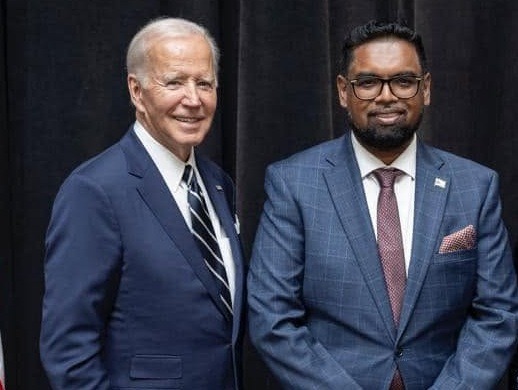
    A set of diplomatic gifts presented by Guyanese President Irfaan Ali to former U.S. President Joe Biden years ago have officially been transferred to the United States’ National Archives and Records Administration (NARA), according to a recent public filing published in the U.S. State Department’s Federal Register.

    The disclosure details three separate items gifted during 2022, all of which exceed the annual minimum value threshold for mandatory public reporting and archival transfer that is set each calendar year by U.S. federal guidelines. For 2022, that reporting threshold stood at $415, a mark all three gifts easily surpassed. The first item, a landscape painting titled “At Parika Stelling (Guyana)”, was received by the White House on March 2, 2022, and carries an estimated assessed value of $650. Five months later, on August 8, 2022, Ali gifted a second set of items: a gold brooch and a lapel pin printed with the Guyana national flag, which are together valued at approximately $736.

    In its official filing, the State Department noted that the gifts were accepted under the rationale that declining the presents would have caused unnecessary diplomatic embarrassment for both the Guyanese donor and the U.S. government. Per longstanding U.S. federal law, the president, cabinet members, and other senior federal officials are required to publicly disclose all gifts received from foreign sources that exceed the established annual value threshold.

    NARA, the independent federal agency tasked with preserving government records and historical artifacts, holds official responsibility for managing and archiving all gifts — both foreign and domestic — given to sitting U.S. presidents, and the three items have now been formally transferred into the agency’s permanent collection. The public disclosure marks a routine compliance with federal transparency rules governing diplomatic gifts to senior U.S. leaders.

  • UG, ACCA ink accord advance dual award pathway in accounting education

    UG, ACCA ink accord advance dual award pathway in accounting education

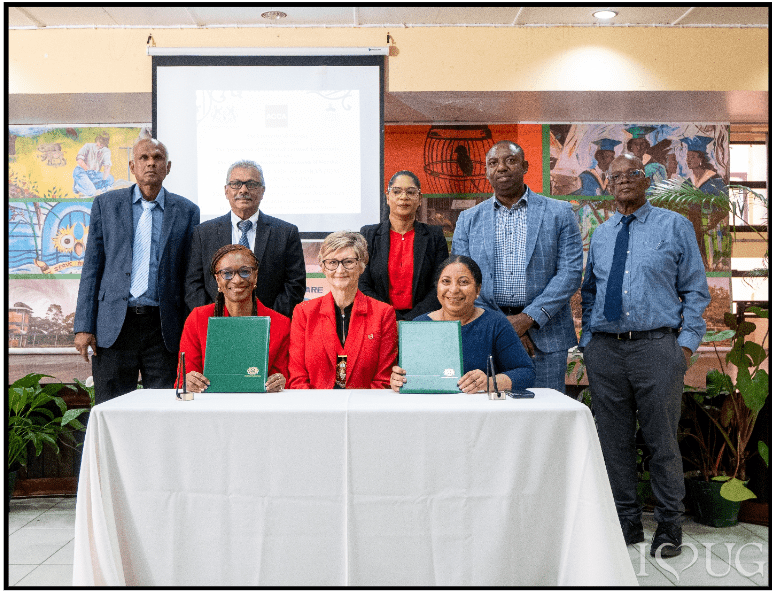
    In a landmark move set to transform professional accounting education across the Caribbean region, the University of Guyana (UG) and the Association of Chartered Certified Accountants (ACCA) have formally signed a Memorandum of Understanding (MOU) to launch a pioneering dual award pathway for students enrolled in UG’s Bachelor of Science in Accountancy programme.

    The signing ceremony was held at UG’s Turkeyen Campus Education Lecture Theater, cementing a growing collaborative bond between the two institutions that began earlier this year when UG’s accountancy degree earned ACCA accreditation. That initial accreditation already secured graduates exemptions from four foundational ACCA papers and aligned UG’s curriculum with global professional benchmarks. The new MOU advances this partnership by establishing a formal structured framework for joint curriculum refinement and the creation of the integrated academic-professional dual award track.

    Guyana’s Minister of Education Sonia Parag, who delivered the event’s keynote address, emphasized that this initiative marks an unprecedented milestone for professional education in the region. “For the first time across the Caribbean, students will earn a dual credential – an academic degree from UG and a globally recognized ACCA professional qualification,” Parag noted. She added that the full alignment of the programme with international standards will leave graduates with far stronger competitive qualifications, cementing UG’s position as a globally competitive higher education institution. Parag also expressed strong backing for an early launch of the programme, suggesting a rollout as soon as September this year would allow students to begin accessing the benefits of the new pathway without delay.

    UG Vice-Chancellor Professor Paloma Mohamed Martin highlighted that the partnership directly aligns with Guyana’s national priorities for expanding professional certification and building a skilled, competitive workforce. She pointed out that the initiative matches the national vision laid out by Guyana’s President, who has publicly called for programmes that equip students with both academic degrees and industry-recognized professional certifications. Professor Martin noted that while UG currently maintains more than 170 international partnership MOUs, this agreement carries unique weight: it will not only strengthen professional career pathways in accounting and finance but also support stronger national fiscal accountability by producing a new cohort of experts trained to the highest global standards. She also extended the university’s gratitude to the Guyana Institute of Chartered Accountants, specifically senior leaders Ramesh Seebarran and Harry Parmesar, for their ongoing support of the initiative.

    Dr Alfred Aaron, Head of UG’s Department of Accountancy and Finance, framed the MOU as the natural next phase of collaboration between the two institutions, with core focuses on curriculum alignment and the rollout of the dual award structure. Aaron explained that the agreement will guide joint work to further align UG’s programme with international professional requirements, closing gaps between academic learning and professional practice. “We are incredibly excited about the opportunities this partnership opens up for our students,” Aaron said. “We look forward to collaborating with ACCA to review and strengthen our syllabus, secure additional exam exemptions for our students, and develop more specialized degree pathways tailored to evolving industry needs.”

    Melanie Proffitt, Global President of ACCA, emphasized that the new agreement reflects both institutions’ shared commitment to preparing next-generation finance professionals to thrive in a rapidly evolving global economy. Proffitt noted that Guyana is currently experiencing one of the fastest periods of economic growth anywhere in the world, a transformation that has generated urgent demand for skilled, ethically trained, globally competent finance leadership. “This is the first partnership of its kind in the entire Caribbean region, giving students a robust, internationally recognized pathway into the accounting and finance profession,” Proffitt said. “This is not a symbolic agreement. It is a practical, intentional partnership designed to evolve alongside Guyana’s growth.”

    Paula Marcelle-Irish, Head of ACCA Caribbean, echoed this sentiment, noting that the MOU represents a concrete commitment to expanding student opportunity while strengthening the regional accounting profession. “This MOU is far more than a formal signed document,” Marcelle-Irish said. “It is our commitment to growing the accounting and finance profession in Guyana, opening new doors for students, and ensuring the country has the skilled talent pool it needs to sustain its ongoing economic expansion.”

    In a pre-recorded address, Professor Leyland Lucas, Dean of UG’s School of Entrepreneurship and Business Innovation (SEBI), underlined that expanding high-quality educational offerings for Guyana requires cross-institutional collaboration. “Delivering the resources this nation needs cannot be accomplished by UG alone,” Lucas said. “We will need to continue deepening collaboration with our existing partners and forging new connections, and we look forward to building on this relationship as we roll out new programmes in the future.”

    Ramesh Seebarran, President of the Institute of Chartered Accountants of Guyana (ICAG), reaffirmed his organization’s full support for the initiative, while ICAG Council Member Harryram Parmesar noted that the agreement is the product of years of consistent, collaborative work to strengthen professional accounting pathways across Guyana. Earlier in the event, Deputy Vice-Chancellor for Academic Engagement Professor Emmanuel Cummings delivered opening welcome remarks, emphasizing the value of aligning academic and professional standards to expand opportunity for UG students.

    UG’s Bachelor of Accountancy programme earned ACCA accreditation in June 2026, with the accreditation valid from January 1, 2026 through December 31, 2030 after a rigorous assessment against ACCA’s global standards for accounting education.

  • Cuban woman disappears on her way to work

    Cuban woman disappears on her way to work

    Five days have passed since 26-year-old Cuban national Dailen Paneque Gómez disappeared while heading to her workplace in Guyana, leaving local law enforcement and the country’s tight-knit Cuban community searching for answers. The case was officially filed with Guyanese police on June 19, 2026, at the Mon Repos police outpost, according to Deputy Police Commissioner Wendell Blanhum, who heads the Guyana Police Force’s Criminal Investigations Department.

    Details of Gómez’s final hours have been shared by her friend Ibrain Beritan Lago, who outlined a timeline of the morning she vanished. On June 18, Gómez was seen preparing lunch by Beritan Lago’s cousin at approximately 6:20 a.m. She exchanged text messages with Beritan Lago at 6:43 a.m., and roughly 36 minutes later, sent a final reply confirming she had nearly reached the Mon Repos Health Centre — her place of employment. No contact has been recorded from Gómez since that 7:19 a.m. message.

    The unexplained disappearance has sparked deep anxiety across Guyana’s Cuban population, as well as among Gómez’s immediate family, friends, and colleagues. In an official statement released on behalf of the Cuban community in the country, organizers noted that the situation has caused significant distress, with many holding out hope and organizing prayers for Gómez’s safe return.

    To escalate efforts to locate the missing woman and uncover the circumstances of her disappearance, the Cuban community has formally appealed to Guyana’s highest state authorities. The appeal is addressed to President Irfaan Ali, Home Affairs Minister Oneidge Walrond, Police Commissioner Clifton Hicken, and all other relevant government agencies, calling on them to deploy all available resources to advance the search and investigation.

  • Manickchand’s jewellery gift to former US ambassador handed over to US gov’t

    Manickchand’s jewellery gift to former US ambassador handed over to US gov’t

    New disclosures from the U.S. State Department have brought to light a protocol-compliant transfer of an unsolicited high-value gift from a senior Guyanese political figure to a former top American diplomat stationed in the South American nation. According to official records, Sarah-Ann Lynch, who previously served as the United States Ambassador to Guyana, accepted a piece of jewelry valued at $1,198 U.S. dollars from Priya Manickchand, Guyana’s former Minister of Education, during a meeting held on September 12, 2023.

    The gift in question consists of two thin gold bangle bracelets paired with a pearl drop necklace, a set whose appraised value far exceeds the $525 U.S. dollar cap on personal gifts that U.S. government officials are permitted to retain under federal ethics guidelines. In line with longstanding U.S. federal gift rules for diplomatic personnel, Lynch turned the jewelry over to the U.S. General Services Administration (GSA), the federal agency tasked with managing and disposing of such unallowed gifts, for official handling.

    Officials note that this case follows a standard protocol applied to hundreds of similar scenarios involving diplomatic gifts to U.S. representatives across the globe. The official justification recorded for temporary acceptance of the gift before transfer aligns with common diplomatic practice: declining the present directly would have created unnecessary social embarrassment for both the donor and the United States government, undermining routine diplomatic courtesy. This procedural transfer underscores the strict ethics frameworks that govern gift acceptance for American diplomatic personnel, designed to avoid perceived or actual conflicts of interest while maintaining basic diplomatic decorum in international engagements.

  • Guyana requests formal relationship with Meta/Facebook

    Guyana requests formal relationship with Meta/Facebook

    Guyana’s top law enforcement official, Attorney General Anil Nandlall, has confirmed he has submitted an official correspondence to Meta Platforms, the parent company of global social media giant Facebook, calling for the establishment of a dedicated formal institutional arrangement between the Guyanese government and the tech firm. While Nandlall has not released specific details about the terms of the requested partnership, he openly signaled that authorities in Guyana have growing discomfort with harmful content circulating on the platform.

    In public remarks, Nandlall emphasized the urgent need for closer, ongoing collaboration with major social media platforms, pointing to the rapid speed at which damaging content can spread online. “You need to have a constant engagement with a platform like Facebook. I mean, all of us here are, we are activists of Facebook and you see the destruction that it includes in one post. And by the time you get that post removed, the damage is already done. It’s already done,” he said.

    This push for a formal arrangement aligns with the Guyanese government’s recent crackdown on anti-government voices hosted on Meta’s platforms. Nandlall himself has already filed multiple defamation lawsuits against anti-government activists based outside of Guyana, and has pushed to extradite at least one of these critics back to the country to face criminal prosecution.

    Currently, the only formal tie between Guyana’s state apparatus and Meta is limited to a portal accessed by the Guyana Police Force via Interpol, Nandlall confirmed. While the company already operates a global portal that allows governments to submit formal requests for content removal and user data disclosure, Guyana has no dedicated government-wide relationship with the firm.

    Meta has not yet publicly responded to Nandlall’s new request, nor has it released aggregated data on government requests from Guyana for the full 2025 calendar year to date. The company’s most recent published data covers the first six months of 2025, during which the Guyanese government submitted three formal legal process requests and 13 emergency disclosure requests, targeting information on 13 separate user accounts.

    Looking back at prior years, the volume of government requests from Guyana has shifted significantly. In 2024, authorities submitted five emergency disclosure requests, three legal process requests, and sought data on nine user accounts. In 2023, the government submitted 32 legal process requests and 36 requests for user account data, totaling 68 requests that year.

    In response to queries about its processing of government requests, Meta has stated that it evaluates all incoming demands for user data and content removal in line with both local applicable laws and the company’s internal terms of service. “Each and every request we receive is carefully reviewed for legal sufficiency, and the company rejects or requires greater specificity on requests that appear overly broad or vague,” a Meta spokesperson said in a previous statement on its government request practices.