标签: Belize

伯利兹

  • No Relief, No Choice: Bus Services May Halt on April 20th

    No Relief, No Choice: Bus Services May Halt on April 20th

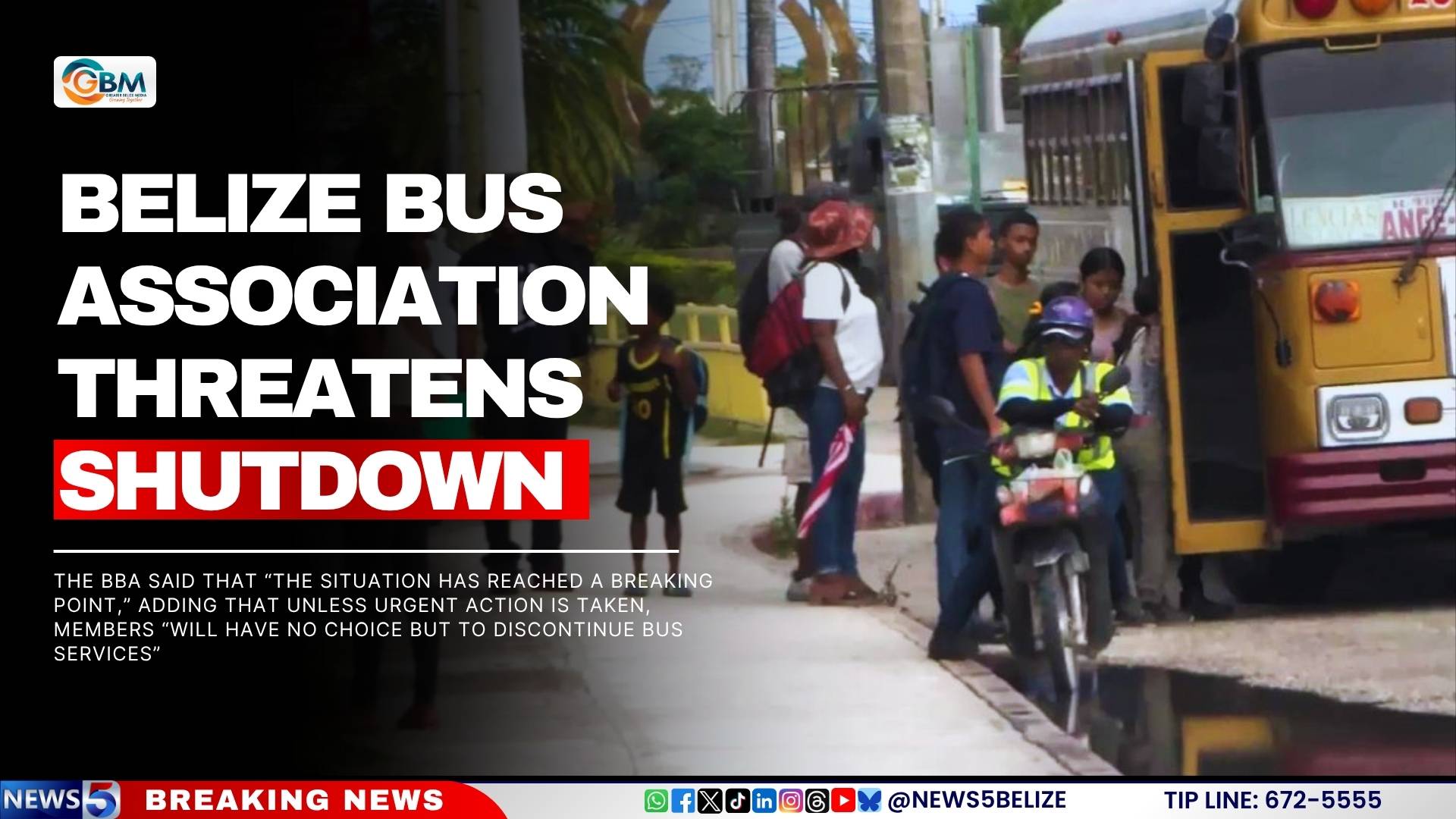
    A looming crisis threatens public transportation across Belize, as the nation’s bus operators have issued an urgent warning that a complete nationwide suspension of services will begin on April 20 if the government fails to intervene immediately to address skyrocketing operational costs. The Belize Bus Association (BBA), which represents the majority of bus operators across the country, says the industry has been pushed to an irreversible breaking point by sustained increases in fuel prices that have drained already razor-thin profit margins.

    In late March, the BBA submitted a formal letter to the Minister of Belize’s Department of Transport outlining a series of targeted policy proposals designed to stabilize the industry and keep public transit running for ordinary commuters. The association’s requests were straightforward: temporary tax exemptions for fuel and bus replacement parts, direct targeted government subsidies to offset rising fuel costs, and permission to adjust passenger fares to reflect increased operating expenses. Each proposal was framed as a viable solution to prevent a total shutdown, but according to the BBA, the central government has responded that it cannot implement any of the requested measures at this time.

    The BBA explains that the current crisis has been years in the making. Bus operators have long operated on extremely narrow profit margins, absorbing incremental cost increases over time to keep fares affordable for working commuters. That breaking point has now been crossed, the association says, as recent global fuel price spikes have pushed operating costs to levels that are no longer financially sustainable. Without urgent policy changes or last-minute intervention from the government, the BBA confirms that all member operators will be forced to halt services starting Monday, April 20.

    The association is making a final plea for immediate emergency talks with the Minister of Transport, emphasizing that a full shutdown would have cascading negative impacts across the country. Millions of daily commuters who rely on public bus transit to get to work, school, and essential services would be stranded without alternative transportation options. Beyond commuter disruption, the shutdown would also threaten the livelihoods of hundreds of bus operators, drivers, maintenance workers, and other industry employees whose incomes depend on the continued operation of bus services.

    The BBA says it remains fully open to collaborative negotiations with the government to reach a last-minute resolution, but stresses that time is running out. Only swift, decisive action from national officials can prevent widespread disruption to Belize’s public transportation network that would touch communities in every corner of the country.

  • Immigration Officer Lawyers Up After Administrative Leave

    Immigration Officer Lawyers Up After Administrative Leave

    A simmering internal conflict within Belize’s Immigration Department is on track to become a high-stakes legal battle, after an immigration officer placed on administrative leave over alleged participation in a coordinated border sickout has retained legal counsel to challenge the government’s disciplinary process. Last week, a coordinated work stoppage dubbed a “sickout” at the country’s western border disrupted border operations, prompting government officials to launch disciplinary action against eight officers suspected of organizing the protest under the guise of simultaneous medical leave. All eight officers have been placed on administrative leave pending an internal investigation into claims they intentionally sabotaged border operations to stage a protest. But for one of those officers, the government’s pre-emptive action has sparked a fierce legal pushback.

    Norman Rodriguez, the attorney representing immigration officer Anne Marie Smith, argues that his client is being unfairly targeted before any formal investigation has been completed. Rodriguez told reporters that Smith was already on approved, doctor-ordered medical leave from March 30 to April 1 for a longstanding chronic health condition, and submitted an official medical certificate to her port commander before her leave began. Smith returned to work as scheduled after her leave ended, only to be served with two formal disciplinary notices. The first, issued under Section 144 of the Republic Service Regulations, placed her on administrative leave over allegations of professional misconduct and breach of personal integrity. The second, dated April 7, formally notified her that she would face an official investigation into the same claims.

    The core of the government’s allegation against the eight officers rests on the timing of their leave: all eight submitted medical certificates for roughly the same window, and all returned to work around the same date, leading officials to conclude the overlapping leave was a coordinated attempt to disrupt western border operations. Rodriguez, however, says the government’s narrative falls apart under scrutiny, emphasizing that Smith’s leave was entirely legitimate and supported by verifiable medical documentation that confirms her illness was not fabricated as a cover for protest activity.

    “Before you level an accusation of sabotage against a public servant, you are obligated to conduct a full, fair investigation first, not impose punitive action before any facts have been verified,” Rodriguez said, noting that disciplinary action was initiated before the probe even began. While Smith and the other seven officers have been allowed to return to their posts during the ongoing investigation, their names remain tied to the sabotage allegations, damage that cannot be undone even if the investigation ultimately clears them, he added.

    When pressed on claims that Smith exploited her pre-existing health condition to participate in coordinated strike action alongside the seven other officers, Rodriguez dismissed the argument as flimsy and legally untenable. He confirmed that the Public Service Union has offered support to the officers, but said Smith is prepared to take her case to court to clear her name if the internal grievance process does not resolve the issue fairly. If the dispute proceeds to litigation, the government’s entire disciplinary process will face formal judicial review, and Smith will seek monetary damages for the reputational harm she has already suffered, Rodriguez explained.

    The outcome of this legal challenge carries broad implications for public servants across Belize, setting a potential precedent for how disciplinary actions against government employees are conducted, and what recourse workers have when they believe due process has been violated.

  • Pharmacists, Ministry of Health Agree on Prescription Rollout

    Pharmacists, Ministry of Health Agree on Prescription Rollout

    Starting in 2026, Belize will implement a long-planned update to the nation’s prescription drug regulations, developed through close collaboration between the Pharmacists Association of Belize and the country’s Ministry of Health. With public anxiety growing over potential access disruptions to essential medications, particularly for patients managing long-term chronic conditions, industry representatives have moved quickly to clarify that the reform is focused on patient safety, not limiting access to care.

    The two governing bodies have agreed to a 12-month phased rollout of the updated rules, a transition period designed to gradually shift Belize’s healthcare culture toward greater medical accountability and routine health monitoring. Speaking on behalf of the association, Public Relations Officer Beverly Coleman explained that while formal prescription requirements have existed in national law for decades, widespread non-compliance and a lack of routine patient follow-up care created the need for a gradual transition. Many patients in Belize have long become accustomed to refilling long-term medications without regular check-ins with physicians or routine lab work to monitor how medications are affecting their health, she noted.

    “Any substance we put into our bodies — from over-the-counter pain relievers like Tylenol to herbal supplements — carries potential impacts that need medical oversight,” Coleman explained during an interview following the announcement. During the 12-month transition, pharmacists will be permitted to dispense limited one-month supplies of medication to give patients time to schedule required check-ups and get formal prescriptions from their doctors. Coleman emphasized the transition is not an unregulated free-for-all, but a structured opportunity for all stakeholders — doctors, pharmacists and patients — to adjust to the new safety standards.

    As the rollout approaches, however, concerns have emerged about strain on Belize’s already stretched healthcare system. Officials project that a surge of patients will flood primary care clinics to obtain required new prescriptions, raising questions about how gaps in care can be addressed, particularly in rural and geographically isolated underserved regions of the country. Discussion has turned to whether expanding prescribing authority to pharmacists could help ease the added pressure on clinics.

    Currently, Belizean law strictly limits pharmacists’ scope of practice: pharmacists are only permitted to dispense medications written by licensed physicians, and are tasked with flagging potential issues such as dangerous drug interactions or incorrect dosages to prescribing clinicians. Coleman confirmed that expanding this scope to allow limited prescribing by pharmacists for simple or stable chronic conditions is a topic that will be negotiated with the Ministry of Health in the coming months, given Belize’s unique geographic context where many remote communities lack consistent access to physicians.

    “Medicine is a constantly evolving field, and pharmacists must stay updated on the latest research to properly educate and counsel our patients,” Coleman added. She noted that any change to professional scope will require careful legislative negotiation and alignment with public health needs, to ensure patient safety remains the core priority as the system adapts.

  • Attempted Murder Charge for Akeem Ferguson After Brutal Ladyville Attack

    Attempted Murder Charge for Akeem Ferguson After Brutal Ladyville Attack

    A brutal weekend violent attack in the Belizean community of Ladyville has left one man clinging to life in hospital and another behind bars facing charges of attempted murder. Thirty-year-old local resident Akeem Ferguson was arraigned before the Belize City Magistrate’s Court this week, after being taken into custody hours following the assault on 42-year-old Lionel Nigel Logan.

    According to official reports from Belizean law enforcement, the violent confrontation unfolded on the evening of Saturday 11 April 2026 on Henry Street in Ladyville, just blocks from the Perez Road intersection. Investigators confirmed that Logan was first stabbed in the lower back by his attacker before being shot at close range. Bystanders alerted emergency services immediately after the incident, and Logan was rushed by ambulance to the country’s main public healthcare facility, the Karl Heusner Memorial Hospital (KHMH), where he remains in critical condition as of the court hearing.

    Crucially, law enforcement officials confirmed that Logan was able to identify Ferguson as his attacker both at the scene of the incident and again in a formal recorded statement taken by investigators while he received emergency care. Acting on this identification, police launched an immediate manhunt, released a public wanted notice to the community, and successfully took Ferguson into custody on the same night the attack occurred. When questioned by detectives about the incident, Ferguson formally denied all allegations that he shot Logan, according to police records.

    Ferguson made his first court appearance on 15 April 2026, arriving at the courthouse under heavy police escort shortly after 9 a.m. local time. He appeared before the court without legal representation, and entered no formal plea during the brief arraignment hearing. The three charges brought against Ferguson include the most severe count of attempted murder, alongside additional charges related to the illegal possession of a firearm and grievous bodily harm. Citing the severity of the charges and the ongoing risk to public safety, Senior Magistrate rejected Ferguson’s application for pre-trial bail and ordered him remanded into custody at Belize Central Prison, where he will remain held until his next court hearing scheduled for 15 June 2026.

    Investigators from the Belize Police Department’s Criminal Investigations Branch are continuing to work through evidence to establish a clear motive for the attack, as they build their case ahead of trial. The investigation remains active, with authorities working to confirm what led to the violent confrontation as Logan continues to fight for his life in hospital care.

  • Convicted BDF Soldier, Police Officer Move to Appeal Prison Sentences

    Convicted BDF Soldier, Police Officer Move to Appeal Prison Sentences

    Five years after the controversial 2021 fatal shooting of Belize Defense Force (BDF) soldier Jessie Escobar in Santa Familia, two convicted law enforcement officials implicated in a cover-up of the incident have launched a bid to reduce their prison sentences.

    BDF Private Ramon Alberto Alcoser and Police Corporal Juan Carlos Morales appeared before High Court Justice Derick Sylvester on April 15, 2026, where the judge scheduled their full appeal hearing for April 27. Up until the hearing convenes, both men will remain in custody at Belize Central Prison.

    The pair were originally convicted and sentenced last December by a magistrate court, after findings that they deliberately falsified information and omitted critical details from their official statements regarding Escobar’s killing. Their accounts of the shooting were ultimately disproven by independent surveillance footage that directly contradicted their testimony. Under the original sentencing order, Alcoser is currently serving a 14-month prison term, while Morales is serving a 23-month sentence.

    During the April 15 procedural hearing, Morales notified the court that he will be represented by private defense attorney Alifah Elrington for the appeal, while the court has appointed attorney Oscar Selgado to serve as Alcoser’s legal counsel. Notably, Director of Public Prosecutions Cheryl-Lynn Vidal will personally lead the prosecution’s argument in the appeal, a move that underscores the high priority and significance the prosecution assigns to this high-profile case.

    The appeal puts the original conviction and sentencing in the hands of the High Court, which will now rule on whether the original prison terms will be upheld, or if the two convicted law enforcement officers will receive a reduction of their sentences. The case has remained a focal point of public attention across Belize since Escobar’s killing in 2021, with observers across the country closely tracking every development in the legal process.

  • Belama Land Dispute Leaves Young Mother Displaced

    Belama Land Dispute Leaves Young Mother Displaced

    Across Belize, land disputes involving undocumented migrants have become an increasingly common source of instability for vulnerable communities. But the story of 24-year-old Dora Enamorado highlights the uniquely devastating human cost of these ongoing conflicts, leaving one young mother and her three children without the only home they have ever known.

    Enamorado’s connection to Belize stretches back to infancy. When she was just a baby, her mother fled escalating violence in El Salvador to seek safety across the border in Belize, building a new life in the community of Belama. Enamorado grew up on Belizean soil, raised her three Belizean-born children here, and spent eight years cultivating and occupying a plot of land that she thought would be her permanent home. That sense of security shattered abruptly when the land was seized from her, leaving her displaced, disenfranchised, and feeling that her decades of belonging in the country have been erased.

    In a statement recorded for Belize’s evening news broadcast, Enamorado explained the bureaucratic chaos and unfair treatment that led to her displacement. She was a participant in community planning meetings for the land redistribution project from its earliest stages, following all official instructions to the letter. The project planned to relocate the existing community to make way for a new development led by politician Francis Fonseca, with 18 households prioritized for new plots, and remaining parcels allocated to other eligible residents after the first round.

    Enamorado had already completed her initial application for a new plot in 2020, with government officials on-site documenting that her home stood on the property, recording her name and lot number in official records. When officials asked her to re-sign the application, she complied, confident her claim would be processed. That is when the first barrier emerged: officials told her she could not receive land because she is not a Belizean citizen. Even after Enamorado pointed out that she has three Belizean-born children, officials accepted her application forms anyway—but never followed up, never issued a receipt, and repeatedly delayed her inquiries by claiming the process was still awaiting a land survey that never concluded.

    Six months after Enamorado and her husband reapplied to move the process forward, an official finally delivered the final blow: the land is now classified as private property, a classification that was never disclosed to her over the four years she fought to secure her claim.

    Enamorado, who has never lived anywhere other than Belize, now finds herself locked out of the home she built, with little recourse to appeal the decision. She shared her story with local journalists in the hope that bringing public attention to her case will force officials to address the injustice she has faced. Her story is one of dozens of similar unresolved disputes in the region, exposing the gaps in policy that leave undocumented migrants and their citizen children vulnerable to displacement in the countries they have always called home.

  • Hurricane Hunters Touch Down for Education, Not Emergency

    Hurricane Hunters Touch Down for Education, Not Emergency

    For most people around the world, the U.S. Air Force Reserve Hurricane Hunters are only a name tied to breaking emergency weather coverage: when a catastrophic tropical cyclone is barreling toward populated coastlines, these elite pilots and their specially modified aircraft fly straight into the storm’s eye to collect life-saving data that forecasters rely on to track intensity and path. But this week, the Hurricane Hunters are touching down in Belize for an entirely different mission – one centered on education, not disaster response.

  • BEL Severance Fight Heats Up

    BEL Severance Fight Heats Up

    A deepening controversy over unequal severance compensation has erupted at Belize Electricity Limited (BEL), newly uncovered internal documents have reignited long-simmering frustrations from frontline and former workers who claim they have been denied owed payouts while senior leaders walked away with large six-figure packages. The conflict, which first dates back to a 1999 restructuring push, has been amplified by the advocacy group Belize Energy Workers for Justice (BEWJ), whose members include aging and ailing former employees who have continued their protest for decades to secure the compensation they say they are legally entitled to.

    Dorla Staine, a core organizer with BEWJ, shared the long history of the dispute in an interview, recalling that workers first raised demands for severance pay back in 1999 ahead of a planned corporate restructuring. At that time, she said, leadership rejected the requests outright, leaving lower-tier workers empty-handed. Now, newly leaked documents tell a different story for the company’s top ranks: the papers clearly show that high-profile senior managers not only received their requested severance packages but also walked away with additional unreported bonuses, Staine alleged.

    The revelations have given new momentum to BEWJ’s campaign, with organizers saying the documented double standard confirms what workers have suspected for more than 25 years. Many of the protesters pushing for resolution are former BEL workers who now face advanced age and chronic health conditions, making the resolution of their severance claims an urgent personal and financial priority.

    BEL has pushed back against the allegations, issuing a formal statement defending its existing pension and severance framework. The company maintains that all of its compensation practices fully align with a landmark ruling from the Caribbean Court of Justice and are supported by binding independent legal opinions.

    Local outlet News 5 has confirmed it has reached out to BEL leadership for additional comment and clarification on the identities of the senior executives named in the leaked documents. The outlet announced it will air a full in-depth report on the controversy, including details of the names redacted in the initial document leak, during its 6:00 pm prime time evening broadcast.

  • Indian Creek Chairman Speaks Exclusively to News 5

    Indian Creek Chairman Speaks Exclusively to News 5

    A high-stakes incident has roiled the small community of Indian Creek Village in Toledo District, Belize, after the settlement’s first founding alcalde was abducted by two unidentified assailants, triggering widespread unrest that has deepened long-simmering internal divisions. In an exclusive interview with News 5, village chairman Domingo Choc detailed the chaos that unfolded in the hours after the abduction was reported.

    According to official police accounts, the alcalde told investigators he was taken captive by two men, bound, and held captive overnight before being released on the outer edges of the village in the early hours of Wednesday, April 15, 2026. While the abducted leader is confirmed to be alive, he remains under medical care for injuries sustained during his kidnapping.

    News of his disappearance quickly sparked mass unrest among confused and angry residents, who turned their anger on two top local community leaders. Choc told reporters that his own home was quickly surrounded by a large crowd of Indian Creek residents, many armed with machetes and slingshots. The group pelted the residence with rocks, vandalized the property, and forced their way inside the building.

    The crowd then marched the short distance to the home of Deputy Alcalde Manuel Ack, shouting threats against the local leader as they arrived. Ack recounted that the rioters chanted that the first alcalde had already been killed, and that he would be the next to die. The group threw sticks and stones at Ack’s property, destroying a stock of cacao beans that Ack’s wife had cured and prepared for upcoming market sale. Ack, who left his wife and seven young children inside the home during the chaos, told reporters he had planned to go outside to defend his family, but a neighbor warned him to remain indoors to avoid potential violence.

    In the immediate aftermath of the unrest, local police launched an investigation into the abduction and subsequent rioting. Authorities identified Choc, Ack, and three other local men as persons of interest connected to the disappearance of the first alcalde, and detained all five for formal questioning. Both Choc and Ack have pushed back against the detention, saying they are being wrongfully treated as criminal suspects despite having no connection whatsoever to the abduction of the village’s first alcalde.

    Two residential properties were confirmed damaged during the unrest, and the two community leaders were held in jail for a short period before being released. The incident has only widened an already toxic rift within the village that has festered for years over competing claims to land and disputes over local leadership, turning a tense situation into an openly dangerous one. A full on-air report of the incident is scheduled to air on News 5 Live at 6 p.m. local time.

  • Belize Bus Association Threatens Shutdown

    Belize Bus Association Threatens Shutdown

    A major crisis is unfolding in Belize’s public transportation sector, as the nation’s leading bus industry body has threatened a full nationwide shutdown starting next week if the government fails to address crippling rising fuel costs that have pushed operators to the edge of financial collapse.

    The Belize Bus Association (BBA), which represents the bulk of the country’s public bus service providers, issued an urgent warning this week that continuous skyrocketing fuel prices have made daily operations financially unsustainable, and that targeted government intervention is the only way to avoid a total halt to services that thousands of Belizeans rely on for daily commutes, work, school and essential travel.

    Back on March 30, the BBA formally submitted a policy proposal to Belize’s Minister of Transport Dr. Louis Zabaneh, outlining three potential solutions to ease the industry’s financial strain: a full goods and services tax (GST) exemption for bus fuel and vehicle replacement parts, direct targeted government subsidies for operating costs, or permission for operators to implement regulated passenger fare adjustments to offset increased fuel expenses. To date, none of these proposals have been accepted by the administration.

    In an interview held this Tuesday, Dr. Zabaneh reaffirmed the Briceño government’s current stance that none of the BBA’s requested measures will be implemented at this time. The minister argued that decisions on tax exemptions and subsidies fall outside the jurisdiction of his ministry, and pushed back against the BBA’s demands by noting that the association previously chose to remain independent from government-led frameworks.

    Dr. Zabaneh explained that as part of the National Bus Company initiative, the government offered BBA members a complimentary operational audit to help identify cost-saving opportunities, but association leaders declined the offer. “This is not a forced nationalization, and if you say you can stand on your own, then we respect that very position that they said they will be standing on their own,” he stated Tuesday.

    For its part, the BBA says the crisis has already reached a breaking point. Unless urgent action is taken to address the fuel cost burden before next Monday, April 20, 2026, BBA members will have no alternative but to suspend all bus services indefinitely. The association is now calling for direct high-level negotiations with Belizean Prime Minister John Briceño to break the current deadlock and avoid a disruptive shutdown that would impact communities across the country.