标签: Belize

伯利兹

  • Will Businessman Be Charged for Assaulting Minor?

    Will Businessman Be Charged for Assaulting Minor?

    In a developing story that has ignited fierce public discourse across the nation, a viral video depicting a local business owner physically assaulting a teenage boy suspected of shoplifting has prompted official pushback from the country’s leading child welfare agency, which is calling for non-violent alternatives to youth discipline. The disturbing footage first circulated on social media platforms this Monday, quickly splitting public opinion over the longstanding debate around when — if ever — physical punishment is acceptable for children who break rules.

    Public reaction to the video has been sharply divided. One camp of online commentators has rallied behind the shop owner, arguing that when parents fail to teach children basic respect for others’ property and the law, outside adults are justified in stepping in to administer corrective discipline. The opposing side has condemned the attack outright, emphasizing that the individual targeted is a legal minor, and that no adult has the right to inflict physical harm on a child, regardless of the alleged offense.

    On Wednesday, the Ministry of Human Development, Family Support and Gender Affairs issued an official statement reaffirming its unwavering opposition to violence against children in all contexts. Ministry CEO Adele Catzim‑Sanchez told local outlet News 5 that vigilante action has no place in addressing youth misconduct, urging business owners who encounter theft or other trouble involving minors to contact law enforcement immediately and secure surveillance evidence rather than taking matters into their own hands.

    “We have to have options that go beyond violence,” Catzim‑Sanchez emphasized in her remarks.
    The CEO also noted that viral social media footage rarely captures the full context of an incident, and stressed that the government already maintains a robust network of evidence-based support programs designed to address problematic youth behavior without resorting to force. Through the Ministry’s Community Rehabilitation Department, young people who run afoul of the law can be referred to prevention and mentorship initiatives via either police or court diversion programs, tailored to the specific circumstances of each case.

    The core intervention is a structured four-month program that works holistically with each participant: it explores underlying personal and family challenges that may contribute to harmful behavior, provides professional mental health counseling, offers support for school engagement when needed, and connects families with basic support such as food assistance if that is identified as an unmet need.

    “Our philosophy is that incarceration or institutionalisation should be an action of last resort,” Catzim‑Sanchez explained.
    In response to the common argument that physical discipline has long been an accepted part of child-rearing in many communities, the CEO argued that it is past time to move beyond the automatic reflex to meet misbehavior with force. She acknowledged that business owners have a clear and legitimate right to protect their property from theft, but noted that long-term public good requires investing in proactive prevention programs rather than reacting to every incident with violence.

    With primary and secondary schools across the country now closed for the annual summer break, Catzim‑Sanchez also issued a targeted advisory to families, urging parents and guardians to enroll their children in structured, positive summer programs. She noted that historical data shows a consistent seasonal spike in youth involvement in law enforcement interactions during the summer months, when unsupervised free time can increase the risk of negative behavior. Keeping young people engaged in constructive, supervised activities, she said, is one of the most effective proactive steps families can take to prevent trouble before it starts. At the time of publication, no official charges have been filed against the shop owner, and authorities have not announced a timeline for a decision on potential prosecution.


  • Multiple Firearm Seizures Across Belize; One Gun Leads to Five Charges

    Multiple Firearm Seizures Across Belize; One Gun Leads to Five Charges

    In a series of coordinated anti-crime enforcement actions carried out across three districts of Belize, law enforcement agencies have seized multiple unregistered firearms and ammunition, leading to the arrest and criminal charging of nine individuals in separate incidents dated through early June 2026.

    The first operation unfolded in Punta Gorda, where officers conducting routine anti-crime patrol spotted two men traveling on a motorcycle. When police signaled for the vehicle to stop, the driver accelerated away at high speed, prompting a law enforcement pursuit. During the chase, 23-year-old passenger Rozaun Vairez, a resident of Punta Gorda Town, fell from the motorcycle and attempted to escape on foot before officers quickly detained him. A search of Vairez’s backpack uncovered a loaded pistol fitted with a magazine holding 18 live rounds of ammunition. He now faces two formal charges: possession of an unlicensed firearm and possession of unlicensed ammunition.

    A second separate search operation in the Cayo District town of Unitedville led to an even larger group of charges. After executing a search warrant at a local residence, police recovered a .22 caliber pistol loaded with five live rounds. Five people who were present at the property – Calvin Garcia, Sydney Forbes, Kareem Garcia, Bernadine Myers, and Kevin Trapp – were all taken into custody and jointly charged in connection with the illegal weapon.

    The third incident stems from a violent alleged assault reported on May 31, 2026, in Maskall Village. According to official police accounts, a male complainant told investigators he had entered a vehicle driven by 45-year-old Virgil Vasquez. When the complainant noticed an unsecured firearm inside the vehicle and tried to leave the car, Vasquez allegedly grabbed the weapon and pointed it directly at him. The complainant managed to run away from the scene without suffering physical injury. Officers later located and detained Vasquez, seizing a .40-caliber pistol from his possession. Vasquez now faces two charges: aggravated assault and possession of an unlicensed firearm.

    The string of seizures comes as Belizean law enforcement continues to prioritize cracking down on illegal gun trafficking and unregistered firearm possession, which remain key contributors to violent crime across the country. The series of interconnected operations across three geographically separate districts demonstrates the ongoing, cross-regional focus of local police on removing illegal weapons from communities before they can be used to harm civilians.

  • Belize’s Newsroom of Tomorrow…Is Being Built Today

    Belize’s Newsroom of Tomorrow…Is Being Built Today

    The 2026 Caribbean Media Summit, hosted last week in Trinidad by the Media Institute of the Caribbean, delivered a stark opening diagnosis: the Caribbean regional media ecosystem is confronting an unprecedented existential crisis. Legacy news outlets across the bloc have been battered by overlapping structural threats, from plummeting advertising revenue and the disruptive rise of artificial intelligence to a algorithm-dominated media economy that prioritizes clickbait sensationalism over rigorous, substantive reporting.

    The scale of the crisis is visible in the wave of news outlet closures that have swept the region over just the last 18 months. Two prominent independent newspapers, Guyana’s Stabroek News and Trinidad and Tobago’s Newsday, have ceased operations, eliminating two critical sources of diverse public discourse that served communities for decades. Newsday’s managing director described the outlet’s collapse as the result of a “perfect storm” of overlapping challenges, noting that print advertising revenue has plummeted by 75% across the last 10 years. For Stabroek News, the final blow came from an approximately $90 million government debt owed for past advertising services.

    The contraction extended to digital media in July 2025, when telecom giant Digicel announced the immediate shutdown of Loop News, one of the Caribbean’s most trusted independent digital news platforms that had operated across the region since 2014. Digicel also wound down its regional sports broadcasting division SportsMax, cutting nearly 100 roles spanning journalists, editors, producers and technical staff across multiple Caribbean nations.

    The most historically staggering loss hit the U.S. Virgin Islands in early 2024, when the St. Croix Avis – founded in 1844 and the oldest continuously operating newspaper in the Caribbean by 1990 – closed its doors after 180 years of continuous publication, unable to compete for audience and revenue with free online news and social media.

    Panelists discussing “Media Viability in the Age of AI” at the summit agreed that the current regional landscape is extraordinarily challenging, with many warning that the core question at hand is no longer whether individual news outlets can turn a profit, but whether Caribbean societies can sustain any form of trusted, independent public interest journalism at all. The pressures facing the sector are simultaneously editorial, financial, technological and political, and the growing list of closed outlets represents a quiet threat to Caribbean democratic discourse, eroding institutions that communities have long relied on for accountable reporting.

    Yet the outlook is not uniformly grim. While the region grapples with widespread contraction, one Belizean media organization has spent years laying proactive groundwork to adapt to the new media landscape: Greater Belize Media (GBM), parent company of News 5 Live and the first Belizean news organization to launch a fully resourced dedicated digital news department.

    Unlike many legacy outlets that were slow to recognize shifting audience habits and technological disruption, GBM identified the transformative impacts of algorithm change, AI and evolving news consumption patterns early and began restructuring long before crisis hit. Last year, the organization publicly launched its transformative “One Newsroom” initiative, a full organizational restructuring that unified reporters, videographers, editors and digital producers under a single integrated editorial structure. The model, adapted from the approach used by leading global news organizations, was customized to align with the unique consumption habits and information needs of the Belizean public.

    The initiative grew from a straightforward but critical insight: in an era where audiences access news in real time across multiple overlapping platforms, the old siloed system that kept broadcast and digital news operations entirely separate was not just inefficient – it was a major competitive disadvantage. “The way news and news consumption is evolving is via social media and online platforms,” explained Hipolito Novelo, GBM’s Digital Editor. “Consumers of news want to consume news almost immediately. That is what GBM offers, immediacy, and of course, the accuracy of it.”

    This dual commitment to speed and uncompromised accuracy sits at the center of GBM’s restructuring. While delivering fast news is simple, maintaining accuracy while operating at speed and meeting audiences across every platform they use is a far greater challenge – one GBM has intentionally built its new structure to meet. The organization has expanded its digital presence across social media, its official website, a dedicated WhatsApp channel and a Facebook Messenger channel, building an integrated distribution network designed around how Belizeans actually access news today, rather than forcing audiences to adapt to outdated legacy structures. GBM also actively monitors ongoing changes to platform algorithms, adjusting its distribution strategy in real time to avoid falling behind audience trends.

    On the most contentious issue reshaping global journalism today – artificial intelligence – GBM has also rejected a reactive, fear-based approach. While many newsrooms across the globe are still debating what AI means for editorial workflows and journalistic integrity, GBM is already finalizing a formal, public AI governance policy, joining a small but growing group of leading news organizations that recognize responsible AI adoption requires clear rules, not just unguided experimentation.

    “We are not afraid of AI,” Novelo said. “We are studying it, understanding it, and figuring out how to use it in ways that make our journalism stronger. Not shortcuts that compromise it. Every single day we are working to make sure we are ahead of it, not behind it.”

    This curious, strategic, disciplined approach to change is exactly what the Caribbean media sector needs more of, summit participants agreed. The path to long-term survival for regional media does not lie in lamenting the disruptive changes that have reshaped the global information ecosystem, but in building intentional institutional resilience: the capacity to adapt editorial practices, technology and organizational structure to a constantly shifting media environment. As Novelo puts it, GBM’s work is not a reaction to crisis – it is a sustained effort to keep pace with change. “We watch how the algorithms evolve, we watch how audiences shift, we adjust our strategy, and we keep delivering. That is the job. The landscape changes every single day and we change with it, because our audience deserves a newsroom that never stops working to reach them.”

  • Two Shootings Overnight; Police Say Pomona Victims Likely Not Intended Targets

    Two Shootings Overnight; Police Say Pomona Victims Likely Not Intended Targets

    Authorities in Belize have launched dual investigations into two back-to-back shooting incidents that rocked the Stann Creek District on the evening of June 2, 2026, leaving three people wounded and local communities on edge.

    The first violent incident unfolded just after 6:30 p.m. in the quiet residential area of Pomona Village, where 25-year-old Orlando Acosta and a 16-year-old minor were caught in crossfire. According to initial police accounts, two motorcycles rode up to a group of people gathered in the area. A passenger seated on one of the two bikes pulled out a loaded firearm and fired multiple rounds into the crowd, striking both Acosta and the teenager.

    In an official briefing on the case, Assistant Superintendent of Police Stacy Smith shared preliminary investigative conclusions, noting that law enforcement does not believe the two injured people were the attackers’ intended targets. “We are not of the view that any of the injured individuals was the target, but another individual that was in the group,” Smith stated. Investigators have already collected surveillance footage from nearby businesses and residential cameras in the Pomona Village area, and teams are currently reviewing the recordings to identify suspects and piece together a timeline of the attack. As of the latest update, no clear motive has been confirmed, and no arrests have been made in connection with the first shooting.

    Roughly two and a half hours after the first incident, at approximately 9:00 p.m., a second shooting broke out in the Rivas Estate neighborhood, located near Dangriga Town. The victim in this attack was identified as 19-year-old Jason Marin, a resident of Dangriga. Police reports indicate Marin was in the process of entering a private property when a vehicle pulled up alongside him. An individual inside the vehicle exited and fired multiple gunshots, hitting Marin before fleeing the scene.

    Smith added context to the second incident, revealing that the property Marin was entering has been linked to prior law enforcement activity. “The property Marin was entering had previously been the subject of police operations related to drugs and weapons,” Smith confirmed. As of the latest update, Marin is being treated at a local hospital, where his condition is listed as critical but stable.

    Both active shooting investigations remain ongoing, with law enforcement appealing to any members of the public who were in the area on the night of the incidents and have information about the attacks to contact the Stann Creek District police station to assist with the case.

  • PM Briceño  Blames Breakdown in Parenting for Spike in Violence

    PM Briceño Blames Breakdown in Parenting for Spike in Violence

    In a public address addressing Belize’s escalating wave of violent crime, Prime Minister John Briceño has pushed past surface-level policy debates to identify a breakdown in parenting and community-led youth oversight as the root of the nation’s surging violence, calling for a cross-sector collective response to reverse the trend. Briceño acknowledged that the current State of Emergency (SOE) implemented to curb violence has delivered measurable gains in public safety, but added that even expanded police deployments are limited in their ability to stop individual conflicts before they escalate into fatal or harmful incidents.

    Digging into the systemic origins of the violence crisis, Briceño traced the issue to eroding discipline within households and community structures. He argued that modern parents are far less likely to correct harmful or disrespectful behavior in their children, and often react defensively when community members or educators flag problematic conduct. Contrasting the current dynamic with his own childhood experience, Briceño recalled a childhood incident where he was disciplined by his own father for a minor act of disrespect toward a neighbor — a level of shared accountability that he says no longer exists in most Belizean communities. “I don’t think we are as good parents as we were a few generations ago,” Briceño said in his remarks. “Today, when you call out a child to a parent, they want to get upset with you.”

    To address this gap in family and community support, Briceño highlighted a proposal from Barbadian Prime Minister Mia Mottley to establish formal parenting clubs as a viable model for Belize to explore. Structured, community-based parenting support, he argued, could help fill the void left by fading informal accountability systems. Beyond exploring the parenting club model, Briceño confirmed the Belizean government is already moving forward with plans to expand access to public childcare centers. The facilities will give working parents a reliable, safe space to leave their children during working hours, an investment Briceño framed as a core component of long-term early childhood development and education strategy.

    Closing his remarks, Briceño emphasized that no single government body or institution can resolve Belize’s violence crisis on its own. He called on local media outlets to prioritize positive coverage of successful, strong families to serve as community models, and urged churches, non-governmental organizations, the private sector, and government agencies to align their efforts to tackle the underlying causes of violence and rebuild a culture of accountability for young people.

  • Belize Gymnasts Bring Home 22 Medals

    Belize Gymnasts Bring Home 22 Medals

    A young delegation of gymnasts from Belize has delivered a historic performance at one of Central America and the Caribbean’s top artistic gymnastics tournaments, returning home with an impressive total of 22 medals across multiple competition categories.

    The multi-day El Salto Team Challenge, hosted this year in El Salvador, ran from May 28 to 31, drawing competitive squads from across the entire Central American and Caribbean region. The Belizean delegation competed under the joint banner of SESA Gymnastics and the Gymnastics Federation of Belize, going up against some of the most promising young talent in the regional gymnastics scene.

    Two team members stood out for their exceptional individual achievements: gymnasts Selene Bedran and Adrianna Paz both advanced through qualifying rounds to earn spots in the event finals. Against stiff competition from top-ranked regional gymnasts, the pair held their ground, turning in strong performances that cemented Belize’s growing reputation as an emerging force in regional youth gymnastics.

    This 22-medal result marks a major new milestone for the development of gymnastics in Belize, highlighting the success of local training programs and the growing skill level of the country’s young athletic talent. It also sets a new benchmark for future Belizean gymnastics delegations competing in regional international events, inspiring the next generation of young gymnasts across the country.

  • Police Believe This Man Murdered a Teenage Boy

    Police Believe This Man Murdered a Teenage Boy

    A devastating act of violence has shaken two small communities in Belize District, leaving a 15-year-old student dead and an 18-year-old vocational graduate clinging to life after a shooting at a family gathering on Sunday. The incident, which unfolded at a barbecue in Gardenia Village, has prompted Belizean police to charge 34-year-old Dean Emerson Vaccaro of nearby Sand Hill Village with the murder of 15-year-old Rakeem Armstrong, a second-form student at Ladyville Technical High School.

    Preliminary law enforcement inquiries point to a disagreement over a motorcycle as the root of the conflict that escalated into gunfire. However, investigators have not yet publicly confirmed whether the two-wheeler was reported stolen, nor released additional granular details about the disagreement that led to the shooting. The second victim, 18-year-old Justin Young, a recent graduate of the IT vocational program at AC Level Two, remains in critical condition at Belize’s main public medical facility, Karl Heusner Memorial Hospital.

    In a harrowing phone interview with local outlet News Five on Tuesday, Young’s mother Kayla Young shared the grim reality of her son’s prognosis. “He’s on a life support machine in a coma because the whole gallbladder and the bowel was ripped up,” she explained. “They tell me that it is a slim chance and they’re not promising me nothing.” Young was scheduled to begin a new job training program just one day after the shooting, a future now hanging in the balance.

    News of the shooting has spread rapidly across Belizean social media, sparking fierce public debate and a range of reactions from community members. Many expressed outrage and grief over the death of Armstrong, with one local resident who knew the teen writing, “Rakeem was an innocent bystander that they mix up in a stolen bike… If this man thought these boys stole his bike, then take it up with the parents… now a sweet young boy is gone that had his future ahead of him… I watched him grow up. He goes to church every Sunday.”

    Other social media users questioned why Vaccaro did not involve law enforcement from the start, asking, “If the cycle was indeed stolen from him and he knew the people, why not call the police?” Still, a small number of commenters defended Vaccaro’s initial frustration, arguing that persistent theft in communities demands a hard line. “It’s not about material stuff. It’s about the hard work you put in to get your things. People feel sorry for these little thieves, but they are the same ones that are gonna grow up to be murderers,” one commenter wrote.

    As the investigation continues, local outlet News Five will air full updates on police’s latest findings during its 6 p.m. News 5 Live broadcast, bringing new details to audiences as they become available.

  • Google Wants to Start a “Mosquito Civil War”

    Google Wants to Start a “Mosquito Civil War”

    Alphabet Inc.’s Google is advancing an innovative public health initiative, dubbed the Debug Project, that leverages biological pest control to curb the spread of life-threatening mosquito-borne illnesses. The ambitious proposal from the global technology giant asks for U.S. federal regulatory approval to release up to 32 million specially modified male mosquitoes across regions of Florida and California over a two-year trial period.

    The target of the project is Aedes aegypti, the specific mosquito species responsible for spreading dangerous viral diseases including dengue, Zika, chikungunya, and yellow fever across tropical, subtropical, and increasingly temperate regions of the world. Unlike broad-spectrum insecticide treatments that can harm beneficial insect populations and leave chemical residues, Google’s approach relies on a natural biological mechanism to suppress wild Aedes aegypti populations without disrupting broader ecosystems.

    Every mosquito released under the program is a sterile male that carries Wolbachia, a naturally occurring bacteria commonly found in many insect species. This bacteria prevents the sterile males from producing viable offspring when they mate with wild female Aedes aegypti mosquitoes. Critically, only female mosquitoes bite humans to feed on blood, meaning the released sterile males pose no bite risk or harm to people.

    The core strategy is straightforward: by flooding local mosquito habitats with large numbers of these sterile males, researchers will outcompete fertile wild males for mating opportunities. Over time, this disruption of the species’ breeding cycle will cause the wild mosquito population to collapse, directly cutting the rate of human exposure to the diseases the insects carry.

    The Debug Project is not an untested concept. Small-scale trials have already been completed successfully in Singapore, and a larger rollout of the Wolbachia-based mosquito control method is already underway in the British Virgin Islands. If U.S. regulators grant the required approval, Florida and California will become the first two U.S. states to host the large-scale trial of Google’s approach, offering valuable data on how the method performs in large, geographically diverse U.S. regions at risk of mosquito-borne disease outbreaks.

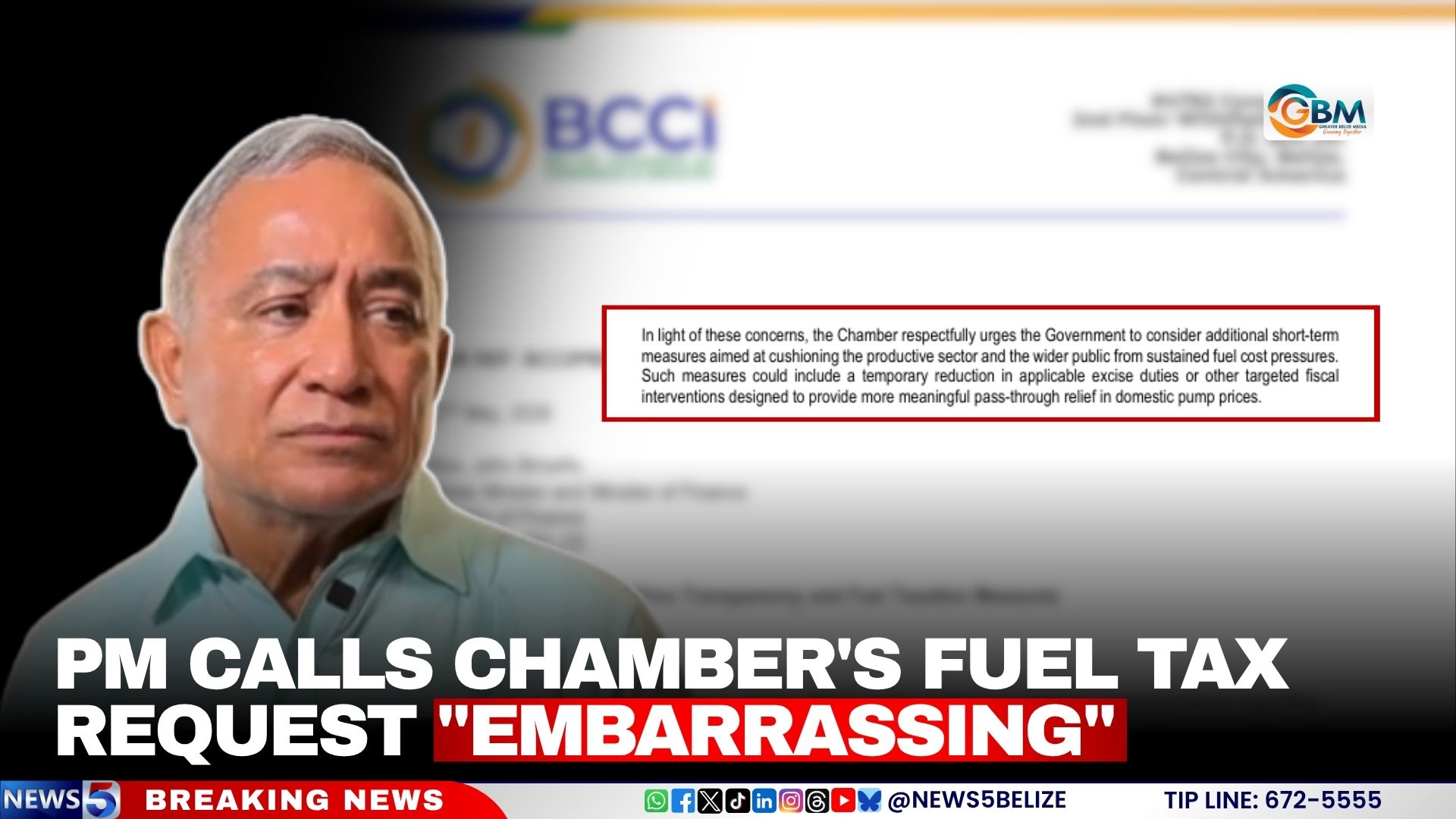
  • PM Calls Chamber’s Fuel Tax Request “Embarrassing”

    PM Calls Chamber’s Fuel Tax Request “Embarrassing”

    A public dispute over fuel taxation has emerged between Belize’s top government official and the nation’s leading business advocacy group, after Prime Minister John Briceno publicly dismissed a call for fuel tax reductions from the Belize Chamber of Commerce and Industry (BCCI) as “embarrassing” in comments made to local outlet News 5.

    The confrontation stems from a formal letter BCCI delivered to the government on May 27, 2026, where the industry group praised the administration’s recent decision to resume public disclosure of detailed fuel price breakdowns, but argued that greater transparency alone cannot address the burden of persistently high fuel costs for consumers and businesses across Belize.

    In its letter, BCCI pointed out that while the proportional share of taxes included in retail fuel prices has dipped marginally in recent months, the total nominal tax amount charged per gallon has remained largely static. Even as global crude oil prices have trended downward, this taxation structure has prevented those international savings from reaching consumers at local fuel pumps, the chamber noted. BCCI explained that excise duties, one of the core components of fuel taxation, have stayed within a narrow consistent range regardless of swings in global commodity prices, creating a bottleneck that blocks price relief for end users.

    High fuel prices have cascading effects across Belize’s entire economy, the business group warned, pushing up costs for passenger and freight transportation, raising overhead for small and large businesses alike, and driving up the price of everyday consumer goods that most households rely on. To remedy the issue, BCCI called on the Briceno administration to implement short-term targeted measures, starting with a temporary cut to fuel excise taxes. The organization closed its letter by emphasizing its willingness to collaborate with the government to craft solutions that strike a balance between the nation’s critical revenue requirements and the need for broad economic stability.

    However, Briceno rejected the chamber’s proposal outright in his response, dismissing the core of the group’s argument as fundamentally flawed. The prime minister contended that reshuffling tax burdens across different tax categories – whether environmental levies, goods and services tax (GST), excise duties, or import taxes – does not reduce the government’s total overall tax take from fuel sales. “If you collect $100 in taxes… it doesn’t matter where you take it from. You could take it off environmental tax or the import tax or the excise tax. It’s still removing money from the whole amount,” Briceno explained. He went further to say that “it’s embarrassing sometimes to read such proclamations from the Chamber,” drawing a sharp line between the government’s fiscal position and the business community’s lobbying efforts.

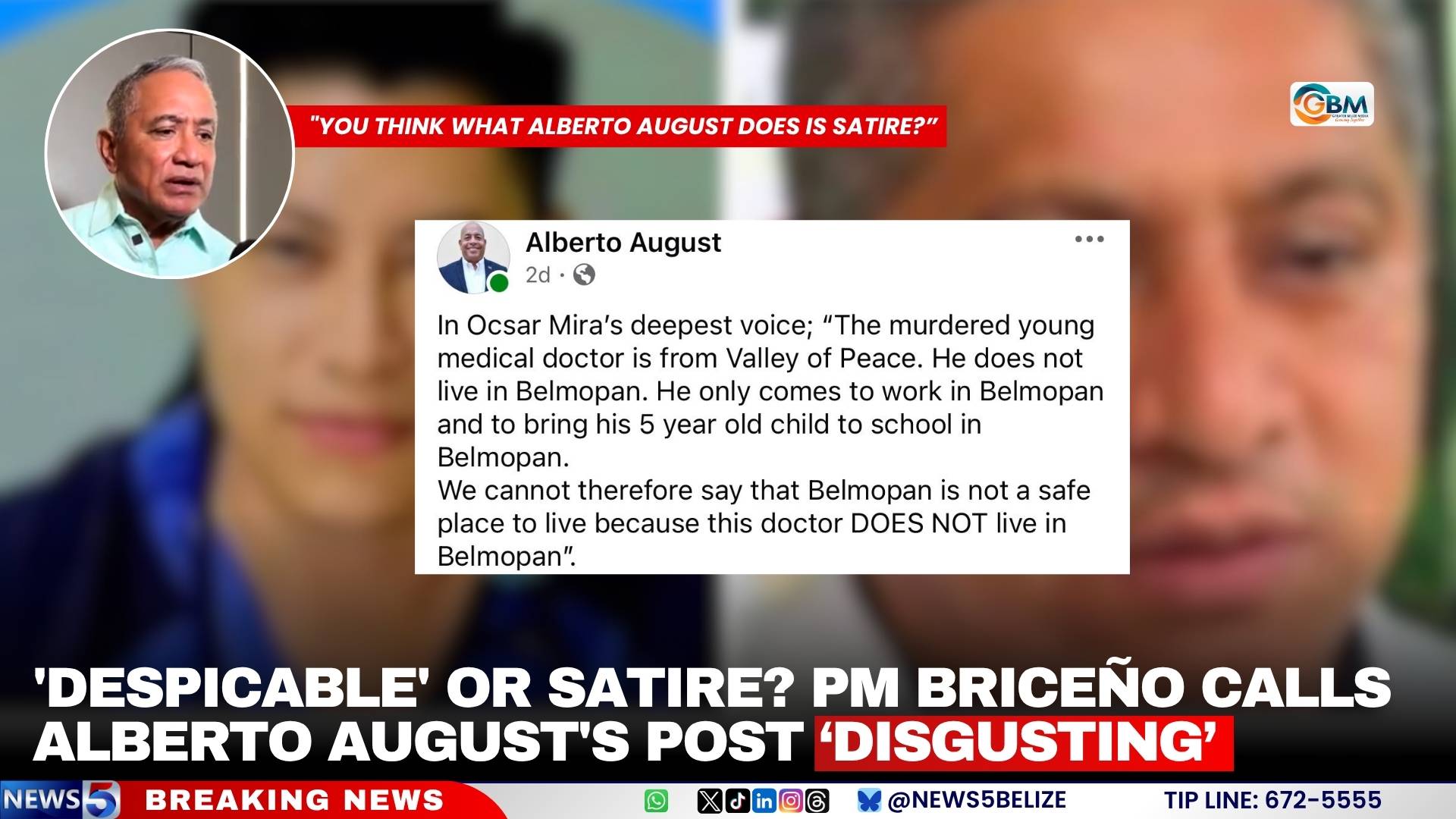
  • ‘Despicable’ or Satire? PM Briceño Calls Alberto August’s Post ‘Disgusting’

    ‘Despicable’ or Satire? PM Briceño Calls Alberto August’s Post ‘Disgusting’

    A fresh political controversy has erupted in Belize, centered on a cyberbullying complaint filed by sitting Home Affairs Minister Oscar Mira against former United Democratic Party (UDP) Chairman Alberto August, and Prime Minister John Briceño has publicly weighed in to defend Mira’s actions amid rising concerns over political free speech.

    Speaking to reporters on June 3, 2026, Briceño made clear that he stands fully behind Mira’s choice to pursue the legal complaint, even as he acknowledged that he would not personally take the same step against his own political critics. The core of Briceño’s argument centers on framing Mira’s action as an assertion of individual constitutional rights, rather than an official government attack on political opposition. Briceño emphasized that Mira retains the same rights as any private citizen in the country: if he believes he has been the target of defamation and harmful slander, he is fully within his legal and constitutional rights to file an official report with authorities.

    Critics of the complaint have raised alarms that the arrest linked to the case sets a dangerous precedent that could stifle legitimate political criticism and erode protections for free speech in the country. Briceño outright rejected these concerns, pushing back against claims that August’s controversial social media post qualifies as protected political satire. In blunt terms, Briceño dismissed the satire framing, calling August’s conduct “disgusting” and accusing the former UDP chair of exploiting the tragedy of a grieving family to score political points.

    The pushback against Mira did not end with free speech arguments: on Monday, August’s attorney, Michael Peyrefitte, labeled the home affairs minister “thin-skinned” and publicly called on Prime Minister Briceño to remove Mira from his cabinet post. Briceño refused this demand, noting that all public figures have different thresholds for offensive speech and that Mira was justified in taking a formal stance against what he saw as harmful defamation. In a surprising turn, Briceño even joked that he himself might consider filing similar legal action against August, though he quickly downplayed the prospect.

    When asked if August’s frequent critical social media posts about Briceño personally have ever tempted him to pursue similar cyberbullying charges, the prime minister was dismissive. Briceño made clear that he does not consider August worth the time or effort of legal action, noting that the former UDP chairman can say whatever he wants about Briceño without causing any personal offense.