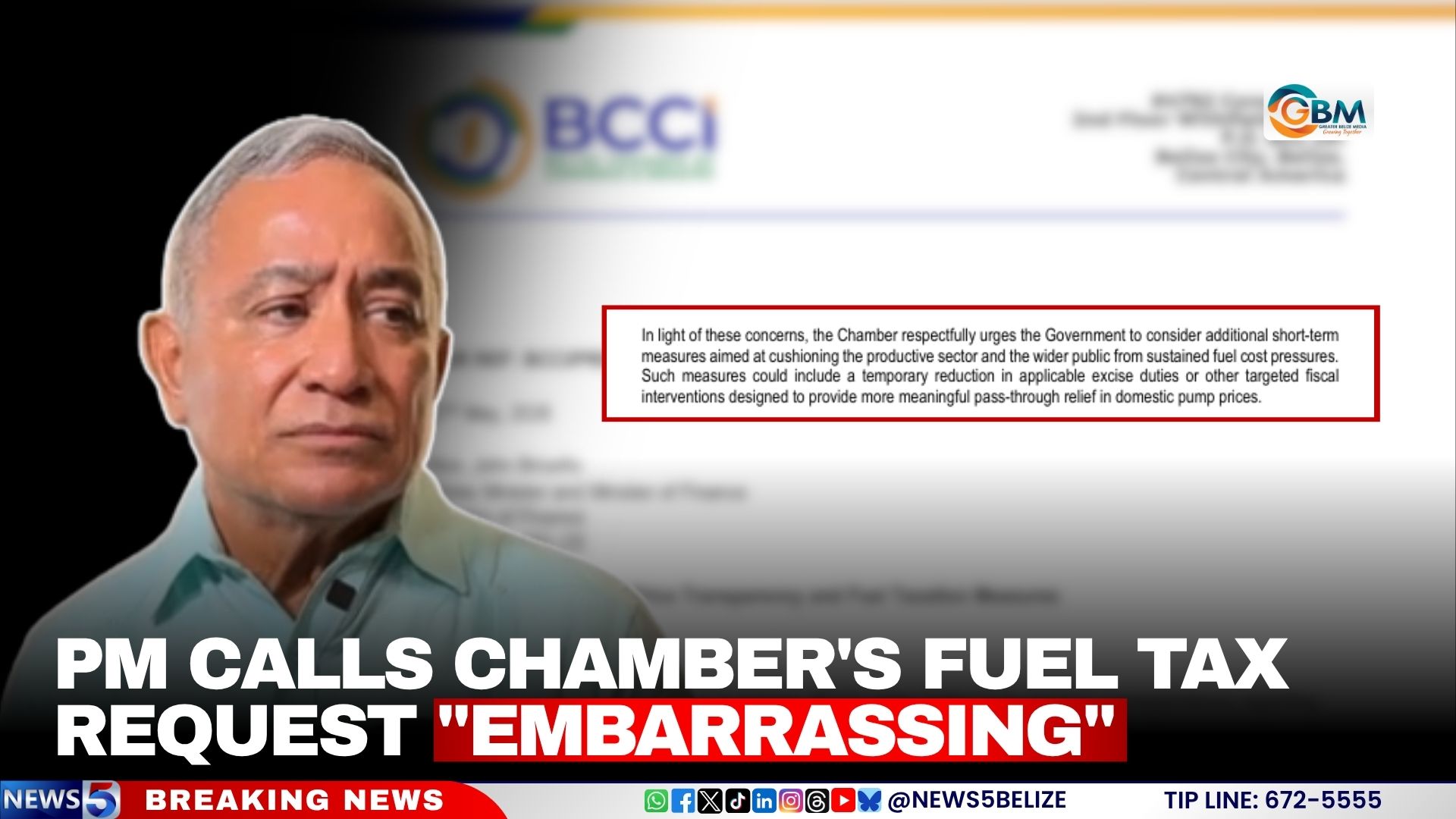
A public dispute over fuel taxation has emerged between Belize’s top government official and the nation’s leading business advocacy group, after Prime Minister John Briceno publicly dismissed a call for fuel tax reductions from the Belize Chamber of Commerce and Industry (BCCI) as “embarrassing” in comments made to local outlet News 5.
The confrontation stems from a formal letter BCCI delivered to the government on May 27, 2026, where the industry group praised the administration’s recent decision to resume public disclosure of detailed fuel price breakdowns, but argued that greater transparency alone cannot address the burden of persistently high fuel costs for consumers and businesses across Belize.
In its letter, BCCI pointed out that while the proportional share of taxes included in retail fuel prices has dipped marginally in recent months, the total nominal tax amount charged per gallon has remained largely static. Even as global crude oil prices have trended downward, this taxation structure has prevented those international savings from reaching consumers at local fuel pumps, the chamber noted. BCCI explained that excise duties, one of the core components of fuel taxation, have stayed within a narrow consistent range regardless of swings in global commodity prices, creating a bottleneck that blocks price relief for end users.
High fuel prices have cascading effects across Belize’s entire economy, the business group warned, pushing up costs for passenger and freight transportation, raising overhead for small and large businesses alike, and driving up the price of everyday consumer goods that most households rely on. To remedy the issue, BCCI called on the Briceno administration to implement short-term targeted measures, starting with a temporary cut to fuel excise taxes. The organization closed its letter by emphasizing its willingness to collaborate with the government to craft solutions that strike a balance between the nation’s critical revenue requirements and the need for broad economic stability.
However, Briceno rejected the chamber’s proposal outright in his response, dismissing the core of the group’s argument as fundamentally flawed. The prime minister contended that reshuffling tax burdens across different tax categories – whether environmental levies, goods and services tax (GST), excise duties, or import taxes – does not reduce the government’s total overall tax take from fuel sales. “If you collect $100 in taxes… it doesn’t matter where you take it from. You could take it off environmental tax or the import tax or the excise tax. It’s still removing money from the whole amount,” Briceno explained. He went further to say that “it’s embarrassing sometimes to read such proclamations from the Chamber,” drawing a sharp line between the government’s fiscal position and the business community’s lobbying efforts.