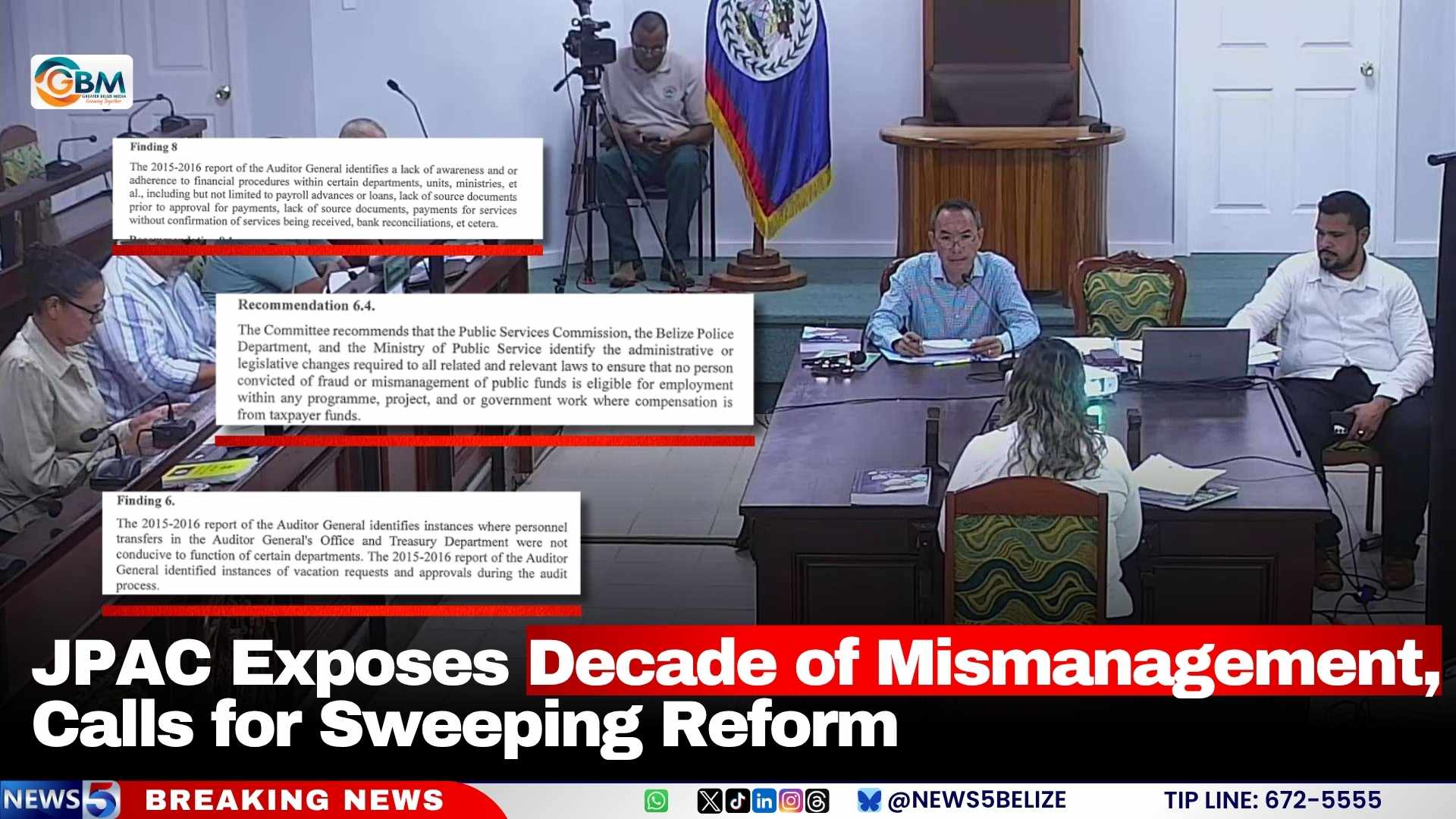
Ten years of unaddressed dysfunction in Belize’s public financial governance has been laid bare in a scathing new report from the country’s Joint Public Accounts Committee (JPAC), which details widespread non-compliance, obsolete regulation, and institutional weaknesses that have left public spending largely unaccountable for years. Chaired by United Democratic Party Area Representative Lee Mark Chang of Mesopotamia, the committee tabled its findings in the national legislature in November 2025, following a review of the long-delayed Auditor General’s report for the 2015–2016 fiscal year – a document that sat unprocessed for nearly a full decade before it was referred to the oversight body.
Among the most alarming revelations in the 2025 JPAC report is the near-total refusal of government entities to cooperate with national auditors. Out of every ministry, department, and public agency across Belize’s government, only the Ministry of Health responded to the Auditor General’s 2015–2016 findings and formal recommendations. All other institutions failed to engage, a direct violation of Section 8(42) of the nation’s Finance and Audit (Reform) Act, which legally mandates that relevant public personnel respond to audit inquiries. This mass non-compliance created a critical “scope of limitation” that prevented auditors from gathering sufficient evidence to complete their work properly, effectively blocking accountability for public funds.
To address this gap, the committee has put forward two key initial reforms: first, that all current chief executive officers, financial officers, and cabinet ministers be required to submit formal written responses confirming whether the 2015–2016 audit recommendations were ever implemented. Second, it is calling on the Ministry of Finance to update and strengthen existing regulations to legally compel all government entities to respond to Auditor General requests in a timely manner.
The document also confirms that the 2015–2016 audit ended with a formal disclaimer of opinion – the most severe qualification an auditor can issue – because core supporting financial documents were either unavailable or completely missing. This problem extends far beyond the 2015–2016 fiscal year, the committee found: multiple annual audits remain incomplete because the Accountant General has failed to submit required financial statements to the Auditor General, as mandated under Section 15(1) of the Finance and Audit Reform Act. Without submitted statements, no audit can proceed, and without audits, there can be no accountability for public spending.
JPAC is calling on the Financial Secretary to immediately convene a high-level meeting with the Accountant General to map the full scope of the backlog, confirm which fiscal years have intact source documents, and estimate how many more audits will require a disclaimer of opinion. The committee also emphasized that where existing reports identify legal grounds to fine or discipline non-compliant public officers, responsible authorities must act and update the Financial Secretary on progress throughout the process.
A core structural flaw undermining all audit work in Belize is the complete lack of meaningful independence for the Office of the Auditor General, the report confirms. Currently, the Auditor General cannot independently publish audit reports or release them directly to the public, and the office operates without a standalone budget. This leaves the government body tasked with overseeing public spending fully dependent on the same government it audits for funding and operational authority.
Testifying under oath at the committee’s October 24, 2025 public hearing, Auditor General Maria Rodriguez shared that a January 2025 review by the U.S. Government Accountability Office specifically recommended sweeping changes: granting her office independent authority to publish reports, securing budgetary independence via direct budget submission to the National Assembly, and giving the Auditor General control over internal human resources management. JPAC has called on the Financial Secretary to release a formal position statement on these requested reforms, and if approved, the Ministry of Finance will seek legal guidance to draft the required legislative changes.
The report also highlights that the foundational rulebook for public financial management in Belize has not been updated in more than 60 years. While the Finance and Audit (Reform) Act was passed in 2011 to modernize governance, the core Financial Orders that guide daily public financial management were written in the 1960s and have never been revised to align with the newer legislation. During a November 17 committee meeting, Senator Kevin Herrera noted that this mismatch creates widespread legal confusion: public officers often do not know which set of rules applies, and this uncertainty has become a cover for intentional or accidental non-compliance. The 2015–2016 audit already documented widespread “unfamiliarity” with the outdated Financial Orders among financial compliance staff, and the committee has moved quickly to authorize hiring an independent consultant to review and update both Financial and Store Orders to align with current law.
Poor record management across government has further exacerbated accountability gaps, the report finds. Government records, files, and financial documents are regularly mishandled, stored improperly, or lost, in violation of national law requiring all public records to be preserved for 20 years. Public hearings heard descriptions of decades-old physical records in decaying condition, scattered across unsecure storage sites, and in some cases, destroyed without the legally required notification to JPAC. The committee has called for a national audit of government storage capacity, plus formal circulars reminding all public personnel of their legal records management obligations, specifically requiring JPAC notification before any records are destroyed.
The committee also uncovered a persistent pattern that disrupts ongoing audit work: key staff at both the Auditor General’s Office and the Treasury Department are regularly transferred or approved for vacation leave while audits are active. While the committee did not confirm whether these disruptions were intentional or coincidental, it noted that the Auditor General and Accountant General have almost no control over their own staffing decisions, which are fully managed by the Ministry of Public Service. Accountant General Teresita Miranda confirmed that her department faces 30% annual staff attrition, with 90% of departures resulting from transfers approved by the public service ministry. JPAC has recommended a cross-ministerial meeting between the Ministry of Finance, Ministry of Public Service, Auditor General, and Accountant General to explore reforms that give audit offices meaningful input into hiring, retention, compensation, and leave decisions for their staff. The committee also supports a legislative change to permanently ban anyone convicted of fraud or public fund mismanagement from any government-compensated employment, a reform that would require joint action from the Public Services Commission, Belize Police Department, and Ministry of Public Service.
The scale of the current audit backlog means Belize will not have up-to-date public financial audits until 2029 at the earliest, even if all reforms are implemented immediately. The Auditor General testified that under current rules that only allow audits of one fiscal year at a time, and assuming all future financial statements are submitted without delay, full catch-up will take another four years. While the 2019–2020 financial statements have been submitted, limited source documentation from line ministries means future disclaimers of opinion are highly likely. Under the current framework, financial statements for the 2025–2026 current fiscal year will not even be ready for submission until January 2028. Notably, the Accountant General added that restructuring her department to separate financial statement preparation and verification duties would cost less than $100,000 annually, requiring only two to three additional full-time staff.
Most damning of all, the committee notes, is that these same problems were formally flagged in a 2018 JPAC minority report covering the 2012–2013 fiscal year, and no meaningful action was taken to address them. The 2018 report warned that public financial mismanagement was growing annually regardless of which political party held power, estimating Belize lost tens of millions of dollars each year to incompetence, corruption, dishonesty, and administrative omission. For the 2012–2013 period alone, the Ministry of Works lost more than $1.18 million due to non-compliance with store management rules. Despite the 2018 report calling for immediate action, estimating full implementation of reforms would cost less than $2 million annually, the same issues remain unaddressed seven years later.
Moving forward, the United Nations Development Programme has offered a forensic accounting consultant to support JPAC’s work on its backlog of pending reviews, which include unreviewed 2014–2015 audits and two special reports on the Belize Sports Council and Julian Cho Technical High School. JPAC is also seeking a dedicated standalone budget from the Ministry of Finance to cover legal support, research assistance, and public hearing media outreach, recognizing that without independent resources, the committee cannot fulfill its constitutional oversight mandate.
In his foreword to the report, Chang emphasized that public financial accountability is a shared national responsibility. The report’s 11 core findings and more than 20 reform recommendations will now go to the full House of Representatives for adoption. Whether this round of findings will lead to meaningful change after a decade of inaction remains to be seen.