标签: Antigua and Barbuda

安提瓜和巴布达

  • House-Lifting Programme to Target Flood-Prone Communities

    House-Lifting Programme to Target Flood-Prone Communities

    The government of Antigua and Barbuda has unveiled a groundbreaking housing resilience strategy designed to protect vulnerable communities from devastating flood damage. Through a specialized home elevation program, authorities will physically raise flood-prone residences to safer elevations, particularly targeting wooden structures built in low-lying areas.

    Social and Urban Transformation Minister Roland Turner explained the critical need for intervention during an interview with ABS News. “Many homes in these vulnerable areas lack sufficient elevation to allow floodwaters to pass safely underneath during heavy rainfall events,” Minister Turner stated. He characterized the solution as “a very simple intervention” that could dramatically reduce property damage and financial losses for at-risk homeowners.

    The innovative program will be integrated into the existing Housing Assistance Programme Initiative (HAPI), which already facilitates repairs, renovations, and reconstruction projects for disadvantaged residents. This expansion comes alongside a significant infusion of resources, including building materials valued at over EC$1 million that have recently arrived for distribution.

    To address implementation challenges, the government has developed a comprehensive workforce strategy. Cabinet has approved the deployment of newly recruited construction workers from the Dominican Republic to supplement existing teams, including inmate labor programs. This additional manpower will support three specialized construction teams operating simultaneously across the nation, significantly accelerating the pace of housing improvements.

    The multi-faceted approach represents one of the Caribbean region’s most comprehensive housing resilience efforts, combining structural interventions, material support, and workforce development to create sustainable solutions for climate-vulnerable communities.


  • Antigua and Barbuda Welcomes New EU Ambassador, Reviews Cooperation Priorities

    Antigua and Barbuda Welcomes New EU Ambassador, Reviews Cooperation Priorities

    The Government of Antigua and Barbuda engaged in high-level diplomatic discussions on Monday with Fiona Ramsey, the European Union’s newly appointed Ambassador to the Eastern Caribbean. The meetings, held with Prime Minister Gaston Browne and Foreign Affairs Minister E.P. Chet Greene, centered on reinforcing the longstanding partnership between the Caribbean nation and the European bloc.

    Prime Minister Browne characterized the EU as a crucial development partner since the country’s independence, advocating for a more strategic framework for regional funding mechanisms under the existing Economic Partnership Agreement. He identified transportation infrastructure as a critical barrier to Caribbean economic integration, noting that exorbitant shipping costs continue to hamper intra-regional trade. Browne proposed innovative, EU-supported maritime solutions—specifically multi-island service vessels—as a potential mechanism to enhance regional connectivity and economic cooperation.

    Foreign Minister Greene described the diplomatic engagement as particularly timely given ongoing reevaluations of EU support structures. While acknowledging decades of productive assistance, Greene expressed optimism that divergent perspectives on key issues—including European Development Fund allocations and concerns regarding Citizenship by Investment Programs—could be resolved through sustained diplomatic dialogue.

    Ambassador Ramsey reaffirmed the European Union’s dedication to maintaining open channels of communication and collaboration. She highlighted climate change mitigation and maritime connectivity as primary areas for continued cooperation, indicating potential advancements in these sectors during her tenure. The discussions established a framework for addressing both immediate concerns and long-term strategic priorities between the EU and Eastern Caribbean partners.

  • Attorney General Signals Push for CCJ Accession, Constitutional Reform Talks

    Attorney General Signals Push for CCJ Accession, Constitutional Reform Talks

    In a landmark address marking the opening of the 2026 legal year, Attorney General Steadroy Benjamin unveiled sweeping constitutional reforms aimed at asserting national sovereignty. The centerpiece announcement confirmed that Antigua and Barbuda will initiate national consultations on acceding to the appellate jurisdiction of the Caribbean Court of Justice (CCJ), terminating its reliance on the British Privy Council as its final court of appeal.

    Benjamin characterized the prolonged dependence on foreign judicial oversight as ‘an affront to our sovereignty,’ emphatically stating that ‘we are now the masters of our own destiny.’ The government simultaneously revealed plans to commence discussions on transitioning to republic status, with a national referendum to be scheduled following comprehensive public consultation.

    A Constitutional Review and Reform Committee has been established to steer these transformative initiatives. Chaired by Benjamin with former Attorney General Justin Simon KC serving as Vice Chair, the committee comprises distinguished members including Dobrene Omarde, Dr. Lenworth Johnson, MP Richard Lewis, Debra Burnette, Beverly Benjamin, and Ralph Bowen. In a gesture of cross-party collaboration, opposition leaders Jamale Pringle and Trevor Walker have received invitations to nominate representatives.

    The Attorney General concurrently addressed judicial administration concerns, acknowledging persistent delays in criminal case resolutions while noting the High Court’s civil division operates without significant backlog. Justice system reforms will feature prominently in the 2026 legislative agenda. Benjamin called upon legal professionals to actively educate citizens about CCJ integration and emphasized that constitutional modernization must balance judicial independence with public confidence built upon transparency, integrity, and equitable justice.

  • Eastern Caribbean Supreme Court Opens 2026 Law Year, Signals New AI Rules and Reforms

    Eastern Caribbean Supreme Court Opens 2026 Law Year, Signals New AI Rules and Reforms

    The Eastern Caribbean Supreme Court (ECSC) has launched its 2026 judicial term with a comprehensive modernization agenda targeting artificial intelligence governance, digital service expansion, and criminal justice acceleration across its nine-member jurisdiction.

    During the ceremonial opening of the High Court, Acting Chief Justice Margaret Price Findlay outlined groundbreaking initiatives that position the regional judiciary at the forefront of legal technology adaptation. The court is developing a formal regulatory framework to govern AI utilization by judicial officers and legal practitioners, responding to increased technological integration in court proceedings and record management.

    Substantial enhancements are underway for the court’s AI transcription system, initially implemented in 2024, to boost record accuracy and dramatically reduce judgment delivery timelines. Justice Findlay emphasized that while embracing technological efficiency gains, the judiciary remains committed to safeguarding judicial independence and procedural fairness, asserting that technology must augment rather than replace human judicial decision-making and ethical responsibilities.

    The court leadership urged universal adoption of the Electronic Litigation Portal, revealing that despite full integration of all case types, inconsistent usage has hampered system effectiveness. Technical assistance programs are being intensified to address operational challenges encountered by court personnel and users.

    Substantial criminal justice reforms show promising advancement, with judge-alone trials now operational in Antigua and Barbuda, Saint Vincent and the Grenadines, and Saint Lucia. This transformative approach aims to eliminate delays associated with jury selection and alleviate chronic case backlogs.

    The ECSC has completed comprehensive revisions to criminal procedure rules, is finalizing updated sentencing guidelines, and has circulated a draft criminal mediation framework for public consultation as part of a broader shift toward alternative dispute resolution mechanisms.
    In a historic development, Justice Findlay announced the acquisition of a permanent, purpose-built headquarters for the ECSC in Saint Lucia, concluding a two-decade pursuit for a dedicated institutional home that symbolizes the court’s enduring regional presence.

  • Antigua and Barbuda’s Energy Minister Elected IRENA Vice President for Latin America and Caribbean

    Antigua and Barbuda’s Energy Minister Elected IRENA Vice President for Latin America and Caribbean

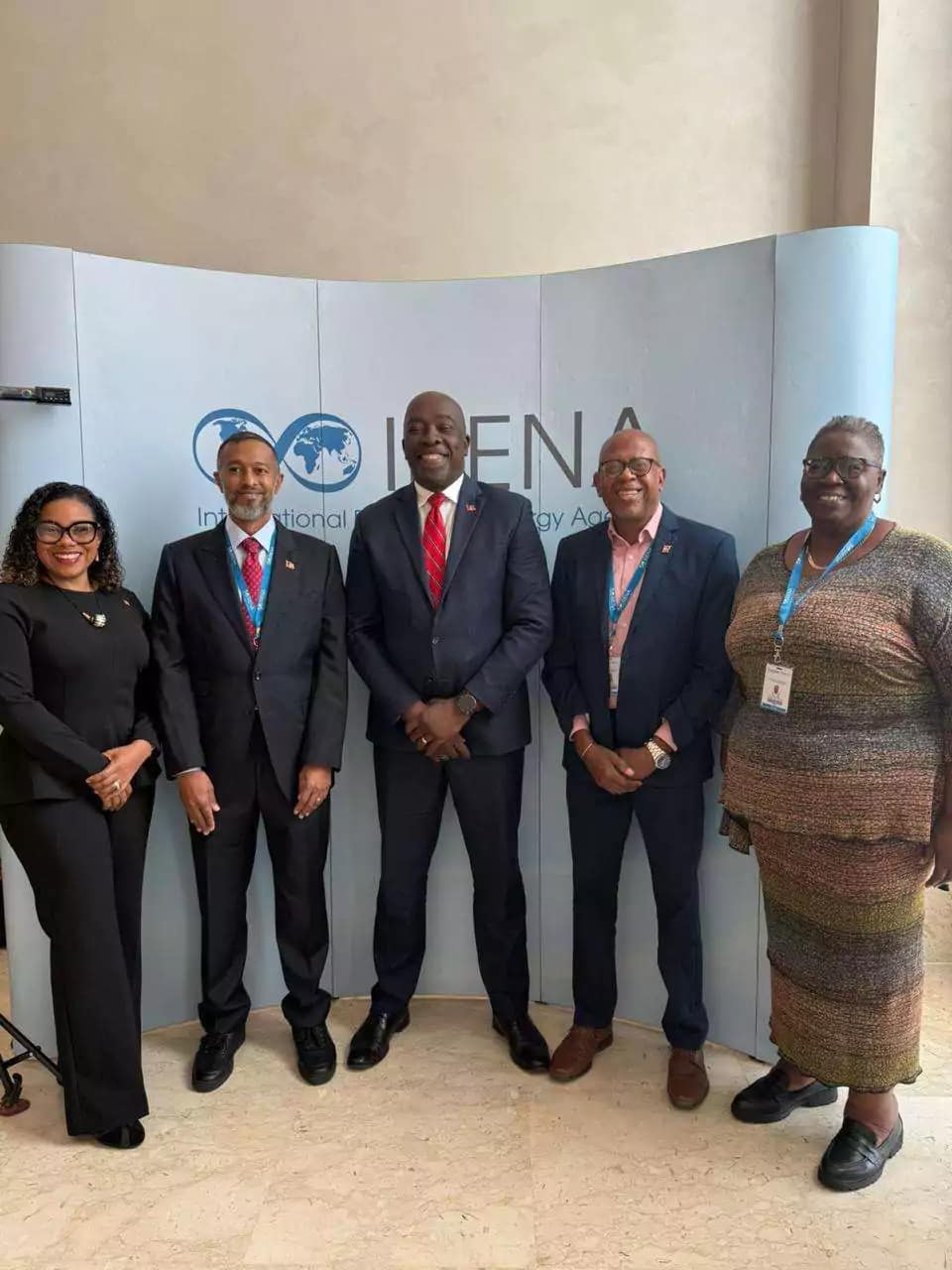
    In a significant development for Caribbean representation in global energy governance, Antigua and Barbuda’s Energy Minister Melford Nicholas has attained the prestigious position of Vice President for Latin America and the Caribbean at the International Renewable Energy Agency (IRENA). This election occurred during IRENA’s 16th Assembly convened in Abu Dhabi, positioning the small island nation in a senior decision-making capacity within the influential international organization.

    Minister Nicholas utilized the platform to articulate the acute energy challenges confronting Small Island Developing States (SIDS). In his national address, he revealed that Antigua and Barbuda remains disproportionately reliant on imported fossil fuels, with fuel expenses constituting approximately 67% of all utility revenues. This economic vulnerability underscores the urgent necessity for transition to sustainable alternatives.

    During high-level discussions with IRENA Director-General Francesco La Camera, Nicholas championed accelerated deployment of renewable energy solutions across SIDS nations. The dialogue centered on strategic investment frameworks, international partnerships, and developing climate-resilient energy infrastructure capable of withstanding environmental disruptions.

    Nicholas emphasized the critical need for enhanced access to concessional financing mechanisms and customized risk-mitigation instruments specifically designed for small island economies. He highlighted ongoing international support, including a hybrid solar project in Barbuda funded by the United Arab Emirates, alongside contributions from the United Kingdom, New Zealand, and the CARICOM Development Fund.

    The minister’s leadership was further demonstrated as he presided over a ministerial-level session, solidifying Antigua and Barbuda’s influential role in shaping global renewable energy policy and reinforcing the nation’s commitment to sustainable energy transition.

  • Antigua Tests Simple Net System That Keeps Bugs Out and Food Chemical-Free

    Antigua Tests Simple Net System That Keeps Bugs Out and Food Chemical-Free

    A groundbreaking agricultural initiative in Antigua and Barbuda is demonstrating remarkable success in pesticide-free vegetable cultivation through advanced insect-proof net technology. This innovative approach, developed under a bilateral cooperation program with China, represents a significant leap toward sustainable farming practices in the Caribbean nation.

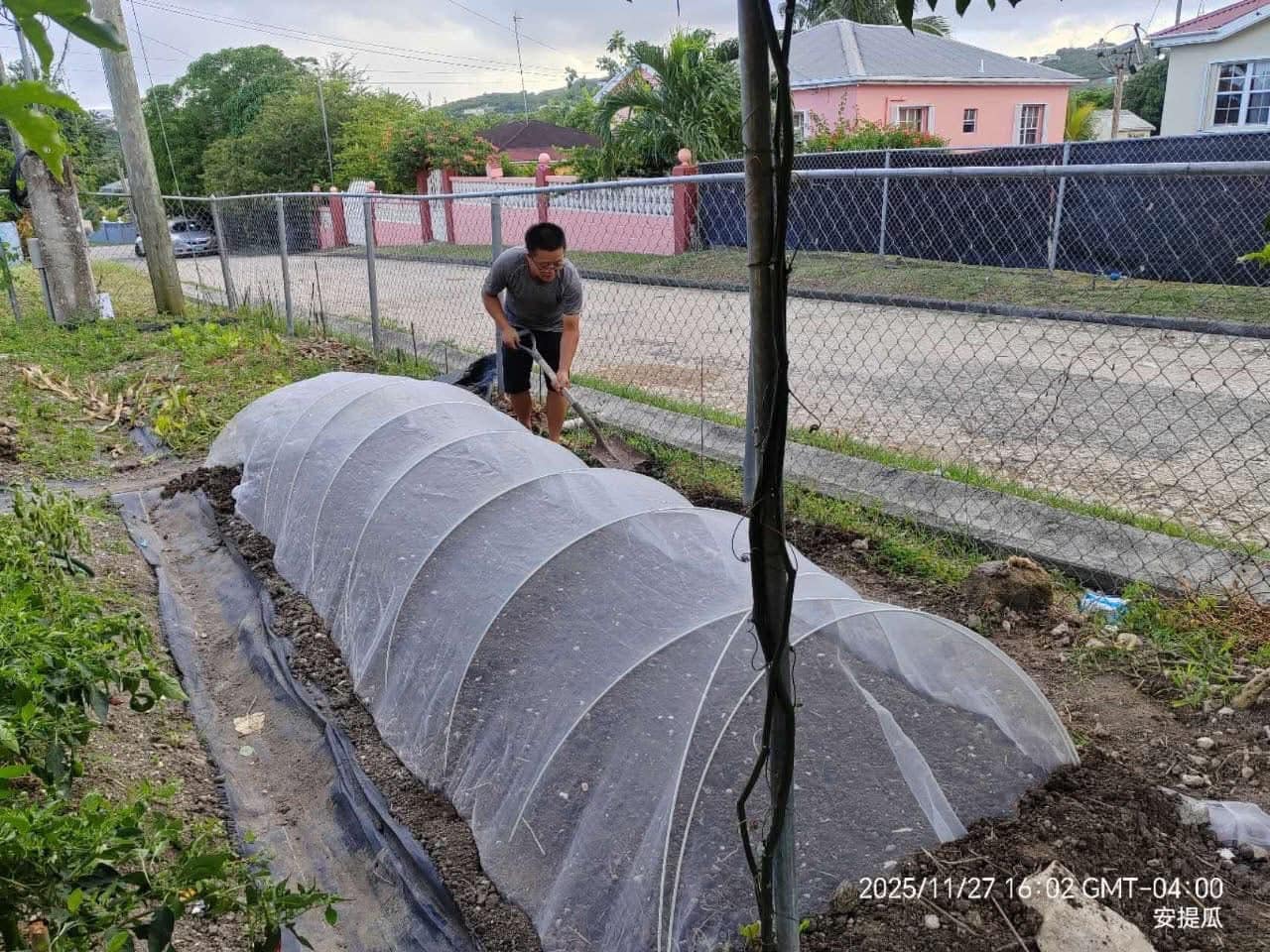
    The technology, formally designated as Light and Simplified Green Prevention and Control Technology for Plant Pests, employs finely woven nets that create a physical barrier against destructive insects while permitting essential sunlight, air, and rainwater to reach crops. This method effectively prevents infestation by common pests including aphids, thrips, flea beetles, and diamondback moths without chemical intervention.

    Dr. Lu Jiaju, Associate Researcher at the Institute of Subtropical Crops, Guizhou Academy of Agricultural Sciences, who serves as lead technical instructor for the project, emphasized the preventive nature of the technology. “This methodology focuses on creating an impenetrable barrier rather than combating pests after infestation occurs,” Dr. Lu explained. “By preventing insect access, we eliminate both crop damage and disease transmission pathways.”

    The comprehensive field trial, conducted in collaboration with Antigua and Barbuda’s Crop Research & Development Division, focused on Chinese cabbage—a leafy vegetable particularly vulnerable to tropical pests. Researchers implemented meticulous preparation protocols including field sanitation and solarization techniques to eliminate existing pest populations before establishing arched greenhouse structures completely enclosed with the specialized netting.

    The results proved unequivocal: the January 2026 harvest revealed stark contrasts between net-protected and control plots. Cabbage grown under insect-proof nets exhibited perfect health, uniformity, and zero pest damage without pesticide application, while unprotected crops suffered near-total destruction.

    Beyond pest prevention, the technology enhances vegetable quality by eliminating plant stress responses that typically produce bitter compounds. This results in superior taste, texture, and visual appeal that meets growing consumer demand for clean, chemical-free produce.

    While initially demonstrated with cabbage, the technology shows promising applications for diverse crops including tomatoes, cucumbers, eggplants, watermelons, broccoli, napa cabbage, and cowpeas—all staples of local agriculture. The Ministry of Agriculture plans expanded trials and demonstrations, including at the Bethesda agricultural base, to encourage broader adoption.

    The subsequent phase of the agricultural assistance project will include comprehensive farmer training programs and hands-on demonstrations. Although initial infrastructure costs exceed traditional open-field farming, experts project rapid cost recovery through reduced pesticide expenses and premium market prices for higher-quality produce.

    “This represents a transformative investment in our agricultural future,” Dr. Lu concluded. “Through continued collaboration with the Ministry of Agriculture, we can empower local farmers to produce healthier vegetables while significantly enhancing national food security.”

  • Senior Magistrate Ngaio Emanuel’s Appointed As Chief Magistrate Confirmed

    Senior Magistrate Ngaio Emanuel’s Appointed As Chief Magistrate Confirmed

    Antigua and Barbuda’s judicial system has ushered in a new era of leadership with the formal appointment of Senior Magistrate Ngaio Emanuel as Chief Magistrate. The landmark appointment was officially confirmed by Attorney General Sir Steadroy Benjamin during a special High Court sitting commemorating the opening of the 2026 legal year, where Magistrate Emanuel delivered her inaugural address.

    The appointment concludes a significant leadership gap within the magistracy that had persisted since July 2023. This vacancy emerged following the suspension and subsequent retirement of former Chief Magistrate Joanne Walsh after disciplinary proceedings were initiated by the Judicial and Legal Services Commission. Magistrate Dexter Wason temporarily filled the position in an acting capacity until his contract concluded in late 2025. Attorney General Benjamin disclosed that he had formally recommended Emanuel for the prestigious position in mid-November 2025.

    Magistrate Emanuel brings substantial judicial experience to her new role, having served on the Antigua and Barbuda magistracy since March 2013 before earning promotion to Senior Magistrate in March 2024. Her distinguished academic credentials include an Honors LLB from the University of the West Indies, Cave Hill Campus, professional legal training at Trinidad’s Hugh Wooding Law School, and a Master of Laws degree with merit obtained from the University of East London in 2023.

    Prior to her judicial appointment, Emanuel established her legal career through private practice in Trinidad and Tobago. She has further demonstrated her commitment to specialized justice sectors through her service as Chairperson of the Child Justice Board, highlighting her particular expertise and dedication to juvenile justice matters.

  • LETTER: Kentish seen as the best choice to replace Watts in St. George

    LETTER: Kentish seen as the best choice to replace Watts in St. George

    The United Progressive Party (UPP) has finalized candidates for fifteen constituencies, with only the substantial St. George electoral district remaining undecided. This key constituency, which boasted over 5,100 voters in the last election cycle, has become a competitive arena with multiple contenders vying to succeed outgoing MP Algernon ‘Serpent’ Watt.

    The primary race features three prominent figures: Antigua Barbuda Workers Union President Kem Riley, newly qualified lawyer Kelton Dalso, and media personality Jermaine ‘Buffy’ Kentish. An analysis of the political landscape suggests significant disparities in candidate viability. Two contenders face substantial challenges—one lacks name recognition beyond his immediate community, while another demonstrates inconsistent political positioning. Conversely, Kentish emerges as a formidable candidate with nationwide recognition, charismatic appeal, and deep community connections transcending traditional political boundaries.

    Kentish’s candidacy is bolstered by his multi-generational roots throughout the constituency. Born in New Winthorpes and raised in Barnes Hill, his family connections extend through Pigotts (his father’s birthplace) and Potters. His political heritage traces back to his grandfather, Samuel Kentish, an early member of the Progressive Labour Movement renowned for advocating workers’ rights and agricultural community interests.

    Political observers note Kentish’s potential to disrupt the electoral dominance of the Antigua and Barbuda Labour Party’s Michael Freeland. His widespread popularity and cross-party appeal could potentially achieve vote totals exceeding 3,000 ballots—a threshold unmatched since Sir Adolphus’s political era. The January 19th primary at Potters Primary School represents a critical juncture for UPP’s electoral strategy and St. George’s political future.

  • Is This Your Dog?

    Is This Your Dog?

    A meticulously groomed canine discovered tethered to a post at Village Walk has prompted an urgent community appeal for its owner to come forward. The well-kept appearance of the animal suggests it may have been accidentally left behind rather than intentionally abandoned. Local authorities or community members who discovered the dog are now spearheading efforts to reunite the pet with its rightful owner. The situation highlights concerning patterns of pets being left unattended in public spaces, whether through forgetfulness or deliberate action. The clean and healthy condition of the dog indicates it has recently received proper care and attention, strengthening the hypothesis that its separation from the owner may have been unintentional. Community networks are being mobilized to spread awareness through social media channels and local communication platforms. This incident serves as an important reminder for pet owners to maintain constant vigilance regarding their animals’ whereabouts, particularly in busy public areas where distractions abound.

  • The Antigua and Barbuda College of Advanced Studies Marks Steady Progress as Second Academic Semester Begins

    The Antigua and Barbuda College of Advanced Studies Marks Steady Progress as Second Academic Semester Begins

    The Antigua and Barbuda College of Advanced Studies (AB-CAS) has entered its second academic semester with significant institutional progress and growing enrollment numbers. Educational authorities report that the institution has successfully implemented its foundational curriculum while expanding faculty resources and student support services.

    According to recent developments, the college has established robust academic frameworks across multiple disciplines, creating pathways for advanced certification and degree programs. The administration has prioritized faculty development, bringing in both local experts and international academics to strengthen the institution’s educational offerings.

    Infrastructure enhancements have been particularly noteworthy, with upgraded laboratory facilities, expanded library resources, and improved digital learning platforms. These improvements come as part of a broader national initiative to strengthen higher education capacity within the twin-island nation.

    Student enrollment has exceeded initial projections, demonstrating strong domestic demand for advanced educational opportunities. The college has also attracted international students from across the Caribbean region, creating a diverse academic community.

    Educational Minister Michael Browne commented on these developments, stating: ‘The steady advancement of our College of Advanced Studies represents a milestone in our national educational development. This institution will serve as a catalyst for intellectual growth and professional development throughout Antigua and Barbuda.’

    The college administration has announced plans to introduce additional specialized programs in emerging fields, with particular focus on sustainable development, maritime studies, and information technology – areas of strategic importance to the nation’s economic future.