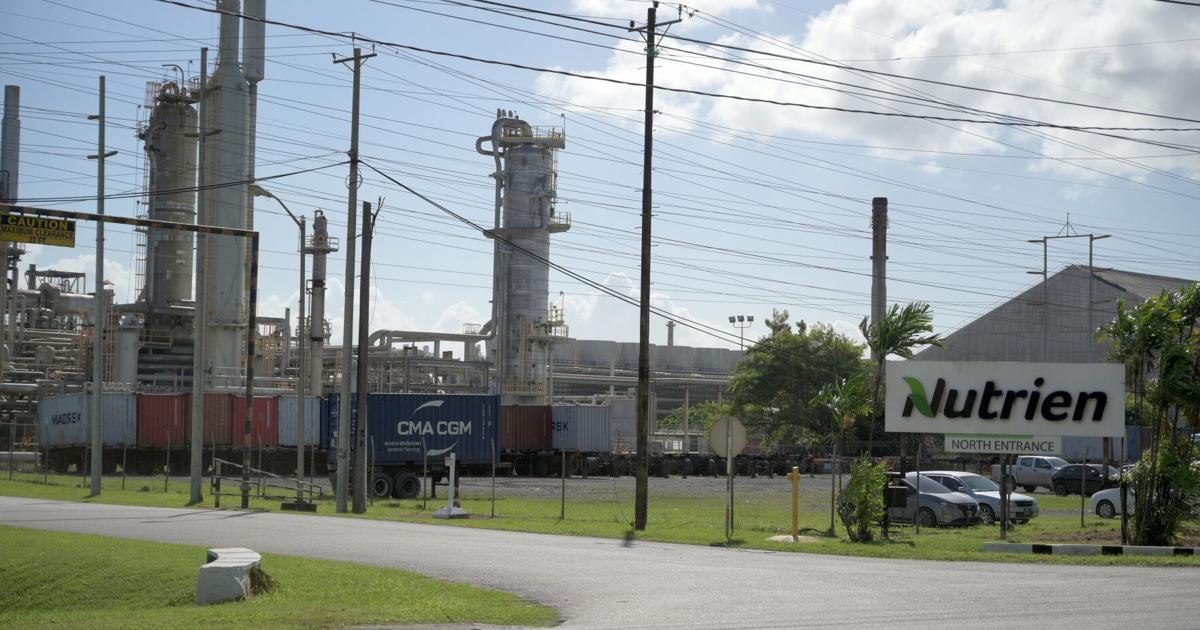
A growing wave of industrial closures has hit Trinidad and Tobago’s key Point Lisas Industrial Estate, with global fertilizer giant Nutrien Ltd becoming the latest major firm to announce an indefinite halt to its nitrogen operations, citing persistent natural gas supply shortages and long-term uncertainty. The move has deepened concerns over the country’s struggling energy sector and ignited fierce political debate over the government’s management of critical natural resources.
Nutrien’s final shutdown announcement comes just 10 months after the company initiated a controlled, partial shutdown of the facility in October 2025, when it already flagged unreliable, economically unviable natural gas supplies and restricted port access that had eroded the site’s free cash flow contribution for years. Following months of extensive strategic reviews and closed-door discussions with key stakeholders, the company confirmed that permanent idling was the only viable path to protect shareholder returns and boost free cash flow.
“Due to ongoing natural gas constraints and uncertainty, this was determined to be the optimal path to enhance free cash flow and return on invested capital,” the company stated in an official release. In a statement acknowledging the impact on staff, Dean Perkins, Nutrien’s Senior Vice-President of Upstream, Nitrogen and Proprietary Product Operations, emphasized the firm’s commitment to a responsible transition: “We greatly appreciate the contributions and dedication of our Trinidad team and are committed to managing the transition responsibly and safely.”
Local media outlet the Express estimates the shutdown will affect hundreds of permanent employees and contract workers. However, Nutrien noted that the decision will not alter its 2026 global nitrogen sales volume guidance, as its projections had already factored in zero production from the Trinidad site. The company added that it remains well positioned to meet global customer demand, with planned growth coming from reliability improvements and low-cost debottlenecking projects at its North American nitrogen assets.
Nutrien’s announcement follows a string of similar exits by major energy firms at Point Lisas, all tied to natural gas supply issues. Less than two weeks before Nutrien’s announcement, Proman Trinidad, the industrial estate’s largest tenant, unveiled a restructuring plan that included workforce cuts to adapt to persistent supply constraints. In July of this year, Methanex Corporation indefinitely idled its Titan methanol plant at the site after failing to secure a new natural gas supply contract, and the company’s Atlas methanol joint venture — where Methanex holds a 63.1% economic stake — has also remained idled in a preserved, inactive state indefinitely.
Reaction from Trinidad and Tobago’s political leadership has been swift and divided. Current Energy and Energy Industries Minister Dr Roodal Moonilal called Nutrien’s decision “unfortunate” but pushed back against the company’s claim that the shutdown was driven by natural gas shortages. In a statement to the Express via WhatsApp, Moonilal argued that the decision was instead rooted in the company’s desire to secure a higher profit margin aligned with the expectations of its international shareholders. He countered that the Trinidad and Tobago government is obligated to prioritize the interests of its own citizens, the country’s de facto public shareholders.
Moonilal revealed that the government, through the state-owned National Gas Company of Trinidad and Tobago (NGC), had been negotiating with Nutrien to keep the PCS Nitrogen complex operational since October 2025, and that these efforts will continue. He added that NGC had made multiple good-faith offers to keep the plant running, including a formal proposal to purchase the complex outright. “At all material times, the National Gas Company has engaged with Nutrien in good faith. They were invited to engage with the NGC for the supply of gas to the facility but refused to accept that invitation,” Moonilal said. He emphasized that the idled plant is a critical national asset, and restarting production remains a top government priority — whether with Nutrien or a new operating partner.
“It is unfortunate that the pursuit of profit has trumped the best interests of this country, the energy sector and the citizens who have in some cases given their entire professional career and adult lives to Nutrien,” he added. Moving forward, Moonilal said the government will ramp up discussions with existing stakeholders and potential new investors to restart the facility as quickly as possible, as part of broader efforts to rebuild the domestic energy sector and mitigate the economic damage of Nutrien’s exit. “We are working to rebuild the domestic energy sector and through this we intend to mitigate the impacts of the decision by Nutrien,” he said, noting the government aims to have the Point Lisas facility operational again “in the not-too-distant future.”
Former energy minister Stuart Young, of the opposition People’s National Movement (PNM), seized on the announcement to criticize the current ruling United National Congress (UNC) administration, calling Nutrien’s decision “black and white confirmation” of the government’s incompetence in managing the energy sector. “This is a loss of foreign exchange, massive loss of jobs, not only at the plants but all associated service providers as well. This is unfortunately bad news for all of Trinidad and Tobago,” Young said in a social media post.
Young defended the PNM’s 2015-2025 tenure managing the sector, claiming the previous administration balanced natural gas supply and demand while keeping energy companies profitable. He accused the current UNC government of failing to negotiate a compromise to resolve the sector’s challenges, adding: “The UNC is incapable of negotiating and finding the necessary middle ground needed in tough times.”
Warning that Nutrien’s shutdown could be the first of many industrial losses, Young said: “This is the first of more to come unfortunately and it is a very sad day for Trinidad and Tobago.” He also challenged the government’s record on natural gas development, claiming the current administration has not delivered a single new natural gas project, noting that all major ongoing projects — including Manatee, Coconut, Mento, Aphrodite, Ginger, Cassia Phase 2, Matapal and Cocuina/Manakin — were initiated under the previous PNM government. “The Kakistocracy is destroying Trinidad and Tobago whilst selling you fake snake oil promises. Elections have consequences,” he added.