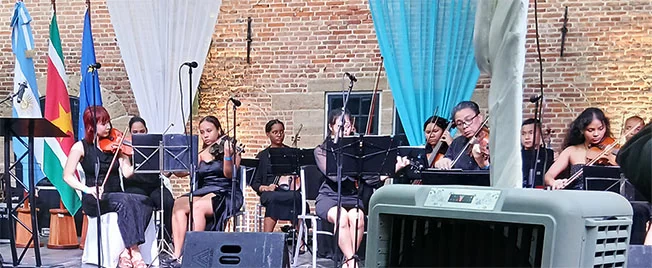
On a warm Friday evening in Paramaribo, Suriname, the weathered stone walls of Fort Zeelandia became the backdrop for an extraordinary cross-cultural gathering that blended art, diplomacy, and historical reconciliation. Organized jointly by the Embassy of Argentina and the Delegation of the European Union, the one-of-a-kind Lyrical Cultural Exchange event drew a distinguished guest list that included Suriname’s Foreign Minister Melvin Bouva, multiple cabinet ministers, members of the national diplomatic corps, and local arts enthusiasts.
At the heart of the evening was a collaborative performance uniting talented musicians from Argentina and Suriname, designed to frame music as a universal language of connection. Representing Argentina were acclaimed baritone Leonardo López Linares and virtuoso recorder player Cecilia Marapino, who traveled specifically to Suriname for the event. Suriname’s roster featured leading local vocalist Duncan Brunings alongside the Cathedral Children’s Choir, alongside other emerging and established artistic talents.
Attendees and critics alike were quick to praise the exceptional artistic standard of every performance. Brunings, in particular, turned in a showstopping set that proved Suriname’s world-class vocal talent can hold its own alongside internationally renowned artists; his performance matched the skill of his Argentine collaborator and was widely ranked as one of the night’s most memorable highlights. The Cathedral Children’s Choir added a gentle layer of uncomplicated sincerity and youthful hope to the program, creating a thoughtful tonal balance that resonated deeply with the audience.
Beyond the quality of the performances, the choice of venue lent the entire event a profound symbolic weight. Fort Zeelandia is far more than a preserved colonial-era monument: for the people of Suriname, it is inextricably linked to the tragic December 1982 killings, where 15 prominent Surinamese citizens were violently killed on the site. Where violence, grief, and division once left deep, permanent scars on the location, Friday evening filled its halls with voices and melodies celebrating beauty, harmony, and cross-community connection.
For many attendees, the evening felt like a quiet act of collective healing. The rich harmonies and warm, resonant tones seemed to wrap the historic fort in light and peace, turning a space long defined by pain into one that held tangible messages of shared humanity, hope, and reconciliation through art.
The event’s focus on connection extended far beyond the stage too. After the formal performances, guests were invited to sample a selection of Argentine wines and local appetizers, with all proceeds from the refreshments donated directly to the Bellas Artes Music School to support the growth and development of young Surinamese musical talent. The night concluded with an informal gathering, where attendees raised a toast to Argentina’s National Day, capping an evening that seamlessly wove together music, friendship, and cross-border collaboration.
Organizers and attendees alike agreed this gathering was far more than a simple concert. It was a celebration of art, international partnership, and the unique ability of music to bridge divides and heal old wounds. Above all, it demonstrated that culture does more than entertain: it can heal divided communities, inspire new optimism, and inject positive new energy into places that carry heavy national historical meaning. For those in attendance, the most lasting takeaway was simple: for a few hours on a June evening, in a place forever marked by tragedy, music took center stage, bringing together people from all backgrounds in a spirit of beauty, mutual respect, and shared hope. That alone made the Lyrical Cultural Exchange a truly historic event in its own right.