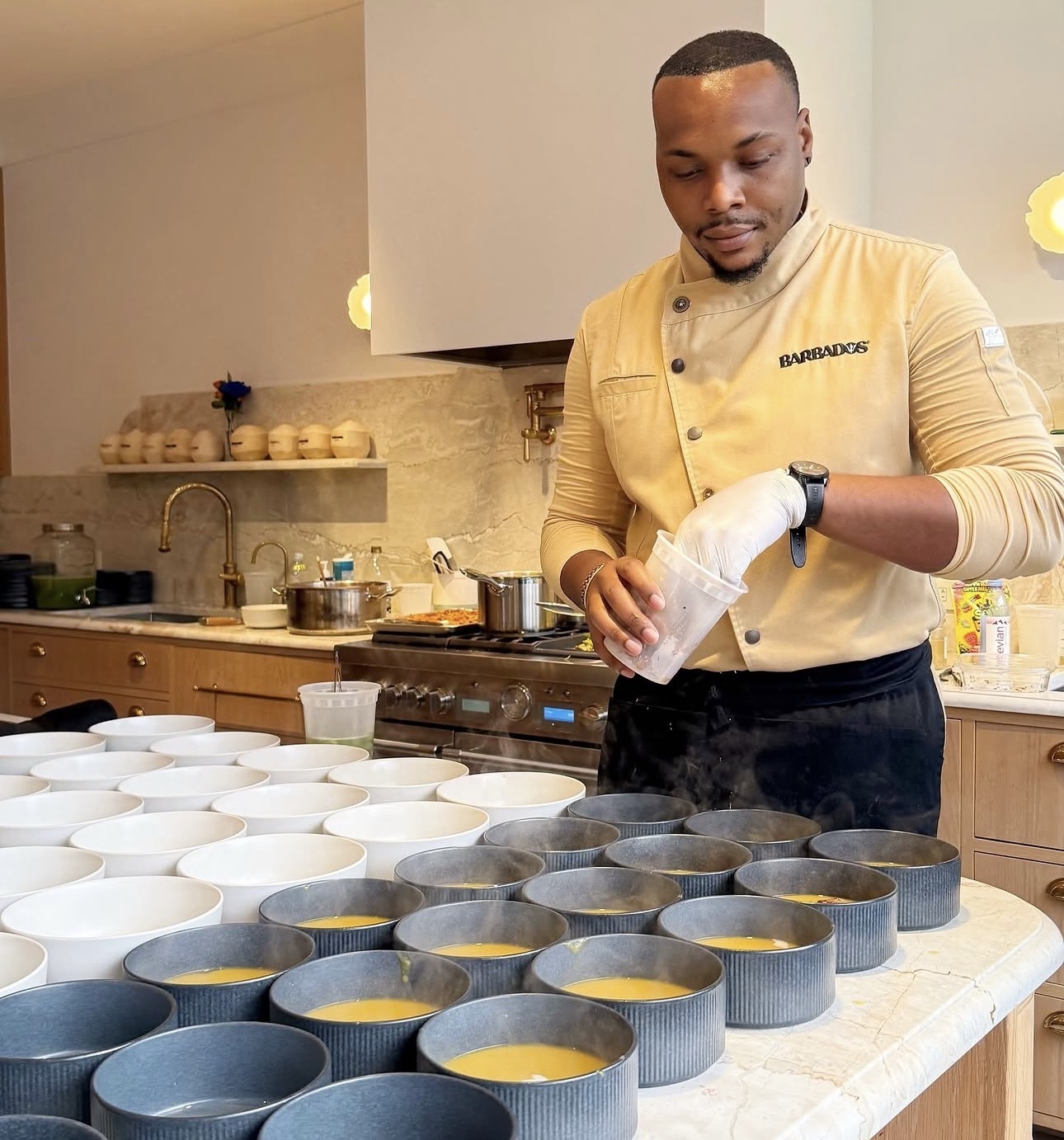
What if one of Barbados’ most beloved traditional dishes, pudding and souse, arrived on a plate nothing like the Saturday afternoon serving generations have grown up with? Acclaimed Barbadian chef Javon Cummins is inviting diners to take that test – and discover how familiar culinary memories can feel brand new when reimagined through a creative, respectful lens.
Cummins’ modern take on the classic starts with slow-braised pork belly paired with a steamed beetroot and sweet potato pudding. He transforms the traditional mango and Scotch bonnet pickle into a vivid, jewel-toned gel, reinterpreting the staple condiment in delicate forms including light foam and crystal-clear jelly. While the finished plate could easily pass as a work of modern art for a gallery wall, that first bite transports any native Barbadian straight back to lazy Saturday family gatherings, and the beloved relative whose souse was always said to be the best on the island.
This gentle challenge to rethink tradition sits at the core of Cummins’ culinary philosophy. “Modernisation should never erase memory,” he explains. “If anything, it should give us another way to experience it.”
Long before he stepped into a professional kitchen, Cummins trained as a visual artist, sketching, painting, and creating handcrafted works. That visual sensibility has become a natural part of his cooking approach, where the plate functions as just another canvas. Ingredients become his colors and shapes, sauces add dynamic movement, and textures bring layered dimension. Even the smallest garnish earns its place in the overall composition. “I want you to look at the plate and be intrigued before you taste it,” he says. “Then, when you finally do, I want the flavour to complete the picture.”
While aesthetically striking dishes are easy to admire in the moment, they are often just as quickly forgotten. Cummins pursues a far deeper goal: every one of his plates is crafted to carry a distinct sense of place, with robust, layered flavor to give the visual beauty lasting meaning. With 14 years of kitchen experience behind him, he has learned that technical skill does not equal culinary maturity. Any chef can learn to transform almost any ingredient, but true wisdom lies in knowing which core elements of a tradition should remain untouched.
This balanced judgement has grown sharper with time. Early in his career, Cummins often wondered whether diners would grasp his instinct to take a familiar flavor and reimagine its form. Years of experience have left him more confident, and more restrained: not every interesting idea belongs on a plate, and tradition does not need to stay frozen in time to deserve respect.
More often than not, the proof of his approach shows on a diner’s face before they ever voice a reaction. At an overseas food festival, Cummins served his reimagined version of cou cou and fish to a Barbadian woman who had not returned to her home country in decades. His dish paired creamy traditional cou cou with fire-roasted fish and a deep, smoky Creole sauce enriched with smoked herring. One bite was enough to change her entire expression, and she spent the rest of the festival returning again and again to sample more of his creations. She talked for hours of her home, her grandmother’s kitchen, and the flavors she had carried with her for years. “For those few minutes, she wasn’t just standing at a food festival overseas anymore,” Cummins recalls. “She was back in her grandmother’s kitchen.”
That kind of reaction means more than any generic compliment. It proves Caribbean cuisine can travel, evolve, and take unexpected new forms while still holding the essence of home at its core. Cummins wants diners to first feel that spark of recognition, then let curiosity lead them to explore something new. This year, that exploration will come with a spoon, as he turns his creative eye to dessert.
At the 2026 Barbados Food and Rum Festival’s flagship Liquid Gold Feast, Cummins – best known for his innovative savory dishes – will reveal a lesser-seen side of his culinary skill, drawing on his long-standing background in pastry work. He has chosen soursop and cinnamon as his core mystery ingredients, two staples that open distinct pathways to shared Bajan collective memory.
Soursop first evokes the creamy, comforting texture of the traditional drink countless Barbadians grew up with. Cummins plans to take that familiar foundation and reimagine it in a lighter, more playful form, playing with contrasting textures, bright citrus notes, and subtle echoes of beloved Bajan sweet bread. Rich creaminess will meet sharp flashes of acidity, soft smooth textures will pair with unexpected crunchy elements. The exact final preparation remains a closely guarded secret – and that secrecy is part of the experience.
Cinnamon offers a warmer, more fragrant path, filled with endless possibility. Nutmeg and ginger may make an appearance, while a hint of black pepper promises a small, delightful surprise. Pastry work gives Cummins precise control over temperature, shape, texture, and even the order that flavors unfold on the tongue. He aims to create a dessert that stops guests in their tracks when they first see it, greets them with a familiar comforting aroma, then unfolds into a flavor profile nothing like they have experienced before.
“That tension between ‘I know this flavour’ and ‘I’ve never had it quite like this’ is where I love to create,” he says.
The Liquid Gold Feast will be held on Sunday, November 8, 2026 at CARIFESTA House in Waterford, as part of the wider Barbados Food and Rum Festival running from November 5 to 8. The event coincides with Barbados’ 60th Independence anniversary, and under the theme “These Fields and Hills”, it centers native Barbadian ingredients and the chefs who transform them as the heart of the experience. Tickets for the Liquid Gold Feast are priced at BBD $350, while a combined ticket for the Rise and Rum event and Liquid Gold Feast costs BBD $500.
Cummins’ new dessert creations fit perfectly into the festival’s narrative. For him, soursop, cinnamon, citrus and spice are far more than just cooking ingredients – they are clues to the identity of an island that takes its food seriously, where friendly debates over who makes the best fish cakes or pudding and souse are common, and where a shared Sunday lunch carries generations of family history.
His ambition for the feast is not simply to hear guests praise his desserts as delicious. He would far rather a guest look up from their plate and say, “I understand what you were trying to tell me.” That core message is simple: Barbadian cuisine has roots deep and strong enough to support endless creative invention. Nostalgia and progression can share the same plate. A familiar flavor can be painted in entirely new colors and still speak in an unmistakably Bajan voice.
So the challenge stands: come to the Liquid Gold Feast, find Javon Cummins, and pause before that first bite. Take in the shape, the fragrance, the small visual clues woven into the plate. Then taste the soursop, or follow the warm notes of cinnamon into its unexpected corners. Does it remind you of a drink you loved as a child, a bake your relative made years ago? Does it introduce you to a Barbados you have never tasted before?
Cummins wants to hear whether you understood the story he is telling. Just do not ask him to give away the ending before you have finished your dessert.
### Full Barbados Food and Rum Festival Schedule & Ticketing
In addition to the November 8 Liquid Gold Feast, the 2026 festival line-up includes two free public events: Oistins Under the Stars on Thursday, November 5, and International Chef Demos on Friday, November 6. The Rum Route experience will be held November 6 for BBD $200, and the Rise & Rum event will take place Saturday, November 7 for BBD $250. Tickets are available for purchase in person at multiple locations across Barbados, including CS Pharmacy (Bridgetown), Nu Look Company (Roebuck Street), Mpowered (Sky Mall), Très Classe Boutique (Sheraton Mall), A&B Music Supplies (Wildey), Visual Oasis (Six Roads), the Lotto Booth (Speightstown, opposite the Bus Terminal), and the National Cultural Foundation (West Terrace). Tickets can also be purchased online via TicketNation.bb. For the latest updates, follow the official festival account @foodandrumbarbados on Instagram.