博客

  • Early onset El Niño triggers slight downward adjustment to the total number of named storms

    Early onset El Niño triggers slight downward adjustment to the total number of named storms

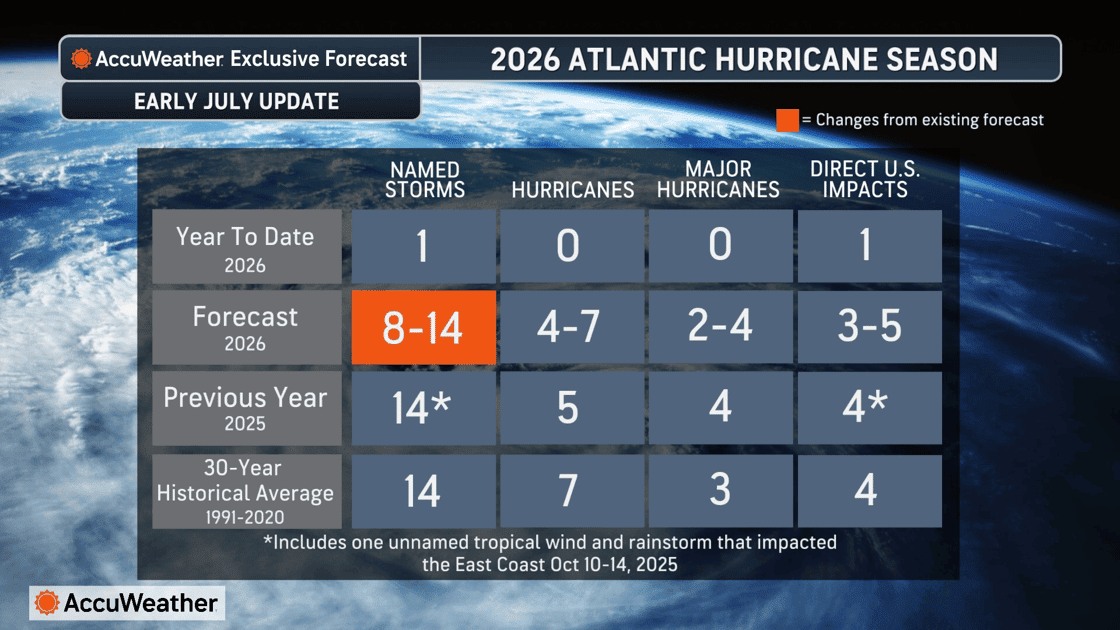
    Less than three months after releasing its initial 2026 Atlantic hurricane season outlook, AccuWeather has issued a downward revision to its projected number of named storms, driven by an earlier-than-expected arrival of El Niño and growing forecasts that a powerful Super El Niño will develop through the peak of the season. The leading weather forecasting firm now projects between 8 and 14 named storms will form across the Atlantic basin this year, a modest drop from the 11 to 16 storm range published in its initial March 2026 forecast.

    AccuWeather’s lead hurricane expert Alex DaSilva noted that El Niño conditions have long shaped the team’s projection that 2026 storm totals will land near or below the historical average. “The stronger the El Niño gets, the fewer named storms we’re likely to get,” DaSilva explained, pointing to the 2015 season, when a strong El Niño produced just 11 named storms – a number he says is the most likely outcome for 2026.

    Unlike many other forecasting outlets, this updated outlook includes clear projections for the most likely range of hurricanes, major hurricanes, and direct storm impacts on the United States, a distinction that Dan DePodwin, AccuWeather Vice President of Forecasting Operations, highlighted as part of the firm’s commitment to data-driven, continuous forecast refinement. AccuWeather originally released its preliminary seasonal outlook on March 25, weeks earlier than most competing forecasting groups.

    Unchanged from the initial March forecast are the projections for stronger storm activity: the firm still expects 4 to 7 hurricanes to develop, with 2 to 4 of those strengthening into Category 3 or higher major hurricanes. Between 3 and 5 storms are projected to make direct impacts on U.S. territory, with the northern and eastern Gulf Coast, the Carolinas, and the northeastern Caribbean continuing to face higher-than-average risk of rapid storm development.

    DaSilva emphasized a key preparedness risk for these high-risk regions: unlike slow-developing storms that track across the open Atlantic from the African coast, storms that form close to shore leave residents with far less time to put emergency plans into action. “That’s why we stress having a hurricane plan in place before the season starts, rather than waiting until a storm is already offshore,” he added.

    El Niño’s early June arrival is the core driver of this forecast adjustment. AccuWeather currently estimates a 70% probability that a Super El Niño will develop before the end of the hurricane season and persist into early 2027. The climate pattern drives increased wind shear across the entire Atlantic basin, a meteorological force that disrupts the organization and intensification of tropical systems, suppressing overall storm development.

    Beyond the overall storm count, the current seasonal pattern points to a lower-than-average risk of major tropical impacts for the central and lower Texas coast. Even so, warm sea surface temperatures close to the U.S. Atlantic and Gulf coasts create conditions that can fuel rapid intensification of storms that form near shore, shrinking the window for public warnings. Impacts of these storms are not limited to coastal zones either: flooding rainfall and tornadoes often extend hundreds of miles inland, meaning even residents far from the coast should monitor forecasts closely throughout the season.

    The 2026 season already saw its first named storm in mid-June, when Tropical Storm Arthur made landfall along the Texas coast on June 17, bringing catastrophic flooding across the Gulf region. Preliminary AccuWeather damage estimates put total economic losses from Arthur between $4 billion and $6 billion, with damage to private property and public infrastructure, widespread flight delays, extended power outages, and halted business operations all contributing to the massive economic toll. Some parts of the region recorded more than 20 inches of rain from the slow-moving storm.

    DePodwin noted that Arthur serves as a critical reminder that tropical systems do not need to reach hurricane strength to cause severe, costly, and even deadly damage. “Flooding, travel disruptions, power outages and business interruptions can quickly add up to billions of dollars in impacts for families, businesses and communities,” he said.

    To help the public better understand the full scope of potential storm impacts, AccuWeather uses its proprietary RealImpact™ Scale for hurricanes, which differs from the widely used Saffir-Simpson scale that categorizes storms solely by maximum wind speed. The RealImpact™ scale incorporates a broader set of factors that affect communities, including rainfall-driven flooding, storm surge, and projected economic damage, to provide a more complete picture of a storm’s potential threat to lives and livelihoods.

    AccuWeather meteorologists are available 24/7 to provide ongoing updates and expert analysis as conditions develop through the 2026 hurricane season. Media outlets can request interviews with AccuWeather experts or access updated forecast graphics for print and broadcast through the company’s media relations team, reachable during regular business hours or via the 24/7 AccuWeather Media Hotline at (814)-235-8710. AccuWeather forecasts reach a wide audience across the United States, appearing in 700 print newspapers, broadcasting on more than 400 radio stations and 100 television outlets, and reaching over 125 million viewers through the AccuWeather Network and AccuWeather NOW® on cable and streaming platforms.


  • Leisure : Did you know ? #39

    Leisure : Did you know ? #39

    Haiti’s leading digital media outlet HaitiLibre has announced a major expansion of its popular twice-weekly general knowledge quiz platform, Quiz.HaitiLibre, adding 31 new interactive trivia games in its July 2026 monthly update that pushes the platform’s total offerings to 180 games. The expansion, which maintains the platform’s core commitment to accessible, free knowledge, comes alongside the 39th installment of its beloved “Did You Know?” trivia segment, which this week shines a spotlight on a defining, little-discussed feature of Haiti’s iconic Gingerbread architecture: the pelmet.

    Often described as the visual calling card of the Gingerbread architectural style that is synonymous with Haitian cultural identity, pelmets are finely cut wooden borders fitted along the upper edges of building roofs. These intricate decorative elements have long drawn comparisons to delicate lace and whimsical fairytale friezes, lending each Gingerbread house a one-of-a-kind, lyrical aesthetic that sets Haitian architecture apart.

    Beyond their well-documented artistic appeal, pelmets also serve a critical practical purpose for Haiti’s tropical climate. Beyond catching sunlight and casting dynamic, shifting shadow patterns across building facades, they redirect rainwater away from vulnerable wooden exterior walls, preventing water infiltration and extending the lifespan of the structure. What makes each pelmet even more distinctive is that nearly every traditional Gingerbread home boasts a custom, hand-carved design crafted by highly skilled Haitian cabinetmakers, turning a functional building component into a canvas for cultural expression.

    This blend of structural utility and artistic craft cements pelmets as a perfect example of the intersection of art and engineering, elevating a simple roof element to a refined, nationally celebrated artistic tradition that is core to Haiti’s cultural heritage.

    Quiz.HaitiLibre, which launched as a standalone platform to make general knowledge accessible to audiences around the world, caters to all skill levels with three adjustable difficulty tiers: easy, intermediate, and hard. All games on the platform are available in both French and English, completely free to access, and require no user registration to play. Users can test their knowledge across a wide range of topics spanning Haitian history, culture, arts, global current events, and science, with expert-level trivia available for more experienced quiz enthusiasts seeking a greater challenge.

    Since its official launch, the platform has followed a regular monthly update schedule to add new content, ensuring returning visitors always have fresh trivia to explore. After the July 1 update, the platform now hosts 180 unique games, with more content scheduled to roll out in future monthly releases. The outlet encourages visitors to share the platform with friends and family, and submit feedback via a simple form available at the end of each game to help shape future updates.

  • Security Exercise to Restrict Access to Parts of St. John’s on Today and Friday

    Security Exercise to Restrict Access to Parts of St. John’s on Today and Friday

    A large-scale inter-agency security exercise is set to shut down access to multiple key zones in St. John’s for two consecutive days, Thursday and Friday, disrupting local travel and daily routines for thousands of residents and commuters. Local law enforcement and emergency management officials announced that the drill is designed to test the region’s response capabilities to potential public safety threats, with training activities concentrated in the downtown core and waterfront districts that see heavy daily foot and vehicle traffic.

    Starting from early Thursday morning, multiple streets, parking lots, and public access points in the affected areas will be closed to unauthorized individuals and vehicles. Officials have warned that delays are likely on major arterial roads leading into the city center, and have urged non-essential travelers to avoid the restricted zones entirely to prevent gridlock. Pedestrian access will also be limited in some parts of the waterfront park and downtown public squares, forcing local businesses to adjust their daily operations for the duration of the exercise.

    Organizers have emphasized that the exercise is a pre-planned, routine training event, and there is no active threat to public safety connected to the activity. The drill will bring together multiple agencies, including local police, fire departments, coastal security units, and emergency medical teams, to practice coordinated response protocols. This joint training is intended to cut down on response times and improve communication between different departments during real-world emergency scenarios.

    Local officials have issued a public apology for the inconvenience caused by the access restrictions, noting that the short-term disruption is a necessary trade-off for long-term public safety preparedness. They have also advised residents to check official city social media channels and transportation websites for real-time updates on road closures and route changes throughout the two-day exercise.

  • Department of Culture to Host Cultural Characters Workshop

    Department of Culture to Host Cultural Characters Workshop

    A new free public workshop focused on preserving centuries-old Caribbean traditional cultural performance practices is set to open its doors to participants this Wednesday afternoon, launched by the Cultural Department of the Ministry of Creative Industries. Conceived by Culture Director Khan Cordice, the multi-week training program will immerse attendees in a range of iconic folk performance skills that form the backbone of regional Carnival celebrations.

    According to Events Coordinator Gilbert Laudat, the curriculum covers hands-on training in core disciplines including stilt walking—locally known as the art of the Moko Jumbie, conch shell blowing, and the performance techniques required to portray traditional figures such as the Caribbean John Bull clown and whip cracker. Beyond performance skills, participants will also learn the history behind these cultural roles, as well as the craft of building authentic costumes and assembling all the elements that bring these traditional characters to life.

    The core mission of the initiative, Laudat explained, is to address a growing gap in intergenerational knowledge transmission by creating accessible opportunities for community members, especially young people, to build deep, practical expertise in these fading folk traditions. By lowering barriers to entry through free, public training, organizers hope to reverse the trend of declining participation and secure the long-term survival of these defining elements of local cultural heritage.

    Registration for the program is open to all interested participants on-site at the Environment Division. Daily sessions will run from 3:30 p.m. to 7:00 p.m., with the entire workshop scheduled to conclude on July 24, 2026, after opening on July 8. Following the completion of the initial training cycle, the Cultural Development Division is aiming to see a noticeable increase in the representation of these traditional cultural characters in the annual Carnival Monday parade, bringing heritage back to the center of the island’s biggest celebration.

    Laudat added that the training initiative will not end with the initial workshop cycle. Long-term plans include ongoing, regular training opportunities for the general public, with an expansion to schools across the island already in the works. After the 2026 Carnival concludes, the program will pause briefly before resuming to add training focused on traditional Christmas cultural characters, extending the initiative’s impact beyond Carnival season to year-round heritage preservation.

  • News : Zapping…

    News : Zapping…

    As the Caribbean nation of Haiti enters the second week of July 2026, a series of key political, diplomatic and cultural developments are unfolding across the country, marking both moments of national remembrance and steps forward for governance and community engagement.

    On July 7, 2026 – exactly five years after former Haitian President Jovenel Moïse was assassinated by mercenary attackers – local officials in Cap-Haïtien gathered to honor his memory. Leading the municipal delegation was Cap-Haïtien Mayor Michel Saint-Croix, who was joined by Deputy Mayor Edeline Jean and senior members of the city’s municipal administration. The group traveled to Moïse’s mausoleum, where they held a formal memorial service and laid a floral tribute to the late head of state. In a statement following the ceremony, the Cap-Haïtien Municipal Administration confirmed its alignment with the national day of remembrance, reaffirming its long-standing commitment to upholding republican values, fulfilling the national duty of remembrance, and strengthening the country’s democratic institutions. Former Haitian Prime Minister Laurent Lamothe also released a public statement marking the somber anniversary, condemning the assassination as an act of “unimaginable barbarity” that altered the entire trajectory of Haiti’s national destiny. Lamothe, who has faced significant personal repercussions for his public calls for full accountability and justice for Moïse’s killing, emphasized that his calls for truth would not waver. “His assassins thought they were killing a man. They shattered the destiny of a nation,” Lamothe wrote. “Jovenel fell, but his memory will live on. I paid a heavy price for refusing to remain silent and demanding justice. I would do it again without hesitation. For Jovenel, for Haiti, until the whole truth comes out.”

    One day before the commemoration, on July 6, 2026, veteran Haitian journalist Lucien Jura officially stepped into the role of Secretary of State for Communication. Jura succeeds Jean Willio, who oversaw a structured handover of institutional knowledge to ensure a smooth transition focused entirely on advancing national priorities.

    In regional diplomatic news, Haitian Foreign Minister Raina Forbin held a high-level bilateral meeting with her Bahamian counterpart Frederick A. Mitchell, Minister of Foreign Affairs and Public Service of the Commonwealth of The Bahamas, on the sidelines of the 51st Ordinary Session of the CARICOM Council of Heads of State and Government hosted in Saint Lucia. Forbin attended the CARICOM summit alongside Haitian Prime Minister Fils-Aimé. The two diplomats centered their discussions on deepening bilateral collaboration between Haiti and The Bahamas, with a particular focus on pressing shared regional priorities: restoring stability and security across Haiti, expanding joint action on maritime security, supporting Haiti’s ongoing electoral process, and addressing evolving tensions across the Caribbean region.

    In cultural news, two Haitian literary voices have earned a spot among the six finalists for the inaugural Quai d’Orsay Literary Prize, a new award launched in 2025 by France’s Ministry for Europe and Foreign Affairs. Louis-Philippe Dalembert’s novel *Je n’ai jamais dit Papa* (I Never Said Dad), published by Éditions Robert Laffont, and Lyonel Trouillot’s *Bréviaire des anonymes* (Breviary of the Anonymous), published by Actes Sud, were selected as finalists from a pool of submitted entries, marking a major milestone for Haitian literature on the global stage.

    On the community cultural front, two Haitian cultural organizations have launched a new initiative to preserve the country’s iconic traditional drumming heritage in Les Cayes. On June 27, La Fabrique des Arts partnered with the Institute for the Promotion and Development of Education and Culture (IPDEC) to launch recurring weekly drum classes open to young residents of the city. Experienced local drummers Ricardo Paisible and Fen Josil lead the instruction, and the first session drew more than a dozen young participants eager to learn traditional Haitian rhythmic patterns in a structured, inclusive, and dynamic learning space. Over the course of the program, participants will build their technical skill, rhythmic awareness, and understanding of drumming’s central role in Haitian cultural identity. The joint initiative aims to intergenerationally transmit traditional knowledge, safeguard Haiti’s musical heritage, and nurture the next generation of Haitian drummers.

  • Antigua and Barbuda Hands Over ECCB Monetary Council Chairmanship to Dominica

    Antigua and Barbuda Hands Over ECCB Monetary Council Chairmanship to Dominica

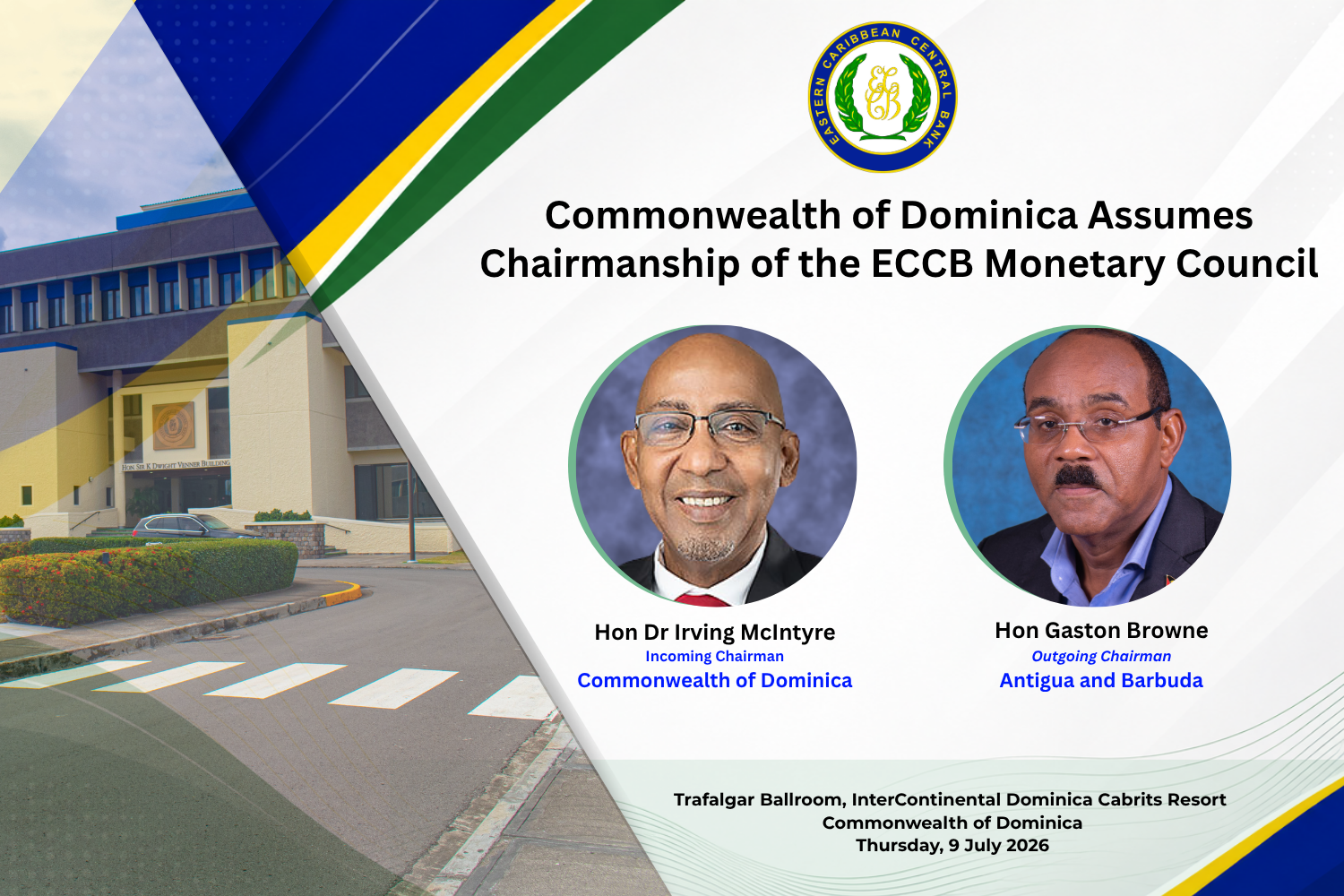
    A key leadership transition is set to take place in 2026 for the Eastern Caribbean Central Bank (ECCB), as the top post of its Monetary Council prepares to change hands in a formal, public ceremony. On July 9, 2026, starting at 5:00 p.m. local time at the Trafalgar Ballroom of the InterContinental Dominica Cabrits Resort located in the Commonwealth of Dominica, current chair Gaston Browne, the council’s representative for Antigua and Barbuda, will officially transfer the gavel to incoming chair Dr. Irving McIntyre, Dominica’s representative to the decision-making body.

    As the highest governing and decision-making authority of the ECCB, the Monetary Council is composed of the finance ministers from all eight of the ECCB’s member jurisdictions across the Eastern Caribbean. Following long-standing institutional rules, the council’s chairmanship rotates on an annual basis, with the role passing to the next representative in alphabetical order of the member territories: Anguilla, Antigua and Barbuda, the Commonwealth of Dominica, Grenada, Montserrat, Saint Christopher (St Kitts) and Nevis, Saint Lucia, and Saint Vincent and the Grenadines. This rotational system ensures equal representation and shared governance across the Eastern Caribbean currency union.

    Beyond the formal leadership handover, the 2026 ceremony will carry special historical significance: it will host the public unveiling of a fully redesigned series of Eastern Caribbean (EC) banknotes and coins, created to mark the 50th anniversary of the EC dollar’s fixed exchange rate peg to the United States dollar.

    The process to update the regional currency began years before the launch. During the Monetary Council’s 105th meeting held on July 21, 2023, members approved a landmark change: the removal of the late Queen Elizabeth II’s portrait from EC currency, a shift that aligns with the region’s evolving sovereign identity. The council also directed the ECCB to lead a period of public consultation to gather input from residents across member territories on what imagery should replace the former portrait. These public engagement sessions ran from July through December 2023, and the results were clear: an overwhelming majority of respondents supported featuring local national heroes and foundational nation builders on the newly redesigned currency.

    For those unable to attend the ceremony in person, the entire event will be broadcast for free via live stream on two platforms: the official ECCB Connects platform and the ECCB’s public YouTube channel, allowing residents, financial stakeholders and interested observers across the region and globally to follow the proceedings.

  • Greene Calls for Public Cooperation as CHOGM 2026 Security Simulation Exercise Begins

    Greene Calls for Public Cooperation as CHOGM 2026 Security Simulation Exercise Begins

    As Antigua and Barbuda advances its preparations to host the 2026 Commonwealth Heads of Government Meeting (CHOGM), the Caribbean nation has launched a critical two-day national security simulation exercise, Foreign Affairs Minister and CHOGM Task Force Chairman Hon. E.P. Chet Greene announced in a public address to all citizens and residents.

    Greene emphasized that this drill is far more than a routine training exercise. It stands as a tangible demonstration of Antigua and Barbuda’s unwavering commitment to delivering a secure, well-organized and successful summit for Commonwealth heads of state and government when the global gathering convenes in November 2026. The simulation is designed to test response protocols, coordinate inter-agency operations and identify gaps in security planning ahead of the major international event.

    In his address, Greene extended formal recognition and praise to the law enforcement officers and security personnel leading the simulation operation. He noted that the dedication, personal sacrifice, and detail-oriented planning these professionals have brought to the process form the very foundation of the nation’s preparedness to welcome world leaders. He urged all participating personnel to uphold the highest professional standards throughout the exercise, noting that their performance reflects the quality and integrity of Antigua and Barbuda as a host nation.

    The task force chairman also offered sincere thanks to the general public for their ongoing support. Public cooperation and patience, he said, are irreplaceable factors that will determine the exercise’s ultimate success. Broad public participation in adapting to temporary changes underscores the unified “whole-of-nation” support behind the 2026 CHOGM hosting effort, sending a clear signal to the global community that Antigua and Barbuda is fully ready to welcome the Commonwealth gathering.

    Greene formally apologized in advance for temporary disruptions to daily public life, including expected traffic delays and temporary restricted access to certain areas. He stressed that these short-term adjustments are a necessary part of robust, effective planning, and that only thorough advance preparation can guarantee the safety of attending international delegates, local residents, and all event staff, while setting the foundation for a globally successful summit.

    As the simulation gets underway, Greene pledged full accessibility and support from himself, the national government, and the entire CHOGM Task Force. “We are all in this together,” he noted, adding that collective shared resolve will ensure the 2026 CHOGM is an event that makes all Antigua and Barbuda residents proud. He closed the address with a blessing for the nation’s security forces and the twin-island state.

  • Pawiroredjo: Ordinaire kwikdiefstal hoort niet achter gesloten deuren

    Pawiroredjo: Ordinaire kwikdiefstal hoort niet achter gesloten deuren

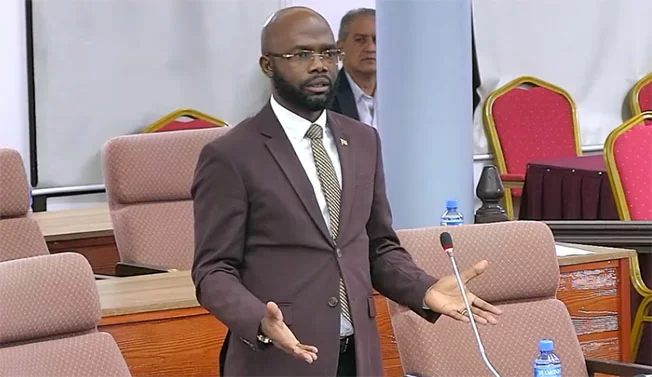
    A heated political clash has erupted in Suriname’s National Assembly (DNA) over plans to discuss the high-profile disappearance of more than 300 kilograms of mercury from the Geyersvlijt police station compound behind closed doors, with cross-faction lawmakers pushing back against the government’s push for a confidential committee general discussion. The controversy centers on a major theft case that has already sparked widespread public concern, with critics arguing the public has a right to full transparency, especially given the case touches on the integrity of the national police force itself.

    Multiple sitting members of the legislature have rejected the proposal to hold proceedings in secret, arguing that the seriousness of the theft and questions around police institutional integrity demand an open, public debate that allows Suriname’s society to follow the proceedings and hold officials accountable. Ebu Jones, a faction member of the NDP opposition, flatly rejected closed-door handling of the case. Jerrel Pawiroredjo, faction leader of the NPS, added that confidential committee general meetings should remain an exceptional procedure, not a default for common criminal cases.
    Pawiroredjo warned that treating a run-of-the-mill mercury theft with mandatory secrecy would push the National Assembly directly into covering up the issue, eroding public trust in the legislative body.

    Government representatives, including Justice and Police Minister Harish Monorath and government coordinator in the DNA André Misiekaba, defended the call for confidentiality, noting that an active criminal investigation into the disappearance is still ongoing under the leadership of the Public Prosecutor’s Office. According to the government, sensitive investigatory details cannot be released in an open plenary session, as public disclosure could jeopardize ongoing investigative work. The government offered to share full sensitive details with lawmakers in a closed committee general meeting if legislators desired more information, but this proposal drew sharp criticism from both ruling coalition and opposition blocs.

    Jones reiterated that the public already has broad awareness of the case and significant concerns, giving Surinamese citizens a legal and moral right to clear, public information. He emphasized that parliament has a fundamental obligation to uphold transparency when addressing missing materials and integrity failures within the police service.
    Krishna Mathoera, a legislator from the ruling VHP party, contextualized the mercury disappearance as part of a longer pattern of problematic incidents within the police apparatus, including other missing seized goods, allegations of extortion, and repeated integrity breaches. Mathoera stressed the issue extends beyond the active criminal probe, touching on core governmental accountability: “What measures is the Minister of Justice and Police taking to stop this kind of incident from happening again?” she asked.

    The government maintained its position that active investigatory work means names and operational details cannot be named publicly, while acknowledging that parliament has a legitimate right to receive accountability updates, noting the relevant minister has already outlined planned policy changes to address gaps. VHP faction leader Asis Gajadien and fellow legislator Rabin Parmessar underlined that the National Assembly retains the sovereign right to vote to make information public if it determines a closed confidential meeting is unnecessary, a precedent that has been set in previous parliamentary cases.

    DNA Speaker Ashwin Adhin outlined a compromise path forward, announcing that after consultations with the government, a new meeting has been scheduled for Thursday at 9:00 a.m. If the government determines all relevant details can be released publicly, the full meeting will be open to the public and media. If sensitive information is deemed necessary to withhold initially, the meeting will open in closed committee general session, after which the full National Assembly will vote on whether to transition the remainder of the debate to an open public session.

    A confidential preliminary meeting has already been convened, with the full parliamentary debate scheduled in the coming days. Multiple legislators have stressed that confidential committee general meetings must not become a routine tool to keep matters of public interest hidden from general view. They reminded fellow members that DNA Standing Order Article 100 mandates secrecy for all members for matters discussed in closed session, unless the full National Assembly votes to lift the confidentiality requirement. The government is set to discuss the matter at a cabinet meeting this week to finalize its position on what information can be released publicly ahead of Thursday’s scheduled parliamentary debate.

  • Football : Everything you need to know about World Cup ticketing and the role of the FHF

    Football : Everything you need to know about World Cup ticketing and the role of the FHF

    Amid growing public questions surrounding access to 2026 FIFA World Cup match tickets, the Haitian Football Federation (FHF) has released an official public statement to clear up confusion, laying out the dual ticketing structures established by FIFA and defining exactly what responsibilities the federation holds in the overall process.

    FIFA’s framework for 2026 World Cup ticketing splits distribution into two fully separate, independent systems, the FHF confirms. The first pathway is open to the general public and Haitian national team supporters, operated entirely directly by global soccer’s governing body through FIFA’s own official ticketing portal. Under this system, the FHF has no involvement whatsoever in sales processing, payment collection, or ticket distribution to individual fans. The federation’s only function here is to validate official fan group affiliations with FIFA, following strict protocols set by the tournament organizer. The FHF also confirmed that the widely reported $60 starting ticket price referenced in multiple local publications applies exclusively to this FIFA-managed public sales system, with all financial transactions processed directly between buyers and FIFA, no third parties or federation intermediaries involved.

    The second ticketing pathway is the institutional allocation reserved exclusively for participating national member associations like the FHF. This allocation follows a fixed timeline of requests, approvals, and payments, all contained within FIFA’s official ticketing window for participating nations. Contrary to some circulating rumors, these tickets are not provided for free; the FHF must purchase its allocation directly from FIFA through the official member association ticketing program. The allocation is designated solely to cover institutional needs tied to Haiti’s participation in the tournament, including tickets for the national team delegation, players, coaching and support staff, club representatives, institutional partners, official guests, and other members of the Haitian football community. All steps of this process – from initial request to validation, invoicing, payment, and final ticket issuance – are completed through FIFA’s official ticketing portal, following the governing body’s strict administrative protocols. Every ticket allocated to the FHF is ordered, invoiced, paid for, and issued by FIFA, with every step logged in FIFA’s official systems to ensure full traceability for every ticket the federation acquires.

    To reinforce transparency, the FHF emphasized that every ticket in its institutional allocation goes through a fully documented, rigorous administrative process that includes written ticket requests submitted to FIFA, formal allocation confirmations, official FIFA invoices, proof of FHF payment, FIFA ticket issuance, and final distribution to pre-approved beneficiaries. The federation also issued a clear warning: it has not authorized any individual or third-party organization to sell 2026 World Cup tickets on its behalf outside of FIFA’s official, publicized channels.

    Outlining its core role in the overall process, the FHF explained that its responsibilities begin and end with acquiring tickets for the Haitian football community per FIFA’s rules and distributing those tickets to the pre-approved beneficiaries. Once distribution is complete, the federation has no practical or legal authority to control how individual ticket holders use their tickets. Any subsequent resale, transfer, or circulation of a ticket after distribution falls entirely under the responsibility of the ticket holder, and cannot be interpreted as official involvement or endorsement from the FHF. The federation added that it stands ready to cooperate fully with FIFA and any other competent regulatory authority if specific, verifiable information emerges that warrants an investigation.

    The statement also noted that since the FHF was placed under the oversight of a FIFA-appointed Normalization Committee, it has adhered to strict global standards of governance, transparency, and accountability. Multiple independent oversight mechanisms are already in place: these include periodic management and compliance audits carried out by independent firms commissioned by FIFA, annual independent external financial audits, and regular public publication of financial statements in line with the federation’s transparency commitments.

  • Veteran Pilot Killed in Crop-Duster Crash Near Spanish Lookout

    Veteran Pilot Killed in Crop-Duster Crash Near Spanish Lookout

    On the morning of July 7, 2026, a routine agricultural fertilizing flight ended in unthinkable tragedy near Spanish Lookout, Belize, when a highly experienced crop-duster pilot lost control of his aircraft and crashed in an open field adjacent to Mennonites Beach. The pilot, identified locally as Henry Plett, a 15-year veteran of agricultural aviation, did not survive the incident.

    Multiple emergency and regulatory agencies have launched a joint investigation to unpack the sequence of events that led to the crash. Reporting on scene for Belize’s News Five, journalist Shane Williams outlined the scope of the probe, which brings together the Belize Police Department, the Department of Civil Aviation, and the National Fire Service. According to on-scene accounts, the crash occurred just before 11 a.m., while Plett was executing a low-altitude maneuver over farmland beyond the tree line near the crash site—a maneuver that witnesses confirmed he had performed successfully thousands of times over his long career.

    Fellow agricultural pilots from the local community, who reviewed crash site footage but chose not to speak on camera, confirmed that the aircraft entered a sudden nosedive, leaving Plett almost no time to eject or attempt a recovery before impact. Emergency response teams from local law enforcement, civil aviation, and the Spanish Lookout Fire Service arrived at the site within minutes, securing the perimeter and preserving evidence for investigators.

    Among the first community members to reach the crash site was Leonard Reimer, former chairman of Spanish Lookout, who had encountered Plett less than 30 minutes before the fatal flight. Reimer recalled running into Plett on the road, where the pilot was heading to the airstrip on his motorcycle to begin his day’s work. “He was always such a positive, friendly, humorous guy,” Reimer shared. “What makes this even more devastating is that he was just weeks away from getting married, so excited to start this new chapter of his life. This is an unimaginable loss for his fiancée and our whole community.”

    Plett was a well-respected fixture in Belize’s agricultural aviation sector, with more than 15 years of consistent experience flying crop-dusting missions for local farmers. A striking, tragic detail has emerged in the wake of the crash: this incident comes almost exactly eight years after Plett survived another crop-duster crash in the More Tomorrow area. A 2018 statement from Joseph Myvette, head of Belize’s National Crimes Investigation Branch, recounted that earlier incident: Plett had been spraying rice fields when his plane developed mechanical failure. He managed to crash land the aircraft, exited safely before it burst into flames, and walked away without a single injury.

    Eight years later, there was no escape for the veteran pilot. Members of the Spanish Lookout community say Plett will be remembered for his consistent kindness, tireless work ethic, and deep dedication to the farming community that relied on his skills for decades. As of July 7, investigators have not released any preliminary findings on what caused the 2026 crash, and they have not indicated when a final report will be made public.