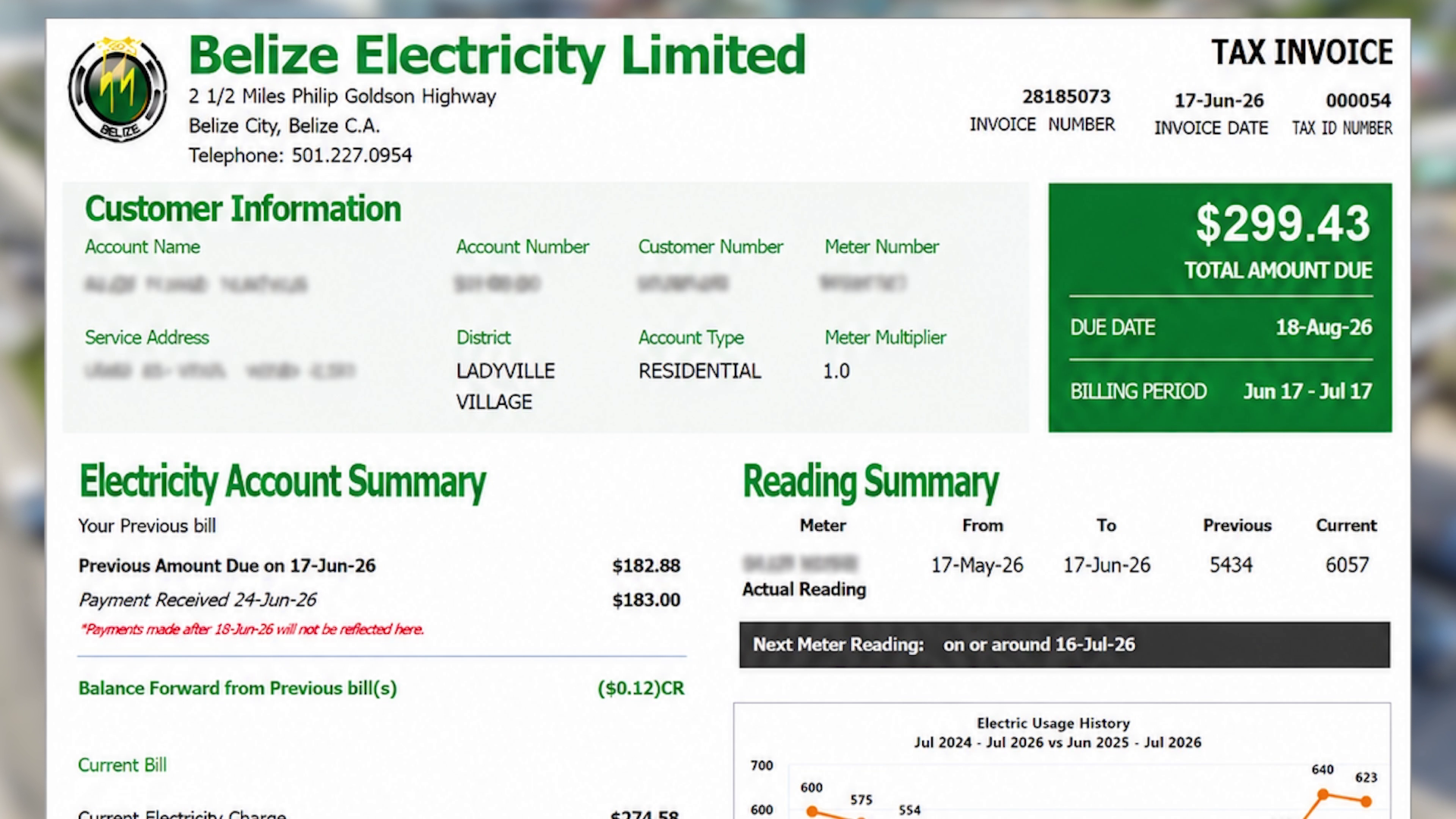
On August 26, 2026, a sudden, unplanned nationwide power outage plunged all of Belize into darkness overnight, adding another layer of crisis to households already reeling from steadily climbing electricity bills. The outage came just after the first 1.5-cent rate hike took effect under the government’s new Cost of Power Adjustment (COPA) framework, and the country’s main opposition party has wasted no time demanding accountability and urgent financial support for struggling families.
At a hastily called press conference, United Democratic Party (UDP) leader Tracy Taegar-Panton issued sharp criticism of the ruling People’s United Party (PUP) Briceño administration and national utility provider Belize Electricity Limited (BEL), calling for far greater transparency around the country’s deepening energy challenges and the growing financial strain falling on consumers.
Taegar-Panton outlined the UDP’s core proposal: immediate, time-limited relief worth 40 million Belize dollars, funded from a recent $100 million general financing loan the government secured from Taiwan. The opposition is calling for the complete removal of Goods and Services Tax (GST) on all electricity charges for an initial 12-month emergency period, a policy change the party estimates will cost exactly the 40 million Belize dollars it wants earmarked. Currently, GST is only exempted from the 1.5-cent COPA rate component.
In addition to the tax relief, the UDP is demanding the government suspend late penalties on all disputed customer accounts while an independent audit of billing practices is completed, arguing that flexible payment plans are no substitute for verifying whether charges are accurate in the first place. Taegar-Panton also questioned the government’s lack of public clarity around how the $100 million Taiwan loan will be allocated, noting that $40 million of the funds are scheduled to be disbursed before the end of 2026 with no public accounting of their planned use.
Beyond the immediate relief push, the opposition leader launched a broad attack on the government’s track record of energy sector investment, pointing out that hundreds of millions of dollars in public and borrowed funding have flowed into major energy projects and acquisitions over recent years, yet consumers have seen none of the promised cost reductions.
Taegar-Panton ticked through a list of major government energy commitments to back her claim: a $332 million purchase of hydroelectric dams from international firm Fortis, a $28 million smart meter rollout program, $77 million in renewable energy financing from the Saudi Fund, $40 million for energy sustainability through the MCC Grant Facility, a $73 million Belize dollar investment into BEL, and the $100 million Taiwan general budget loan. She argued that while the government has celebrated these high-profile investments, ordinary families and business owners who are on the hook for repaying these loans are now unable to afford monthly power bills or keep their operations running at full capacity.
The UDP leader emphasized that the party is not calling for permanent public subsidies to cover sector inefficiencies, but rather urgent, temporary relief while a full review of billing and sector governance is completed quickly. The opposition is also demanding BEL verify all customer bills, publish full cost calculation methodologies, and release all previously undisclosed evaluations and contracts related to the Fortis dam acquisition.
Taegar-Panton also raised alarms about another ongoing government proposal: importing electricity from Guatemala to address supply shortages, a plan being considered in the wake of Mexico’s ongoing energy crisis. She warned that the move could carry serious, unexamined risks for Belize that the government has not disclosed to the public.
This news comes after weeks of growing public frustration over rising energy costs, with the overnight nationwide outage amplifying calls for urgent action to address the sector’s ongoing instability and protect consumers from further financial hardship.