博客

  • STATEMENT: Official results and breakdown for Roseau North constituency by-election

    STATEMENT: Official results and breakdown for Roseau North constituency by-election

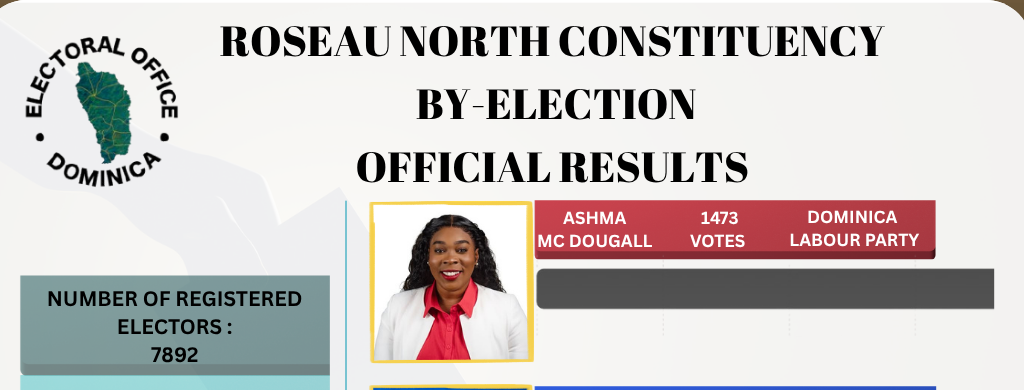
    The final results of the 2026 Roseau North constituency by-election are now official, after the Electoral Office completed full ballot counting on Tuesday, September 8 — one day after polling closed across the district. The contest, triggered by a mid-term parliamentary vacancy, delivered a clear win to the Dominica Labour Party’s candidate Ashma McDougall, who secured a comfortable majority of valid votes to fill the empty seat in Dominica’s House of Assembly.

    The vacancy that prompted the by-election was created when former representative Honourable Miriam Blanchard stepped down from her post on June 12, 2026. Under the Commonwealth of Dominica’s constitution, any parliamentary opening that occurs outside of a full general election dissolution requires a by-election to fill the seat within a three-month window, unless Parliament is dissolved before the deadline. Following constitutional protocols, Dominica’s President officially issued the election writ per Section 12 of the House of Assembly (Elections) Act, setting polling day for Monday, September 7, 2026. Voting ran from 7:00 AM to 5:00 PM across 28 purpose-built polling stations distributed across the constituency’s 10 polling districts.

    Full final vote tabulation confirmed McDougall captured 1,473 valid votes, accounting for 58.45% of all valid ballots cast in the contest. Her closest challenger, Daniel Andrew Lugay of the United Workers Party, finished with 998 votes, equal to 39.60% of the valid vote share. Independent candidate Sherman Boston rounded out the field with 49 votes, making up 1.95% of total valid ballots. In total, 2,520 valid votes were recorded across the constituency.

    Electoral data also shows broader turnout metrics for the contest: out of 7,892 registered eligible voters in Roseau North, only 2,566 ballots were cast, putting overall voter turnout at 32.51%. Just under two-thirds of registered voters — 67.49% or 5,327 people — opted not to participate in the by-election. Of all ballots cast, 98.21% were deemed valid, while 46 ballots were rejected, accounting for 1.79% of total polled ballots.

    This by-election gives Roseau North constituents a new representative to serve out the remaining term of the current parliamentary cycle, fulfilling the constitutional requirement to fill mid-term vacancies in the national legislature.

  • Motorists Warned of Delays as Major Works Continue on All Saints Road

    Motorists Warned of Delays as Major Works Continue on All Saints Road

    The Antigua and Barbuda Ministry of Works has issued an official public advisory announcing upcoming large-scale infrastructure upgrades along All Saints Road, located adjacent to the LICS Limited property. Starting at 7:00 p.m. on Wednesday, September 8, 2026, crews will reduce the active roadway to a single lane of traffic, and this configuration will remain in place until all construction work is fully completed. To prevent traffic gridlock and guide motorists safely through the construction zone, trained flag persons will be stationed at key points along the work site. Permanent and temporary directional signage has also been installed along both directions of travel to help commuters navigate the changed route and anticipate slowdowns ahead of time. Local residents who live within the immediate area of the construction zone will retain full access to their properties throughout the duration of the works. Project organizers have emphasized that heavy-duty construction machinery will be operating in close proximity to public access areas, and have asked all passersby to remain alert to maintain personal safety. Importantly, all commercial establishments along the affected stretch of All Saints Road will continue normal operations throughout the construction period. This road improvement initiative forms a core component of the government-led All Saints Road Project, a multi-stage infrastructure investment intended to upgrade the long-term functionality and safety of this key roadway. Public Works officials are urging all road users and local stakeholders to proactively adjust their travel itineraries to accommodate potential delays during the construction period. Anyone seeking additional information or clarification on the project timeline or traffic changes can contact the Project Implementation Management Unit directly via telephone at 562-9173 during operating hours.

  • Tribunal warns bosses on dismissal procedures

    Tribunal warns bosses on dismissal procedures

    In a landmark ruling delivered Tuesday, the chairman of the Employment Rights Tribunal (ERT) has issued a sharp, clear warning to employers across the jurisdiction: cutting corners on statutory dismissal processes will destroy any legal defense an employer may bring before the adjudicative body. The ruling came in a case against Markham Construction Limited, which the tribunal found had violated formal dismissal procedures when terminating former employee Alanna Hazell. As a consequence of the unfair dismissal finding, Chairman Vere P. Brathwaite ordered the construction firm to pay Hazell $6,576 in compensatory damages. Delivering a forceful statement to all parties present, Brathwaite emphasized that the tribunal cannot overstate the consequences of non-compliance with the procedural requirements laid out in Parts A and B of the Fourth Schedule of the Employment Rights Act. Even in situations where an employer claims the employee exhibited poor performance or unprofessional conduct, whether proven or alleged, failure to follow these mandatory procedures will still result in the employer losing their case, Brathwaite said. She warned that employers who disregard the strict requirements of the Employment Rights Act do so at significant legal risk. Brathwaite also used the ruling to clarify a second critical obligation for employers: they are legally required to comply with ERT requests to turn over documentation and information relevant to any dispute brought before the tribunal. In the case of Markham Construction, the company failed to produce key documents even after being ordered to do so by the employment rights body. Addressing this specific failure, Brathwaite noted that for the requirements outlined in Sections 12 through 16 of the Employment Rights Act, which mandate employers provide certain particulars to their employees, non-compliance is far more than a minor legal breach. It signals poor organizational governance and a failure to uphold basic standards of good management practice, she said. Contrary to common claims from employers that such failures are accidental administrative oversights, Brathwaite framed these omissions as substantive, material failures of governance. She pointed out that the Employment Rights Act uses the mandatory term “shall” when laying out these requirements, which makes clear that all obligations are non-negotiable legal requirements. When employers fail to maintain and organize required employment documents and key particulars, they put themselves in a position of being unable to produce that information when the law requires it, a situation that directly undermines their ability to defend their actions in a tribunal, Brathwaite explained. This specific case against Markham Construction serves as a clear example of the negative legal outcomes employers can face when they neglect or outright ignore their statutory duties under the Employment Rights Act, she added.

  • Dominican Republic and U.S. sign agreement to develop critical minerals and rare earths

    Dominican Republic and U.S. sign agreement to develop critical minerals and rare earths

    In a move that reshapes strategic resource partnerships in the Americas, the Dominican Republic and the United States have formalized a new agreement to broaden collaborative work across the extraction, processing, and advancement of critical minerals and rare earth elements. The core objective of this partnership is to fortify global supply chains for these high-demand materials and draw new international investment to the region.

    This newly established Cooperation Framework creates a structured pathway for both nations to work together on three key fronts: pinpointing high-priority strategic mineral projects, investigating viable financing options for development initiatives, and accelerating the growth of resources that underpin modern technology, renewable energy, and advanced manufacturing sectors. Unlike ad-hoc cooperation, this formal agreement lays out a clear long-term agenda for aligned action between the two governments.

    The official signing ceremony took place in Santo Domingo, with Dominican Minister of Foreign Affairs Víctor-Ito Bisonó and U.S. Ambassador to the Dominican Republic Leah F. Campos putting pen to paper on the framework. Dominican Minister of Energy and Mines Joel Santos Echavarría also attended the event to mark the milestone in bilateral economic cooperation.

    Speaking after the signing, Bisonó emphasized that the framework unlocks a transformative opportunity for the Dominican Republic to develop its untapped natural resource reserves. He stressed that the agreement is structured to ensure the country captures maximum economic value from its mineral resources, delivering widespread benefits to local communities and the national economy. Bisonó framed the partnership as a core component of the Dominican government’s proactive economic diplomacy strategy, which centers on attracting targeted foreign investment and building up globally competitive strategic industries at home.

    For her part, Ambassador Campos noted that the collaboration extends far beyond traditional mining development. She tied the expansion of critical mineral cooperation directly to broader goals of strengthening shared economic security, building more resilient global supply chains, and cutting collective reliance on a small number of third-party suppliers for these strategically essential materials.

    The agreement comes at a moment of rapidly growing global demand for critical minerals and rare earth elements, which have become foundational inputs for everything from electric vehicle batteries and smartphone semiconductors to renewable energy infrastructure and defense technology. For the Dominican Republic, this new partnership positions the country to become a meaningful player in emerging global strategic supply chains, opening new avenues for sustainable economic growth in the coming decades.

  • Abinader supports PUCMM semiconductor lab after first university microchip

    Abinader supports PUCMM semiconductor lab after first university microchip

    In a landmark step for the Dominican Republic’s emerging technology sector, President Luis Abinader has formally thrown his support behind a new initiative from the Pontifical Catholic University Madre y Maestra (PUCMM) to establish a collaborative semiconductor laboratory open to all higher education institutions across the country. The endorsement comes on the heels of PUCMM’s achievement of developing the nation’s first fully university-created microchip, a breakthrough that has already paved the way for expanded domestic innovation in the semiconductor space.

    This cross-university lab proposal is directly aligned with the Dominican government’s national priorities laid out in Decree 324-24 and the country’s National Strategy for the Promotion of the Semiconductor Industry, known as Enfis. The core goal of the national strategy and the new lab initiative is to build a pipeline of highly skilled, specialized local talent to grow the domestic semiconductor industry from the ground up.

    PUCMM’s debut microchip was the product of end-to-end work by the institution’s own faculty, current students, and alumni. The team oversaw every stage of development, from initial electronic architecture design and simulation through final manufacturing and performance validation. Built using 180-nanometer GF180MCU manufacturing technology, 50 fully functional units of the microchip have been produced and validated to meet strict global industry standards.

    President Abinader made the endorsement official during the national event titled “STEM Transforms RD: Innovation to Build the Future”. He emphasized that the semiconductor project fits directly into the administration’s long-term 2036 National Development Strategy, which centers on growing high-value industries, expanding technology adoption, and creating higher-wage professional opportunities for Dominican workers.

    PUCMM Rector Father Secilio Espinal revealed that the university is already moving forward with its next research milestone: developing a second microchip integrated with neural processing capabilities. This new chip will enable exploration and development of artificial intelligence applications directly at the hardware level, opening new doors for AI innovation in the country.

    The successful development of PUCMM’s first microchip relied on global collaboration with key industry partners. Major international technology firms including GlobalFoundries, Synopsys, and Keysight provided critical support across manufacturing processes, design software tools, professional training, simulation infrastructure, and final performance testing.

    In addition to the semiconductor breakthrough, PUCMM announced a key institutional milestone at the same event: its Civil, Electrical, and Mechanical Engineering programs have earned new ABET accreditations, the gold standard for global engineering program recognition. With this addition, the university now counts four internationally accredited engineering programs across its campus, strengthening its position as a leading hub for STEM education in the Caribbean region.

  • Dominican Republic issues commemorative stamp for Cocoa Commission’s 50th anniversary

    Dominican Republic issues commemorative stamp for Cocoa Commission’s 50th anniversary

    A new milestone in the Dominican Republic’s agricultural history is being celebrated through philately, as three leading national institutions have joined forces to launch a special commemorative postage stamp honoring the 50th year of work by the country’s National Cocoa Commission.

    The joint initiative brings together the Dominican Postal Institute (Inposdom), the Ministry of Agriculture, and the National Cocoa Commission itself, creating a tangible tribute to half a century of contributions that have reshaped the nation’s cocoa industry. Over the past five decades, the commission’s work has laid a solid foundation for the sustained growth of Dominican cocoa, transforming the sector into a core pillar of the country’s economic performance. Today, Dominican cocoa is a key driver of national export revenue, generates widespread employment across rural producing regions, and bolsters the Dominican Republic’s reputation as a competitive, trusted player in global cocoa markets.

    Beyond economic gains, public officials emphasized during the launch that cocoa cultivation delivers far-reaching benefits that extend beyond agricultural output. The crop plays an underrecognized but critical role in national environmental conservation efforts: cocoa agroforestry systems help protect existing forested areas, preserve biodiversity, and advance the goals of sustainable development that benefit both current and future generations in producing communities.

    Officially cataloged as issue No. 08-26, the commemorative stamp carries a face value of 75 Dominican pesos, with a limited print run of 10,000 individual copies. Measuring 40 by 40 millimeters, the design was crafted by architect Alejandro Vignieri and brought to life by printing firm Editora de Formas. Its official release and circulation were formally approved through Decree No. 147-26, signed into effect on March 4, 2026, formalizing the tribute to the commission’s five decades of public service.

  • 5 Dominican beaches recommended by HolidayCheck for water sports

    5 Dominican beaches recommended by HolidayCheck for water sports

    A leading German travel portal, HolidayCheck, has named five standout beaches across the Dominican Republic as premier global destinations for a wide range of water-based activities, drawing fresh attention to the Caribbean nation’s diverse coastal appeal for adventure travelers.

    The curated list includes Cabarete, Playa Bávaro, Playa Grande, Boca Chica and Playa Rincón, each located across the country’s northern, eastern and southern shorelines, every spot offering a one-of-a-kind experience tailored to different water sports preferences.

    Per HolidayCheck’s assessment, the Dominican Republic’s consistent, warm year-round climate, crystal-clear coastal waters, and reliably ideal wind and wave conditions are the key attributes that cement its reputation as a go-to location for water sports lovers from around the globe. These natural advantages create consistent conditions that suit both beginner enthusiasts and seasoned pros alike.

    Breaking down the strengths of each recommended location, Cabarete and its adjacent Kite Beach in the Puerto Plata region have earned top marks as world-class kitesurfing hubs, thanks to their steady trade winds that create perfect conditions for the sport. Further east in the popular tourist hub of Punta Cana, Playa Bávaro stands out as a top pick for snorkeling, with its shallow, calm reef waters teeming with diverse marine life.

    Near the town of Río San Juan, Playa Grande benefits from its direct exposure to the open ocean and consistent regular breezes, creating versatile conditions that support surfing, windsurfing, and kitesurfing all in one location. On the country’s southern coast, Boca Chica – which sits just 30 kilometers outside the capital city of Santo Domingo – has been highlighted as an ideal spot for jet skiing and other casual, recreational water activities that cater to day-trippers and casual visitors.

    Rounding out the list is Playa Rincón in the Samaná Peninsula, which offers a more low-key alternative for travelers who want to pair water sports with a peaceful, secluded beach experience. Tucked away amid unspoiled natural surroundings, the beach caters to visitors looking to avoid the crowds of more developed tourist spots while still accessing high-quality water sports opportunities.

  • US invests $245,000 to restore historic Fort Montagu and cannons

    US invests $245,000 to restore historic Fort Montagu and cannons

    A landmark cross-border cultural preservation effort is underway in The Bahamas, as the United States commits $245,000 to restore Fort Montagu — one of the Caribbean nation’s oldest remaining military installations — with targeted conservation work focused on the site’s corroded historic cannons.

    The funding comes from two U.S.-backed initiatives: the Ambassadors Fund for Cultural Preservation and the Freedom 250 Initiative. U.S. Ambassador to The Bahamas Herschel Walker confirmed that this grant marks the second-largest U.S. investment in Bahamian cultural heritage protection to date, bringing total American support for such projects across the country to more than $750,000.

    Senior officials from both nations gathered at the National Art Gallery of The Bahamas this week to formally launch the restoration project, a step Walker framed as more than just a construction effort. “Fort Montagu has stood there for nearly three centuries,” Walker noted, emphasizing that conserving the fort means safeguarding a core chapter of the Bahamian national story. He added that the collaborative venture also serves as a powerful example of what shared commitment between the two neighboring countries can deliver.

    Completed in 1741, the coastal fort has faced decades of damage from its harsh seaside environment. Dr. Michael Pateman, executive chairman of The Bahamas’ Antiquities, Monuments and Museums Corporation, explained that the work will include critical repairs to the fort’s roof alongside urgent interventions for its 18th-century cannons. “Salt, moisture, and the coastal environment have caused serious corrosion,” Pateman said, adding that the cannons have reached a point where immediate action is required to stop irreversible damage.

    To address the corrosion, conservation specialists will use electrolytic reduction, a specialized technique designed to leach destructive chlorides and salt deposits out of the metal. According to Pateman, the full process is expected to take roughly 12 months, but it provides the most reliable path to preserving the cannons intact for future generations to study and experience.
    Leslia Miller-Brice, The Bahamas’ Minister of Culture, Arts and Heritage, highlighted that the project draws on professional expertise from three nations: The Bahamas, the United States, and the Dominican Republic. Beyond repairing the physical structure of the fort, Miller-Brice emphasized that the initiative is focused on protecting the collective history and national identity tied to the site.

    “Fort Montagu is still standing, and tonight, The Bahamas and the United States are connected once again through this historic site, not through conflict, but through friendship, collaboration, and a shared commitment to preservation,” Miller-Brice said. “We are preserving memory. We are preserving identity. We are preserving a place where history happened.”

    A core goal of the project, she added, is to make local history accessible to young Bahamians, pushing back against the idea that meaningful historical events only occurred in far-flung places covered in textbooks. “I want our young people, especially, to understand that history did not only happen in distant places in textbooks,” she said. “History happened here, on our shores, in this harbor, on Bahamian soil.”

  • INDEX opens 2026 “Footprints of My Quisqueya” short film contest

    INDEX opens 2026 “Footprints of My Quisqueya” short film contest

    The Institute of Dominicans Abroad (INDEX) has officially kicked off the fifth iteration of its beloved “Footprints of My Quisqueya” short film competition, opening a call for creatives across the global Dominican diaspora to share their unique perspectives and audiovisual work with the world. This long-running initiative is designed specifically to give Dominicans and their descendants living outside the Dominican Republic a dedicated platform to craft and showcase narratives that honor their relationship to their ancestral home. More than just a creative contest, it works to foster ongoing connection between diaspora communities and the cultural roots of the Dominican Republic, inviting creators to explore themes of identity, inherited tradition, lived experience abroad, and the enduring bonds that tie diaspora communities back to Quisqueya.

    Eligibility requirements are clearly defined for interested participants to streamline entry. All applicants must be 18 years of age or older, hold legal immigration status in their current country of residence, have resided outside the Dominican Republic for a minimum of one full year, and identify as either a Dominican citizen or a descendant of Dominican people. To accommodate a wide range of experience levels, the competition is split into two distinct tracks: one for amateur creators and one for professional independent filmmakers, allowing emerging and established talent alike to participate.

    Creators hoping to take part have an extended window to prepare and submit their work: all registration forms and required supporting materials must be submitted by 6:00 p.m. local Dominican Republic time on November 9, 2026. Full official rules, eligibility details, and step-by-step registration instructions are posted exclusively on INDEX’s official website, listed under the dedicated “Footprints of My Quisqueya” competition page.

    This year’s edition is backed by a strong coalition of domestic Dominican institutional and private partners. Leading national bank Banco BHD serves as the competition’s primary sponsor, with additional strategic support from the General Directorate of Cinema (DGCINE), the largest regional theater chain Caribbean Cinemas, and a panel of contributing representatives from across the Dominican domestic film industry. Drawing on the success of previous competitions, which drew international entries from diaspora communities across the globe, the fifth edition continues the initiative’s core mission: strengthening cross-border cultural ties between the Dominican Republic and its far-flung global diaspora through the power of visual storytelling.

  • School administrators set to receive promotion letters

    School administrators set to receive promotion letters

    After years of unmet promises and a rare show of labor unrest that disrupted the start of the academic year, a breakthrough has emerged for hundreds of senior school administrators in the Bahamas waiting for career advancement. The Bahamas Educators Managerial Union (BEMU) confirmed this week that long-overdue promotion notification documents have been formally handed over to the Ministry of Education, clearing the way for distribution to eligible staff.

    BEMU President Stephen McPhee told reporters on Wednesday that some affected union members have been stuck in stalled promotion processes dating all the way back to 2016. That backlog of unaddressed advancement issues stood as one of the core grievances that pushed more than 90 percent of the nation’s school administrators to join organized industrial action on September 2, a move that sent roughly 40,000 students home early on the first week of the new school term.

    According to McPhee, the promotion letters arrived at the Ministry of Education on Monday, and ministry staff are currently preparing the documents to send out to the eligible administrators. This step forward comes after a series of tripartite meetings between BEMU representatives, the national Labour Relations Unit, and Ministry of Education officials, held to resolve the full slate of union concerns beyond just promotions. Those other outstanding issues include unfilled administrative vacancies across the country’s public school system, an expired industrial agreement governing union member working conditions, and multiple other unresolved workplace matters.

    McPhee noted that formal negotiations for a new collective industrial agreement have already gotten underway, and negotiators have made measurable progress updating policies related to staffing levels, working conditions, and the formal rights of BEMU members. Still, the BEMU president struck a cautious note, emphasizing that critical financial components of the new agreement remain on the table with no final resolution reached to date.

    “BEMU will continue to advocate strongly for a financial package that properly recognises the responsibilities and value of our members as leaders in education,” McPhee said, adding that the union is now entering what he called the most critical phase of negotiations around financial terms. Union leadership hopes to see all outstanding financial matters resolved before the end of the current week.

    The promotion dispute was explicitly named by McPhee as one of the driving forces behind the September 2 industrial action. The backlog affects three separate groups of school leaders: administrators connected to a 2021 Supreme Court filing over delayed promotions, staff who completed all requirements for advancement as early as 2018, and eligible members who applied for promotion last year but have not yet received a decision or placement. The group waiting for notification includes senior education leaders across all levels of the public system: principals, vice principals, district superintendents, and assistant directors of education, all of whom are also waiting for the corresponding salary increases that come with their new roles.

    The industrial action prompted the Minister of Education and the Attorney General to file an urgent court request for an injunction, which was granted by Justice Darron Ellis shortly after the work stoppage. The court order prohibits BEMU, its leadership, and its members from organizing or participating in any future strike or industrial action, and requires all Ministry of Education-employed staff to report to their assigned workplaces during scheduled hours. It also restricts unapproved sick leave, requiring a valid medical certificate for any absence, and bans union representatives and members from pressuring, intimidating, or encouraging other staff to skip work.

    As negotiations continue through the critical financial phase, McPhee urged BEMU members to maintain solidarity throughout the process. “To our members, I say, remain encouraged, remain unified, and remain vigilant,” he said. “Success is being achieved, and your union continues to work for you.”