In a landmark step for the Dominican Republic’s emerging technology sector, President Luis Abinader has formally thrown his support behind a new initiative from the Pontifical Catholic University Madre y Maestra (PUCMM) to establish a collaborative semiconductor laboratory open to all higher education institutions across the country. The endorsement comes on the heels of PUCMM’s achievement of developing the nation’s first fully university-created microchip, a breakthrough that has already paved the way for expanded domestic innovation in the semiconductor space.
This cross-university lab proposal is directly aligned with the Dominican government’s national priorities laid out in Decree 324-24 and the country’s National Strategy for the Promotion of the Semiconductor Industry, known as Enfis. The core goal of the national strategy and the new lab initiative is to build a pipeline of highly skilled, specialized local talent to grow the domestic semiconductor industry from the ground up.
PUCMM’s debut microchip was the product of end-to-end work by the institution’s own faculty, current students, and alumni. The team oversaw every stage of development, from initial electronic architecture design and simulation through final manufacturing and performance validation. Built using 180-nanometer GF180MCU manufacturing technology, 50 fully functional units of the microchip have been produced and validated to meet strict global industry standards.
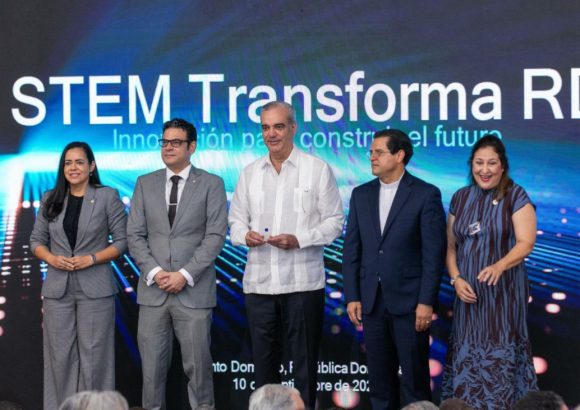
President Abinader made the endorsement official during the national event titled “STEM Transforms RD: Innovation to Build the Future”. He emphasized that the semiconductor project fits directly into the administration’s long-term 2036 National Development Strategy, which centers on growing high-value industries, expanding technology adoption, and creating higher-wage professional opportunities for Dominican workers.
PUCMM Rector Father Secilio Espinal revealed that the university is already moving forward with its next research milestone: developing a second microchip integrated with neural processing capabilities. This new chip will enable exploration and development of artificial intelligence applications directly at the hardware level, opening new doors for AI innovation in the country.
The successful development of PUCMM’s first microchip relied on global collaboration with key industry partners. Major international technology firms including GlobalFoundries, Synopsys, and Keysight provided critical support across manufacturing processes, design software tools, professional training, simulation infrastructure, and final performance testing.
In addition to the semiconductor breakthrough, PUCMM announced a key institutional milestone at the same event: its Civil, Electrical, and Mechanical Engineering programs have earned new ABET accreditations, the gold standard for global engineering program recognition. With this addition, the university now counts four internationally accredited engineering programs across its campus, strengthening its position as a leading hub for STEM education in the Caribbean region.