博客

  • Proposed change to law will not affect election cases – senator

    Proposed change to law will not affect election cases – senator

    A looming constitutional debate in St. Vincent and the Grenadines has sparked political friction between the ruling New Democratic Party (NDP) and the opposition Unity Labour Party (ULP), with a sitting government senator pushing back against opposition claims that the proposed clarification of the nation’s constitution is an underhanded, last-minute power grab.

    The core of the political dispute centers on two pending election petitions filed by the ULP, which challenge the eligibility of sitting Prime Minister Godwin Friday and Foreign Minister Dwight Fitzgerald Bramble to retain their seats won in the November 2025 general election. The ULP has argued that the pair violated constitutional requirements for parliamentary candidates by holding citizenship of a foreign power, a charge that stems from longstanding ambiguity around how the constitution defines the term “foreign power”.

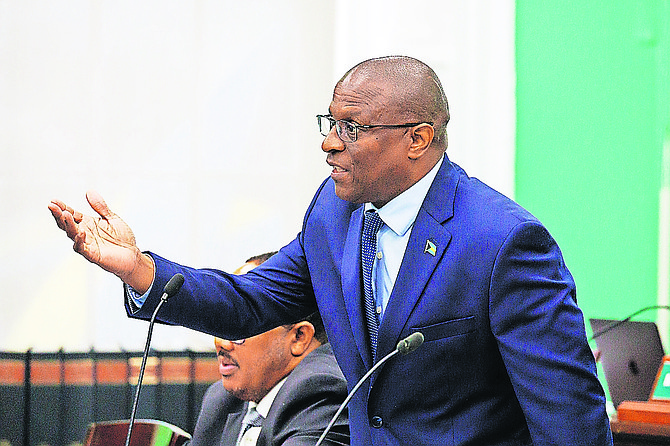
    Government Senator Jemalie John, a practicing lawyer, laid out the administration’s position during an interview with Hot 97 FM on Wednesday, emphasizing that the planned parliamentary action to clarify the constitutional language will have no impact on the pending court proceedings. John stressed that the two petitions remain fully active before the judiciary, and even if the amendment includes a retroactivity clause, it will ultimately fall to the courts to decide whether the new language applies to the ongoing case, leaving the opposition fully free to pursue their legal challenge.

    John rejected opposition claims that the NDP rushed the amendment through without public transparency, noting that the plan became public through standard parliamentary procedure: the official Order Paper for the upcoming April 21 parliamentary sitting was circulated to all legislators one week in advance, as required by law, making the planned debate a matter of public record from that point.

    He framed the ULP’s objections as a political power play, noting that the NDP secured a landslide 14-1 victory over the ULP in the November election, ending 25 years of ULP rule. The opposition’s end goal, John argued, is to overturn the results of two constituencies where voters overwhelmingly reelected Friday (to a sixth consecutive term) and Bramble (to a second five-year term) and install the defeated ULP candidates in their place. “Their mission is to have our prime minister and our foreign minister replaced with Carlos Williams and Luke Browne,” John stated, pointing out that the ULP has never won either of the two seats in its entire political history. “They essentially want to impose someone on the people that the people never voted for. Ethically and morally, they are wrong.”

    Addressing claims that the amendment is a self-serving measure, John countered that the move is designed to protect St. Vincent and the Grenadines’ democratic process. “If the people went out in an election and voted for a particular candidate, how could it be ethically, morally or legally right that the votes of thousands of Vincentians should be disregarded, thrown away, and there’s somebody then sitting in Parliament represent them who they never voted for in the first place?” he asked. “Ensuring that that democratic right is protected, it could never be appropriately described as self-serving. If anything, it protects the right of the Vincentian people and protects a democratic franchise.”

    On the substance of the amendment, John clarified that the proposal does not rewrite the constitution entirely, but only resolves existing ambiguity that directly led to the court case being filed. The key point of contention is how to define a “foreign power”: some interpretations hold that any dual citizenship, even with another Commonwealth nation, disqualifies a candidate, while others argue that Commonwealth countries do not count as foreign powers under the constitution. John noted that proponents of the latter interpretation often cite a landmark case from St. Kitts and Nevis, but St. Kitts’ constitution is explicitly different from St. Vincent and the Grenadines’ charter, making a direct application of that ruling inappropriate.

    John also reaffirmed the separation of powers between the legislative and judicial branches, arguing that when constitutional ambiguity exists, it is the role of parliament – not the courts – to clarify the law. “The court is not there to make laws. The court is not there to change laws or to repeal laws. That rests with the parliament. The court is there to interpret the laws that parliament passes,” he explained. “If the role and function of the Parliament is to make, change and repeal laws, then we should not say, ‘Oh, well, let the judges do it.’ Parliament is the law-making body of St. Vincent and the Grenadines, and it will continue to act on that responsibility to clarify policy that serves the public good.”

    John added that the core policy question at hand is whether native-born Vincentians who acquire a second citizenship, including through marriage, should be barred from serving in parliament, a question he said will be fully debated during the April 21 parliamentary session.

    The pending election petitions have already gone through a case management hearing in early March, with the next procedural hearing scheduled for May 19. The trial for the two challenges is set to begin on July 28, with three days allocated for proceedings.

  • St. Kitts & Nevis opens High Commission in India, deepening Bilateral Ties

    St. Kitts & Nevis opens High Commission in India, deepening Bilateral Ties

    The content provided consists exclusively of the hierarchical navigation menu structure of a prominent India-based digital news and media website, with no full news story or reported event included in the source material. This organized menu system lays out the platform’s full content categorization to help visitors quickly locate topics of interest. At the top level, core sections include live television streaming access, a dedicated feed for the latest breaking updates, and a prominent highlighted section covering the 2026 edition of the Indian Premier League (IPL) cricket tournament, one of the world’s most-watched annual sporting competitions. The menu also features a broad “India” section that breaks down geographically, sorted by major Indian urban centers including Bengaluru, Bhopal, Chennai, Chandigarh, the Delhi National Capital Region, Hyderabad, Jaipur, Kolkata, Lucknow, Mumbai, and Patna, allowing readers to access localized city-specific news coverage. Beyond regional and national content, the menu organizes coverage across a wide range of popular verticals: a dedicated global “World” section for international reporting, a comprehensive “Sports” hub divided into subcategories for cricket (India’s most popular sport), WWE professional wrestling, and other niche athletic competitions. Additional content verticals include entertainment coverage, automotive news and reviews, technology reporting, trending topics, and business and economic updates, alongside a photo gallery section for visual content. A secondary “More” dropdown expands to include additional niche sections focused on religion, lifestyle content, a series branded “Bharat ek soch” (India One Thought), and education-related reporting. The interface also includes a functional search bar to let visitors look up specific content directly, as well as a user login option for personalized account access. What this source material reveals is how modern Indian digital news platforms structure their content to cater to diverse reader interests, balancing national, regional, topical, and sport-specific coverage aligned with the audience preferences of the Indian market.

  • Vakbond EBS vraagt ingrijpen president in conflict met directie

    Vakbond EBS vraagt ingrijpen president in conflict met directie

    On Tuesday, April 15, the Suriname Energy Workers’ Union (Ogem Werknemers Organisatie Suriname, OWOS) — the registered labor body representing employees of state-owned utility N.V. Energiebedrijven Suriname (EBS) — brought its long-running internal conflict with EBS management to the desk of Suriname President Jennifer Simons during a formal meeting at the Presidential Cabinet.

    The labor dispute recently escalated to a temporary work stoppage, making it a pressing priority for the union leadership to escalate the issue to the highest level of national government. OWOS Chairman Marciano Hellings emphasized that the ongoing tensions at the utility have reached a critical stage, demanding rapid intervention to restore stability to the organization, according to official statements from Suriname’s Communication Service.

    In response to the union’s appeal, the Presidential Cabinet has committed to facilitating structured dialogue between the union bargaining team and EBS executive leadership. President Simons announced she will conduct a thorough review of the dispute in the coming days before inviting both parties to sit down for direct negotiations. Her core goal for the mediation process is to de-escalate tensions and ensure the utility can continue its core operations without further disruption.

    Hellings voiced confidence in the president’s ability to mediate a fair resolution to the standoff. He noted that Simons has acknowledged the severity of the unrest at EBS and has given a formal commitment that she will not allow the crisis to drag on unresolved.

    Beyond the immediate labor conflict, Hellings underscored the critical strategic role EBS plays in both Suriname’s social fabric and broader national economy. With major new development projects on the horizon in Suriname’s fast-growing oil and gas sector, Hellings said EBS stands to capture significant new opportunities to expand its operations and contribute more to national growth — but those gains are only achievable with stable internal governance and a clear long-term strategy.

    “Everything hinges on strategic leadership, a transparent shared vision, and a concrete multi-year development plan,” Hellings said. “If that foundational structure is in place and organizational policy receives consistent support from all stakeholders, EBS can get back on a strong positive trajectory.”

  • Saint Lucia lead Windward U19 championship

    Saint Lucia lead Windward U19 championship

    In a decisive clash on April 14, Saint Lucia delivered a dominant performance to claim the pole position in the Winlott Inc Windward Islands Under-19 Men’s Super50 Championship, beating defending title holders and match hosts Dominica by a convincing 89-run margin. The upset result reshuffled the tournament standings, pushing Saint Lucia’s net run rate to a tournament-leading 1.719, while Dominica dropped to second place with a net run rate of 0.642. Both teams hold an equal win-loss record of two victories and one defeat through their first three matches, after Grenada dropped further off the pace by handing St. Vincent & the Grenadines their first win of the competition.

    Played at Dominica’s Benjamin Park, the match got off to a solid start for Saint Lucia after captain Theo Edward won the pre-match toss and elected to set a target batting first. A match-winning half-century from middle-order batsman Johnathan Daniel anchored the visitors’ innings, guiding them to a total of 162 all out in 42.1 overs. Daniel faced 64 deliveries during his standout knock, striking four boundaries and one maximum to become Saint Lucia’s first half-centurion of the 2025 tournament. He received valuable support from the team’s opening pair: Roystan Fanis compiled a patient 25 runs from 59 balls, while Tyler Venner chipped in with 20 runs from 46 deliveries to build on the early foundation.

    Dominica’s chase got off to a catastrophic start that they never recovered from. Venner, who contributed with the bat earlier, opened the bowling for Saint Lucia and sent Dominica’s top-order batter Derwin Lewis back to the pavilion for a golden duck with just his fifth legal delivery of the innings. By the end of the fourth over, Nathaniel Joseph produced a caught-and-bowled dismissal to remove the other Dominica opener Alex Armstrong, also without scoring, leaving the hosts reeling at two wickets down for no runs. The collapse continued in the eighth over, when Bjorn Fanis claimed his only wicket of the day to leave Dominica three wickets down before they had even reached double figures.

    Venner struck again in the very next over, dismissing batter Earsinho Fontaine for just three runs to extend Dominica’s misery. A late mini-resistance pushed the home side’s score to 47 for four, but off-spinner Neil Poyotte triggered the final collapse that wrapped up the match. Poyotte took back-to-back wickets of Kelan Christmas and Kenneth Burton, before combining with paceman Cody Fontenelle to clean up the last four Dominica wickets for just 18 runs. The defending champions were bowled out for only 73 runs, handing Saint Lucia a comprehensive 89-run victory. The bowling figures told the story of the visitors’ dominance: Poyotte finished with incredible figures of 4 wickets for 11 runs from his four overs, Fanis claimed 1 for 10 from four overs, and Fontenelle took 2 wickets for 9 runs from 2.5 overs.

    Daniel’s standout knock marked not only his first half-century for the tournament but only the second half-century recorded across all competing teams this year. The innings pushed Daniel to the top of the tournament’s run-scoring charts, with a total of 107 runs from three matches at an average of 35.67. For Saint Lucia’s bowling attack, Nathaniel Joseph claimed his seventh wicket of the competition to move him to the top of the team’s wicket-taking rankings, and only two bowlers across the entire tournament — Poyotte and Liam Wilson — boast a better economy rate than Joseph’s 3.23 runs conceded per over.

  • UPP highlights concerns over IMF report on Dominica’s economic outlook

    UPP highlights concerns over IMF report on Dominica’s economic outlook

    The International Monetary Fund’s 2026 Article IV Mission Report on the Commonwealth of Dominica has sparked intense political scrutiny from the island nation’s main opposition bloc, the United Progressive Party (UPP), led by attorney Joshua Francis. The UPP has raised sharp alarms over the report’s findings, which paint a mixed picture of Dominica’s economic trajectory and highlight deep structural vulnerabilities that the party argues have been left unaddressed by the long-ruling Dominica Labour Party.

    According to the IMF’s analysis, Dominica delivered a solid 4.5% GDP growth rate in 2025, a figure that reflects short-term expansion following recent global and regional economic disruptions. But the fund’s medium-term outlook is far from encouraging: projections show growth will slow to a range of 2% to 3% in coming years, with overall economic risks explicitly “tilted to the downside.”

    One of the most pressing issues flagged in the report is Dominica’s extreme current account deficit, which the IMF estimates has reached 38% of total GDP. This gap underscores the country’s persistent heavy dependence on imported goods and services, a structural imbalance the UPP says the current administration has failed to correct. Even more concerning for the opposition is Dominica’s public debt load, which sits at roughly 103% of GDP — far higher than standard regional benchmarks, placing the island at high risk of sovereign debt distress. The IMF’s recommendation of an additional EC$60 million in fiscal consolidation further confirms the ongoing fiscal pressure squeezing the national budget, the UPP notes.

    The report also draws attention to weaknesses in Dominica’s financial sector. Non-performing loans remain at elevated levels, and regulatory oversight has not kept pace with the rapid growth of the country’s credit union industry, which now holds more than 50% of all private sector credit in the economy. Additionally, the IMF echoes longstanding questions about Dominica’s heavy reliance on revenue from its Citizenship by Investment (CBI) program, raising concerns about both transparency and long-term fiscal sustainability. For the UPP, this overreliance is clear proof that the ruling Labour Party has neglected to build a diversified, shock-resilient national economy.

    Institutional weaknesses round out the list of risk factors: the IMF highlights gaps in public financial management systems and limited fiscal transparency, both of which the UPP says contribute to the country’s overall economic fragility. In a formal statement following the report’s release, UPP leader Joshua Francis emphasized that the IMF’s findings validate the opposition’s longstanding warnings. “The IMF report confirms that Dominica’s economy remains fragile and exposed,” Francis said. “We need responsible leadership, stronger governance, and a clear path toward sustainable economic growth.”

    The UPP has laid out its policy vision, calling for urgent nationwide reforms to cut public debt, generate new private sector jobs, expand economic diversification, tighten financial sector oversight, and improve government transparency. The party warns that without bold, immediate policy intervention, Dominica will remain trapped in a cycle of slow growth, limiting opportunity for citizens and blocking progress toward long-term economic resilience.

    For its part, the ruling administration has acknowledged the IMF’s conclusions. Prime Minister Roosevelt Skerrit recently addressed the report’s findings during a parliamentary session, noting that the government respects the fund’s conclusions and has outlined its own official position on the issues raised to provide contextual perspective for lawmakers and the public.

  • Saint Lucia Jazz and Arts Festival launched with Barbados brunch event

    Saint Lucia Jazz and Arts Festival launched with Barbados brunch event

    On a sunlit Tuesday, the highly anticipated annual Saint Lucia Jazz and Arts Festival kicked off its official launch with a convivial Jazz and Brunch gathering held at the picturesque Savannah Beach Club Hotel and Spa. The kickoff event, hosted by the Saint Lucia Tourism Authority, gave invited guests an early preview of the Caribbean island’s vibrant cultural and musical programming ahead of the full festival’s run at the end of April into early May. In addition to dropping the full 2025 performance lineup, the launch treated attendees to a spread of buffet-style brunch options alongside immersive live musical performances that set the tone for the main event.

    Tourism leaders outlined that this year’s iteration of the festival will feature seven distinct, thoughtfully curated events running from the Opening Night gala on April 30 through a grand Ultimate Celebration on Mother’s Day, May 10. The roster of performers already drawing widespread excitement includes reggae icon Capleton, R&B stars Ella Mai and Brandy, chart-topping Afrobeats musician Tems, and legendary British-Caribbean singer Billy Ocean. Speaking to reporters from Barbados TODAY during the 11 a.m. to 2 p.m. launch, Saint Lucia Tourism Authority Marketing Manager Christopher Gustave explained that the festival’s themed slate of events was intentionally designed to cater to every possible musical preference, cementing the gathering’s reputation as one of the premier cultural festivals in the Caribbean.

    “We try to cater for every musical taste… from reggae to soca to dancehall to gospel to jazz to R&B, [and] pop,” Gustave said. “No matter what you’re into, you could find at least either a night or an artiste that you’re interested in.”

    Headlining the launch’s own live entertainment was Ronald “Boo” Hinkson, the legendary homegrown Saint Lucian jazz musician. Hinkson opened the event with a soulful solo rendition of John Lennon’s “Imagine”, before bringing Barbadian trumpeter Dr. Ricky Brathwaite and Saint Lucian vocalist Christa Bailey to the stage for collaborative numbers that earned thunderous, standing applause from the assembled crowd. In attendance at the launch was a cross-section of guests including working entertainers, social media influencers, and global arts industry professionals, many of whom traveled from neighboring Caribbean nations to attend the preview.

    Barbadian singer-songwriter Adrianna Mayers shared that she left the launch deeply impressed by the festival’s commitment to inclusivity and its expansive range of programming. Sharkia Pereira, a Barbadian influencer who attended her second consecutive festival launch, echoed Mayers’ positive assessment. Pereira highlighted World Beats and the closing Ultimate Celebration as her most anticipated events on this year’s calendar. First established in 1992, the Saint Lucia Jazz and Arts Festival has grown from a small niche jazz gathering into one of the Caribbean’s most recognizable cultural events, drawing thousands of international tourists and arts lovers to the island each year to celebrate a diverse spectrum of global and regional artistic talent.

  • APUA Installs New 10-Inch Pipeline on Buckleys Line, Night Works Underway to Improve Water Reliability

    APUA Installs New 10-Inch Pipeline on Buckleys Line, Night Works Underway to Improve Water Reliability

    A critical infrastructure upgrade project is currently underway along Buckleys Line, where a specialized team from the local Water Business Unit is executing overnight construction work to install a brand-new 10-inch high-density polyethylene (HDPE) water pipeline.

    Following the completion of the connection phase scheduled for this evening, the project will move into its next stage: comprehensive testing and formal commissioning of the new infrastructure, set to kick off tomorrow. This replacement work marks a key investment in the region’s water network, addressing long-standing issues plaguing the aging original pipeline that has suffered repeated ruptures and service disruptions in recent years. The modern HDPE pipeline being installed offers far greater structural strength and operational resilience, promising to deliver noticeably more stable and higher-quality water service to local residents and businesses once fully operational.

    To ensure worker safety and minimize traffic disruption, local authorities have enacted a temporary detour route for vehicles traveling through the area. Project organizers have issued a formal request for motorists to remain vigilant and reduce their speed when approaching the secured work zone to avoid accidents. The Water Business Unit has extended its gratitude to the local community for their patience and understanding during the construction period, noting that the short-term inconveniences will deliver long-term benefits by strengthening the overall reliability of the regional water service network.

  • Sirens and Sinners at Art House 473

    Sirens and Sinners at Art House 473

    Tucked inside Art House 473, a former repurposed church that has been reinvented as a serene, chapel-like contemporary art space, the collaborative exhibition *Sirens and Sinners* from creators Asher Mains and Susan Mains unfolds not as a flashy public spectacle, but as a quiet, introspective reckoning with identity, morality and human experience.

    Drawing on decades of creative exploration into masks and the layered personal stories they carry, the exhibition upends the binary moral framing suggested by its title, which evokes ancient myth, traditional morality, and the tension between temptation and transgression. Far from the seductive, dangerous figures of legend, the sirens depicted here do not lure viewers—they confront them. Likewise, the so-called sinners are not portrayed as condemned outsiders, but as deeply, tenderfully human. Most works center mask-like visages that are not generic pre-written archetypes, but cumulative identities shaped by lived experience, layered with the sediment of years of memory and struggle.

    Susan Mains’ contribution to the show carries a particularly distinct sense of temporal layering. Her iconic “little faces” carry an uncanny, arresting weight: miniature in scale yet monumental in emotional impact, they read as both naive and knowing. Rooted in Caribbean masquerade traditions, the works transcend cultural reference to explore internal, psychological terrain, framing faces as thresholds of experience rather than static surfaces. Every small visage feels less like a finished art object than a residue of a lived moment, a faint, persistent trace that refuses to fade completely.

    Asher Mains’ practice offers a compelling spatial and atmospheric counterpoint to Susan’s intimate works. His practice oscillates between abstraction and figuration, weaving the portrait-focused work into broader environmental and narrative contexts. He incorporates found ghost nets—discarded fishing gear that washes up on the beaches of the Grenadian fishing village Calliste—into both his installations and paintings, where the tangled nets hold, caress, and even trap the depictions of sirens. Drawing inspiration from Homer’s *Odyssey* and Derek Walcott’s *Omeros*, the St. Lucian poet’s reimagining of the Homeric epic, Asher crafts a unique magical realist narrative deeply rooted in Caribbean maritime life. If Susan’s pieces are quiet, intimate confessions, Asher’s installations are the resonant spaces where those confessions echo out for viewers to encounter.

    What unifies the entire exhibition is its deliberate refusal to offer easy answers. There is no clear moral axis, no didactic narrative that draws a hard line between virtue and vice. Instead, *Sirens and Sinners* puts forward a far more unsettling core thesis: the categorical lines between good and evil, purity and corruption are porous, perhaps even entirely illusory. Viewers are left to navigate a creative landscape where allure and guilt, innocence and complicity coexist in the same quiet gaze.

    It is this commitment to ambiguity that gives the exhibition its quiet, enduring power. In an era that constantly demands rigid clarity, quick labels, fixed positions and loud public declarations, *Sirens and Sinners* insists on the value of uncertainty. It does not invite viewers to judge the figures on display, but to recognize them—to see something uncomfortably familiar in their layered, weathered faces. In the end, the exhibition does not demand audiences answer who the sirens or sinners are. Instead, it poses a far more subtle, probing question: when you look long enough at these faces, can you still tell the difference between them?

  • APUA Mainline Upgrade Enters Final Phase on Newgate Street, Traffic Delays Expected

    APUA Mainline Upgrade Enters Final Phase on Newgate Street, Traffic Delays Expected

    The Antigua Public Utilities Authority (APUA) Water Business Unit is putting the final touches on a critical water main upgrade project in St. John’s Point, a long-awaited infrastructure improvement that relies on durable high-density polyethylene (HDPE) piping to modernize the area’s aging water distribution network.

    The upgraded pipeline corridor runs along Newgate Street, stretching from the former site of the Barnes Funeral Home all the way to the intersection with Cross Street, covering a high-traffic stretch that serves both local residents and through traffic. As construction crews work to wrap up installation and connection work, road users traveling through the zone are being put on advance notice to adjust their travel plans. Temporary delays are unavoidable during this final construction phase, and some sections of Newgate Street will be fully closed to motor vehicles for short periods to accommodate safe work. The authority is urging all drivers to reduce speed and exercise extra caution when navigating any open sections of the work zone.

    APUA has publicly acknowledged that the construction work has caused significant disruptions to daily travel and damage to existing road surfaces, and the organization apologized for the inconvenience this has created for local businesses, residents, and regular commuters. To address concerns about post-construction road repair, APUA confirmed that it maintains ongoing, active communication with the Ministry of Works to coordinate full restoration of Newgate Street once the water main work is finalized.

    As the project moves into its closing days, APUA extended its gratitude to the St. John’s Point community for their understanding and cooperation throughout the upgrade process, noting that the new HDPE pipeline will deliver long-term benefits including more reliable water service and reduced risk of main breaks for area residents.

  • Greene Tells St. Paul’s Constituents to ‘Judge Me by the Work’ as He Seeks Re-Election

    Greene Tells St. Paul’s Constituents to ‘Judge Me by the Work’ as He Seeks Re-Election

    As campaign season kicks into high gear for congressional seats across the United States, incumbent Representative Greene is making his case to voters in St. Paul, urging constituents to base their November voting decisions on his tangible policy achievements over his current term rather than outside noise or partisan rhetoric.

    In a series of recent community meetings and public addresses hosted across the district’s diverse neighborhoods, from downtown St. Paul business districts to suburban residential blocks, Greene directly addressed questions about his record and encouraged voters to hold him accountable for the work he has delivered since taking office.

    “I don’t ask anyone to support me based on party labels or empty campaign promises,” Greene told a packed gathering of local residents last week. “What I ask is simple: judge me by the work I have done for this community, the progress we have delivered together, and the plans I have to move St. Paul forward over the next term.”

    Over his current tenure, Greene has prioritized legislation focused on expanding access to affordable healthcare for low-income constituents, securing federal funding for local infrastructure upgrades—including road repairs and public transit improvements—and pushing for stronger funding for St. Paul’s public K-12 school systems. He has also positioned himself as a key advocate for small businesses in the district, backing tax relief packages and grant programs designed to help local establishments recover from recent economic headwinds.

    His re-election bid comes as control of Congress hangs in the balance, with competitive races across the country expected to determine which party sets the legislative agenda in Washington for the next two years. The St. Paul district has long been viewed as a competitive seat, with national party committees already pouring resources into both the Greene campaign and that of his challenger. For his part, Greene has centered his campaign on local issues rather than national partisan fights, a strategy designed to resonate with independent voters who make up a sizable share of the district’s electorate.

    Local voter reaction has been mixed so far: long-time supporters have praised Greene’s focus on constituent services and his consistent presence in the district, while some undecided voters note they are still weighing his record against the policy proposals put forward by his opponent. Regardless, Greene’s call for performance-based evaluation represents a common tactic for incumbents seeking to turn their time in office into a key electoral advantage, framing the race as a choice between proven results and untested opposition.