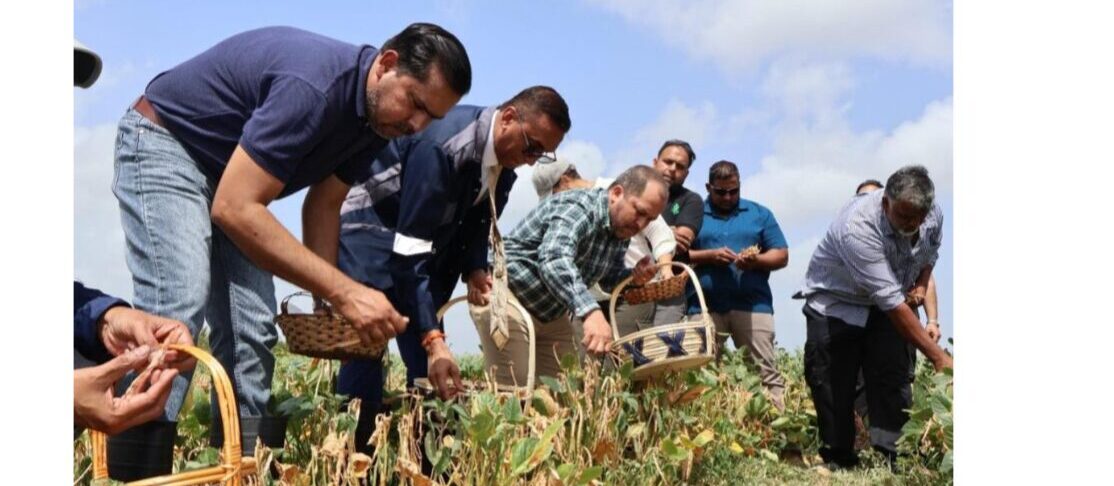
On Tuesday, stakeholders gathered in Warrenville, Trinidad, to celebrate the landmark success of a collaborative black-eyed peas pilot project that is poised to reshape the island nation’s agricultural landscape and advance long-standing food security goals. Led by the Caribbean Agricultural Research and Development Institute (CARDI) in partnership with Trinidad and Tobago’s Ministry of Agriculture and Fisheries, the initiative drew cross-sector support from the Ministry of Education, National School Dietary Services Limited (NSDSL), the Food and Agriculture Organization’s Caribbean office, and the Inter-American Institute for Cooperation on Agriculture.
Early data from the trial plots has exceeded even the most optimistic projections, confirming that black-eyed peas can thrive in Trinidad and Tobago’s unique local growing conditions. The project recorded an exceptional germination rate of over 96%, with crops reaching full harvest maturity in just 56 to 60 days – a full month faster than the 90-day growing window predicted by international guidance from overseas agricultural bodies. The black-eyed peas were planted across two acres of a six-acre demonstration site, which also hosted complementary trials for soybeans and corn.
Addressing attendees at the official launch event, Minister of Agriculture and Fisheries Ravi Ratiram framed the project as a critical turning point for the country’s push toward greater food sovereignty. “Today marks the moment we move from talking about food security to taking tangible action,” Ratiram stated. “The empirical data we have collected from these trial plots gives us the confidence to advise local farmers on the production viability, environmental suitability, and profit potential of integrating black-eyed peas into their crop rotations.”
Ratiram emphasized that cutting the nation’s reliance on imported food and agricultural inputs remains a core policy priority, and credited the cross-institutional collaboration between researchers, farmers, technical specialists, and government agencies for the project’s early success.
CARDI Executive Director Ansari Hosein expanded on the far-reaching economic and public health benefits of scaling local black-eyed pea production. He noted that Trinidad and Tobago’s national school feeding program already consumes more than 300,000 kilograms of imported black-eyed peas annually – a demand that could be fully met by domestic production once farmers adopt the refined growing framework developed through the pilot.
“Scaling local production doesn’t just cut import dependence – it opens new, stable income streams for small and mid-sized farmers, generates new local employment opportunities, and reduces the outflow of foreign exchange spent on food imports,” Hosein explained. Beyond economic gains, he added, black-eyed peas are a nutrient-dense food that supports better public health outcomes and helps reduce the national burden of non-communicable diseases.
CARDI Technical Manager Fayaz Shah broke down key actionable takeaways for local farmers emerging from the pilot, highlighting the critical roles of early soil preparation, structured irrigation planning, proactive pest and disease management, and timely fertilizer application in achieving strong yields. As part of Tuesday’s event, CARDI researchers delivered technical training sessions and hosted live harvesting demonstrations for attending farmers, education officials, and stakeholders to share best practices directly.
The successful pilot is part of a broader regional push across the Caribbean to strengthen agricultural resilience, reinforce local food production systems, cut ballooning regional food import bills, and expand sustainable, nutrient-focused feeding programs for schools and communities. Stakeholders involved in the project project that as production scales, locally grown black-eyed peas will become a staple of national institutional feeding programs, while opening growing new market opportunities for farmers and agribusinesses across Trinidad and Tobago.