博客

  • Overeenkomst LVV basis voor landbouwproject waarbij Mennonieten zijn betrokken

    Overeenkomst LVV basis voor landbouwproject waarbij Mennonieten zijn betrokken

    Newly released public contractual documents and a 10-year business plan have cast fresh clarity on the complex structure behind a controversial large-scale agricultural development project in Suriname, confirming that Mennonite farmers who migrated to the country for the initiative do not hold any formal stake in the state land agreement at the heart of the project.

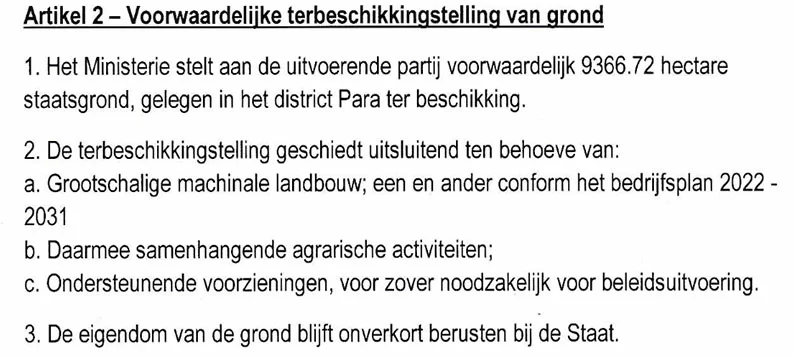
    The deal, signed January 13, 2026, between Suriname’s Ministry of Agriculture, Livestock and Fisheries (LVV) and local entity Braganza Marketing Group N.V. — the firm that recruited the Mennonite farmers to work on the project — grants the company conditional use rights to 9,366.72 hectares of state-owned land in Suriname’s Para district for an initial 20-year term. The land remains the formal property of the Surinamese state, and Braganza holds a non-transferable right to use the plot exclusively for large-scale mechanized agriculture and related agribusiness activities. Under the terms of the agreement, Braganza is required to bring at least 10 percent of the total allocated area under cultivation every year to retain its access rights. What makes the arrangement notable is that despite the Mennonite farmers being central to the project’s on-the-ground implementation, their names do not appear anywhere in the formal public contract between LVV and Braganza.

    LVV Minister Mike Noersalim had previously stated that his ministry never entered into a separate agreement with the Mennonite community, noting that the ministry’s contract was exclusively with the Surinamese registered firm for the production of commodity crops including soybeans and corn, and that Braganza did not present itself as a representative of the migrating farmers during negotiations. Braganza, however, has publicly confirmed its plan to rely on Mennonite agricultural workers for the project’s two core sites: one group of Mennonites from Belize for the Tibiti site, and a second contingent from Mexico for the Kabalebo site.

    During a recent visit to the Tibiti area by members of Suriname’s National Assembly and journalists, Peter Petersen, a Mennonite leader from Belize, explained that his group was recruited to Suriname by Lionel Blokland and Ruud Souverein, two figures connected to Braganza. Petersen said his community sold all of their assets in Belize and shipped heavy farm machinery to Suriname under the expectation that they would be able to operate large-scale farms on the Para district land. His group, he added, expects to use more than 9,000 hectares and has agreed to pay $150 per hectare for access, though details of who receives this payment and what contractual rights the group holds remain unclear.

    Braganza’s 2022-2031 business plan, also made public, shows that plans for the Tibiti and Kabalebo sites have been in development for nearly a decade, with the firm explicitly outlining its goal to produce soy and corn across the two concessions. The plan also highlights the project’s international backing, naming Adrian Barbero of Bolivia-based Rural Real Estate Investments Ltd. (RREI) as a lead initiator. According to the document, RREI brings more than 30 years of experience investing in large-scale agriculture and livestock operations across South America, with a track record of developing and acquiring large agricultural concessions across multiple regional countries where “agricultural specialist colonies” operate. While the plan does not explicitly confirm these colonies refer to Mennonite communities, it is now verified that Braganza has specifically recruited Mennonite farmers to carry out on-ground work for its Suriname projects. RREI, alongside Blokland, is listed as a stakeholder in Braganza Marketing Group, with international investors planning to contribute their own capital to develop agriculture, livestock, and dairy projects across the allocated Surinamese land.

    The disclosures confirm a clear structural separation: the Surinamese state has granted land access to Braganza, not directly to the Mennonite farmers, who are only involved as contracted workers through the local firm. Crucially, no details of the private agreement between Braganza and the Mennonite community — including terms for land use, per-hectare payments, investment responsibilities, or profit sharing — appear in the public contract with LVV or the released business plan. This lack of transparency raises regulatory questions, as the LVV-Braganza agreement explicitly bans transferring use rights to any third party without the ministry’s prior written approval.


  • Who Gets to Tell Belize’s History? Magical History Tour Reaches Final Stop

    Who Gets to Tell Belize’s History? Magical History Tour Reaches Final Stop

    As Belize prepares to mark 45 years of full national sovereignty on September 21, 2026, a landmark national history education initiative is drawing to a close this week at its final venue. The Belize @45 Magical History Tour, organized jointly by the National Institute of Culture and History (NICH) and veteran historian and ambassador Assad Shoman, has spent the past several weeks bringing untold and underrepresented stories of Belize’s path to independence to young audiences across every district of the country.

    Launched on August 26 in the southern coastal town of Punta Gorda, the eight-stop tour traveled sequentially through Dangriga, San Ignacio, Benque Viejo del Carmen, Belmopan, Belize City, and Orange Walk, before concluding its cross-country journey at the Corozal House of Culture on September 16, 2026. Unlike traditional textbook-centered history lessons, the initiative was designed to facilitate active dialogue rather than one-way instruction. It encouraged participating students from all regions to ask critical questions, share their own community’s historical narratives, and debate the cascading events that have collectively forged Belize’s unique modern national identity.

    Beyond student-focused sessions, the tour also hosted open public forums that created space for ordinary residents and local community leaders to exchange divergent perspectives on Belize’s past, drawing clear connections between historical struggles, decisions, and the social and political realities the nation faces today. At its core, the project was built around a central, urgent question: Who gets to write and share Belize’s national story? Organizers argue that centering young people in this conversation is critical, as this generation will not only steward the country’s historical memory for decades to come but also pass that legacy on to future generations of Belizeans. As the country gears up for its official independence day celebrations, the tour has already left a lasting mark by reimagining how national history is taught, discussed, and owned across Belize.

  • Opposition Leader Responds to Prime Minister: “We Cannot Eat 5.1% Growth”

    Opposition Leader Responds to Prime Minister: “We Cannot Eat 5.1% Growth”

    In a direct response to Prime Minister John Briceño’s 2026 State of the Nation Address delivered on September 16, opposition leader Tracy Panton has launched a pointed critique of the incumbent government’s policy framing, arguing that official economic indicators do not align with the daily struggles of ordinary Belizeans. Panton’s address pushed back against Briceño’s opening claim that, at 45 years old, he embodies the nation of Belize, re-centering the identity of the country around working people rather than political leadership.

    “He told us to look at him, that at forty-five, he is Belize. Mr Prime Minister, with respect, you are not Belize. Belize is the cane farmer in Orange Walk, the fisherman in Sarteneja, the market vendor trying to make a living, and the mother in Belize City trying to stretch a dollar that simply cannot be anymore,” Panton stated in her opening remarks.

    At the core of Panton’s critique is the disconnect between the government’s headline economic data and household financial pressures. Briceño highlighted a 5.1% national economic growth rate, 98% employment, and a stable Belizean dollar as markers of a successful economy — metrics Panton says mean nothing to families struggling to cover basic costs.

    “The Prime Minister says the economy is growing at five point one per cent. He says employment is at ninety-eight per cent. He says Belize has a strong dollar. I have a very simple question: Are we feeling it? When you go to the grocery store, are we feeling the five point one per cent growth? When you fill your vehicle with fuel approaching sixteen dollars a gallon, are we feeling it? When we pay our electricity bill, when we pay rent, when we try to put food on the table, an economy cannot simply look good on paper. It has to work for the people,” Panton argued.

    Panton also pushed back against government celebration of Belize’s recently reaffirmed B-/B credit rating, noting that the ranking remains deep in speculative grade and offers no tangible relief to struggling households. “We cannot eat five point one per cent growth. We cannot put a credit rating in our gas tanks, and we cannot tell struggling families that the economy is doing wonderfully when our money buys less and less,” she added.

    Beyond economic metrics, Panton called out the government’s failure to address the ongoing national electricity crisis. While Briceño offered explanations for spiking utility costs, Panton emphasized that Belizeans do not need excuses — they need immediate action to bring down prices.

    She further highlighted that the government’s temporary fix for lost electricity supply from Mexico’s national utility CFE, which cut Belize’s supply to zero earlier this year, only highlights long-term policy failure. The government has filled the gap with a six-month diesel-powered arrangement, while promised solar and battery storage projects first announced in 2023 are not scheduled to come online until 2027. While Panton acknowledged the partial relief of removing GST from residential electricity bills under $200, she noted the policy does nothing to resolve the underlying crisis of unreliable and unaffordable energy that plagues the country.

    Turning to national security, Panton addressed the recent September 10 Sarstoon River sovereignty incident, praising the courage of civilian Belizeans who participated in the event but raising critical concerns about the government’s failure to protect national territory. “I salute every Belizean that was present. Their courage was real. Their patriotism was real. But we must not confuse courage with security. What happened on the Sarstoon should trouble us. Belizeans were challenged while travelling in territory that belongs to us. Brave citizens found themselves on the frontline of a sovereignty issue. That cannot become normal,” she said.

    Panton called for full resourcing, modern equipment, and clear political backing for the Belize Defence Force, stressing that the nation should never rely solely on civilian courage to defend its sovereignty.

    A large portion of Panton’s address focused on issues entirely omitted from the Prime Minister’s State of the Nation address, starting with demands for greater accountability and anti-corruption action. “Where was the serious discussion about corruption and accountability? Where was the response to the questions being raised about unexplained wealth and conduct at senior levels of the public service? While nurses struggle and patients search for medications, Belizeans have every right to demand accountability from those entrusted with public resources. We deserve answers,” she stated.

    Panton also highlighted other unaddressed everyday concerns: new village trade taxes that place added burden on small entrepreneurs and street vendors, a persistent school transportation crisis that leaves parents scrambling to get children to class even as the government delays delivery of promised new buses, and plummeting morale among under-resourced police officers. “These are not small matters. They are the everyday realities of Belizeans. And a State of the Nation Address should confront them. Because sometimes what a government chooses not to talk about tells us just as much as what it does,” she noted.

    Closing her address, Panton laid out an alternative progressive vision for Belize that centers working people, rejecting the Prime Minister’s framing that he equals the nation. She called for a country where economic growth translates to tangible household gains, public procurement and contracting are fully transparent, corruption allegations are investigated regardless of who is involved, energy is reliable and affordable, the military has the resources to defend national sovereignty, and young Belizeans can build prosperous lives at home.

    “I believe we can build a Belize where economic growth reaches the kitchen table, where public money is treated with respect because every dollar earned is earned on the backs of the Belizean people, and where contracts and procurement are transparent. Where allegations of corruption are investigated and wrongdoing has consequences regardless of who is involved. Where families can afford electricity and the government has a real energy security plan. Where our soldiers have the resources they need to defend our sovereignty, and where a young Belizean can work hard, build a home, raise a family, and believe that their best future is right here at home,” Panton said.

    She concluded by reaffirming that Belize belongs not to the government or any single political party, but to all its people, who must always be the nation’s first priority. “Mr Prime Minister, this morning you told Belizeans to look at you, that at forty-five, you are Belize. I see it differently. Belize is not one man. Belize is all of us. Our country faces serious challenges. I refuse to believe that those challenges are greater than our people. We can do better. We must do better together. We will do better. Belize does not belong to a government. It does not belong to a political party. Belize belongs to its people. It is the people who must always come first.”

  • Dominica Bar Association reaffirms confidence in CCJ after leaked emails reveal internal contention

    Dominica Bar Association reaffirms confidence in CCJ after leaked emails reveal internal contention

    A growing regional controversy sparked by the unauthorized leak of confidential internal judicial correspondence has prompted the Dominica Bar Association (DBA) to publicly reaffirm its unwavering confidence in the Caribbean Court of Justice (CCJ), the Caribbean’s apex regional judicial body.

    The controversy erupted in August, when private communications between CCJ President Justice Winston Anderson and other sitting judges were leaked to the public. The documents exposed long-simmering internal disagreements over a range of administrative issues, including a proposed revision to the court’s judicial dress code and broader institutional operating practices. Beyond procedural debates, the correspondence included formal allegations questioning Anderson’s management of judicial panel assignments and other core court governance functions. The situation intensified after Jamaica’s Nationwide Radio published remarks attributed to Trinidadian Justice Peter Jamadar, who was quoted describing the court’s internal working environment as “increasingly toxic.”

    In response to the allegations, Justice Anderson has issued a formal rejection of all claims, while strongly condemning the breach of court confidentiality that allowed private communications to enter the public sphere. Following the leak, multiple leading regional legal organizations—including the Organization of Eastern Caribbean States (OECS) Bar Association and the Organisation of Commonwealth Caribbean Bar Associations (OCCBA)—have publicly called for full, independent investigations into both the security breach that enabled the leak and the substantive concerns raised in the disclosed correspondence, according to reporting from the Guyana Chronicle.

    Against this tense regional backdrop, the DBA released a detailed public statement addressed to the people of Dominica aiming to ease growing public uncertainty about the court’s integrity. In the statement, the association emphasized that internal administrative disagreements among judicial officers do not equate to a systemic failure of the CCJ’s core judicial function, and doubled down on its longstanding support for the regional court.

    The DBA acknowledged that the leak and subsequent reporting have naturally sparked concern, skepticism, and uncertainty among the Dominican public and across the Caribbean. It framed the internal friction exposed by the leak as a normal feature of large human institutions, rather than a sign of irreversible structural collapse. “Conflict and disagreement are integral to human institutions. Robust internal debates, far from being a sign of structural failure, are an essential component of growth and, at times, self-correction,” the statement read.

    The association also noted that the unauthorized disclosure of uncontextualized confidential communications is deeply regrettable, as it often fuels unsubstantiated speculation and sensationalized media coverage that distorts public understanding. It stressed that despite the administrative disagreements, the CCJ remains fully committed to its core mandate of delivering impartial, independent justice, and that the court’s commitment to the rule of law remains untarnished.

    Dominica is one of the founding pioneering nations that acceded to the CCJ’s appellate jurisdiction in fulfillment of regional treaty obligations, and the DBA highlighted the court’s 20-plus year track record of delivering internationally respected jurisprudence across the Caribbean. “A leaked administrative challenge in over twenty years of distinguished operation does not dismantle a legacy built on legal brilliance, accessibility, and uncompromising fairness,” the statement added.

    Joining regional legal bodies in calling for accountability, the DBA outlined three core priorities moving forward: first, it backs the OCCBA’s call for thorough investigations into the court’s data security protocols and internal administrative practices to strengthen transparency and prevent future breaches; second, it commits to expanding public legal education initiatives for Dominican citizens to demystify court operations and build long-term public trust; third, it reaffirms the legal community’s role as independent guardians of the court’s transparency and institutional independence.

    Concluding the statement, the DBA emphasized that the CCJ is a Caribbean-created institution built on the sovereign will of regional nations. It urged the Dominican public to look past sensationalized media coverage, and reaffirmed that the court remains fully capable, independent, and steadfast in its commitment to serving Caribbean communities.

  • Weapons in Space? United States Says It Has Them

    Weapons in Space? United States Says It Has Them

    In a historic and unanticipated announcement that has shifted global conversations about the militarization of outer space, the United States has publicly acknowledged for the first time that it has placed operational weapons into Earth’s orbit. The U.S. Air Force confirmed the development, noting that the deployed systems are officially framed as a defensive measure designed to protect American military assets from adversarial attacks.

    The revelation arrives at a moment of escalating strategic competition in space, with Washington increasingly raising alarms over expanding anti-satellite capabilities developed by China and Russia that it claims could put critical American orbital satellites at risk. Air Force Secretary Troy Meink stated explicitly that the U.S. now possesses “on-orbit space control weapons capable of defending the Joint Force against hostile adversary action.”

    Notably, Meink declined to provide any specific details about the newly deployed systems. He did not disclose the category of weapons currently in orbit, their operational mechanisms, how long they have been active in space, nor whether they are engineered to target other orbital assets or strike locations on Earth’s surface. However, ABC News has cited anonymous sources within the U.S. Space Force indicating that the capabilities are designed to be flexible enough for both offensive and defensive operations, with their use case determined by the direction of combatant command leadership.

    Beyond direct military implications, the deployment of weapons in space carries far-reaching risks for all space-faring nations. Any conflict that damages or destroys satellites would generate massive amounts of high-velocity orbital debris, which can travel at speeds of tens of thousands of kilometers per hour. This debris would dramatically raise the risk of catastrophic collisions with operational civilian and military spacecraft, potentially rendering entire orbital regions unusable for generations.

    The U.S. has been steadily expanding its military footprint in space for more than a decade. A major milestone in this process came in 2019, when then-President Donald Trump formally established the U.S. Space Force as an independent branch of the American armed forces, dedicated exclusively to space operations and national security in the orbital domain.

  • Witness Missing? Extortion Charge Against Immigration Officer Dismissed

    Witness Missing? Extortion Charge Against Immigration Officer Dismissed

    In a case that has lingered for more than two years, criminal extortion proceedings against immigration officer Monique Escalante have been terminated without a trial, after authorities failed to locate the Jamaican traveler who first brought the $3,000 extortion allegation against her.

    The legal saga began in March 2024, when Janhoi Shaun-Dhee Richards, a Jamaican national, filed a formal complaint alleging that Escalante and two other unidentified immigration personnel confronted him shortly after his arrival at Philip Goldson International Airport. According to Richards’ original claim, when he told the officers he was carrying no large sums of cash, they escorted him directly to an on-site ATM, where he was forced to withdraw $3,000 USD and hand the money over to the group.

    Following the filing of charges, Escalante, who has repeatedly maintained her innocence, was placed on official administrative interdiction and released on bail ahead of trial. She remained out on bail through the entire duration of the pre-trial process, and reappeared at the High Court for a scheduled hearing on Tuesday this week.

    Prosecutors from the Crown spent months attempting to contact Richards to secure his testimony for the trial, reaching out through every available channel: phone calls, email communications, and direct outreach via social media platforms. None of these efforts yielded a response, and the key witness could not be located to appear in court to give evidence. Left with no in-person testimony, prosecutors applied to have Richards’ original out-of-court statement admitted into the record as hearsay evidence.

    The admissibility of this statement was debated at length during a pre-trial voir dire hearing, where four separate witnesses gave testimony related to the issue of the statement’s credibility.

    In his final ruling, Justice Pilgrim granted the no-case submission put forward by Escalante’s defense attorney Leslie Hamilton. With the prosecution’s central witness unavailable to give sworn testimony in court, and Richards’ out-of-court statement deemed insufficient to sustain the extortion charge on its own, the Crown entered a formal nolle prosequi — a legal order that formally discontinues the prosecution — bringing the entire case to a close.

  • Flood watch issued for Dominica as tropical wave affects Iiland

    Flood watch issued for Dominica as tropical wave affects Iiland

    The Caribbean island nation of Dominica remains under an official flood watch Wednesday through early Thursday, as a combination of a tropical wave and an upper-level trough brings unstable, rain-heavy weather to the area. The watch was put into effect by the country’s Office of Disaster Management (ODM) starting at 12:00 p.m. local time on September 16, and is scheduled to expire at 6:00 a.m. on September 17.

    Through Wednesday afternoon and overnight, Dominica can expect persistent cloudy to overcast skies, alongside scattered showers that will likely intensify into moderate to heavy downpours. Isolated thunderstorms and gusty winds are also forecast across the island. Meteorological projections estimate total rainfall could reach up to two inches across most areas, with higher accumulations possible in elevated, mountainous regions of the country, which raises the risk of runoff and slope instability.

    ODM has issued clear safety guidance for residents, particularly those living in zones that are historically prone to flooding, landslides and falling rock debris. The agency urges all at-risk residents to monitor official updates continuously, remain alert to changing conditions, and take proactive precautions to protect themselves and their property. For context, a flood watch designation means that weather conditions are favorable for flooding to occur, rather than an immediate flood warning that indicates flooding is already underway or imminent.

    Wind forecasts call for sustained northeast to southeast winds of 15 to 35 kilometers per hour, with occasional stronger gusts. As of Wednesday afternoon, no additional official warnings or weather advisories are active across the island.

    Off the coast, sea conditions are projected to stay between slight and moderate through the watch period. Significant wave heights will range from 1 to 2 meters (3 to 7 feet) overall, with more specific variation by coast: around 3 feet along Dominica’s sheltered west coast, and up to 7 feet along the more exposed east coast. ODM is urging small vessel operators and recreational sea bathers to exercise extra caution when entering coastal waters during this period of unsettled conditions.

    The unstable rainy weather is expected to persist through Wednesday night. Forecasters project that by Thursday, conditions will clear as a drier air mass moves in, alongside the return of annual Saharan dust outflow to the region, which will suppress further rainfall.

  • One Communications to push cancer testing, amid mixed response to Health Ministry’s screening efforts

    One Communications to push cancer testing, amid mixed response to Health Ministry’s screening efforts

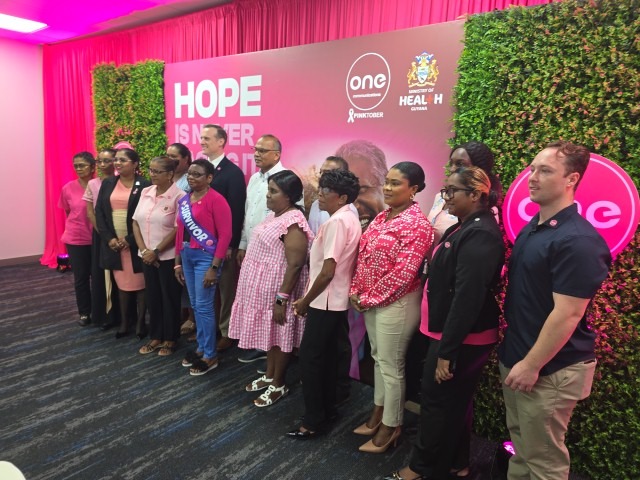
    On Wednesday, September 16, 2026, One Communications – the rebranded telecom firm formerly known as GTT – formally launched its expanded PinkTober 2026 campaign, partnering with Guyana’s Ministry of Health to shift the country’s cancer advocacy conversation beyond awareness to tangible, life-saving action. The initiative, themed “One Hope,” marks a deliberate break from the telecom company’s decade-long history of focusing exclusively on breast cancer outreach, now expanding support to all Guyanese affected by any form of cancer, with a new targeted push for prostate cancer screening alongside breast cancer services.

    Speaking at the launch event, One Communications CEO Abraham Smith emphasized that the campaign’s core goal is to drive meaningful behavior change across the country. For ten years, the company has successfully drawn thousands of participants to its annual October breast cancer walk, but Smith argued that incremental awareness is no longer enough. “We know we can get thousands of Guyanese to show up and walk. We’ve done that for a decade. But now we have to ask ourselves, can we get thousands to screen?” Smith said. This year, the campaign will go far beyond the traditional October 25 walk, working to remove barriers that prevent at-risk Guyanese from accessing life-saving early detection testing.

    Under the new partnership with the Ministry of Health, One Communications will amplify public outreach to share clear, accessible information about where local screening services are available, address common fears and uncertainties that lead many people to delay care, and provide direct practical support to reduce access barriers. The company will distribute free mammogram vouchers to support breast cancer screening for women, and launch targeted outreach to encourage men to discuss Prostate-Specific Antigen (PSA) testing with their healthcare providers to detect prostate cancer early. To extend its reach across all regions of Guyana, One Communications is also collaborating with eight leading local cancer-focused non-governmental organizations: Champions of Hope, the Cancer Institute of Guyana, Periwinkle Club, Giving Hope Foundation, the Cancer Foundation, Beacon Foundation, Recover Guyana, and the Guyana Cancer Society. These partnerships will strengthen existing efforts to educate communities, advocate for expanded cancer care, and deliver direct support to patients and families across the country.

    Health Minister Dr. Frank Anthony, who also spoke at the launch, outlined the urgent public health context that makes this expanded campaign critical. Despite the Guyanese government’s recent investment in expanding access to mammography services – adding new machines to public sector hospitals in Georgetown, Berbice, Essequibo Coast and Lethem, as well as expanding access through private sector providers – uptake remains far too low. Between January and September 2026, only 1,667 mammograms were conducted across the country. “Before, when we didn’t have the machines, the problem was, okay, we didn’t have enough machines, people didn’t have access. Now we are opening up access, but people are not coming,” Dr. Anthony explained.

    With 6.4 percent of all screened patients so far this year testing positive for breast cancer, Dr. Anthony noted that current screening numbers are skewed toward already health-conscious Guyanese, meaning many at-risk people are still not accessing care. Widespread national and regional outreach campaigns like PinkTober 2026 are essential to reach the right population segments and drive up screening numbers significantly, he added.

    Dr. Anthony also highlighted progress in HPV vaccination, a key public health tool to prevent cervical and penile cancers, which are linked to HPV infection. Vaccination coverage for children aged 9 to 15 has jumped from just 16 percent to nearly 70 percent in recent years, but Guyana still needs to reach and sustain a 90 percent coverage rate to meet World Health Organization (WHO) guidelines for eliminating these preventable cancers. The vaccine is also currently available for women aged 16 to 45 as part of the national cervical cancer prevention strategy. “In about 10 years, if we maintain this rate of vaccination, we would be on that journey of eliminating one of the most prevalent cancers among women. We can change that outcome. We can see that in our lifetime,” Dr. Anthony said. To date, the government’s HPV testing voucher program has identified 4,000 positive cases among 24,000 tested people over the past two years, all of whom have been connected to ongoing treatment.

    On the topic of prostate cancer, Dr. Anthony reported that 137 new cases have been detected in the first nine months of 2026, a relatively high number that he attributes to the government’s new proactive testing program, which offers free PSA testing vouchers in collaboration with private laboratories. Previously, most prostate cancer cases were only diagnosed at late, untreatable stages, but the expanded screening program is shifting this trend by enabling earlier detection that dramatically improves patient outcomes. Dr. Anthony closed by calling on local non-governmental organizations to leverage their community networks to encourage more people to take advantage of free and subsidized screening opportunities, noting that five years ago, little action was being taken on cancer in Guyana, but ongoing public-private partnerships are working to change that trajectory.

    Cancer is now one of the leading causes of death in Guyana, and both public and private sector leaders emphasized that collaborative, action-focused campaigns like PinkTober 2026 are critical to reducing preventable cancer deaths and improving health outcomes for all Guyanese.

  • MacDougall proposes support desk for practical business solutions in Roseau North

    MacDougall proposes support desk for practical business solutions in Roseau North

    Freshly sworn-in parliamentary representative for Dominica’s Roseau North constituency, Ashma McDougall, has put forward a targeted policy proposal to cut through barriers for local micro and small business owners: the creation of a dedicated in-constituency Business Support Desk. McDougall outlined the plan during an appearance on the Focus on Government and Development program, broadcast this week by Dominica’s state-owned radio station DBS.

    While existing national bodies including the Dominica Youth Business Trust, the National Development Foundation of Dominica (NDFD), and the government’s Small Business Unit already offer enterprise support services, McDougall noted that many micro enterprise owners face unaddressed hurdles when engaging with these large, centralized institutions. Many small-scale operators, she explained, find the process of accessing formal institutional support intimidating or logistically challenging, leaving them without the guidance they need to grow and stabilize their businesses.

    The proposed local Business Support Desk would operate out of the constituency’s office, staffed by a dedicated business support officer. This on-site resource would give small and micro business owners a low-barrier, accessible point of contact to get help with core needs, from navigating applications for development financing to building skills in basic financial record keeping. McDougall emphasized that for many local entrepreneurs, a quick, informal stop at their local constituency office to consult with a support officer would be far more approachable than making an appointment at a distant national agency.

    According to McDougall, this localized model has the potential to fundamentally reshape how micro and small businesses operate across Roseau North, unlocking growth for a segment of the local economy that is often overlooked by centralized support schemes. Beyond her own constituency, she added that the approach could serve as a replicable blueprint for other electoral districts across Dominica looking to boost local small enterprise development.

  • A judge’s legacy: Justice Gilford leaves Grenada after 13 years

    A judge’s legacy: Justice Gilford leaves Grenada after 13 years

    In a ceremonial special sitting of Grenada’s St George’s High Court held on September 14, the Caribbean nation’s legal community gathered to mark a pivotal moment for the local judiciary: honoring the departure of its longest-serving sitting judge, Paula Gilford, while formally welcoming incoming Justice Akilah Anderson to the bench.

    Born in Guyana, Gilford departs the Grenadian bench after 13 years of service, a tenure that placed her at the heart of the country’s justice system and saw her preside over thousands of judgments and hundreds of the nation’s most complex criminal and civil trials. As she prepares to take up a new judicial post in St Kitts and Nevis on September 21 – a jurisdiction where she previously served early in her career – legal leaders across Grenada have hailed her lasting impact on the island’s criminal justice system.

    Acting Director of Public Prosecutions Howard Pinnock emphasized the public trust Gilford rebuilt through her work on the bench. “Judges have to be mindful of maintaining confidence in the criminal justice system by the sentences they impose,” Pinnock told the assembled court. “And I say, my lady, without fear of no objection, that you have restored confidence in the criminal justice system in Grenada. That is one of your monuments.”

    Longtime criminal defence attorney Jerry Edwin echoed that praise, highlighting the dual pillars that defined Gilford’s judicial approach: unwavering adherence to legal principle and consistent fairness. Describing her commitment to upholding the rule of law, Edwin noted “a stern observance to the law” that translated to firm sentencing that deterred repeat offenses. “She has meted out sentences that caused fear in the minds of many offenders,” Edwin said, before adding that the judge’s reputation for even-handed justice remained unchallenged: “She has a reputation for, yes, fairness… She would throw the book at you,” only when the facts of the case demanded it, he clarified.

    In her own farewell remarks, Gilford reflected on the profound weight of judicial responsibility, emphasizing that every matter brought before her court touched real lives. “Every case represents real people facing real challenges, anxieties and hope,” she said. She added that the role of a judge carries “a profound responsibility to listen carefully, remain impartial and always strive to ensure that justice is administered fairly and without fear or favour.” Gilford also reaffirmed the critical role of judicial independence in sustaining public trust in Grenada’s democratic institutions.

    The same ceremony that celebrated Gilford’s legacy introduced the justice who will succeed her at St George’s No. 1 High Court: Jamaican-born Akilah Anderson, a legal professional with more than 20 years of experience across a diverse range of practice areas, including environmental law, criminal law, constitutional law and administrative law. Anderson takes up her post at a time when Grenada’s judiciary faces a significant backlog of cases: the upcoming September Assizes is set to open with 85 matters listed on its official roll, including multiple long-pending criminal cases that have waited years for resolution.

    Veteran criminal defence attorney George Prime noted that Anderson faces substantial challenges as she steps into the role, not least of which is filling the void left by Gilford’s decades of dedicated service. “The new judge has an uphill battle to now step into the shoes of Justice Gilford, who, in my humble view, has done a tremendous job,” Prime said.

    As Gilford moves to her next appointment and Anderson settles into her new position, the moment marks both a conclusion of a defining era for Grenada’s justice system and the start of a new chapter, with the local legal community waiting to see how Anderson will navigate the heavy caseload and build on the foundation Gilford leaves behind.