博客

  • Exclusieve WK-rechten STVS maken uitzending via ATV en SRS mogelijk

    Exclusieve WK-rechten STVS maken uitzending via ATV en SRS mogelijk

    As the much-anticipated 2026 FIFA World Cup approaches, Suriname has finalized its broadcast rights arrangement for the global tournament, though the deal has quickly drawn political scrutiny over financial transparency. The Surinaamse Televisie Stichting (STVS), Suriname’s state-owned public broadcaster, now holds the exclusive national broadcast rights for the 2026 tournament, enabling coverage across traditional television, radio and digital streaming platforms for audiences across the South American nation.

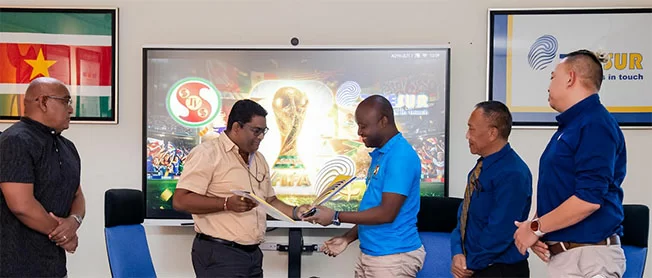
    To ensure widespread, nationwide access to all matches, STVS has already issued sublicenses to two major local media operators: N.V. Telesur and SRS Radio. The latest formal step in this partnership was marked by a document exchange ceremony between Telesur director Doric Ramlakhan and STVS representative Raoul Abisoina, formalizing Telesur’s sublicense to air matches via its ATV television channel and stream content through its on-demand platform TelesurPlus.

    Ramlakhan emphasized in comments after the ceremony that the core goal of this partnership is to bring the world’s biggest football tournament within reach of every Surinamese football fan. “We want every person, whether they’re at home, commuting, at work, in the coastal districts or the rural interior, to be able to follow the action wherever they have internet access,” he explained. Beyond live match broadcasts, Telesur plans to deliver a comprehensive, immersive football experience for fans, including dedicated studio discussion shows, expert pre- and post-match analysis, interactive fan content, public viewing events and targeted digital activations to engage audiences across age groups.

    The 2026 FIFA World Cup, which kicks off on June 11 and runs through July 19, marks a historic expansion of the tournament, featuring a record 104 total matches played across three host nations. Widely regarded as one of the largest and most-watched media and entertainment events on the global calendar, the tournament presents Suriname’s media sector with both a major opportunity and a significant financial outlay.

    STVS has reaffirmed its status as the official rights holder for Suriname, noting that its rights acquisition aligns fully with FIFA’s official licensing framework. The broadcaster referenced a FIFA statement issued on April 16, 2026, that confirms IRIS LATAM Limited holds the authority to issue sublicenses for the Caribbean and Latin American region, including Suriname. A subsequent confirmation letter dated May 12, 2026, formalized STVS’s acquisition of exclusive national media rights for the tournament, and the state broadcaster emphasized that the sublicense agreements with Telesur and SRS Radio do not alter its position as the primary rights holder responsible for compliance with FIFA and IRIS LATAM Limited requirements.

    In a clear warning to unauthorized users, STVS noted that any redistribution or use of 2026 World Cup audio-visual content without explicit written permission violates international copyright law, and the broadcaster will not hesitate to pursue legal action against violators.

    Despite the focus on public access, the deal also has a clear commercial angle: STVS has positioned the broadcast rights as a business opportunity for local and international brands, framing it as a “unique chance” for companies to build their profile during the world’s largest sporting event. The broadcaster has developed a range of commercial advertising packages designed to deliver maximum visibility and impact for partnering brands.

    The agreement has not come without controversy, however. Lawmaker Mahinder Jogi of Suriname’s ruling VHP party has raised pointed questions about the $500,000 public investment reportedly made by the government to secure the exclusive rights. Jogi is calling for full transparency around the financial terms of the rights acquisition, specifically pressing for answers on how the public funds allocated for the purchase will be recouped through commercial and other revenue streams.

    To address public and political questions, STVS has scheduled a press conference for Thursday, May 28 at the Mingle Cocktail Lounge in Paramaribo’s International Mall of Suriname, where it will provide additional details on the rights deal, partnerships with local media outlets and ongoing preparations for tournament broadcasts.

  • Protester, friend taken away

    Protester, friend taken away

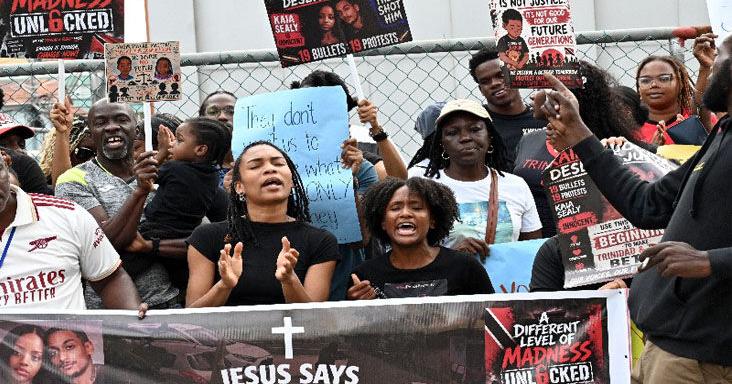
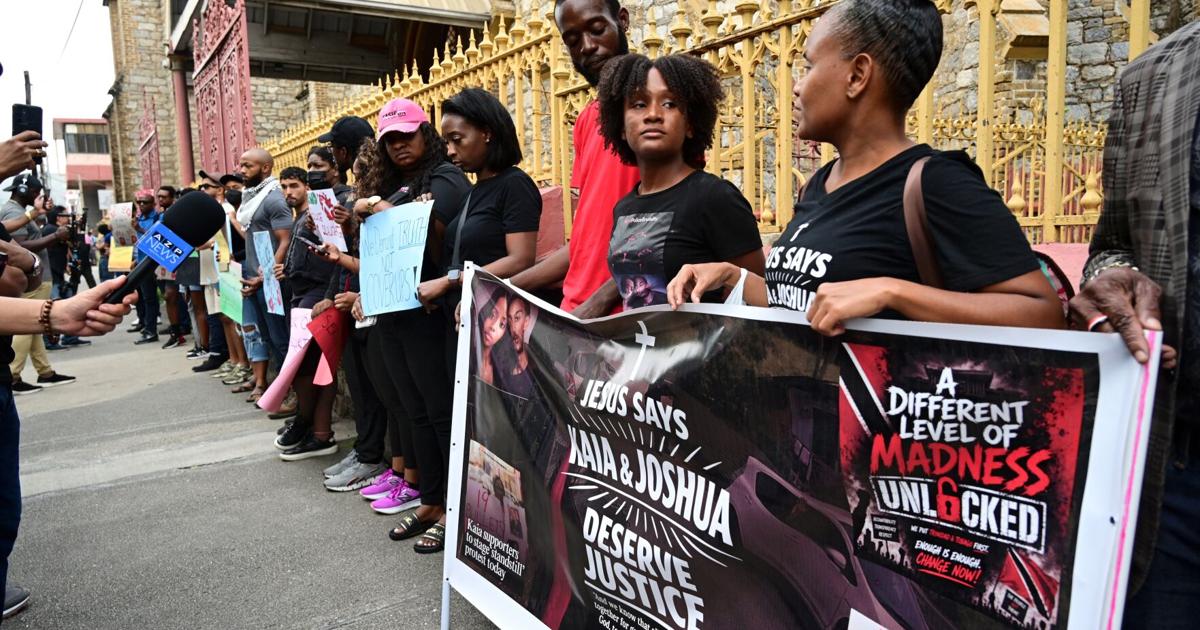
    A protest demanding transparency over the prosecution of Kaia Sealy — a woman charged in the January police-involved shooting death of her common-law husband Joshua Samaroo — ended in the detention of three people, including the demonstration’s lead organizer Alyssa Phillip, in downtown Port of Spain on Wednesday.

    Just minutes before police took her into custody near the Director of Public Prosecutions (DPP) office on Richmond Street, Phillip told reporters: “The only weapon we have are our voices. And that is the weapon that they are afraid of the most.” As officers led her to a police vehicle, she shouted defiantly to the crowd, “This is not the end of the fight!”

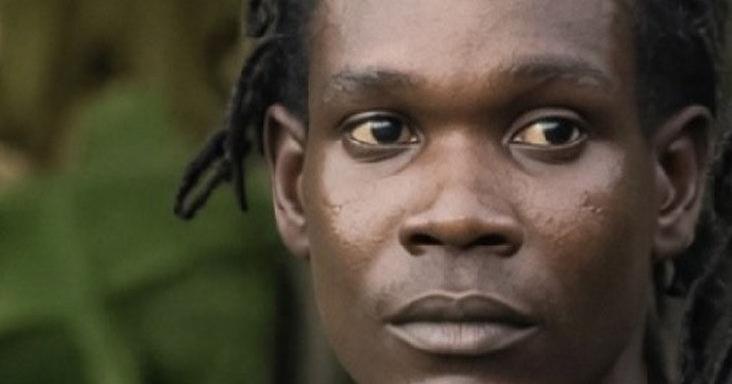
    The other two people detained include well-known local blogger and influencer Jason De Silva, and Phillip’s mother Camille Caresquero. Police have not yet confirmed whether Caresquero was formally arrested or accompanied her daughter voluntarily. As of Wednesday evening, all three were held at Port of Spain’s Central Police Station, and law enforcement sources had not announced any formal charges against the detainees.

    The protest unfolded against a pre-existing warning from the Trinidad and Tobago Police Service (TTPS) issued on Tuesday that barred public gatherings outside the DPP office. Despite the order, demonstrators began assembling shortly before 4 p.m. Wednesday.

    De Silva was the first protester detained. After multiple verbal warnings from officers over his conduct, he continued questioning whether the police response aligned with democratic standards, accusing law enforcement of “weaponising the State against citizens.” When De Silva attempted to leave the area, a team of senior officers led by Assistant Commissioner of Police Garvin Henry and Senior Superintendent Baird moved to arrest him. Video and on-site photos captured De Silva dropping to his knees, raising his hands, and repeating the phrase “hands up, don’t shoot” before officers removed him from the site.

    As more protesters arrived, many told on-site reporters they were shocked arrests began before the demonstration even fully got underway. Law enforcement responded by deploying large numbers of officers from multiple specialized units, including riot police, with Deputy Commissioner of Police Suzette Martin spotted coordinating with senior leadership at the scene.

    When the crowd grew to roughly 50 people gathered on the adjacent sidewalk, ACP Henry first approached Caresquero to issue an order: the group had to clear the sidewalk for public passage and stop loud chanting that constituted a public disturbance. Caresquero agreed and relayed the warning to other protesters. When Phillip arrived shortly after, Henry repeated the instructions and ordered the entire group to move further down the street, away from the DPP building. The crowd complied, relocating to the front of Sacred Heart Catholic Church at the intersection of Sackville and Richmond streets.

    By this point, riot police had blocked Richmond Street and diverted vehicle traffic toward Charles Street. After gathering at the new location, the crowd opened with a prayer before launching into chants, including calls for the resignation of Commissioner of Police Allister Guevarro and Minister of Homeland Security Roger Alexander, and slogans condemning TTPS actions in the Samaroo case.

    ACP Henry approached the group a second time to reissue warnings about blocking the sidewalk and loud chanting, noting that under the country’s current state of emergency, unsanctioned public assembly was prohibited. Movement for Social Justice leader David Abdulah attempted to mediate the standoff, but officers proceeded with enforcement.

    Phillip then read a prepared statement to the crowd, growing visibly emotional before she began loudly leveling accusations against the police service. It was at this point that Henry signaled for her arrest. When Senior Superintendent Baird moved to detain Phillip, Caresquero grabbed her daughter to stop officers, leading police to escort both women to a waiting police vehicle on Sackville Street. Protesters followed, chanting “shame” in condemnation of the law enforcement action.

    Riot officers then formed a linked human blockade with batons across the street, ordering the crowd to disperse on three separate occasions. When protesters did not leave, officers advanced to push the entire group — including one young child accompanying their mother — back to Richmond Street. After the forced dispersal, the protesters agreed to relocate to Port of Spain’s Woodford Square, where they held a short prayer before disbanding. Police were quick to follow the crowd to Woodford Square, but officers observed no further unrest and no additional arrests were made.

    Wednesday’s demonstration stems from the controversial decision to charge Sealy with manslaughter over Samaroo’s death, alongside three counts of shooting at police officers and multiple firearms-related offenses. The case has sparked fierce national debate in Trinidad and Tobago after leaked video footage emerged earlier this year showing police opening fire on the vehicle Samaroo and Sealy were occupying following a high-speed chase through St Augustine on January 20. Samaroo was killed in the shooting, while Sealy survived but was left paralyzed. Her family reports she is currently in the United States receiving ongoing medical treatment for her injuries.

  • Four more charges for Kaia Sealy

    Four more charges for Kaia Sealy

    A developing legal case in Trinidad and Tobago has taken a new turn, as authorities have announced four additional criminal charges against 24-year-old Kaia Sealy, who is already facing multiple allegations connected to a January police-involved shooting that left her common-law husband Joshua Samaroo dead.

    The new charges laid by the Trinidad and Tobago Police Service (TTPS) include possession of a firearm, possession of ammunition, possession of a firearm with intent to endanger life, and discharging a firearm within 40 meters of a public place. Once the associated warrants are officially issued, they will be served to Sealy immediately upon her re-entry to the country. Sealy is currently receiving medical care in the United States for injuries she sustained during the January 20 incident.

    These four new charges bring the total number of accusations Sealy faces to eight. Just last week, TTPS already confirmed three charges of shooting with intent to cause grievous bodily harm against serving police officers, filed under Section 12 of the country’s Offences Against the Person Act. Authorities have also previously issued a manslaughter warrant, alleging Sealy unlawfully caused Samaroo’s death.

    The fatal encounter dates back to January 20, when both Samaroo and Sealy were shot during a confrontation with police following a high-speed pursuit. According to the official police account, the pair traveled to Maloney in a white Toyota Aqua that day to arrange the sale of a firearm and an unspecified quantity of narcotics to a man working as a police informant. The informant has already given a formal statement to investigators, and his mobile phone has been transferred to the TTPS Cyber Crime Unit for forensic analysis.

    Police allege that when Samaroo and Sealy arrived at the meeting location, Sealy concealed a firearm in her bra before Samaroo removed it to show the informant. When officers from the Maloney Police Station moved in to approach the vehicle, Samaroo allegedly accelerated away, sparking a lengthy high-speed chase that saw police activate emergency lights and sirens. The National Operations and Dispatch Centre was quickly alerted to the possibility that the vehicle was carrying illegal weapons and ammunition, and additional units from the North Central Task Force Area West joined the pursuit after the vehicle was identified via radio dispatch.

    Investigators say multiple attempts to force the vehicle to stop were ignored by Samaroo. The chase finally came to an end when the Toyota Aqua crashed into a roadside drain on Bassie Street Extension in St Augustine, a moment that was captured on video and circulated widely across social media platforms.

    Moments after the crash, officers opened fire, after Samaroo raised his hands out of the driver’s side window. Participating officers have defended their use of force, stating they perceived an immediate threat from the vehicle and that Sealy was armed. One officer involved in the shooting reported seeing Sealy, who was in the front passenger seat, point a gun in his direction. He told investigators he returned fire after hearing what he described as muffled explosions and seeing the vehicle’s rear windscreen shatter. He added that other officers surrounded the crashed car and repeatedly ordered the occupants to drop their weapon before more shots were fired. According to evidence police submitted to the Director of Public Prosecutions (DPP), one officer recovered a firearm from the driver’s side of the vehicle after the shooting stopped.

    Both injured parties were transported to the Eric Williams Medical Sciences Complex in Mt Hope for emergency care, and forensic investigators processed the crash and shooting scene thoroughly after the incident.

    Sealy’s account of the events contradicts the narrative laid out by police. In a statement included in the evidence submitted to the DPP, Sealy says she was running routine errands with Samaroo when he received an unexpected phone call asking him to meet someone in the Maloney area. After the pair arrived and Samaroo spoke briefly with the man, she heard him change his tone and say “Don’t bother,” before he began reversing the car. Moments later, a marked police vehicle pulled up with an officer exiting the car holding a drawn weapon, prompting Samaroo to reverse and flee the area. Sealy also says she observed the man who had been speaking with Samaroo get into the police vehicle after the chase began.

    Sealy states that she repeatedly begged Samaroo to stop the car during the pursuit, but he refused. After the crash, she says she saw Samaroo raise both of his hands out the open window before multiple gunshots rang out. She has repeatedly maintained that neither she nor Samaroo was in possession of a firearm at any point during the encounter. In a formal written statement released through her legal representative last Saturday, Sealy reaffirmed her innocence, questioned key elements of the police investigation, and claimed she has never handled a gun at any point in her life.

  • Cops warn of SoE protest rules

    Cops warn of SoE protest rules

    A growing public dispute over a high-profile police-involved fatal shooting has erupted into a confrontation between law enforcement and protest organizers in Trinidad and Tobago, just 24 hours before a planned demonstration outside the Office of the Director of Public Prosecutions. On Wednesday, the Trinidad and Tobago Police Service (TTPS) issued an official statement clarifying that no formal permission had been submitted or approved for the protest scheduled for 4 p.m. Thursday. While the release did not explicitly name the Kaia Sealy-led demonstration, it issued a clear warning that any unauthorised public gathering held amid the current state of emergency (SoE) — governed by the 2026 Emergency Powers Regulations — would carry serious legal consequences for attendees.

  • Angelo’s stepdad appears in court

    Angelo’s stepdad appears in court

    A high-profile missing child case in Tobago has taken a tragic turn, as 24-year-old Shannon Miller, a resident of Goodwood, has been formally charged with the murder of two-year-old Angelo Tobias Plaza, his stepson. Angelo’s body has yet to be recovered, more than six months after he was first reported missing from his home.

    The case dates back to the evening of May 11, when two-year-old Angelo vanished from his residence on Cambridge Trace in Goodwood. Local authorities received the missing person report at approximately 7:30 p.m. that same night, launching an extensive multi-agency search effort that drew resources from across the island. Police officers, members of the national Defence Force, and Coast Guard teams led the operation, with critical logistical and on-the-ground support from the Tobago Emergency Management Agency (TEMA) and the volunteer Hunters Search and Rescue Team (HSRT). The search spanned land, coastal waters, and airspace surrounding Goodwood and neighboring communities, yielding no clues for the first six days of the operation.

    On May 17, investigators received an anonymous tip suggesting the young child’s body had been dumped at the Studley Park landfill in the days after Mother’s Day. Search teams immediately redirected their efforts to the massive waste site, but after days of systematic searching, Angelo still was not located.

    After months of ongoing investigation, law enforcement authorities brought Miller in for formal processing last Saturday. The charge came only after investigators held a case review meeting with a specialist legal advisor from the Office of the Director of Public Prosecutions (DPP) to assess the evidence collected throughout the probe. In an official public statement on the case, police confirmed that a full detailed review of all gathered evidence led to legal guidance confirming there was sufficient proof to move forward with criminal murder charges against Miller.

    Miller made his first virtual court appearance on Monday before Scarborough Magistrate’s Court Master Shabanna Shah. During the hearing, the defendant was formally notified of the indictable murder charge against him, but the court did not request him to enter a plea at this early stage of the legal process. The case has been adjourned until November 30, when a preliminary sufficiency hearing will be held to determine if the evidence against Miller meets the legal threshold to proceed to a full trial.

  • Ministers tour ‘USS Nimitz’ supercarrier

    Ministers tour ‘USS Nimitz’ supercarrier

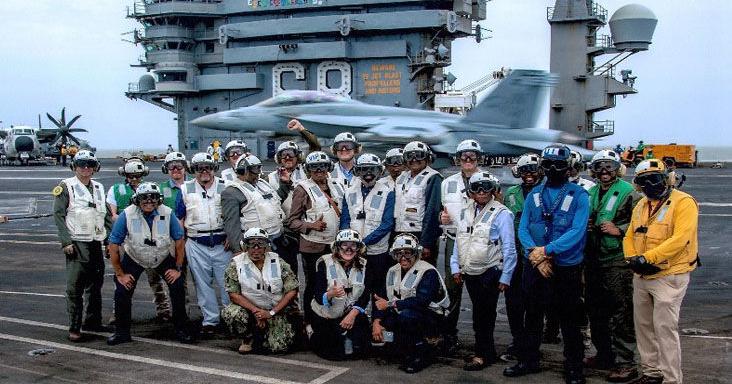
    In a high-profile display of bilateral military engagement, three cabinet ministers from Trinidad and Tobago traveled via a U.S. military C-2 transport aircraft on Monday to meet the USS Nimitz (CVN-68), the U.S. Navy’s iconic nuclear-powered supercarrier anchored in international waters north of Venezuela. The visit was organized as part of the vessel’s ongoing Distinguished Visitor (DV) Day program, hosted by the Nimitz Carrier Strike Group at the invitation of the U.S. Embassy in Port of Spain and U.S. Southern Command.

    The visiting delegation was led by Trinidad and Tobago’s Defence Minister Wayne Sturge, and included Works and Infrastructure Minister Jearlean John, and Land and Legal Affairs Minister Saddam Hosein. Senior national security and military officials also joined the tour, among them Ministry of Defence Permanent Secretary Narine Charran, Chief of Defence Staff Commodore Don Polo, Trinidad and Tobago Regiment Commanding Officer Captain Kemba Hannays, and Trinidad and Tobago Coast Guard Commanding Officer Captain Akenathon Isaac.

    As the lead flagship of the U.S. Navy’s Nimitz-class carrier program, the 100,000-ton nuclear-powered warship is designed to conduct sustained global operations without requiring mid-deployment refueling. Named after World War II Fleet Admiral Chester W. Nimitz, the vessel functions as a mobile, self-sustaining floating airbase that can project formidable military power across the globe. The Nimitz Carrier Strike Group, a fully integrated combat formation, is supported by guided-missile cruisers, guided-missile destroyers, attack submarines, logistics supply vessels, and an embarked air wing composed of fighter jets, intelligence, surveillance and reconnaissance aircraft, and utility helicopters. U.S. carrier strike groups are widely recognized as one of the world’s most powerful conventional military assets, allowing the U.S. to deploy air and naval power anywhere in the world without relying on host-nation land bases.

    During the day-long tour, the Trinidad and Tobago delegation received detailed briefings on the supercarrier’s daily operations, walked the vessel’s 4.5-acre flight deck to observe catapult launches and arrested recoveries of fixed-wing aircraft, and reviewed the carrier’s strict safety protocols for flight operations. At the conclusion of the visit, the commanding officer of the USS Nimitz presented a commemorative plaque to Minister Sturge, who reciprocated with a plaque on behalf of the Government of Trinidad and Tobago.

    In an interview with local outlet *Trinidad Express* following the tour, Sturge confirmed the trip to the supercarrier, which was positioned just a few miles north of Venezuela’s Guiria Peninsula. He shared that the delegation had a surprising, heartwarming encounter during the visit: six Trinidadian-born sailors currently serving aboard the Nimitz joined the tour. When five of the sailors mentioned they craved doubles, a popular Trinidadian street food, the minister arranged to have the traditional dish delivered to the vessel after the delegation departed.

    Sturge also expressed his awe at the supercarrier’s advanced engineering, particularly its steam catapult launch system. “The landing and take off was done by catapult which I never quite understood until I experienced it,” he told reporters. Sturge declined to share further sensitive details of the discussions held during the visit, noting that matters related to national security require appropriate confidentiality, and that additional information would be released at a later date.

    The USS Nimitz publicly acknowledged the historic visit in an official post on its Facebook page. “Today USS Nimitz was honored to welcome distinguished visitors from Trinidad and Tobago while operating in the Caribbean. Their visit reflects the strong ties between our nations and the importance of continued engagement among partners committed to security, cooperation, and stability throughout the region,” the post read. “We were also proud of our Trinidadian-American sailors who were able to join the tour and show off their Old Salt strength! To our guests from Trinidad and Tobago, thank you for your friendship and for joining us aboard Nimitz!”

    The deployment is part of Southern Seas 2026, an ongoing maritime security initiative led by U.S. Naval Forces Southern Command and the U.S. 4th Fleet. The deployment is focused on expanding regional military capacity, improving interoperability between partner nations’ armed forces, and strengthening maritime security cooperation across the Caribbean and Latin America through joint exercises, multinational exchanges, and inter-agency collaboration.

  • Penny wants a stronger PCA

    Penny wants a stronger PCA

    Trinidad and Tobago’s opposition leader Pennelope Beckles has ramped up pressure on Prime Minister Kamla Persad-Bissessar, accusing the sitting head of government of ignoring a sharp rise in public distrust of national police operations. Speaking out via a public social media statement on Wednesday, Beckles laid out two urgent legislative priorities her bloc is pushing to overhaul police accountability: strengthening the oversight powers of the Police Complaints Authority (PCA) and mandating all frontline law enforcement officers to wear activated body-worn cameras during duty.

    Beckles argues the current PCA lacks sufficient investigatory authority to handle high-stakes cases involving police-involved killings, and is calling for the local oversight body to be restructured along the lines of Jamaica’s Independent Commission of Investigations (INDECOM), a model that grants independent investigators immediate on-site access to preserve evidence and launch probes right after a fatal police incident occurs. “As Opposition Leader I have made a plain and simple call for the Prime Minister to immediately cause legislative amendments to be made to improve the powers and investigatory procedures of the Police Complaints Authority modelling the Jamaican INDECOM example which will allow features such as on-scene site evidence preservation and access by PCA personnel immediately upon the occurrence of police killing,” Beckles said in her official statement.

    The push for PCA reform is paired with a longstanding opposition demand for binding legislation requiring body-worn camera use for all on-duty police and authorized law enforcement personnel. Beckles emphasized that updated legislation covering both PCA oversight and body cameras would deliver tangible benefits for all parties: “Legislation relating to the PCA and the use of body cameras will ensure transparency, accountability and protection for both officers and civilians alike,” she said.

    Beyond attacking the prime minister’s inaction, Beckles also targeted Homeland Security Minister Roger Alexander over the unexplained cancellation of a planned procurement of body cameras, noting the public has received no official clarification or timeline for reversing the decision. She also took aim at the soon-to-expire State of Emergency (SoE), suggesting the government is quietly paving the way to extend emergency powers by manufacturing a new national crisis to shield cabinet ministers who have avoided media scrutiny amid widespread corruption allegations.

    As chair of the National Security Council, Persad-Bissessar has completely failed to address growing public concerns over police accountability and transparency, Beckles claimed. She criticized the prime minister for only recently breaking her public silence on policing issues via text message, using the outlet only to announce vague plans for appointing a new Chancellor of the Judiciary and adjusting age limits for alcohol consumption, recreational marijuana use, and gambling—while ignoring the far more pressing demand for policing reform.

    “From the vacuum of her silence and absence, the Prime Minister as the head of the National Security Council has finally emerged by text message once again to now gift the nation with two cryptic quotes and the promise of a Chancellor of the Judiciary, an increase in the age for consumption of alcohol, use of marijuana and gambling,” Beckles said. She called Persad-Bissessar’s inaction on policing transparency a clear dereliction of constitutional duty, noting that balanced reform would protect the rights of both civilians and law enforcement officers by creating clear, documented records of police interactions.

    Beckles tied the growing public distrust to recent high-profile developments, including the controversial execution of warrants against Kaia Sealy. “It is undeniable that suspicion in police action has taken unnecessary root in the matter of the charges brought against Kaia Sealy,” she stated. She also condemned previous provocative comments made by the prime minister about public safety, including remarks describing “rough men” protecting citizens at night and earlier calls to “buss heads and kill people violently”—language that Beckles says has done nothing to ease public anxiety about excessive police force.

    In closing, Beckles praised the Office of the Director of Public Prosecutions as one of the last remaining independent pillars of public trust in the country, while reiterating that the prime minister has consistently refused to engage with or adopt the opposition’s evidence-based recommendations for strengthening policing accountability.

  • PM Friday promises ‘course correction’ on SVG debt

    PM Friday promises ‘course correction’ on SVG debt

    When Prime Minister Godwin Friday’s New Democratic Party (NDP) swept into power in St. Vincent and the Grenadines last November, ending a quarter-century of Unity Labour Party rule, the incoming administration expected fiscal challenges. What it uncovered, however, was a public finance crisis far deeper than any public disclosures or opposition analysis had prepared it for.

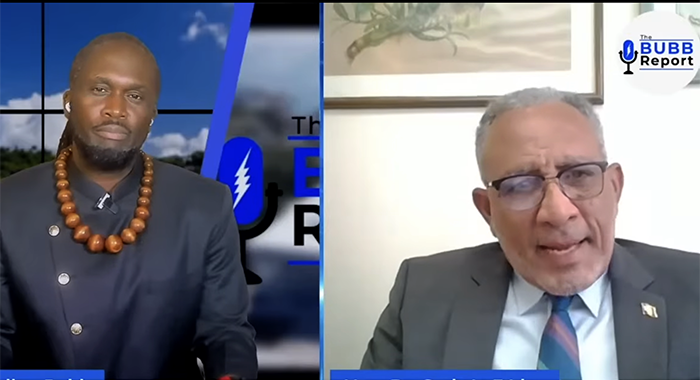
    In a bombshell interview with Grenadian journalist Kellon Bubb on *The Bubb Report*, broadcast Sunday, Friday detailed the extraordinary fiscal reckoning his government is now navigating, framing the administration’s immediate priority as a urgent “course correction” to pull the country back from unsustainable debt levels.

    Even after years of reviewing government budgets from the opposition benches, Friday said the true scale of the nation’s debt burden remained hidden until the NDP took office. “To be honest with you, I thought there was nothing about the economy that could surprise me,” he shared. “We knew that things were pretty difficult… but I was not quite ready for the depth of the crisis that we found ourselves in, in terms of the finances of the country.”

    Long publicly pegged at a debt-to-GDP ratio around 90%, the actual figure clocked in at 113% — and projections show it will climb even higher in the near term. Friday described the country’s public finances as “very precarious”, noting that the government’s overdraft facility was completely maxed out, and the ballooning debt is already crippling the state’s ability to deliver policy programs and public services to citizens.

    The incoming government’s discovery of the crisis overlapped with the existing national budget timeline, leaving little room to build a new fiscal plan from scratch. “We had to, essentially, tag on to the budget process that was there, because we didn’t have time to redo the entire thing ourselves, at the same time acknowledging that we are in really worse economic shape than we had thought,” Friday explained, adding that even the NDP’s sharpest opposition criticism fell short of the reality the party inherited.

    Friday attributed the crisis to systemic fiscal recklessness from the previous administration, which he said disregarded long-standing fiscal guardrails in pursuit of short-term priorities. “We’ve been saying this all the time when we were in opposition: you can’t disregard the guardrails and simply say, ‘Well, I’m doing it in the best interest of the people,’” he said. “In the end, if you are reckless and you don’t pay attention… the very people that you say you want to help are the ones who are going to wind up paying the cost of it.”

    To reverse the trajectory, Friday’s administration has committed to returning to the Eastern Caribbean Central Bank’s recommended 60% debt-to-GDP cap, a target that is far more challenging to reach today after years of unreported debt growth. “But we have to signal… that we want to turn it around,” he emphasized.

    On the global stage, the prime minister laid out a clear plan for rules-based, collaborative engagement with international financial institutions including the International Monetary Fund. While Friday acknowledged that working with these bodies is unavoidable for a small nation facing fiscal crisis, he stressed that any partnership will be rooted in domestic priorities and democratic accountability.

    He described the institutions’ policy advice as thoughtful and constructive, framing engagement as a collaborative rather than adversarial process designed to support the country’s social and development goals. At the same time, he noted, “They have their views, their positions, and they cannot be ignored… but we also have our own understanding of the needs of [the] country, of the people, and we are politicians as well. We have to listen to the voice of the people. That’s the nature of democracy.”

    Friday outlined a multi-pronged strategy to reduce the debt burden, including pursuing debt swaps, seeking international debt forgiveness, and securing new concessional loans with favorable terms. But the prime minister stressed that sustainable economic growth is the only long-term solution to the nation’s fiscal woes.

    External analysts project St. Vincent and the Grenadines’ growth will remain below 3% in the coming term, and Friday framed lifting growth above that threshold as his administration’s core economic test. The NDP won a landslide mandate in November’s election, taking 14 of 15 parliamentary seats, running on a promise to deliver improved living standards, security and opportunity to all Vincentians.

    To drive that growth, the government is launching an aggressive push to attract foreign direct investment that aligns with national development priorities and creates local jobs, while unlocking untapped domestic private capital — a critical priority in a region that faces persistent capital scarcity. “Where we can have investment that fits with our own developmental goals, that creates jobs, that are responsible for our people, we invite and will court such investments,” Friday said. “You will see during the term of this government… a tremendous push in investments that will create jobs and business opportunities for people. That’s the way we get out of the debt.”

    Ultimately, Friday said, growth must deliver tangible benefits for citizens: better-paying jobs, expanded business opportunities, and robust social programs, not just improved fiscal ratios. “We have to find mechanisms for our people to find work, better-paying jobs, to have business opportunities, and where social programmes are necessary… they are put in place,” he said.

  • Union Island mourns beloved educator, historian, and lawyer

    Union Island mourns beloved educator, historian, and lawyer

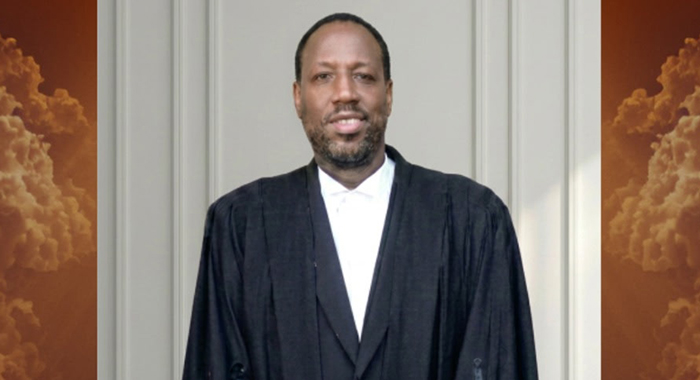
    In the mid-1990s, decades after Category 5 Hurricane Janet devastated Union Island in 1955, a visionary secondary school teacher named Steve Eugene Stewart gave his students at Union Island Secondary School an unusual research assignment that would leave a lasting mark on both the students and the small island community. Instead of asking them to flip through textbook pages or dig through static encyclopedia entries to study the historic storm, Stewart tasked his class with a far more meaningful project: seek out the island’s oldest residents, visit them in their homes, and record their first-hand memories of the catastrophic 1955 hurricane.

    What many students discovered through the project surprised them. Unlike modern natural disaster early warning systems that rely on televised alerts, radio broadcasts and mobile phone notifications, the only warning Union Island residents received before Janet hit came from leaflets dropped by a low-flying aircraft. Beyond that key historical fact, the interviews exposed young people to far more than just stories of destruction. They heard accounts of extraordinary neighborly solidarity in the aftermath of the storm, and quiet tales of courage from residents who had rebuilt their lives and their home from scratch.

    For Stewart, the project was never just about collecting historical data. It was a deliberate lesson designed to nurture an appreciation for living history, preserve the island’s fading oral storytelling traditions, teach young people to respect their elders, and foster intentional knowledge transfer between generations. The project also benefited the elderly participants: many had not received such focused attention from younger people in years, and the interviews gave them a renewed sense of purpose, showing that their experiences and wisdom still mattered to the island community. Many enjoyed connecting with young people, even walking them through generations of their family bloodlines to strengthen intergenerational ties.

    This project was just one small example of Stewart’s lifelong legacy as an educator and community leader on Union Island. His core mission as a teacher was always to root young people in their local history, connect them to experienced community leaders, and grow a deep, abiding love for their island home. His commitment to his students went far beyond standard lesson plans: on one occasion, he even sat the Caribbean Examinations Council (CXC) exam alongside his students for a subject he had been teaching for years — surprising them all when it was revealed he never held formal certification in the subject himself, choosing to learn alongside his students to better serve them.

    Stewart’s drive to lift up others extended well beyond his own classroom. When other local teachers risked losing their jobs because they lacked required subject certifications, Stewart organized free evening classes to help them pass their mandatory exams. He was also a passionate advocate for local cultural heritage, and a founding member of the Union Island Museum Society, where he led efforts to reclaim historical artifacts from Union Island’s early settler communities that were being held in museums across Europe.

    His influence stretched across nearly every corner of Union Island’s public life. He contributed to the island’s sports, recreation and cultural sectors as a key member of the Easterval festival committee, local NGO O.S.D.E.R., May Day celebration organizing teams, and community drama and arts programs. He dedicated himself to advancing youth opportunities, regularly supporting Union Island students who moved to the mainland for higher education — helping them secure affordable housing during their studies and connecting them to job placements after they graduated.

    An avid writer and public commentator, Stewart penned dozens of articles highlighting influential local figures, little-known historical events, and ongoing policy debates affecting his homeland. He led campaigns to grant official historical heritage status to important older landmarks across the island, including Union Island’s first concrete home near Cross Road, the colonial-era cotton industry old post office building, the historic overseer’s house on Health Centre Hill, and dozens of other culturally significant relics. He even integrated tours of these sites into his teaching to help students connect with their local history firsthand.

    One of Stewart’s final community projects was the restoration of Society Hall, transforming the historic building into a living museum that preserves the story of financial organizing by Union Island’s community of formerly enslaved people. A lifelong advocate for continuous learning, Stewart even began studying law decades into his career as an educator, always reminding his students: “to never stop dreaming, never stop learning, and never stop selling opportunities.”

    An extensive traveler and widely respected thought leader on issues of sustainable island development, efficient governance, and educational reform, Stewart spent his entire life as a champion for positive change on Union Island. From his early days selling newspapers to local residents to representing his country at international forums in Switzerland, he never missed an opportunity to improve life for his fellow islanders. Above all else, Stewart was a man of deep faith, who prioritized sharing the importance of personal spiritual life, led regular Bible study classes at his church, and encouraged everyone he met to build a personal relationship with Jesus.

    This op-ed is written by Nkarlo Alexander, a former student of Stewart’s at Union Island Secondary School, and reflects the personal views of the author, not the official editorial stance of iWitness News.

  • Hopeful Hearts Foundation Donates Examination Kits to Pares Primary Grade 6 Students

    Hopeful Hearts Foundation Donates Examination Kits to Pares Primary Grade 6 Students

    A community-focused charitable organization, Hopeful Hearts Foundation, has launched a new initiative to support graduating elementary students at Pares Primary by donating specially prepared examination kits to all Grade 6 learners. The contribution comes ahead of critical national standardized assessments that will shape students’ next steps in their academic journey, addressing a gap where many low-income families struggle to afford necessary testing supplies.

    Local education representatives have praised the foundation’s effort, noting that the donation does more than just provide physical materials: it also boosts students’ confidence and reduces financial stress for working-class households enrolled at the school. Foundation organizers shared that they developed the project after hearing from Pares Primary teachers about the unmet needs of Grade 6 families, and they hope to expand similar support programs to other neighboring primary schools in the coming academic year.