
A fierce political debate has unfolded in St. Vincent and the Grenadines’ Parliament over a proposed national security bill, pitting current Deputy Prime Minister and National Security Minister St. Clair Leacock against former Prime Minister and Opposition Leader Ralph Gonsalves. The tension stems from Leacock’s recent startling revelations about the extent of citizen data collected by Gonsalves’ Unity Labour Party (ULP) administration, which held power for 25 years until its electoral defeat in November 2024.\n\nSpeaking during debate on the Advanced Passenger Information and Passenger Name Record Bill on Tuesday, Leacock expressed shock at the types of intelligence that now cross his desk, collected by the previous government. “When I see the things that come across my desk in this role… sometimes I hold my head and ask, ‘Is this the kind of intelligence the former prime minister held on me, my party, and ordinary private citizens during his time in office?’” Leacock told the legislative chamber.\n\nThe bill, designed to strengthen border and national security by standardizing collection and sharing of traveler data, ultimately passed with no formal unified position from the three-member opposition. Gonsalves, a trained lawyer, launched sharp criticism of the legislation, arguing that it reads like an unfinished draft rather than a final piece of law. He raised pointed concerns about gaps in data protection, unclear frameworks for official appointments, and ambiguous timelines for mandatory information submission, also questioning whether the bill had completed required vetting through the CARICOM Legal Affairs Committee (LAC).\n\nLeacock pushed back forcefully against these critiques, framing Gonsalves’ objections as part of a long-standing pattern of authoritarian control over policy. He told Parliament, “If it is not under the suzerainty of the Honourable Ralph Everett Gonsalves, it ain’t good. Nobody is good enough for him unless he presides over it.” The Central Kingstown MP added that as a former prime minister and decades-long national security minister, Gonsalves has a greater national responsibility to avoid undermining the credibility of current national and regional security institutions. Leacock accused Gonsalves of nitpicking over minor drafting details like punctuation to erode public trust in the new government’s work, calling his focus “all semantics” that amounts to an attack on the integrity of public servants.\n\nLeacock further alleged that Gonsalves’ 25-year administration left St. Vincent and the Grenadines with a disjointed, ramshackle national security apparatus that the new government is working to repair. He pointed to port security as a key example: while the previous ULP government installed passenger screening equipment at the main port, it failed to put in place legal mechanisms that would automatically share screening data with police, leaving critical security gaps. On the question of regional vetting, Leacock clarified that the bill was already reviewed by the CARICOM LAC during Gonsalves’ own tenure, and passed through all required regional processes when Gonsalves led the country’s involvement in CARICOM IMPACS, the regional security body.\n\nResponding to Gonsalves’ comment that the current New Democratic Party administration would only serve one term, Leacock framed the remark as evidence of the opposition’s core goal of undermining the new government rather than working for the national good. “It points to a poison that in order for this country to go forward, we must not underestimate the hurdles that remain for us to climb. Your single purpose is to ensure that we become a one-term government,” he said.\n\nIn his rebuttal, Gonsalves rejected all of Leacock’s claims, denying that he had ever criticized or disrespected regional security bodies.\n\nLeacock closed his argument by reaffirming the core purpose of the new legislation: to protect travelers entering and exiting St. Vincent and the Grenadines, boosting public confidence that the country offers both safety and streamlined access for visitors. He noted that any minor drafting imperfections can be corrected through regular governance processes down the line, and there is no justification for delaying the critical security framework the country needs to address modern transnational threats that may outpace the capacity of the outdated system inherited from the previous administration.
博客
-

US talks on third-country nationals ‘slowed down quite significantly’
In a formal address to the country’s parliament on Tuesday, St. Vincent and the Grenadines’ (SVG) Minister of Foreign Affairs Dwight Fitzgerald Bramble issued a clear, public clarification that the Caribbean nation has not entered into any binding agreement with the United States centered on third-country national relocation arrangements, confirming that negotiations over the proposed deal have slowed to a near standstill in recent weeks.
Brambles’ comments came in direct response to a question posed by opposition senator Carlos James, who asked the ruling administration to confirm whether the U.S. had submitted a formal request for a third-country agreement — a deal that would allow for the transfer of non-U.S. nationals from American territory to SVG for processing and relocation — and whether Kingstown had finalized and signed any such arrangement.
Bramble laid out the full timeline of the outreach to parliament, explaining that the U.S. government first approached SVG with a formal request to explore a partnership focused on third-country national issues, and followed the initial request by sharing a draft draft memorandum of understanding (MoU) for SVG’s leadership to review. He emphasized that this U.S. initiative is not targeted exclusively at SVG, but is part of a broader regional outreach effort that includes all member states of the Organization of Eastern Caribbean States (OECS).
In line with the regional scope of the proposal, Bramble noted that SVG has coordinated closely with its OECS neighbors to review the draft text collectively, approaching the potential arrangement through a collaborative regional framework rather than engaging in independent negotiations. Despite months of preliminary discussions and review of the draft document, Bramble stressed that talks have never advanced to the stage of a binding commitment.
When updating lawmakers on the current state of negotiations, Bramble confirmed that the process has decelerated sharply over the past few weeks, with little to no forward movement on finalizing any terms. He repeated multiple times during his address that no agreement has been signed, nor has any finalized binding deal ever been presented to SVG’s government for approval.
Brambles did not provide additional specific details on the contents of the draft MoU, including what specific groups of migrants would have been covered by any finalized arrangement. The question from the opposition senator comes amid growing regional and global debate over third-country national processing and relocation schemes, which have become a controversial topic of migration policy discussions across the Americas in recent years. Bramble’s address made a clear distinction between receiving and reviewing a proposal, and formally agreeing to enter into a binding deal, leaving no ambiguity about SVG’s current position on the proposed U.S. partnership.
-

COMMENTARY: Multilaterialism and Diplomacy in an Era of Uncertainity
Against a backdrop of spreading armed conflict and rising global instability, the annual International Day of Multilateralism and Diplomacy for Peace, observed on April 24, has emerged as a critical platform to sound the alarm over the erosion of the post-World War II international order. UN Secretary-General António Guterres opened this year’s observance by reaffirming a core founding truth of multilateral cooperation: no single nation can tackle the interconnected challenges facing the modern world in isolation.
This year’s gathering carries unique gravity, centered on the urgent theme “The UN Charter at a Crossroads: Renewing Commitment to Universal Values, Multilateralism and Diplomacy in an Era of Global Uncertainty”. The theme calls for renewed global partnership, steadfast adherence to international law, and inclusive dialogue to de-escalate tensions across a world grappling with multiple simultaneous conflicts. From Russia’s invasion of Ukraine to ongoing hostilities in the Middle East, Sudan and other regions, the foundational principles outlined in the UN Charter are facing unprecedented direct assault.
Widespread conflict has left ordinary consumers footing the bill, with grocery and fuel costs climbing week after week, while a looming global recession casts a shadow over vulnerable economies worldwide. Disturbingly, a small set of well-connected interest groups have profited economically from ongoing hostilities, even as civilian populations bear the brunt of violence. Civilians have been deliberately targeted in multiple conflict zones, critical civilian infrastructure including schools and hospitals have been destroyed, and international humanitarian law is being broken with near-complete impunity. Each unaddressed violation further weakens the global frameworks designed to prevent large-scale war.
Many observers have pointed to these ongoing crises as evidence that multilateralism has failed. But this year’s observance pushes back against that narrative: the current crisis is not a failure of multilateralism itself, but a failure of world powers to uphold and enforce its core principles. Multilateralism, built on founding values of consultation, inclusive participation and collective solidarity, operates through mutually agreed rules that enable sustainable, effective cross-border cooperation. It is both a method of global cooperation and the core organizing structure of the modern international system.
The roots of institutionalized multilateralism stretch back to the establishment of the League of Nations in 1920, created after World War I to facilitate peaceful cooperation between nations. The United Nations, founded in 1945 in the aftermath of World War II’s devastation, inherited and expanded that mission with a central mandate: to preserve international peace and security, and to protect future generations from the “scourge of war” by requiring nations to resolve disputes through peaceful means. The UN remains the only universal global body with the legitimacy to represent the collective interests of all nations, giving every state, large and small, a seat at the table. But legitimacy alone is not enough: international law must be consistently respected and enforced to deliver on the promise of multilateral cooperation.
Against this backdrop, this year’s International Day carries an urgent appeal: nations must step back from aggression and unilateral action, and return to good-faith negotiation to resolve disputes. Echoing Nelson Mandela’s vision of peace, the observance emphasizes that true peace is not merely the absence of conflict. It is the creation of a global environment where all people can flourish, regardless of race, religion, gender, class or any other marker of difference.
This commentary, by educator and social commentator Wayne Campbell, who focuses on how development policy shapes culture and gender equity, frames the 2024 observance as a make-or-break moment for the global order built over the past 80 years.
-

Police officer charged with wounding 61-y-o farmer
A criminal case with significant public attention is unfolding in Kingstown, where a serving 31-year-old police officer has been formally charged with unlawful wounding following an alleged attack on a 60-year-old local farmer. According to official police allegations, the defendant, Patrick Franklyn, who resides in Questelles, is accused of assaulting the Vermont-based farmer on April 18. Prosecutors claim that Franklyn struck the older man on the right side of his face, a blow that forced the farmer to fall to the ground and sustain additional head trauma from the impact.
Franklyn made his first court appearance before Senior Magistrate Tammika McKenzie at the Kingstown Magistrate Court this Thursday, where he entered a formal not guilty plea to the single wounding charge brought against him. Following the arraignment, the court granted Franklyn pretrial release on bail set at 2,900 Eastern Caribbean dollars, on the condition that he secure a third-party surety to guarantee his compliance with bail conditions.
As part of the release terms, Magistrate McKenzie imposed several key restrictions on Franklyn ahead of his trial. He is strictly prohibited from making any direct or indirect contact with the alleged victim, who is recognized as the virtual complainant in the case. He has also been ordered to sign in at the Questelles Police Station every Friday to confirm he remains in the area. To prevent any attempt to flee the jurisdiction ahead of proceedings, the court further issued an order for stop notices to be posted at all official ports of entry and exit across the country.
The case is scheduled to move to trial on September 28, with all parties set to present evidence and arguments before the court at that time. -

Non-nationals charged over 434kg of cocaine on yatch plead not guilty
Authorities in St. Vincent and the Grenadines have rejected bail applications for two foreign citizens facing a series of major charges connected to one of the region’s recent large-scale drug seizures, ordering the pair to reappear before the court on April 30.
The accused, identified as Frank Garcia, a Venezuelan national, and Alister Haynes, a citizen of Grenada, are currently being held in remand at His Majesty’s Prison following Thursday’s bail ruling by the local court.
The entire operation unfolded after local law enforcement launched a stop and search at a coastal location in Cumberland earlier this week, when officers intercepted a yacht carrying the two men that had entered the country’s territorial waters and anchored off the Cumberland coast. After the pair were taken into custody, the vessel was escorted to the local Coast Guard base in Calliaqua for a full inspection. During the search, officers uncovered containers and packages holding a total of 434,268 grams, or approximately 957 pounds, of cocaine.
Both men face three separate indictable charges related to the drug haul: possession of the large quantity of cocaine for the purpose of drug trafficking, attempted importation of the controlled substance, and possession of cocaine with intent to supply to other parties. All drug-related charges are dated April 20, 2025 at Calliaqua, according to court documents.
In addition to the drug offenses, the pair are facing four charges related to violating St. Vincent and the Grenadines’ immigration laws. All immigration charges stem from their illegal entry on April 20 at Cumberland. Specifically, they are accused of entering the country at a location that is not an official designated port of entry. For this count, Garcia entered a guilty plea, while Haynes pleaded not guilty.
Court proceedings hit a brief procedural pause when Chief Magistrate Colin John confirmed that Garcia does not speak English. A serving officer from the local Coast Guard was appointed to serve as a translator for the hearing, an arrangement that was approved by the court as valid.
A second immigration charge accuses the two men of entering the country by boat and disembarking from the vessel without prior approval from an authorized immigration officer. Once again, Garcia pleaded guilty to this count while Haynes maintained a not guilty plea. Haynes faces an additional separate charge of entering St. Vincent and the Grenadines without a valid passport as a prohibited immigrant, to which he has also pleaded not guilty. Garcia, meanwhile, has pleaded guilty to a corresponding charge that he knowingly and intentionally allowed himself to be landed in the country as a prohibited immigrant.
-

Bevelhebber Labadie: Nieuwe fase voor leger met focus op discipline en vernieuwing
On April 25, a historic leadership transition took place for a national army, as newly installed Brigadier General Mitchell Labadie formally took command from President Jennifer Simons during an official inauguration ceremony. In his first public address after assuming office, the newly appointed commander laid out a clear, ambitious vision for the institution’s next chapter, centered on three core pillars: strengthening organizational discipline, driving comprehensive modernization, and reinforcing the army’s core operational capabilities.
Labadie opened his remarks by framing his appointment as a profound honor, describing the role as a “calling to serve, protect, and lead” the nation and its military personnel. He gave a public assurance that under his leadership, the national army will be guided by unwavering discipline, uncompromising integrity, and steady determination, telling attendees and the public that “the army is in capable hands.”
The commander emphasized that the armed forces are entering an entirely new phase of development that requires balancing respect for long-held institutional traditions with intentional space for progressive change. “We will strengthen our foundational structures, raise our professional standards, and further shape our unique identity as a national military force,” he stated.
One of the top policy priorities Labadie identified is rebuilding and embedding strict discipline across every rank and organizational layer of the army. Beyond cultural reform, he also plans to streamline command structures to improve operational efficiency, and advance widespread professionalization through expanded training and education programs for all personnel.
Military modernization is another key focus of his tenure, with Labadie noting that shifting global security dynamics and emerging hybrid threats demand targeted investments in new technologies, updated equipment, and enhanced operational capabilities. “We must improve our ability to monitor, patrol, and protect our national territory,” he explained, adding that updated infrastructure and resources are critical to meeting 21st-century security challenges.
Labadie also addressed a long-standing demographic challenge facing the force: aging personnel across multiple branches caused by years of low recruitment intake, which has negatively impacted operational readiness. To reverse this trend, he announced plans for targeted recruitment campaigns and improved compensation and recognition for serving members to attract new talent and retain existing personnel.
In addition to structural and operational reforms, the new commander stressed that institutional integrity and mutual trust between leadership and troops will be non-negotiable priorities. He said he expects commitment, discipline, and loyalty from all service members, and pledged to uphold the same standards in his leadership of the force. “Leadership is a mutual obligation,” he noted.
Closing his inaugural address, Labadie called for unity across the entire armed forces, reinforcing a shared commitment to national service. “We will form one corps, one team, one military, united by the same mission and the same dedication to our country,” he said.
-

Nevis Mango Festival 2026 Unveils Expanded Four-Day Experience with New Flavours and Fan-Favourite Events
On April 24, 2026, officials from the Nevis Island Administration officially launched the 12th iteration of the Nevis Mango Festival, one of the Caribbean’s most beloved annual culinary and cultural celebrations. This year’s event has been reimagined as an expanded four-day experience, running from July 2 to 5, packed with brand-new immersive events and returning fan-favorite activities that highlight the Caribbean island’s iconic mango harvest and vibrant culinary identity.
Pheon Jones, Sales and Marketing Director of the Nevis Tourism Authority (NTA), broke down the revamped schedule for attendees and participants alike. The festival will kick off on Thursday, July 2 with an official opening ceremony, followed immediately by the all-new flagship event “Nevis Goes Mango.” This island-wide initiative invites every bar, restaurant, and food business across Nevis to craft and showcase their most creative mango-infused dishes, drinks, and desserts. Patrons will be able to craft their own self-guided culinary tour, moving between participating venues to sample unique mango-inspired creations across the island.
The opening day will also feature the exclusive Mango Supper Club, an intimate fine dining experience hosted at one of Nevis’ top premium venues. This special dinner, which centers mango in every course, will be helmed by celebrity guest chef Eric Adjepong — a celebrated Ghanaian-American cookbook author, Food Network host, and former finalist on *Top Chef: Kentucky Season 16*. Adjepong will bring his signature bold, globally influenced cooking style to the festival, creating a one-of-a-kind experience that blends Nevis’ local culinary traditions with international gastronomic innovation.
On Friday, July 3, Adjepong will lead a hands-on public cooking masterclass at CHASKA Indian Cuisine & Bar, the venue formerly known as Yubrenta. The afternoon will bring back the ever-popular Mango Mania, the festival’s rowdy, crowd-pleasing event that features both a competitive mixology challenge and the iconic mango-eating contest that draws participants and spectators from across the region each year.
Saturday, July 4 will host the Passport Food Crawl, a guided progressive tasting experience that transports attendees across the island via a dedicated party bus. Stops are pre-curated by festival organizers to showcase the best mango-infused small bites and craft cocktails from top local establishments.
The festival will wrap up on Sunday, July 5 with its iconic signature closing event “For the Love of Mangoes,” held this year at the Malcolm Guishard Recreational Park. The full-day grand showcase will host 60 local food and beverage vendors, a dedicated kids’ activity zone, a premium VIP lounge, and nonstop entertainment for attendees of all ages. Highlights of the closing day include the festival’s highly anticipated competitive chef cooking challenge and a starlit open-air Mango Festival Concert to cap off the weekend.
In remarks at the official launch, NTA CEO Andia Ravariere framed the festival as far more than a seasonal tourism event. “Nevis is blessed with an extraordinary abundance of mango varieties, rich soil, culinary creativity, and a community spirit that transforms something simple into something spectacular — that is the magic of the festival,” she said. “We take what is authentically ours and turn it into an experience that captures international attention.”
Honourable Mark Brantley, Premier of Nevis and the island’s Minister of Tourism, added that the event has seen consistent year-over-year growth in both scale and global impact, now drawing a diverse mix of local attendees, regional visitors, and international tourists from key markets including the United States and Canada. This year, roughly 60 chefs will participate across the festival’s events, promising attendees a wide-ranging, exceptional culinary experience.
“For the Love of Mangoes,” he said. “If you have a love for mangoes and a passion for great food, this festival is for you. It has evolved into a premier culinary showcase, and we warmly welcome everyone to come and be part of the experience.”
Tickets for the 2026 Nevis Mango Festival are available for purchase now through the festival’s official website at https://www.nevismangofest.com/.
-

Lloyd Pool herkozen als voorzitter ABPLAZ en wijst op urgente problemen personeel
On April 25, a decisive union election at the Academic Hospital Paramaribo delivered a clear mandate to incumbent leader Lloyd Pool, who won a new term as chair of the General Union of Staff of the State-Owned Academic Hospital Paramaribo (ABPLAZ) by a wide margin. Pool secured 403 votes, outpacing challenger Mireille Tolud, who garnered 121 votes, in balloting and vote counting held at the hospital’s on-site auditorium.
This re-election will kick off Pool’s tenth consecutive year leading the labor organization, a tenure that reflects sustained trust from union members. In his first remarks after the result was confirmed, Pool extended gratitude to voters for their continued confidence in his leadership. “Today you have once again shown that ABPLAZ retains your full support,” he told attendees. “We have put in hard work over past years, but we will redouble our efforts to deliver for every member moving forward. Progress can only happen when we stand together, and that is the approach we will keep.”
Despite the clear election victory, Pool did not shy away from outlining the major challenges the union will face in his new term, identifying fair compensation for hospital staff as the most pressing issue the organization must tackle. “The core problem is funding,” he explained. “Hospital employees are not paid in line with their contributions and the cost of living, which has driven a steady outflow of skilled workers to other sectors or countries. Staff should earn enough to be able to build stable lives and own homes, and that is our non-negotiable priority.”
Beyond higher base wages, Pool also pledged to push for measurable improvements to workplace conditions and expanded secondary benefits for all ABPLAZ members. For years, the union has also been advancing a land subdivision project that will provide affordable housing opportunities for hospital staff, a initiative that has been developed in partnership with external stakeholders. Pool announced that the union will once again formally request government support to unblock the project and move it to official, full-scale development.
In closing, Pool emphasized that widespread recognition of healthcare workers’ critical contributions remains just as important as policy and wage gains. “Every single healthcare worker plays an irreplaceable role in our community,” he said. “My hope is that we can achieve fair wages and the public recognition our staff deserve, which will stop the outflow of skilled talent that is hurting our hospital and the patients who rely on it.”
-
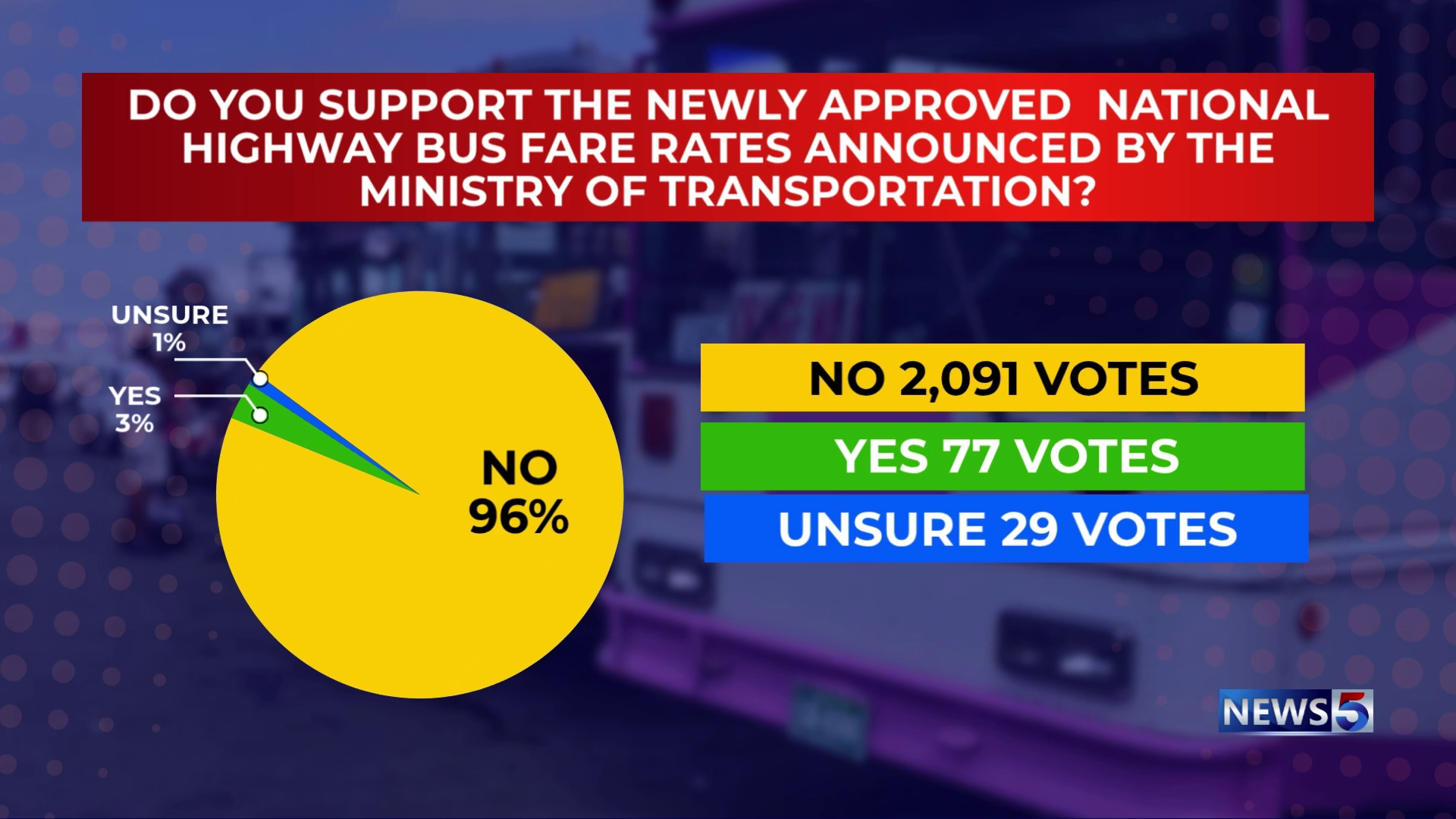
News 5 Facebook Poll Shows Overwhelming Rejection of New Bus Fares
Scheduled to go into effect this coming Monday, a government-approved bus fare increase in Belize has sparked widespread public anger, with a recent informal social media poll showing nearly unanimous opposition from daily commuters who rely on public transit.
The new pricing structure, approved by Belize’s Cabinet and the Ministry of Transport, grants the Belize Bus Association (BBA) permission to raise rates to 18 cents per mile for regular routes and 20 cents per mile for express services. While the per-mile increase appears modest at first glance, the cumulative cost adds up sharply for passengers making long-distance trips on a daily basis. The southern long-distance route between Punta Gorda and Belize City — a 160-mile one-way trip — will see regular one-way fares capped at $39, jumping to $78 for a round trip. Express service on the same route will cost commuters $87 round trip, a notable jump from previous pricing. For the 89-mile Corozal to Belize City run, regular service will cost $15.25 one-way ($30.50 round trip), while express trips will run $18.50 one-way ($37 round trip), with similar increases rolled out across all regional routes.
News Five, a Belizean media outlet, conducted an informal non-scientific public poll on its Facebook page to gauge public sentiment on the new fares. The poll drew more than 2,000 responses, with 96% of participants indicating outright opposition to the price hike. Online criticism quickly went viral, with many commuters highlighting that most people rely on public buses precisely because they cannot afford private vehicle ownership and fuel costs. Many respondents also called out the poor quality of the current bus fleet, noting that decades-old, poorly maintained vehicles offer an uncomfortable ride that does not justify higher pricing.
On-the-ground interviews with commuters at the Belize City Bus Terminal echoed most of these online complaints. While a small number of short-distance travelers said the small 50-cent increase would be manageable, most daily long-distance commuters expressed frustration. “Not fully prepared but I will have to be whether I like it or not,” one regular commuter from Hattieville who travels to Belmopan for work told reporters, adding that most riders would accept small increases only if the government followed through on long-promised upgrades to bus infrastructure. A retired commuter echoed this concern, noting that many aging buses offer such a poor quality ride that passengers arrive at their destinations sore, and no upgrades have been delivered to match higher costs.
Belize’s Transport Minister Dr. Louis Zabaneh acknowledged that public criticism of the new fares is entirely legitimate. He explained that Cabinet approved the increase after BBA operators, particularly those operating northern routes, threatened to launch a full strike that would have disrupted transit across the country, a outcome government officials deemed far more damaging to commuters than the moderate fare hike. “Nobody wants to pay more for any of their needs including for transportation, but Cabinet had to make a decision to avoid a total shutdown of service,” Zabaneh noted.
Not all bus providers will be raising fares, however. The state-owned National Bus Company has confirmed that it will keep its current pricing in place for the foreseeable future, leaving cost-sensitive commuters with limited alternative options for cheaper travel.
-
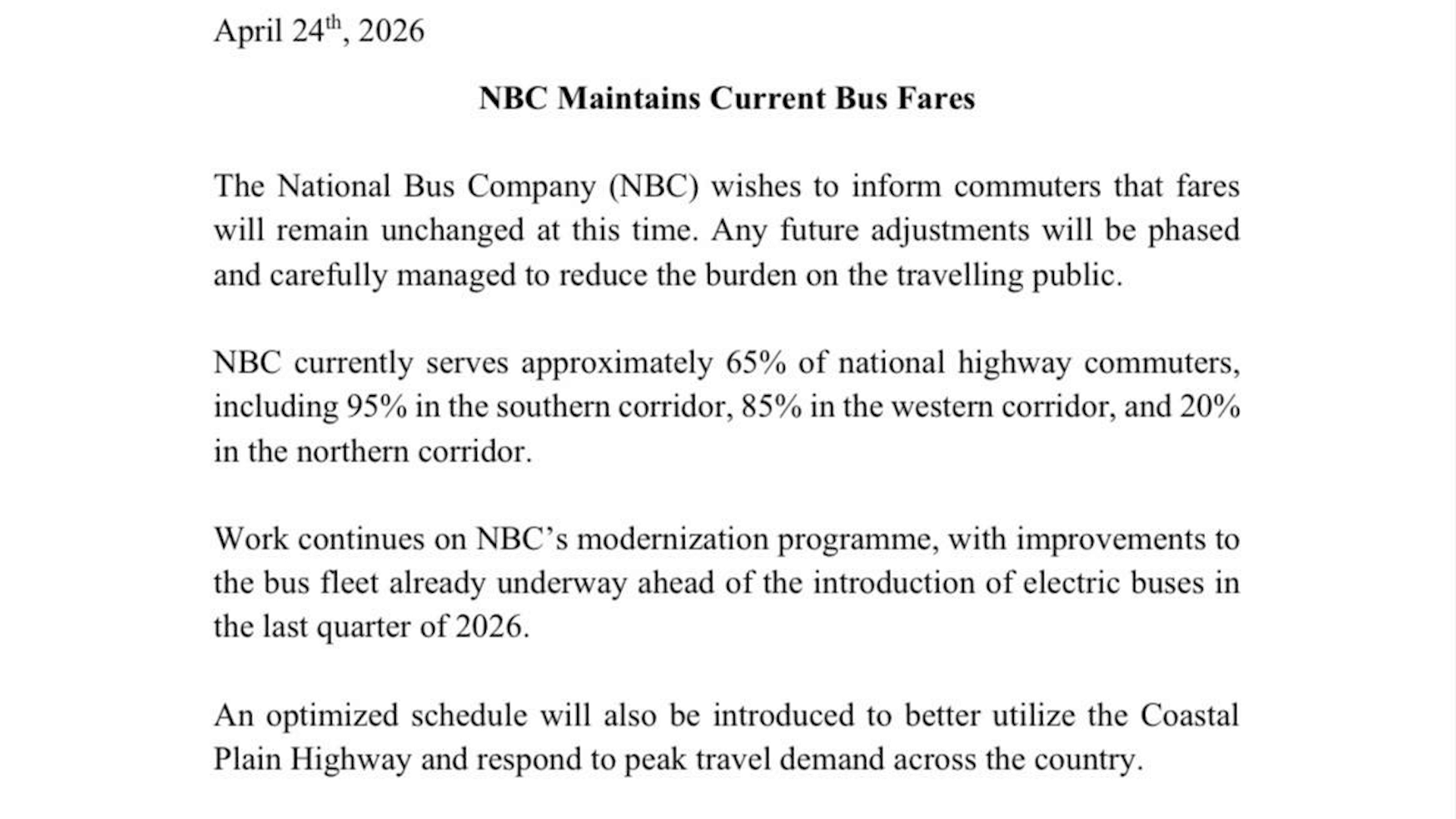
National Bus Company Keeps Rates Unchanged
In a much-anticipated announcement that has brought relief to tens of thousands of daily commuters across Belize, the National Bus Company (NBC) confirmed on April 24, 2026 that it will hold current ticket rates steady for the immediate future, even as other regional operators have moved forward with approved fare increases. This decision comes at a time when widespread speculation about rising bus fares has left daily commuters, particularly those in the country’s busy southern corridor, bracing for added monthly travel costs.
As the dominant provider of intercity highway bus service across Belize, NBC carries approximately 65% of all national highway commuters, serving between 8,000 and 12,000 passengers daily depending on the day of the week. Its market share is especially pronounced in the critical southern route, which runs from Punta Gorda through Independence, Dangriga, and Belmopan before reaching Belize City, with upcoming routing adjustments along the coastal road expected to cut travel time for passengers. In this corridor, NBC controls 95% of the commuter market, meaning nearly all travelers along the high-traffic route will avoid the recently approved fare hikes that had been set to take effect. The company also holds an 85% market share on the western corridor connecting Belize City to Belmopan, San Ignacio, and the western border at Benque Viejo del Carmen. Its smallest footprint is in the northern corridor leading to Orange Walk, Corozal, and the northern border, where it only serves 20% of commuters, with most northern service provided by private operators affiliated with the Belize Bus Association (BBA).
Belize’s Transport Minister Dr. Louis Zabaneh confirmed that the formal NBC press release, published this afternoon, explicitly notes that the rate freeze is not a permanent policy. The company has retained the right to revisit pricing if global and domestic fuel prices continue their upward trajectory. Dr. Zabaneh praised NBC’s decision, framing the temporary rate hold as a responsible step to prioritize the needs of commuters who rely on public transit for daily travel to work, school, and essential services.
When asked whether commuters could expect rate reductions if fuel prices decline in the future, Dr. Zabaneh acknowledged that standard economic dynamics make downward price adjustments far less common than increases, a phenomenon widely referred to as sticky prices. He added that long-term fare stability for NBC will not come from fluctuating fuel markets, but from the company’s planned transition to a brand-new fleet of electric buses. Operating an electric bus costs only 25% of the operating cost of a traditional diesel bus when measuring energy expenses, he explained, meaning the shift to electric technology will create permanent long-term cost savings that can be passed on to commuters. For private operators that have already implemented fare increases to offset rising fuel costs, Dr. Zabaneh noted that operators have little remaining capital to invest in upgrading outdated fleets, but he agreed fully with widespread public expectations that improved service and newer vehicles should accompany any future price increases.
The decision to freeze fares has sparked immediate pushback from the Belize Bus Association, the industry group representing the country’s 14 private bus operators that mostly serve the northern corridor. In a statement released just before this evening’s news broadcast, the BBA pushed back against public narratives surrounding the recent fare hikes, placing blame for the industry-wide price adjustments squarely on NBC and the government agencies that regulate the sector.
The BBA argues that NBC operates under direct control of the Ministry of Transport, creating an inherent conflict of interest that skews both fare policy decisions and public messaging around the recent increases. The association claims that NBC has long charged the highest fares in the Belizean bus industry, while private BBA operators maintained lower rates for years, absorbing rising fuel and maintenance costs out of pocket to avoid passing burdens onto commuters. According to the BBA, the recent fare adjustment for its members was not an arbitrary price hike, but a forced alignment with NBC’s existing higher price structure after the government rejected repeated requests for fuel tax relief and operating subsidies.
The association further alleges that government officials are attempting to deflect public anger over higher fares by positioning NBC as a responsible, commuter-friendly alternative, while allowing private operators to bear the brunt of public criticism—even as commuters across the country face higher travel costs overall. The BBA emphasizes that it remains the largest provider of bus service in the northern corridor, and that the Belizean public deserves full transparency about the policy decisions that led to the current fare landscape.