博客

  • Mayor Cawich Defends City Council’s Handling of Investigation

    Mayor Cawich Defends City Council’s Handling of Investigation

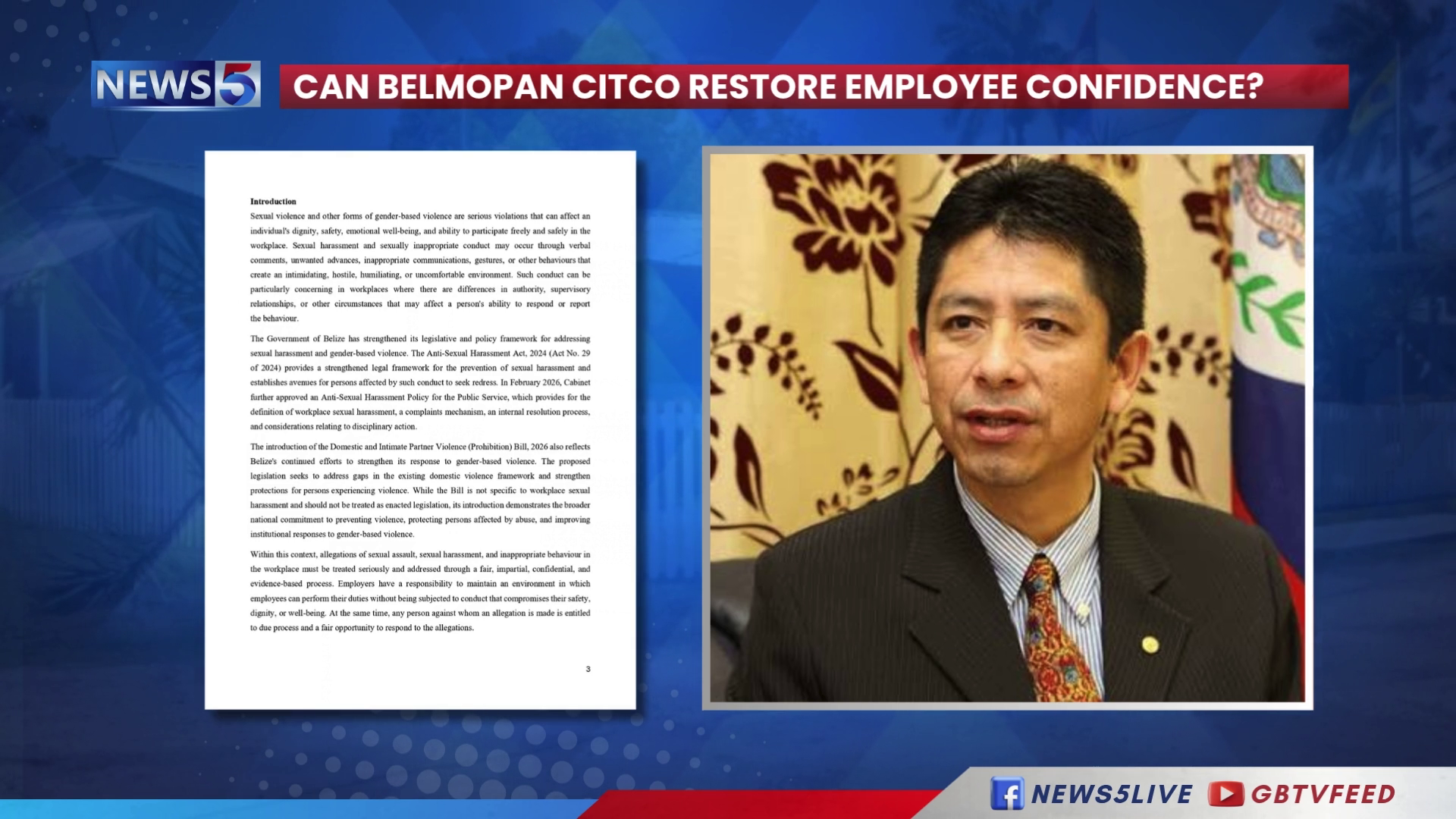
    Nearly three years from now, in October 2026, public debate continues to swirl around the Belmopan City Council’s handling of a closed sexual harassment investigation, even after the probe officially concluded. Belmopan Mayor Pablo Cawich has stepped forward to publicly address lingering questions about the process, pushing back against growing claims that city officials intentionally hid the investigation’s findings from the general public.

    At the center of the case are sexual harassment allegations leveled against Efrain Novelo, a contract employee who served as the council’s local economic development advisor. Novelo has repeatedly denied all claims of misconduct, and the formal investigative committee convened by the city ultimately found no concrete evidence to support the allegations against him. Despite the lack of evidence tying Novelo to wrongdoing, Cawich confirmed this week that the council has parted ways with the employee, a change that has sparked fresh suspicion among observers.

    Cawich was quick to decouple Novelo’s departure from the investigation, explaining that the advisor’s contract had reached its scheduled end, and the council simply no longer required his services. He pushed back against widespread rumors that the separation was a quiet disciplinary action tied to the harassment claims, noting that Novelo’s role was always a time-bound contracted position, and the mutual separation followed the council’s standard contracting protocols. He also emphasized that Novelo never served as a personal advisor to him, correcting a common misrepresentation of the employee’s role that has circulated in public discussion of the case.

    Addressing the most persistent criticism that the council attempted to cover up the investigation’s findings, Cawich argued that the multi-step process of forming a special investigative committee, conducting interviews and analysis, and drafting a final report naturally requires significant time. He pushed back on narratives that frame delays in releasing the findings as proof of an intent to hide information, arguing that critics who make this claim simply do not understand the formal procedures required for an impartial internal investigation.

    The mayor repeatedly stressed that the Belmopan City Council remains fully committed to two core priorities: radical transparency in its internal operations, and maintaining a safe, respectful working environment free from harassment for all city employees. He pointed to the creation of an independent investigative committee to review the claims as proof that the council took the allegations seriously and had no intention of sweeping the issue under the rug, contrary to recent public claims.

    This report is adapted from a verbatim transcript of a televised evening news broadcast, with Kriol language quotes transcribed using a standardized spelling system for accuracy.
  • PSU Raises Nepotism Concerns Over Mai Jr.’s Appointment

    PSU Raises Nepotism Concerns Over Mai Jr.’s Appointment

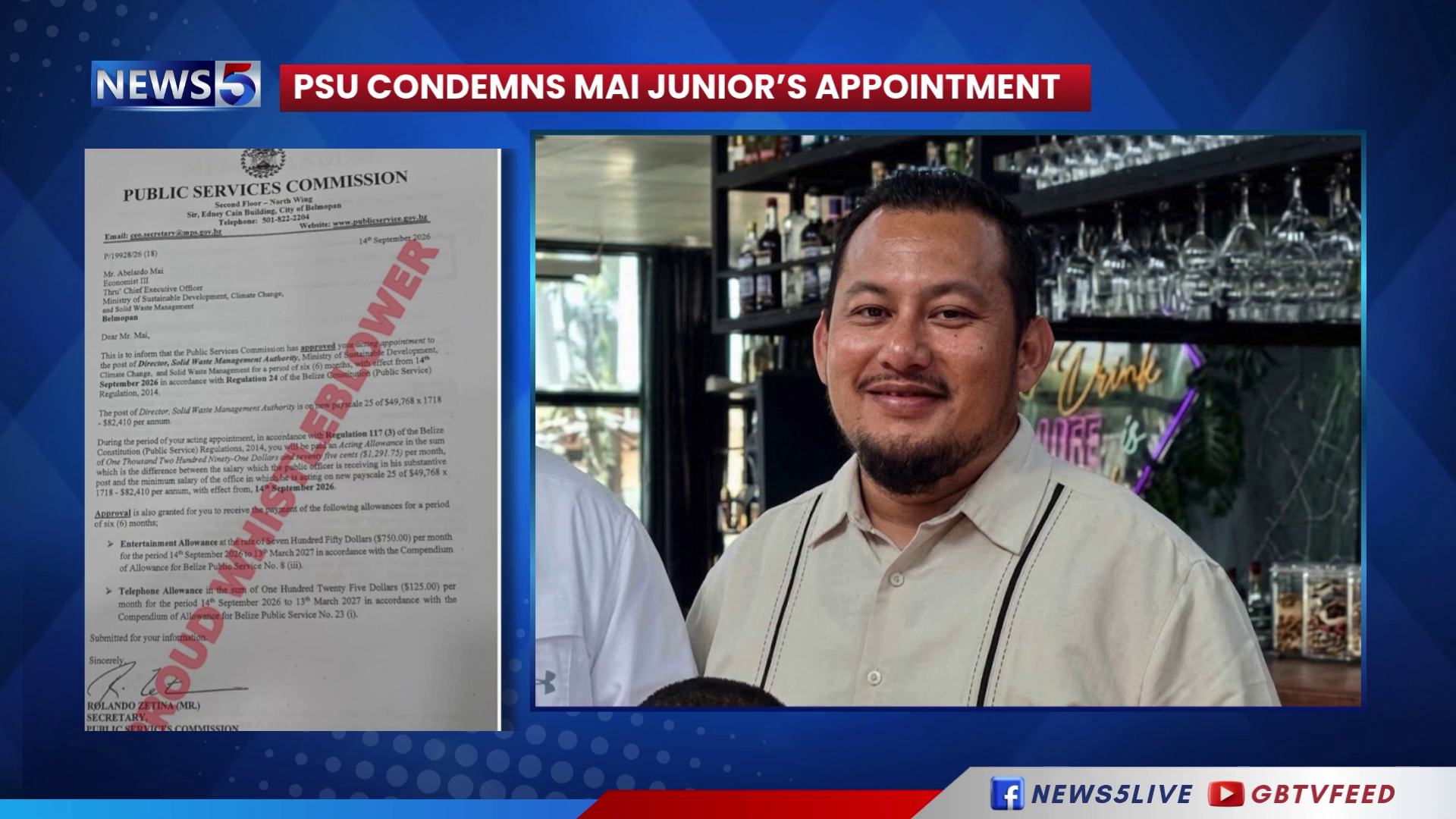
    A controversial appointment to a top leadership post at Belize’s Solid Waste Management Authority has ignited widespread debate over systemic favoritism, broken merit-based promotion principles, and eroding morale across the country’s public service sector. Scheduled for publication on October 1, 2026, the report centers on the appointment of Abelardo Mai Jr., a junior-level economist with no prior ties to the solid waste management ministry and no specialized technical training in the field, to the role of Acting Director.

    The Belize Public Service Union (PSU) has emerged as the leading critic of the hiring decision, pointing to multiple red flags that point to nepotism and systemic disregard for experienced career public servants. According to PSU leadership, no open call for applications was issued for the senior role, and no existing qualified public officers with years of specialized experience in solid waste management were invited to interview for the position. The union has also highlighted Mai Jr.’s familial connection to a former Belizean government minister as a core source of nepotism concerns, arguing the appointment is far from an isolated incident.

    PSU President Dean Flowers emphasized that the repeated pattern of sidelining long-tenured career public servants in favor of politically connected external candidates has done severe damage to workplace morale across the entire public service. In comments recorded for a televised evening newscast, Flowers described the demoralizing impact on public servants who have dedicated decades of service to Belize, waiting for a fair opportunity to advance into leadership roles only to be passed over for unqualified political appointments.

    “When you listen to the voice of people who have served this country for well over twenty years, who have been waiting for an opportunity to be given a fair chance to lead a unit or a department, only to see the son of a politician, handpicked out of nowhere, no experience, definitely not qualified in the field that the vacancy requires, and just be placed there. It breaks their heart and it pains me as the leader,” Flowers stated.

    Flowers was careful to note that the blame for the controversial appointment does not lie with Mai Jr. himself, who was handpicked for the role. Instead, he is calling on the Belizean public to hold two senior government leaders accountable: Rolando Zetina, Chief Executive Officer of the Ministry of Public Service, and Milagro Martos, Chief Executive Officer of the Ministry of Sustainable Development, Climate Change, and Solid Waste Management. Flowers accused the pair of perpetuating a grave injustice against long-serving public servants by prioritizing political patronage over merit, pointing out that Mai Jr. was working as a low-level junior economist (graded Economist 3) before his unexpected appointment to the senior leadership role.

    This report is a transcript of an evening television newscast, with Kriol language statements transcribed using a standardized spelling system for publication.

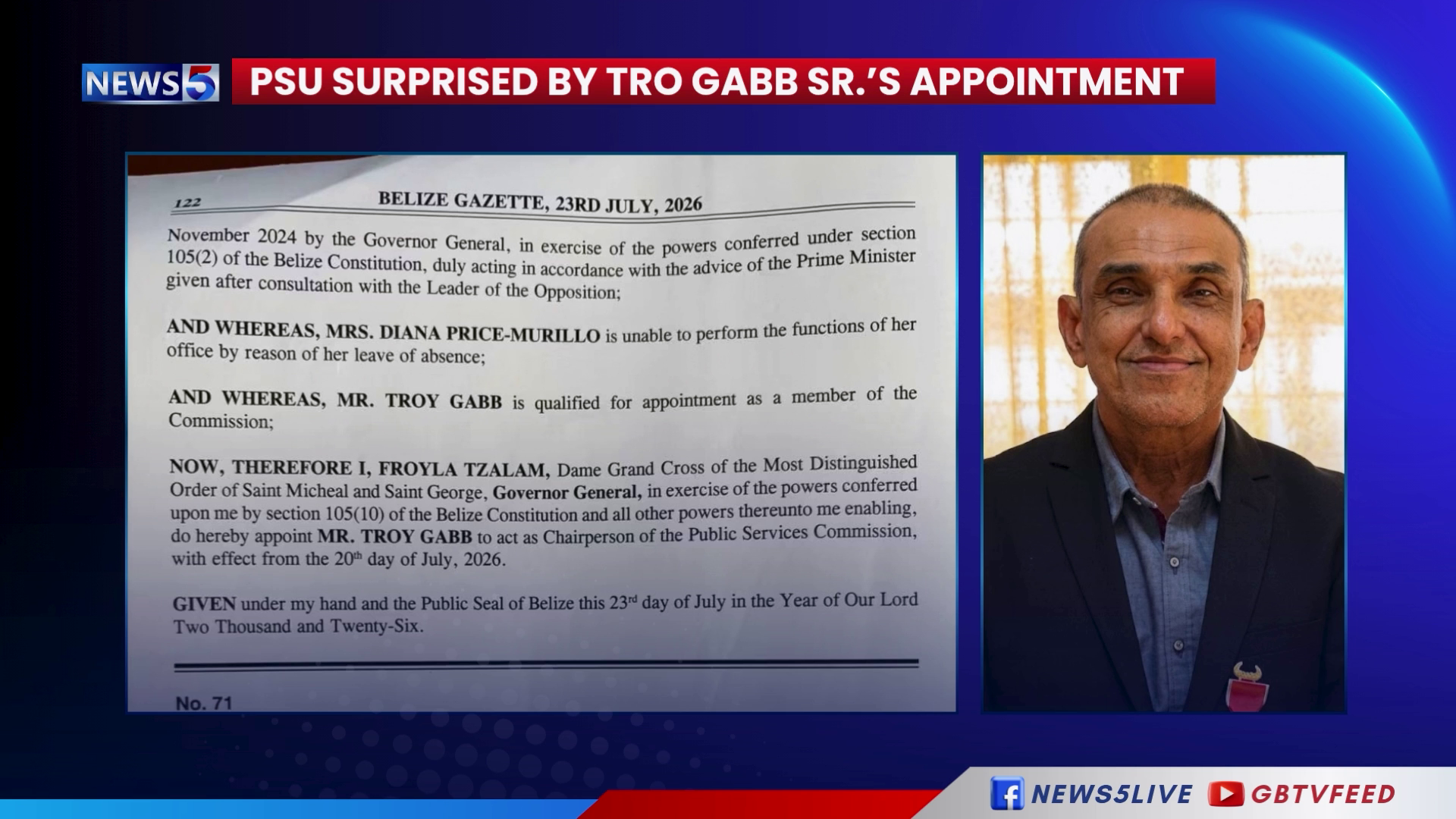
  • PSU Rejects Gabb’s Appointment as Public Services Commission Chair

    PSU Rejects Gabb’s Appointment as Public Services Commission Chair

    A fresh controversy has erupted in Belize’s public sector governance landscape, as the country’s largest public service employee organization has openly rejected the interim appointment of a known labor critic to lead the key oversight body for public service operations.

    The Public Service Union (PSU) has raised formal objections to the temporary placement of Troy Gabb Sr. as interim chair of the Belize Public Services Commission, the independent authority tasked with managing public sector hiring, promotions, disciplinary actions and workforce governance. The appointment was officially announced in a July 23 edition of the Belize Gazette, which confirmed that sitting chair Diana Price-Murillo is currently on approved leave and unable to fulfill her official duties, prompting Gabb, an existing commission member, to step into the role temporarily until Price-Murillo resumes her responsibilities.

    This political flashpoint comes as Belize already faces public scrutiny over another contested public appointment related to Abelardo Mai, adding another layer of tension to the country’s ongoing debates over the independence of public governance bodies. For PSU leadership, the core grievance centers on two major issues: a complete lack of prior consultation with the union that represents thousands of public sector workers, and deep concerns over Gabb’s ability to act as an impartial arbiter on matters affecting public employees.

    PSU President Dean Flowers told reporters that the union was completely caught off guard by the announcement of Gabb’s appointment. He emphasized that for years, the union has maintained an open, collaborative communication channel with government officials overseeing the public service, a norm that was completely ignored in this decision. When current cabinet minister Henry Charles Usher took office in November 2020, Flowers noted, Usher personally committed to maintaining transparent, amicable dialogue with the union on all matters affecting the public service – a commitment that was not honored in this process.

    Flowers also acknowledged that sitting chair Price-Murillo has worked consistently to uphold impartiality in the commission’s work, but argued that even a fully engaged, neutral chair would be outvoted by a bloc of politically aligned members already on the commission. Gabb, he classified as one of these partisan members, whose appointment further shifts the balance of the body away from independent oversight.

    The most damaging barrier to Gabb’s credibility, Flowers argued, comes from his long public record of vocal criticism against trade unions and public sector workers. Gabb regularly hosts opinion segments on the local Love FM radio and television network three days a week, where he has repeatedly taken strong stances against the union movement and PSU in particular. Given this public track record, Flowers said, public sector workers have no confidence that Gabb can fairly weigh disputes or governance matters affecting union members that come before the commission.

    The dispute highlights growing tensions between the Belizean government and public service employee groups over the political impartiality of key governance institutions, with the PSU signaling it will continue to challenge the appointment through formal channels.

  • Belizean Women Share Powerful Testimonies on Abortion

    Belizean Women Share Powerful Testimonies on Abortion

    As the national debate over abortion rights gains new traction in Belize, the conversation is shifting beyond abstract legal and policy arguments to center on the intimate, life-altering personal experiences of women from all walks of life. With sharply divided perspectives rooted in individual hardship and survival, local women are stepping forward to share their stories, humanizing one of the country’s most contentious social issues and pushing for public dialogue that honors lived reality.

    One of the most compelling voices in the current conversation is Shawla Leslie, a pro-life advocate and mother of three whose connection to the abortion debate begins before she was even born. Leslie explains that her birth mother attempted to abort her at a late stage of pregnancy, but she survived and was ultimately raised by an adoptive family. That brush with death has shaped every part of her stance on abortion. “I certainly am pro-life simply because I wanted to be alive, and I would have wanted that I am able to make that choice and not anybody else that would not be living in my life,” Leslie shared in an interview.

    Her experiences have led her to critique the current framing of the national debate, arguing that too little attention is paid to the inherent value of unborn life and the personal responsibility potential parents should take to prevent unplanned pregnancies. “What I don’t see is the value of life. I don’t see the value for the life of the child. I don’t see the responsibility that a couple, both male and female, would take in order to not become pregnant. I am not seeing that. I am only seeing the conversation as it relates to after she has become pregnant,” Leslie said.

    Remarkably, Leslie has also faced the kind of high-stakes pregnancy decision that pro-choice advocates often cite, yet her experience only reinforced her pro-life convictions. During her first pregnancy, Leslie developed hydronephrosis, a condition where her kidney was swollen and growing alongside the fetus. Her doctor gave her an impossible choice: keep the kidney or continue the pregnancy, as the doctor said both could not survive. Leslie chose to continue the pregnancy, trusting her body and her faith. Today, both she and her daughter are alive and healthy. Her story has become a centerpiece of her advocacy, urging the nation to strengthen family support systems that help women carry unplanned pregnancies to term while encouraging more intentional decision-making around sexual activity and parenthood.

    On the other side of the debate, other Belizean women draw from their own experiences of pregnancy, loss and risk to argue that reproductive decision-making must remain in the hands of the individual woman. Cherisse Halsall, a journalist and mother, says her own journeys through pregnancy, miscarriage and childbirth convinced her that only the person facing the physical and emotional risks of pregnancy can make the right choice for their life. Halsall notes that pregnancies can turn dangerous or unviable without warning, leaving lasting trauma that outsiders cannot fully understand.

    Joan Burke, executive director of the Belize Family Life Association (BFLA), adds that broader systemic change is needed to address the root factors shaping abortion outcomes in Belize. Burke points out that Belize holds the second highest adolescent pregnancy rate in the entire Caribbean region, a statistic she says is a stain on the nation in the modern era. She is calling on policymakers to revisit national policies around comprehensive sexuality education, arguing that equipping all young people — both young men and women — with accurate, evidence-based information about sexual health is the most effective way to reduce unplanned pregnancies and support informed decision-making.

    “Females don’t have babies on their own,” Burke explained. “We equip both males and females with the right information to make informed decisions for their sexual health and wellness. That is one vehicle where we equip individuals” to build healthier lives. Burke argues that greater investment in reproductive healthcare and support systems for women and girls is the key to building stronger, healthier communities across the country, regardless of how the debate over abortion legal status unfolds.

    As the national conversation continues to evolve, these overlapping personal testimonies have put a human face on a debate that often reduces people to ideological talking points. From pro-life advocates who survived attempted abortions to pro-choice supporters who have navigated life-threatening pregnancies, the shared thread across all these stories is the demand for a more compassionate, honest public conversation that centers the needs and experiences of Belizean women. The report was compiled by Britney Gordon for News Five.

  • Market Vendor and City Council Trade Blame Over Rotting Meat

    Market Vendor and City Council Trade Blame Over Rotting Meat

    In a high-stakes public dispute unfolding at Belize’s iconic Michael Finnegan Market, a 20-plus-year veteran vendor and the Belize City Council are trading sharp accusations over who is responsible for thousands of dollars worth of rotting meat that has been declared a pressing public health hazard. The conflict, which dates back more than a month, has now escalated into formal legal action, putting a spotlight on the treatment of small business owners at the hands of local municipal authorities.

    Aaron Castillo, the vendor at the center of the dispute, tells a damning story of overreach by city officials. According to Castillo and his attorney Orson “OJ” Elrington, the Belize City Council illegally locked Castillo out of his market booth more than 30 days ago, cutting off all access to his inventory and leaving thousands of dollars worth of frozen meat to spoil. Elrington lambasted the council’s actions as an egregious, unlawful violation of a small business owner’s civil rights, dismissing the council’s official narrative as nonsensical arrogance.

    In a scathing rebuke of the municipal government, Elrington argued that the council created this crisis entirely through its own unauthorized actions. Even after the legal team formally demanded that the city restore access to Castillo’s booth, Elrington said officials ignored repeated requests, only issuing a vague promise to respond at an unspecified later date. “This is the city council trampling on the small man,” Elrington stated. He added that the total losses from the spoiled inventory top at least $75,000, a devastating hit for a small independent vendor. “We wish we had smell-o-vision so that leaders could understand the stench and the gravity of the losses my client has suffered,” Elrington said, characterizing the council as acting as if it is above the law, unaccountable to courts and due process.

    The Belize City Council has pushed back hard against these claims, shifting all blame to Castillo for his repeated failure to meet financial obligations. Jermaine Hyde, the council’s Courts Manager, defended the municipality’s actions, arguing that officials repeatedly extended flexibility to Castillo to resolve outstanding payments, even reaching a formal consent agreement that allowed him to make installment payments on overdue fees. According to Hyde, Castillo repeatedly defaulted on those commitments, creating the chain of events that led to the spoiled meat.

    Hyde countered the claim that Castillo was wrongfully evicted, explaining that the council only issued a stop order barring him from operating after he failed to pay for his required trade license. He clarified that it was ultimately Belize Electricity Limited (BEL) that disconnected power to the booth after Castillo failed to pay his long-overdue utility bill, not the council. With no power to run commercial freezers, the perishable meat left on site began to rot, creating a dangerous public health nuisance. Hyde added that the council properly notified Castillo of the hazard, placing full responsibility for the outcome on the vendor.

    When pressed on whether the dispute would damage the council’s reputation as a supporter of the small-scale entrepreneurship that Michael Finnegan Market represents, Hyde rejected the criticism outright. He argued that the council went above and beyond to accommodate Castillo by agreeing to a payment plan, and the vendor’s own choice to default on his obligations led to the current crisis.

    Now, after months of back-and-forth, Castillo and his legal team have initiated formal legal proceedings against the Belize City Council, seeking financial compensation for the six-figure losses he sustained from the spoiled inventory. The case is set to test whether the court will side with the small business owner’s claims of unlawful overreach, or uphold the council’s position that the crisis stemmed from the vendor’s own unmet financial commitments.

  • Could Belize Have Won Independence Without Diplomacy?

    Could Belize Have Won Independence Without Diplomacy?

    As the small Central American nation of Belize marks 45 years of full sovereignty in 2026, a groundbreaking new book is shining a long-overdue spotlight on the critical role international diplomacy played in securing the country’s hard-won independence. Titled *Enduring Diplomacy: Belize 1971–2026*, the recently published work from the Belize Policy Research Institute (BELPRI) traces the untold story of how a small cohort of determined diplomats, policymakers, and public servants carried Belize’s fight for self-determination beyond its borders to win global backing for nationhood.

    In an interview featured alongside the book’s launch, co-author Dr. Assad Shoman emphasized that the book’s core message extends far beyond historical retelling. For Belize to thrive in the modern global landscape, Shoman argued, the country needs a cohesive foreign policy doctrine rooted in genuine non-alignment – not just rhetorical commitment. He outlined that contemporary priorities for Belizean foreign policy must frame public health, climate resilience, and labor rights as core national security concerns, while clearly establishing boundaries that no external pressure can force Belize to cross.

    Long before Belize officially raised its independence flag in 1981, its diplomatic corps was already hard at work building a global coalition in support of self-rule. Fellow co-author Dr. Alexis Rosado recalled the humble, chaotic origins of Belize’s early foreign service: when the first post-independence prime minister tasked diplomat Robert Leslie with establishing a dedicated foreign affairs office, the only available space in the National Assembly building was an unused kitchen. Rosado also reminded readers that Belize’s independence was achieved against steep odds: facing persistent territorial opposition from a powerful neighboring state and pressure from the departing colonial power to cede land as the price of sovereignty.

    Unlike many historical accounts that frame Belize’s independence as a purely domestic political struggle, *Enduring Diplomacy* centers the quiet, uncelebrated work of diplomats who lobbied foreign capitals and international bodies to back Belize’s cause. The book’s authors aim to educate a new generation of Belizeans on how diplomacy shapes national survival: while military personnel defend the country’s territory at home and legislators craft domestic policy, diplomats are the frontline defenders of Belize’s sovereignty, building global alliances and advancing national interests on the world stage. In many respects, the history of Belizean diplomacy is the history of how a young, small nation learned to navigate an increasingly fragmented and unpredictable global order.

    BELPRI Executive Director Dr. Dylan Vernon explained that the book fills a critical gap in Belizean historical record-keeping. Long before independence, when Guatemala’s territorial claim hung over every step of Belize’s path to nationhood, Belize’s first act of foreign policy was to internationalize the issue, winning broad support from the global community for its independence. This was achieved with a tiny team of diplomats who lobbied governments and international organizations across the world, eventually securing the backing that made sovereignty possible. The book does not stop at 1981, either: it tracks how Belize’s foreign policy has evolved from its early independence days through to 2026.

    The legacy of these early diplomatic efforts remains deeply felt in modern Belize. Today, Belize’s foreign service engages on a sprawling range of global issues, from climate change adaptation and sustainable development to regional integration, international trade, and national security. Belize Ministry of Foreign Affairs CEO Oscar Arnold noted that understanding the origins of Belizean diplomacy offers essential lessons for current and future generations of foreign policy leaders. Arnold pointed out that today’s global context presents new challenges: multilateral cooperation and the rules-based international order that small, vulnerable economies like Belize depend on are increasingly under threat. This means modern Belizean diplomats must be more agile, strategic, and creative than ever before to advance national interests in this shifting landscape.

    At its core, *Enduring Diplomacy* is far more than a retrospective historical work. It tells the story of how Belize’s journey to independence extended far beyond its own borders, driven by the tireless work of a small group of advocates who carried the country’s message to every corner of the globe. Their efforts secured Belize’s permanent place among the community of nations, a legacy that continues to shape the country’s foreign policy and national identity 45 years after independence. This report was compiled by Paul Lopez for News Five.

  • Senate Unites Behind Domestic Violence Bill

    Senate Unites Behind Domestic Violence Bill

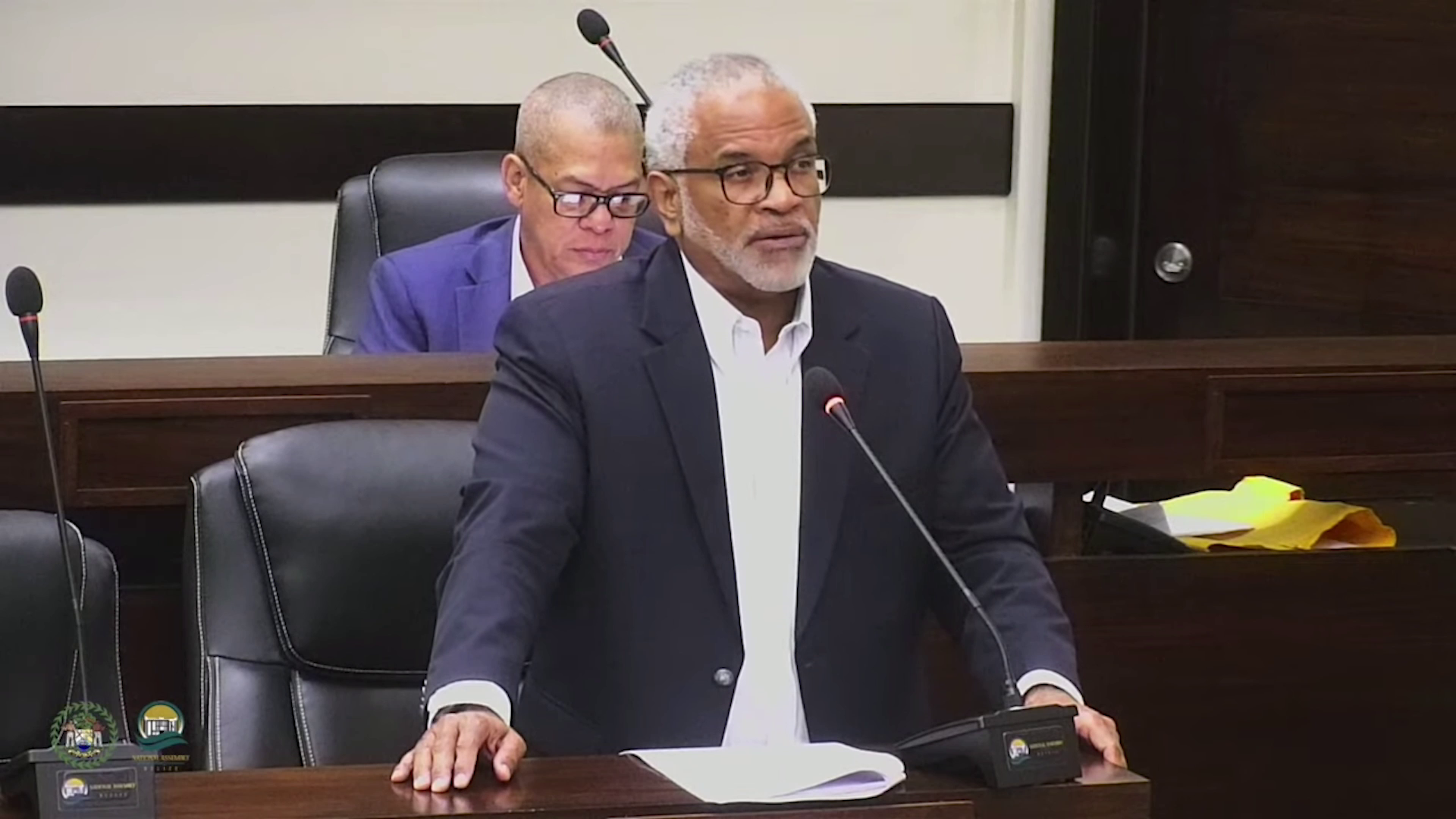
    In a rare display of cross-aisle solidarity, Belize’s Senate has unanimously thrown its support behind a landmark overhaul of the nation’s domestic violence protections, marking a critical step forward for survivor justice nearly a year after the government first tabled the legislative reform package.

    The country’s ruling administration first introduced the sweeping changes to Belize’s outdated domestic violence framework back in November 2025. On October 1, 2026, senators brought the final draft of the Domestic and Intimate Partner Violence Bill to the floor for debate, where every voting member aligned to back the proposal, which centers survivor needs and expands protection to vulnerable people in relationship types long excluded from existing law.

    Unlike current legislation that implicitly frames domestic abuse as a harm limited exclusively to married or common-law couples, the new bill explicitly covers intimate partner violence in all non-marriage and non-common-law relationships. It also recognizes the full spectrum of abusive behavior, including physical, mental, psychological and financial violence that survivors often endure outside of formalized domestic arrangements.

    Eamon Courtenay, the senate’s lead government representative, emphasized that the legislation addresses a longstanding gap in Belize’s legal code. “Domestic violence is a serious problem in our society,” Courtenay told fellow lawmakers. “One of the primary purposes of the bill is to account for the fact that the current legislation presumes abuse only occurs within formal marriage or cohabitation. This reform recognizes that people in other types of relationships can also suffer severe, violent abuse across multiple forms.”

    Patrick Faber, the senate’s opposition leader, echoed that support, drawing on heartbreaking anecdotes shared by constituents across the country to illustrate why the reform is so urgently needed. “Too many Belizean women, some men, and far too many children live with violence behind their own front doors,” Faber said. “Too many of our constituents have told us the same story: police did not come, or they arrived and left quickly. The court was closed, the protective order was never served, and the perpetrator was back in the home by the weekend. Some of those stories ended in funerals.”

    Even Louis Wade, the senate’s appointed church representative, who has historically centered traditional marriage as a social gold standard, threw his weight behind the bill, prioritizing survivor safety over ideological disagreement about non-traditional relationships. “There are relationships we approve of, and there are relationships we do not approve of. We also believe that certain relationships, specifically marriage, are the gold standard,” Wade noted. “But this bill focuses on the victim, because one thing we can all agree on is that nobody deserves to be beaten, to be victimized. Nobody should feel that they are a prisoner, that they are owned, or that the system is not hearing them or responding effectively to them.”

    The unanimous vote makes clear that the reform will move forward toward enactment, bringing long-overdue protection to thousands of Belizeans who have been failed by the country’s existing legal framework. This report is adapted from a transcribed broadcast of an evening TV news program from Belize.

  • Seventy-Three Million Dollars to Rescue BEL

    Seventy-Three Million Dollars to Rescue BEL

    As rolling blackouts sweep across the country and state-owned electricity provider BEL teeters on the edge of severe financial collapse, the Belizean government has formally submitted a request to the Senate for approval of a $73.3 million capital injection to keep the critical utility operational. The administration says the emergency funding is designed to cover BEL’s outstanding obligations to creditors and prevent a total disruption of the national power supply, which forms the backbone of every sector of the country’s economy. The plan would see the government take up preference shares in BEL priced at $2 per share, with an guaranteed annual dividend of up to 5% for public stakeholders. If BEL declares dividends exceeding that 5% threshold in any given year, the government — and by extension, taxpayers — will capture a share of that excess upside, according to lead government senator Eamon Courtenay.

    The proposal has already ignited sharp debate among legislative representatives, with opposition senators from the UDP pushing back hard on the terms of the bailout. Opposition senator Patrick Faber emphasized that no lawmaker wants to see BEL fail, noting that every corner of national life — from private businesses and hospitals to schools, hotels, and public water systems — relies on a consistent, reliable power supply. Prolonged rotating outages or a total supply interruption from the Central Electricity Grid would inflict widespread harm on all Belizeans, Faber acknowledged. But he stressed that the current discussion is not about whether BEL needs support, but about addressing the root causes of the crisis rather than just injecting emergency cash to cover immediate shortfalls.

    Faber’s criticism centers on whether the $73 million infusion tackles the underlying structural issues that pushed BEL to the brink of insolvency. He called out longstanding systemic problems: decades of poor strategic long-term planning, overreliance on expensive imported fossil fuels that has driven up generation costs steadily, and gaps in regulatory oversight that allowed the company’s financial position to deteriorate to this point. The opposition also raised questions about safeguards to protect public funds, asking whether the current deal includes meaningful reforms that will prevent the same situation from recurring, which would force lawmakers to approve another taxpayer-funded bailout in as little as three years.

    This report is adapted from a transcribed broadcast of an evening television newscast originally published online in October 2026.

  • Delisha Estrada’s Family Holds Fundraiser for Orphaned Son

    Delisha Estrada’s Family Holds Fundraiser for Orphaned Son

    October 1, 2026

    For the family of Delisha Estrada, an unimaginable grief has become their daily reality, compounded by unneeded public scrutiny that has added to their already heavy burden. The 21-year-old mother lost her life in a recent murder-suicide, leaving behind an infant son who now must grow up without his mother. As her relatives work to process their loss and build a stable future for the orphaned child, they have launched a public fundraiser to secure the care, education, and long-term stability the boy deserves.

    In a phone interview, Delisha’s aunt Juanita Vanegas opened up about the dual pain the family is navigating: the raw heartbreak of losing a loved one, and unfair public attention centered on the family’s decision not to retrieve any belongings, including bedding, from the home where the tragedy occurred. This unnecessary scrutiny has kept Delisha’s name in the public spotlight in ways that prevent the family from healing and honoring her memory peacefully.

    “All we ask as a family is that we are allowed to grieve,” Vanegas said. “We still can’t get over everything at once, you know? My sister, Delisha’s mother, is trying to get her grandson settled, transfer him to a closer school, and seek help for the future, while a woman has been all over the media refusing to let my niece rest in peace.”

    To support the young boy, the family has organized a fundraising event and public awareness gathering focused on domestic violence, scheduled for October 23 at 7 p.m. at the Cayo Welcome Center. The family is accepting monetary donations of any size, as well as new clothing and toys for the child. “Every dollar counts,” Vanegas emphasized. “It doesn’t have to be money — we don’t want anyone to say we are trying to gain anything from this tragedy. We just want what is best for the baby.”

    This report is a transcribed excerpt from an evening television newscast, with Kriol language dialogue rendered in standard spelling for accessibility.

    Viewers can access the full broadcast recording via the original publication’s linked content.

  • Churches Vow to Fight Against Abortion Laws

    Churches Vow to Fight Against Abortion Laws

    A fierce public debate over updating Belize’s restrictive abortion laws has erupted nationwide this week, reignited after a leading reproductive health organization launched a renewed push for decriminalization, drawing a swift and hardline pushback from the country’s major religious institutions.

    Leading the opposition is Church-appointed Senator Luis Wade, who has publicly committed that faith communities will block any legislative efforts to liberalize the country’s existing abortion framework. Wade argues that the current legal statutes already strike an appropriate balance, and that national attention would be better directed toward expanding community-based support systems for vulnerable families and young mothers facing unplanned pregnancies.

    In his remarks, Wade framed decriminalization as equivalent to sanctioning the death of unborn Belizean children, pointing to long-running national demographic data that shows Belize’s fertility rate has declined steadily over the past decade. Drawing on core religious doctrine, he added that every unborn child is a divine gift, and a mother has no moral or social right to end a pregnancy.

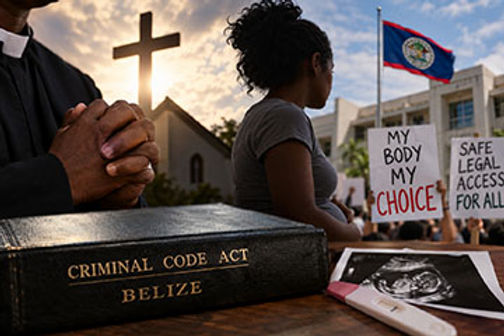
    To understand the stakes of the debate, it is critical to contextualize Belize’s current abortion laws, embedded in the national Criminal Code Act. Under existing rules, abortion is criminalized in most cases: any person who intentionally carries out an unlawful abortion or miscarriage faces up to 14 years of imprisonment. A woman convicted of intentionally inducing her own miscarriage can be sentenced to life in prison, while anyone who supplies tools or substances for an abortion faces misdemeanor charges.

    The law only permits pregnancy termination by a licensed medical professional in narrow, specific circumstances: when continuing the pregnancy threatens the pregnant person’s life, would cause permanent harm to their physical or mental health, or when a severe fetal abnormality has been confirmed that would leave a child seriously handicapped after birth.

    The current debate was sparked earlier this week after Joan Burke, Executive Director of the Belize Family Life Association, laid out her organization’s case for reform in a public interview. Burke argued that outdated, restrictive laws force women with unwanted pregnancies to seek out unregulated, dangerous illegal procedures, making reform a critical public health priority rather than just a social issue. She is now actively seeking backing from Belize’s Attorney General’s Ministry and Ministry of Health to advance legislative changes.

    Burke emphasized, “We need to ensure that there are proper data collection and a healthcare delivery system that accommodates this service for women within the context of their rights, and then also to make sure that we remove these restrictive laws.”

    She also pointed to regional public health data to back up her case: Belize currently holds the third-highest adolescent pregnancy rate in the entire Caribbean and Central American region. Meanwhile, neighboring countries that have already liberalized their abortion laws, including Barbados and Guyana, have recorded significantly lower overall unsafe abortion rates.

    Since Burke’s comments, the debate has spread rapidly across Belize’s social media platforms, drawing divergent views from across the political and social spectrum. Pro-reform advocates have argued that all people have a fundamental right to bodily autonomy, with some calling for exceptions even in cases of rape and incest to be explicitly codified in law. Opponents of reform, meanwhile, have framed abortion as an inherently immoral act, arguing that women must take responsibility for their pregnancies.

    Many commentators on both sides of the debate have called for broader systemic changes regardless of the legislative outcome: improved access to affordable contraception, evidence-based comprehensive sex education in schools, stronger protections against sexual violence, expanded social support for women navigating high-risk or unwanted pregnancies, guaranteed access to confidential, qualified reproductive healthcare, and targeted protection for minor pregnant people.

    Recent preliminary data from the Belize Crime Observatory underscores the urgency of the conversation: between January and March 2026 alone, the organization recorded 10 reported cases of unlawful sexual intercourse and nine reported rape cases. While official data on how many of these assaults result in unwanted pregnancies is not yet compiled, one confirmed case has already been documented: a 16-year-old girl who became pregnant after being assaulted by her stepfather.