博客

  • Minister Currie houdt vast aan dialoog ondanks oproep onderwijsbonden

    Minister Currie houdt vast aan dialoog ondanks oproep onderwijsbonden

    On October 1, the first day of the new academic year in the Netherlands, Dutch Minister of Education, Science and Culture Dirk Currie carried out on-site inspections at six schools across the country, where he encountered starkly different attendance patterns that laid bare ongoing tensions between his ministry and education unions over the 2024/2025 school year opening.

    During his visits, Currie observed that attendance conditions varied dramatically from campus to campus: three of the inspected schools saw both teaching staff and students show up for the first day of classes as scheduled, while the other three had all planned teachers in attendance but no students at all. This divide followed a controversial call from a faction of education unions, which urged teachers to report for duty but asked parents to keep their children at home as a protest over lingering sector issues, most notably teacher shortages.

    Currie stated he was caught off guard by this unusual protest strategy, noting that he first received the union’s open letter calling for the action through an informal channel, rather than directly from the unions themselves. Despite his public criticism of the action, the minister stressed that the Ministry of Education, Science and Culture remains fully committed to maintaining open dialogue and negotiations with education sector organizations to resolve outstanding disagreements.

    The most recent round of talks between the ministry and the unions was held on September 29, two days before the new school year started. During that meeting, parties discussed the implementation of a landmark agreement signed back in June, with the terms of that deal set for regular scheduled evaluations. According to Currie, both sides already agreed to schedule follow-up negotiations for the coming week to hash out remaining sticking points.

    One key point of contention that was settled during the September 29 talks was the fixed starting date of the new school year. Currie confirmed that unions had proposed delaying the start of classes to a later date, but the ministry refused to make a last-minute change to the schedule, holding firm to the planned October 1 opening. “We made clear that it is the ministry’s decision to open schools on October 1, because we did not want to introduce disruptions right on the eve of the new academic year,” Currie explained, adding that authority over the official academic calendar rests with the national ministry.

    Addressing the teacher shortages that unions have highlighted as a core concern, Currie pushed back on the narrative of a nationwide crisis, noting that the severity of staffing gaps differs significantly between schools. For campuses where available teachers and administrative leadership are already present, the minister argued that it is critical to run normal school operations at the campus level.

    In line with this position, Currie is directly urging parents to send their children to school as scheduled, while calling on school principals and teaching staff to proactively reach out to parents to share accurate, up-to-date information about local conditions at their respective schools. The minister added that at the three schools where students did attend classes on October 1, principals had already successfully contacted parents well in advance to prepare for the opening. During his visits, Currie also observed that parents at the inspected schools maintained strong trust in local school leadership.

    Currie emphasized that all existing bottlenecks were discussed in detail during the September 29 talks, and that he has listened closely to all arguments put forward by union representatives. He rejected the claim that nationwide teacher shortages justify refusing to welcome students on the first day of the scheduled academic year. While no new talks have been held between the ministry and unions since October 1, Currie expects negotiations to resume next week as planned. For the minister, ongoing open dialogue remains the most effective tool to resolve all outstanding issues related to the launch of the new school year.

  • Delisha Estrada’s Family Condemns Viral Livestream

    Delisha Estrada’s Family Condemns Viral Livestream

    In the quiet town of San Ignacio, Cayo District, a double death investigation has already left one family shattered — and now an unauthorized viral social media livestream has compounded their pain while sparking public health concerns across the community.

    The tragedy unfolded in late September 2026, when 21-year-old mother Delisha Estrada and her partner Michael Williams were found dead inside their shared home. Official autopsy results have since clarified the circumstances of the deaths: Williams passed away from severe pulmonary edema, while Estrada’s death has officially been classified as a homicide, with a post-mortem examination confirming she sustained a fatal blow to the head.

    Weeks after the discovery, a local resident decided to stream live footage of the property on major social media platforms Facebook and TikTok, showing discarded bedding and other personal items left exposed outside the home. During the stream, the resident raised public alarms, claiming the abandoned items pose a serious unaddressed biohazard risk to the surrounding neighborhood.

    For Estrada’s grieving family, the uninvited broadcast and the subsequent viral public discussion have opened new wounds at a time when they are still struggling to process their loss and care for the young son Estrada left behind.

    Juanita Vanegas, Estrada’s aunt and the family’s spokesperson, spoke out publicly this week to condemn the livestream, saying the content creator crossed a fundamental line of respect for the deceased and her loved ones. “They just can’t let my niece rest in peace,” Vanegas said in an interview.

    She added that the family had already spoken to the person behind the broadcast the day before the stream went live, making it clear they did not consent to any filming of the property or personal items. “She never had no right to do a live and show mattress or anything when my sister went and talked to her the day before,” Vanegas said.

    Beyond their grief, the family is now navigating the practical challenges of raising Estrada’s minor son, including a push to enroll him in a school closer to their home to provide a more stable, supportive environment. To cover ongoing living and education costs for the child, the family has launched a public fundraiser, and they are asking for space to grieve rather than unwanted public attention.

    “All we are asking now is just give us as family the time where we need to grieve,” Vanegas said. If the invasive content is not removed and the livestreamer does not respect the family’s request for privacy, Vanegas confirmed the family is prepared to take formal action: “If she cannot do that, then we will have to file a report against her ’cause it was a big thing on Facebook and TikTok yesterday.”

    Local residents have echoed mixed concerns, with many supporting the family’s call for privacy while others continue to question why the potentially hazardous discarded bedding has not been properly removed and disposed of by authorities.

  • “There’s Still a Lot of Work Left to Do”: Belmopan Mayor Seeks Re-election

    “There’s Still a Lot of Work Left to Do”: Belmopan Mayor Seeks Re-election

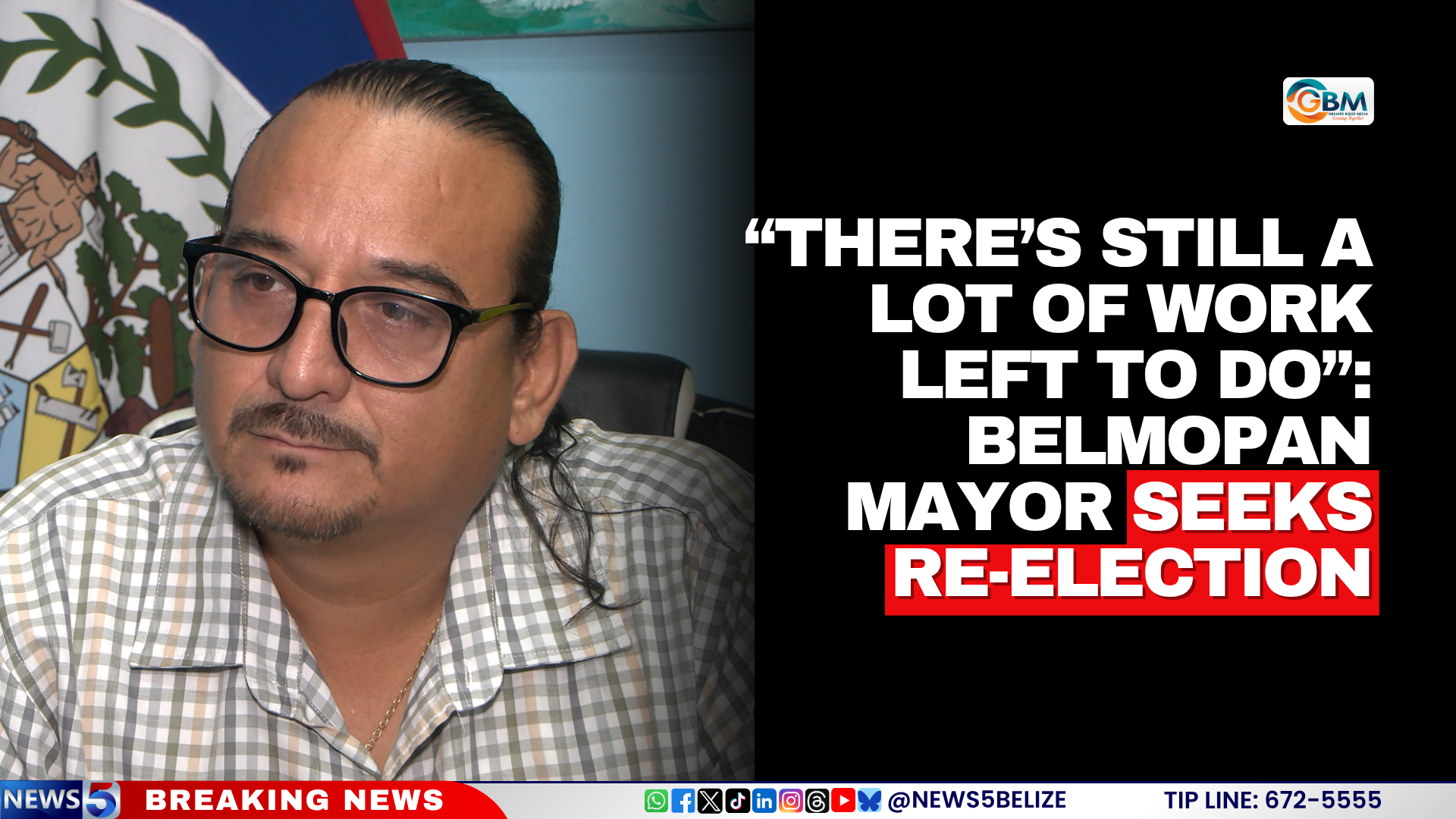
    As the 2026 local political cycle enters its campaigning phase in Belize’s Cayo District, incumbent Belmopan Mayor Pablo Cawich has officially announced his bid for a second consecutive term, leading a full slate of council candidates from his party. With weeks remaining before voters head to the polls, Cawich has centered his campaign around uncompleted priorities that he argues justify another term in office, pinning his top policy goals on widespread road upgrades and long-overdue municipal infrastructure improvements across the city.

    First elected to the mayor’s office in 2024, Cawich acknowledged that his administration has made measurable progress across nearly two and a half years in power, but stressed that the city has not yet reached the development benchmarks his team set when they took office. In comments to reporters, Cawich detailed the difficult starting point his administration inherited: when his party took control of City Hall in 2024, both the municipal budget and the city’s core public assets were left in disarray by the previous governing administration. While he confirmed that significant structural and financial reforms have pulled the municipality into a far more stable position today, he argued that continued leadership from his team is needed to see ongoing projects through to completion.

    To advance his infrastructure and development agenda, Cawich explained that his council has adopted a targeted approach to project prioritization, actively pursuing collaborative partnerships with public and private organizations to secure additional funding and streamline the delivery of public works. This strategy, he argued, has allowed the city to move forward with improvements that would not have been possible through municipal funding alone.

    Cawich’s re-election bid faces a direct challenge from United Democratic Party (UDP) candidate Richie Galvez, who is looking to unseat the incumbent. In response to the challenge, Cawich pushed back against Galvez’s campaign, tying the challenger to the previous UDP administration that Cawich blames for leaving the municipality in what he describes as an exceptionally poor state. He argued that Galvez’s ties to the previous failed leadership make him an unsuitable candidate to lead the city forward.

    One of the most notable points of Cawich’s campaign platform is his commitment to continuing his working relationship with Belmopan Area Representative Oscar Mira, despite the ongoing “Mira Millions” procurement scandal that has surrounded Mira in recent months. Cawich emphasized that Mira holds an elected regional position that is critical to advancing Belmopan’s development goals, making continued cooperation a practical necessity for the city’s growth. While he acknowledged that the scandal surrounding Mira is an unfortunate development, Cawich argued that questions around the scandal are a matter for higher-level authorities to resolve, and that he remains focused on moving the city’s development agenda forward regardless of the ongoing controversy.

    The announcement of Cawich’s re-election bid has also sparked local political speculation about whether his party, the People’s United Party (PUP), is at risk of losing support in the key Belmopan constituency heading into the 2026 elections, as voters weigh the incumbent’s progress against ongoing controversies and the opposition’s challenge.

  • BAA: ‘Tropic Air is not Leaving PG Because of the $10 Passenger Fee’

    BAA: ‘Tropic Air is not Leaving PG Because of the $10 Passenger Fee’

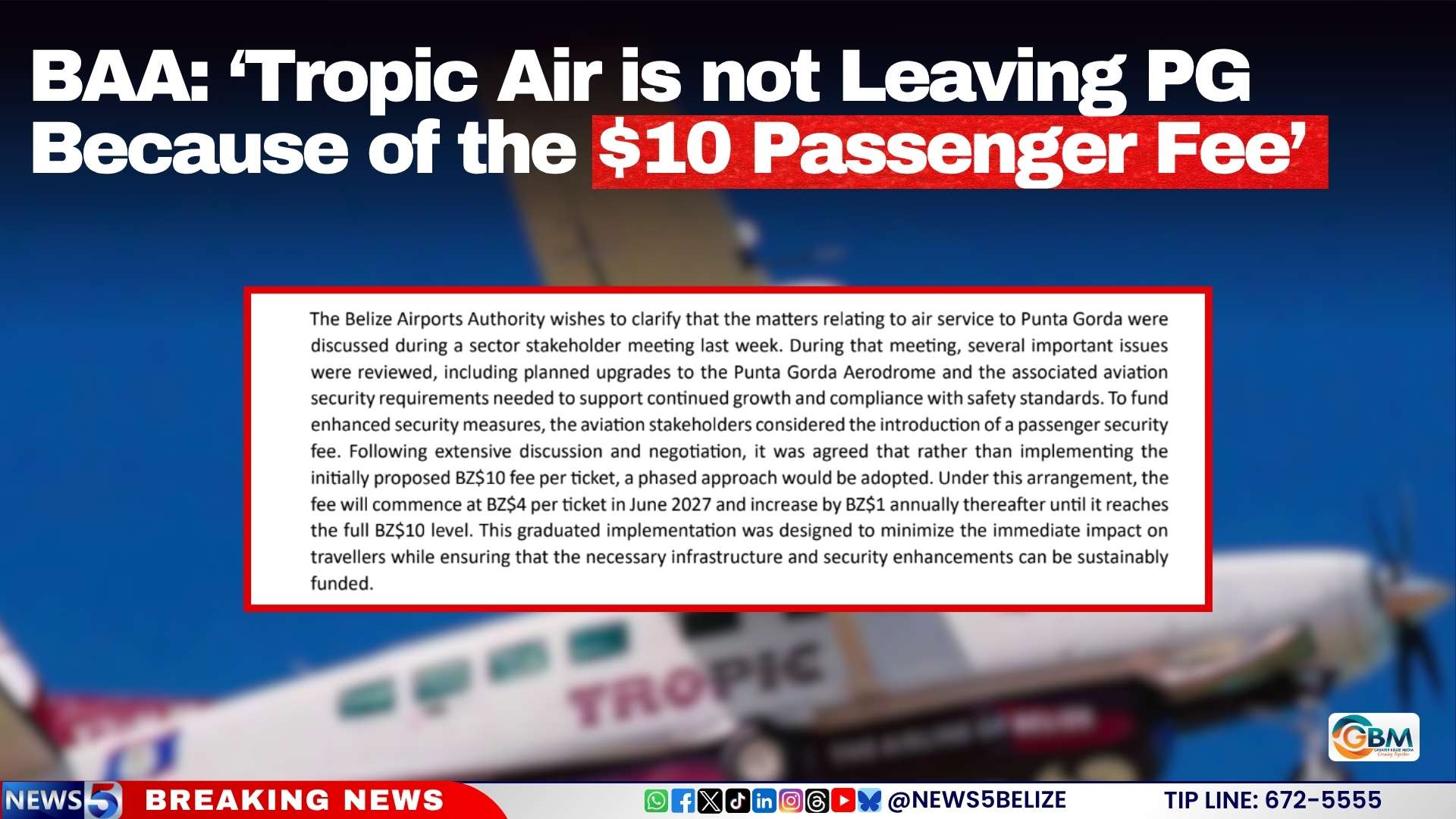
    In a recent official clarification issued ahead of Tropic Air’s scheduled service withdrawal from Punta Gorda, the Belize Airports Authority (BAA) has pushed back against widespread claims that a proposed $10 per-passenger security fee forced the regional airline to end its operations at the Punta Gorda Aerodrome.

    According to the BAA’s statement, the controversial $10 fee has never been implemented, and no final formal decision has even been made to roll out the new security charge. The rumor that the fee was already in place emerged after People’s National Party Leader Wil Maheia publicly claimed the cost was driving down passenger demand for flights to and from Punta Gorda, prompting a fierce public debate over local aviation policy.

    This narrative has now been corroborated by local representative Dr. Osmond Martinez, who confirmed during a community gathering in Punta Gorda on October 1, 2026 that no such fee has been added to passenger tickets to date. BAA officials added that the proposed fee structure was only discussed during a stakeholder meeting last week alongside plans for long-term upgrades to the Punta Gorda Aerodrome.

    During those discussions, stakeholders reached a tentative agreement on a phased rollout rather than an immediate full $10 charge. Under the tentative plan, the fee would start at just BZ$4 per ticket starting in June 2027, with a $1 incremental increase each year until it hits the proposed $10 cap. That timeline places any implementation of the fee years out, ruling it out as a factor in Tropic Air’s upcoming exit.

    Tropic Air is still set to end all scheduled service to Punta Gorda on November 1, 2026. The airline has listed its own reasons for the withdrawal: years of sustained operating losses, persistent logistical operational challenges, ongoing uncertainty in Belize’s domestic aviation sector, and planned infrastructure changes at the aerodrome that disrupt regular flight operations.

    Despite the upcoming service suspension, the BAA noted that active discussions are still ongoing with Tropic Air leadership and other local aviation stakeholders. The goal of these talks, the authority says, is to find a mutually practical solution that could restore regular passenger service to Punta Gorda in the future, addressing the concerns that led Tropic Air to withdraw in the first place.

  • ‘We Are Not Making This Up’: Belize Defends Evidence of Guatemala’s Incursion

    ‘We Are Not Making This Up’: Belize Defends Evidence of Guatemala’s Incursion

    A cross-border diplomatic dispute between Central American neighbors Belize and Guatemala has erupted in early October 2026, after Belize formally accused Guatemala of allowing an unauthorized military-linked aircraft to violate its sovereign airspace — a claim Guatemalan President Bernardo Arévalo has flatly rejected. Oscar Arnold, Chief Executive Officer of Belize’s Ministry of Foreign Affairs, has forcefully defended the credibility of his country’s evidence, pushing back against any implication that the incursion claim is fabricated. Contrary to public speculation that Belize relied only on open-source flight tracking data to level the accusation, Arnold clarified that the government waited for confirmation from its own national radar systems before escalating the issue. “We had to await an official report from our agencies, personnel operating our primary and secondary radar networks, to confirm that an unauthorized aircraft had in fact entered our airspace,” Arnold explained in an official statement. Beyond in-house radar confirmation, Arnold added that Belize has secured independent third-party verification from multiple reputable, credible sources that both the flight and the unapproved border crossing took place. “We are not individuals who are in the business of making this information up,” he emphasized, rejecting any accusations of falsifying the diplomatic incident. In a key detail that raises questions about the flight’s intentions, Arnold confirmed that the aircraft’s transponder — the device that transmits a plane’s identity and location to air traffic control systems — was deliberately turned off during the incursion. He declined to expand on how this disabled transmitter affects official flight logging records, however, noting that the core principle at stake is far more important than technical details. According to Arnold, the central issue for Belize’s government remains the violation of national sovereignty: an unapproved aircraft entered Belize’s legally recognized airspace, and that incursion cannot be dismissed. After confirming the incident, Belize moved swiftly to file a formal diplomatic protest with Guatemala, and also submitted documentation of the incursion to the Organization of American States (OAS), the regional body tasked with mediating inter-state disputes in the Americas. Arnold noted that Guatemala has already publicly stated it would support a neutral OAS investigation into the claim, and Belize is now actively reviewing the prospect of inviting the OAS to oversee an impartial inquiry. “If both countries formally request intervention from the OAS Secretary General, the organization would step in to act as an impartial observer to resolve the dispute,” Arnold explained. The standoff comes as the two nations have a long history of intermittent border disputes, making this latest airspace incident a sensitive test of regional diplomatic mechanisms. As of press time, Guatemala has not issued any further comment beyond Arévalo’s initial flat denial that the flight ever occurred.

  • Kwéyòl Heritage Month launched with call for Saint Lucians to embrace the language

    Kwéyòl Heritage Month launched with call for Saint Lucians to embrace the language

    The 2026 edition of Mwa Ewitaj Kwéyòl, better known as Kwéyòl Heritage Month, officially got underway on Wednesday at Laborie Market in the coastal Saint Lucian community of Laborie, opening a 30-day calendar of events dedicated to celebrating the island nation’s unique Kwéyòl language, cultural traditions, and ancestral heritage.

    Organized by the island’s Folk Research Centre (FRC), this year’s celebration centers on the inclusive slogan “Kwéyòl-la Sé Sa Nou Tout,” which translates to “Kwéyòl Belongs to All of Us.”

    Speaking at the opening ceremony, FRC founder Monsignor Patrick Anthony emphasized that the theme reflects a core truth about the language’s role in national identity. Anthony, who is widely recognized as a driving force behind Kwéyòl cultural preservation efforts, noted that Saint Lucians who have not learned the language are disconnected from a foundational part of their own personal and cultural identities.

    “Kwéyòl is our culture, Kwéyòl is our identity, and every Saint Lucian should come to understand that unless I know my language I am missing out a lot about myself,” Anthony told attendees. “The wisdom in our proverbs, in our riddles, all of that, [remains] closed to us, if we do not understand the language.”

    Anthony framed Kwéyòl as a distinctly Saint Lucian creation forged by generations of the island’s people. “We created it, we moulded it, we formed it…and it is the basis of all that is Saint Lucian,” he added.

    Three communities across the island have been selected to host the month’s flagship activities, as well as the highlight national celebration Jounen Kwéyòl, scheduled for Sunday, October 25. Anthony extended congratulations to the selected host communities while urging organizers to center the language’s cultural importance in all their programming.

    The official host sites are La Caye in Dennery, Vieux Fort South, and La Clery in Castries North. A representative of the Dennery planning committee shared that the community will deliver an authentic, engaging celebration aligned with its local sub-theme “From the Field to the People.”

    Organizers in Vieux Fort have outlined a full slate of community-focused events running throughout the month, including a traditional games and storytelling evening set for October 10 and a cultural dance showcase on October 17. The main Jounen Kwéyòl festivities in Vieux Fort will open with a traditional J’ouvert street celebration on the morning of October 25.

    John Paul Estephan, Minister in the Ministry of Tourism, Culture and Heritage, also addressed the launch, framing the opening of Heritage Month as the start of a national celebration of Saint Lucian identity. “We have gathered to honour those who have come before us, and we have gathered to make a simple but powerful declaration – Kwéyòl-la Sé Sa Nou Tout,” he said.

    Estephan highlighted that the language carries the full breadth of Saint Lucian collective experience: “It carries our history, it carries our humour, it carries our wisdom, it carries our struggles and our resilience, it carries the unmistakable rhythm and spirit of the Saint Lucian people.”

    He added that many Kwéyòl expressions hold unique cultural meaning, reflecting a distinctly Saint Lucian approach to life and wisdom. Beyond a claim of collective ownership, Estephan noted that this year’s theme also carries a call to action. “It is a statement of responsibility, because if Kwéyòl belongs to us then its future also belongs to us,” he explained.

    Wednesday’s opening ceremony featured lively performances of traditional Saint Lucian folk music and dance, drawing attendance from a range of public officials and community group representatives. FRC Executive Director Melchoir Henry formally declared the 2026 Kwéyòl Heritage Month officially open at the conclusion of the event.

  • COMMENTARY: The World Creole Music Festival – Celebrating culture, heritage, and community

    COMMENTARY: The World Creole Music Festival – Celebrating culture, heritage, and community

    As Dominica prepares to mark the 25th anniversary of its iconic World Creole Festival, a longstanding cultural event that has cemented the island’s reputation as the Caribbean’s premier hub for Creole music and culture, conflicting claims of credit for the festival’s creation have prompted a long-overdue clarification of its origins from a key insider directly involved in the event’s founding.

    The author, who served in dual leadership roles as a director of Dominica’s National Development Corporation (NDC) and chair of the NDC board that approved the festival’s launch, first shared this account in an interview with the late journalist Ferdina Frampton years ago. Now, amid renewed debate over who deserves credit for the beloved event, this firsthand recollection is being republished to set the historical record straight.

    A core principle underpinning this clarification is a foundational rule of democratic governance: no single government official can unilaterally enact policy or allocate public funds without following established institutional processes and securing formal cabinet approval. This standard guided every step of the festival’s creation, from its initial proposal to its first launch in 1996.

    The original seed for the festival was planted years before its approval, when the Dominica Hotel Association—where the author served as public relations officer—submitted a formal proposal to the NDC board under the previous Freedom Party government. The proposal’s core goal was simple: boost tourism arrivals to the island by celebrating Creole music and culture. That administration ultimately rejected the proposal, a fact confirmed by both insiders Sobers Esprit and prominent music promoter McCarthy Marie, who has reaffirmed this timeline repeatedly on social media.

    The tide shifted after the United Workers Party (UWP) won the 1995 general election and appointed a new NDC board, which the author was invited to chair—an honor extended despite the author not being a member of the new ruling party. The board was composed of some of Dominica’s most respected cross-sector leaders: entrepreneur Michael Pascal, local Coca-Cola franchise owner Louis Gabriel, trade union representative and former reporter Elsworth Carter, business leader Sheridan Gregoire, engineer Isaac Baptiste, hotelier Janice Armour, and acting general manager Stanley Georges.

    The new board wasted no time approving the festival concept, initially branded as the Cadence Festival before the committee renamed it the Creole Festival (a suggestion from Marie, chosen for its broader cultural inclusivity) and later added the word “World” at the suggestion of sponsor Michael Fagan—contrary to later claims that a single minister deserved credit for the iconic name.

    A dedicated sub-committee led by acting NDC general manager Stanley Georges, who oversaw the project before Gregoire was appointed to the permanent general manager role, was tasked with developing the festival’s framework. The founding committee included NDC official Sobers Esprit as secretary, Freddy Nicholas, and McCarthy Marie, and had already completed core planning before Gregoire took over as NDC general manager, after which he continued to lead the project as the key NDC liaison to the new festival commission.

    Following constitutional process, then-Tourism Minister Norris Prevost, widely regarded as one of the most effective ministers to hold that portfolio, championed the project, and Finance Minister Julius Timothy arranged the required state funding after full approval from Prime Minister Edison James’ cabinet. As the author emphasizes, all credit for the formal authorization of the festival rightly rests with the UWP government cabinet, as is standard for all public initiatives in a functional democracy.

    After the NDC board approved the initial plan, members agreed that an independent festival commission would be best suited to manage the event long-term. Following extensive consultations led by Gregoire, the commission was established, and Eddy Toulon was selected as its first executive director in 1996. Toulon played a pivotal role in growing the festival’s profile before his untimely death, and a host of other early contributors also shaped its success: Gordon Henderson served as international coordinator, building connections with audiences and media across New York, France, and the French Antilles; Denis Joseph helped refine the commission’s strategic vision; Michael Fagan resolved critical operational and promotional challenges; Sobers Esprit continued his foundational work as the founding secretary; early cultural leaders including Kelly “Ghost” and current Cultural Ambassador Wadix joined the first commission team, building regional audience for the event; and Gregory Rabess and Dr. Steinberg Henry contributed key expertise in the early years.

    Today, 25 years after its first edition, the World Creole Festival has far exceeded its founders’ expectations. It has become a core pillar of Dominica’s national identity, fostering pride and unity among locals, strengthening cultural ties with the Dominican diaspora, and advancing the critical work of preserving Creole heritage for future generations. It has also delivered on its original founding promise: the event consistently drives massive increases in hotel occupancy and tourism revenue for the island.

    Looking ahead, the author argues that the festival would benefit from re-embracing its original vision as a global celebration of all Creole music genres, building deeper connections with Creole communities across Africa, the Indian Ocean, and South America, including French Guiana and Seychelles, to honor the shared ancestral roots of Creole culture worldwide. There is also enormous untapped potential, the author notes, to expand the festival with additional programming focused on Creole crafts, drumming, and cuisine, and to aggressively market the event to the millions of potential visitors from neighboring Martinique and Guadeloupe, located just 50 miles from Dominica’s shores.

    As a direct participant in the festival’s founding from the initial proposal stage through to the launch of the first edition, the author says it remains a privilege to have contributed to the creation of an event that has put Dominica on the map as a world-class Caribbean cultural destination.

  • Traffic arrangements: National Democratic Congress (NDC) Rally

    Traffic arrangements: National Democratic Congress (NDC) Rally

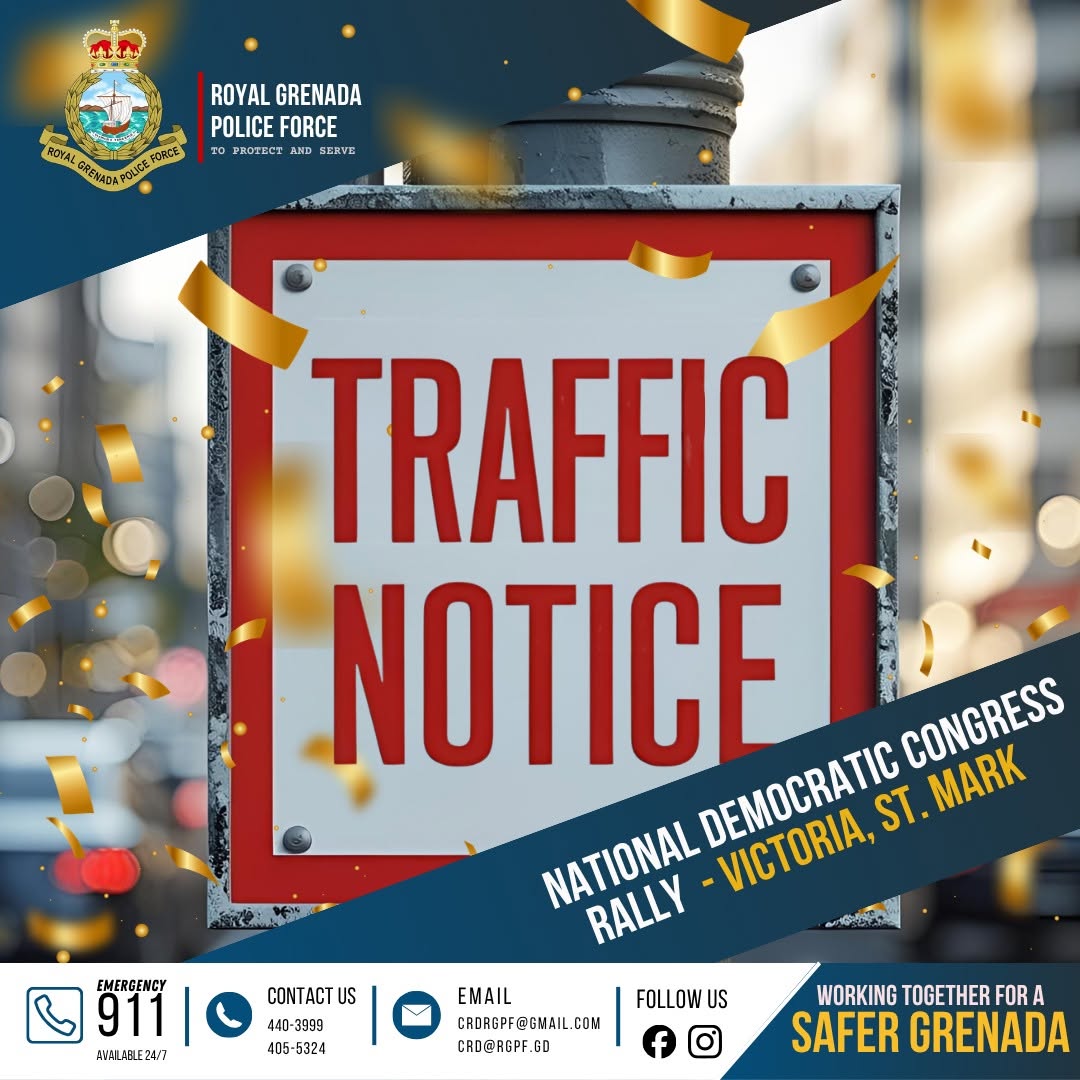
    Ahead of a high-profile political rally hosted by the National Democratic Congress (NDC) next year, the Royal Grenada Police Force (RGPF) has rolled out a comprehensive set of temporary traffic regulations to manage crowd movement and ensure public safety. The rally, scheduled to take place on Sunday, 4 October 2026 at St Mark’s Alston George Park in Victoria, will trigger traffic changes starting at 4 pm the same day, which will remain in place until midnight.

    Multiple central thoroughfares near the event venue will face restricted access for non-resident vehicles. St David’s Street, beginning at its junction with Queen Street, will be closed to all incoming traffic, as will Diamond Street from its intersection with Heroes Square, and Haddon Smith Street from the crossroads with St David’s Street. The only exception applies to Bonair public road, which will block entry from the Queen Street intersection near the bridge exclusively for non-locals; Bonair residents will still be permitted to access the route.

    To streamline what traffic will be allowed in the area, the RGPF has converted several key streets to one-way operation. Diamond Street will run solely from the Queen Street intersection toward Heroes Square, while St David’s Street will direct traffic only from Heroes Square to Queen Street. Bonair public road, stretching from the bridge near Bonair Government School, will operate exclusively in a southerly direction, and Haddon Smith Street will carry traffic one way from its junction with Diamond Street toward St David’s Street.

    Strict no-parking zones have also been mapped out across the event precinct to clear travel routes. Curbs on both sides of Queen Street will be off-limits for parking. On one-way routes, the left side of every directional stretch – including Diamond Street toward Heroes Square, St David’s Street toward Queen Street, the southerly section of Bonair public road, and Haddon Smith Street toward Diamond Street – will enforce no-parking rules for the duration of the event.

    Designated parking spaces have been allocated separately for different groups of attendees to avoid congestion. VIP guests, invited dignitaries, and sitting parliamentarians will be able to park along the outer perimeter of the Alston George Park playing field, as well as in the dedicated lot at the Pastoral Centre. For general members of the public attending the rally, approved parking includes the right-hand side of Diamond Street toward Heroes Square, the right-hand side of St David’s Street toward Queen Street, the playing field and basketball court at Bonair Government School, and the left-hand side of Haddon Smith Street heading toward St David’s Street.

    In addition to the static rally, a parade organized as part of the NDC event is slated to kick off between 5:30 pm and 6 pm. The procession will assemble near the constituency office close to the Bonair bridge, before moving along Queen Street, turning right onto Diamond Street, making a second right turn onto Chancery Street, and finally proceeding to the Alston George Park playing field. While the parade travels along Queen Street, any vehicles coming from the direction of Sauteurs will be required to divert left onto Church Hill Road, continue along Fairfield Road, and rejoin the main route via Bonair Bridge.

    The RGPF, in an official announcement released through its Office of Community Relations, has issued an apology in advance for any disruptions to regular travel that the temporary arrangements may cause, and urged all local residents, motorists and event attendees to comply with the new rules to keep the event running smoothly. Local outlet NOW Grenada noted that it does not take responsibility for third-party contributed content associated with this announcement, and provided a channel for users to report any abusive content related to the post.

  • Nevis Geothermal Project Poised for Regional Impact

    Nevis Geothermal Project Poised for Regional Impact

    A landmark renewable energy initiative on the Caribbean island of Nevis is poised to reshape subregional energy security, after the European Union formally committed to supporting the project with targeted technical expertise, industrial connections, and flexible financial backing.

    Located beneath Nevis Peak, an existing volcano on the small Eastern Caribbean island, the geothermal project centers on the planned construction of a 30-megawatt clean power plant that will replace the island’s current reliance on imported fossil fuels for electricity generation. Beyond local benefits, planners have long envisioned the project as a hub for exporting low-cost renewable energy to neighboring island nations across the Eastern Caribbean via a future interconnected transmission grid.

    The recent commitment from the EU followed a high-level 24 September working meeting between a three-member EU delegation and senior leadership from the Nevis Island Administration (NIA) held at the NIA Cabinet Room. The EU delegation was led by David Mogollón, Head of EU Cooperation for Trinidad and Tobago, Barbados and the Eastern Caribbean States, and included Martino Vinci, EU Policy Officer for St. Kitts and Nevis, and Federico Fische from the EU Global Technical Assistance Facility for Sustainable Energy (EU GTAF). NIA representatives in attendance included then-Acting Premier Spencer Brand, NIA Legal Advisor Helene Lewis, Permanent Secretary for the Premier’s Ministry Wakely Daniel, and NIA Energy Consultant Dr. Ernie Stapleton.

    In remarks following the meeting, Mogollón emphasized that the initiative carries far-reaching importance that extends well beyond Nevis and the broader Federation of St. Kitts and Nevis. “The European Union is ready to partner and support this initiative,” Mogollón stated, noting that the EU brings decades of specialized know-how in geothermal resource assessment, power plant engineering, and cross-border energy transmission that will help de-risk the project and ensure its successful delivery. “We are ready to mobilise financial support as well,” he added, outlining that multiple funding mechanisms are on the table, including concessional loans, targeted investment grants, and other flexible structures that can be tailored to the project’s needs. Mogollón also confirmed the EU can connect the project to experienced European industrial partners with specialized backgrounds in geothermal development, transmission infrastructure, and inter-island energy connectivity, adding that the EU’s core priority is advancing outcomes that deliver long-term benefit to the people of Nevis and the wider federation.

    Nevis Premier and Minister of Energy Mark Brantley confirmed the EU’s engagement in remarks delivered at his monthly press conference on 29 September, detailing that the EU’s proposal frames the Nevis geothermal project as the cornerstone of a broader subregional energy security initiative. Under the EU’s vision, the Nevis plant would be linked via undersea transmission lines to St. Kitts, Dutch Caribbean islands including Saba, Sint Eustatius, and Sint Maarten, French territories St. Barths and St. Martin, and eventually extend further to markets such as Antigua.

    Brantley explained that senior EU officials have already held preliminary discussions with St. Kitts and Nevis Prime Minister Dr. Terrance Drew, including talks held in Brussels, before the delegation traveled to Nevis to consult with local stakeholders. “They’re trying to basically persuade us to partner with the EU on this project for a wider subregional project on geothermal and on energy security for the sub region,” Brantley said, adding that the NIA is currently conducting a thorough assessment of the EU’s proposal. He noted that the EU is not the only international partner interested in the initiative: the United States government has also expressed interest in collaborating on the project, a reflection of the initiative’s transformative potential for the entire region.

    Preparations are already advancing for the next phase of development at the project’s Hamilton geothermal site, led by the Nevis Electricity Company Limited (NEVLEC) on behalf of the NIA. Once completed, the 30-megawatt plant is expected to deliver reliable, zero-emission electricity to Nevis, cut consumer energy costs by reducing exposure to volatile global fossil fuel markets, and strengthen the island’s long-term energy independence. For neighboring small island states, which currently face disproportionately high energy costs due to their own reliance on imported fossil fuels, the project offers a pathway to access low-cost clean power that would otherwise be out of reach for many smaller economies.

    “This project is so transformative that these governments, these agencies, want to be a part of it,” Brantley said. “They want to play a role because they recognize the value of what geothermal energy exploration on the island of Nevis can mean.”

  • Budget preparations continue as elections timetable takes shape

    Budget preparations continue as elections timetable takes shape

    As Grenada enters the final stretch before the scheduled dissolution of its sitting Parliament and the launch of a general election cycle, technical work on the 2027 national budget remains on track, according to senior finance ministry officials.

    Mike Sylvester, Permanent Secretary at the Ministry of Finance, confirmed that pre-budget preparations have proceeded without interruption since the process kicked off in July, aligned with a calendar formally approved by the country’s Cabinet. To date, the Fiscal Resilience Oversight Committee (FROC) has completed its review of the government’s Medium-Term Fiscal Framework, with the document already receiving Cabinet approval and being published for public access by the finance ministry.

    Sylvester added that all line ministries and government departments have submitted their draft 2027 budget requests earlier this month, meeting the established timeline. The next phase of work will see the finance ministry continue tracking performance across Grenada’s core economic sectors as it drafts the full supporting documentation required for the final budget proposal.

    However, the technical progress is now running up against a shifting political calendar. Prime Minister Dickon Mitchell has confirmed that the current Parliament will be dissolved on Friday, 2 October, with the official date for the next general election set to be announced just two days later on Sunday, 4 October.

    Under Grenada’s Constitution, a sitting Parliament serves a five-year term unless dissolved early, and a general election must be held within three months of dissolution. This constitutional timeline has raised key questions about when the 2027 budget will move from the preparation phase to formal parliamentary presentation and approval.

    Political commentator Christopher De Allie noted that overlapping election campaigning and the traditional end-of-year budget presentation window could create practical complications for government operations. “Under normal procedure, a new budget must be approved before the end of December to allow government ministries to legally draw down allocated funds starting January 1,” De Allie explained. “Without an approved budget in place, the spending authority of all government departments is restricted, limiting their ability to deliver programs and services.”

    As of yet, the final timeline for the 2027 budget remains undetermined, pending confirmation of the full election schedule after Parliament is dissolved. This is not the first time the current Mitchell administration has deviated from the traditional end-of-year budget timeline: the 2025 national budget was presented in March 2025, three months later than the standard November or December presentation schedule. That delay was driven by the after-effects of Hurricane Beryl, when the government prioritized immediate disaster recovery and relief efforts over advancing the fiscal plan — a set of circumstances vastly different from the political scheduling conflict facing the 2027 budget.

    For 2027, the final presentation and approval timeline will depend heavily on how the election schedule shapes up following the dissolution of Parliament. It is important to note that ongoing fiscal preparations extend beyond the 2027 budget year itself. The 2026 Estimates of Revenue and Expenditure already includes forward projections for 2027 and 2028, and the government has scheduled a return to binding fiscal rules and targets under the Fiscal Resilience Act for 2027. This means the current work on the 2027 budget forms a core component of the government’s broader medium-term fiscal strategy for the country.

    For the immediate future, Sylvester said the Ministry of Finance remains focused on completing all required technical work, with the next phase of the budget process set to unfold in lockstep with Grenada’s emerging general election timeline.