博客

  • Discover Dominica Authority to host discussion on wellness tourism and its role in Dominica’s development

    Discover Dominica Authority to host discussion on wellness tourism and its role in Dominica’s development

    Against the backdrop of a rapidly expanding global wellness travel market, the Discover Dominica Authority (DDA) has announced an upcoming high-profile panel discussion that aims to unpack the transformative potential of wellness tourism for the Caribbean island’s local economies, communities, and long-term tourism brand positioning.

    Scheduled for Thursday, June 11, 2026, from 10:00 AM to 11:30 AM at the scenic Jungle Bay Resort & Spa, the discussion carries the theme “Wellness Tourism in Dominica: A Destination That Benefits Everyone,” and forms a core centerpiece of DDA’s 2026 Tourism Awareness Program, an annual initiative carried out this year under the overarching banner “Wellness by Nature.”

    Unlike conventional conversations that frame wellness tourism as a luxury niche limited to high-end spas and private retreats, organizers have structured the session to center on how Dominica’s unique natural assets and indigenous cultural knowledge can turn wellness-focused travel into a driver of broad-based economic and social progress. The dialogue will explore how embedding the island’s abundant natural landscapes, traditional healing practices, and local cultural heritage into wellness offerings can strengthen Dominica’s competitive edge in the fast-growing global experience-driven travel sector, while opening new doors for local entrepreneurship and community participation.

    A diverse cross-sector lineup of expert panelists has been assembled to bring multiple perspectives to the conversation. The group includes Dr. Paula Lockhart, a prominent holistic wellness advocate and co-author of *Natural Plant-Based Remedies*; Marva Williams, DDA’s Chief Executive Officer and Director of Tourism; Ellen Joseph, a holistic practitioner and wellness consultant at Rosalie Bay Eco Resort & Spa; Antonina Okinina, lead wellness practitioner at InterContinental Cabrits Resort & Spa; and Renauld Deschamps, a certified naturopath, herbalist, and President of the Dominica Herbal Business Association. Monelle Alexis, DDA’s Communications and Public Relations Specialist, will serve as moderator for the interactive session.

    Odile Jno Baptiste, Product Promotions Manager at DDA, emphasized that Dominica’s approach to wellness tourism goes far beyond the conventional spa model that dominates mainstream perceptions of the sector. “When people think about wellness tourism, they often think about spas and retreats. In Dominica, wellness is also found in our rivers, hot springs, local foods, traditional practices, and the ways people connect with nature,” Jno Baptiste explained. “This discussion will highlight how those experiences can create opportunities for communities and entrepreneurs while contributing to the well-being of both residents and visitors.”

    Organizers have issued an open call for broad participation, inviting tourism industry stakeholders, independent wellness practitioners, local small business entrepreneurs, university students, community organization representatives, and general members of the public to attend. The event will include a dedicated interactive question-and-answer segment that gives attendees the chance to pose questions directly to panelists and share their own insights on developing inclusive wellness tourism in the country.

    Per DDA’s official press release, the annual Tourism Awareness Program is designed to deepen public understanding of tourism’s outsize contribution to Dominica’s national development, and encourage broader public participation in industry-building initiatives. This year’s focus on wellness is intentional: it is meant to showcase how the island’s unspoiled natural resources, existing wellness offerings, and generations of local traditional expertise can be leveraged to deliver shared, long-lasting benefits for local residents, host communities, and visitors alike.

    Anyone seeking additional details about the event can contact the Discover Dominica Authority directly at +1 (767) 448-2045.


  • How steep World Cup ticket prices affect Caribbean football

    How steep World Cup ticket prices affect Caribbean football

    As the 2026 FIFA World Cup co-hosted by Mexico, the United States and Canada draws near, a fierce debate has erupted over skyrocketing ticket prices – even as the tournament is poised to deliver unprecedented financial gains for developing football regions across the Caribbean. The 39-day global tournament will capture worldwide attention when it kicks off on June 11, 2026, with the opening match between co-host Mexico and South Africa in Mexico City. But long before the first whistle blows, industry insiders and casual fans alike have sounded the alarm that inflated costs have put in-person attendance out of reach for ordinary supporters.

    Price hikes across all ticket tiers are staggering compared to the 2022 Qatar World Cup. A base Category 3 general admission ticket for a group-stage match not featuring a host nation now starts at $120, marking a 74% jump from the equivalent seating four years ago. The most dramatic increase comes for the World Cup Final, where ticket prices have surged 236.1% – the largest single-cycle rise in FIFA’s history. Even the discounted $60 entry tier, introduced by FIFA to defuse public backlash, is restricted exclusively to verified loyal fans who purchase through their national football associations. Even this budget option costs 445.5% more than the cheapest entry-level tickets from the previous tournament cycle.

    As a registered non-profit governing body, FIFA maintains that its premium pricing structure is not designed to generate profits for the organization itself. Instead, governing body leaders argue that every dollar of revenue from ticket sales and commercial partnerships goes toward global football development – a promise that opens new opportunities for small, developing member associations in the Caribbean and CONCACAF more broadly. Projected total revenue for the 2026 tournament cycle now sits above $11 billion, with updated forecasts pushing the total as high as $14 to $15 billion thanks to stronger-than-expected ticket and commercial demand, far surpassing initial projections.

    Speaking at the CNBC Invest in America Forum, FIFA President Gianni Infantino outlined the organization’s global redistribution model, tying every dollar of World Cup revenue to grassroots and youth football projects across 211 member associations. “That [revenue] goes into 211 countries all over the world, to allow football projects, academies, stadiums, pitches, competitions for girls, for boys, in 211 countries – more than the UN – to be played and organised. Three-quarters of them would probably not be able to have organised sport without the advance that they receive from a competition like the World Cup,” Infantino said.

    FIFA pools all tournament revenue, including ticket sales, broadcasting rights and sponsorships, then redistributes funding to member associations through its Forward development program. At the 76th FIFA Congress held in Vancouver, the governing body announced that funding for the upcoming Forward 4.0 cycle would increase by an additional 20% thanks to the record-breaking revenue, meaning small Caribbean member states belonging to CARICOM are set to receive larger development grants in the coming years.

    Tennyson Glasgow, a veteran Saint Lucian football commentator, told St Lucia Times that small Caribbean nations stand to gain meaningful benefits from the new funding stream, even with the controversial ticket pricing. “FIFA may have done their homework as well to realise that when it comes to sports in that part of the world, people really go out, especially for the fan experience, and that comes at a cost,” Glasgow noted. “We’re talking about the best footballers globally. It’s not going to be cheap. Of course, FIFA would want to maximise that. We have seen records of FIFA always living up to the expectation in terms of taking care of their member countries. So, I’m certainly saying that yes, Saint Lucia, as a small nation, yet a member of FIFA, will benefit, especially when it comes to grassroots programmes, female football, and of course, we might just see some facilities being improved or some new ones may be placed.”

    Despite these potential long-term gains for developing football nations, critics argue that shifting the cost of global development onto ordinary matchgoing fans is fundamentally unfair. High-profile figures have joined the backlash: California Attorney General Rob Bonta has publicly condemned FIFA for what he calls “misleading ticketing practices”, and even former U.S. President Donald Trump has weighed in, saying he “wouldn’t pay it either” when asked about the inflated ticket prices.

    At its core, the 2026 World Cup’s pricing model is a double-edged sword. The unprecedented revenue from ticket sales, combined with massive broadcasting and sponsorship deals, will deliver badly needed funding to grow grassroots football, expand women’s programs and upgrade playing infrastructure across small developing nations in the Caribbean and beyond. But for millions of ordinary fans who can no longer afford to attend matches in person, the steep price increases remain a bitter disappointment that undermines the World Cup’s identity as a global people’s game.

  • LIVE NOW: Press Conference with Prime Minister Roosevelt Skerrit 10th June 2026

    LIVE NOW: Press Conference with Prime Minister Roosevelt Skerrit 10th June 2026

    When attempting to process a news analysis and rewriting request, only social media sharing prompts including “Share”, “Tweet”, “Share”, and “Pin” were received. No complete core news text, event details, or relevant background information was included in the submission. Without the full body of the original news content, it is impossible to carry out the required in-depth analysis, structural reconstruction, or accurate rewriting that meets the established standards. Users who wish to obtain professional news processing services need to provide the complete original news content along with their request to ensure the output meets accuracy and completeness requirements.

  • U.S. Revokes Visas in Crackdown on Birth Tourism Networks

    U.S. Revokes Visas in Crackdown on Birth Tourism Networks

    The U.S. State Department has announced a major escalation of global efforts to dismantle illegal birth tourism operations, a practice that sees foreign nationals enter the country specifically to secure U.S. citizenship for their children by birth. As part of this expanding enforcement campaign, the agency has already revoked hundreds of visas linked to these schemes and moved to break up coordinated criminal networks operating across three continents. In an official statement released this week, the department outlined how consular teams working alongside law enforcement partners have uncovered multiple organized rings spanning multiple global regions. These networks allegedly relied on fraudulent paperwork, unlicensed visa consultants, and pre-interview coaching to help applicants secure tourist visas under false pretenses, hiding their true goal of giving birth on U.S. soil. One high-profile bust unfolded at a U.S. embassy in West Africa, where investigators uncovered a sophisticated operation connected to more than 100 participating foreign nationals. The probe confirmed that ring members used forged documentation and worked with so-called visa “fixers” to secure entry to the U.S. All visas linked to this network have been revoked, and U.S. officials are now collaborating with local law enforcement to root out other similar groups in the region. Enforcement action has also been aggressive in Europe, where one U.S. mission has identified over 400 suspected birth tourism cases since the start of 2024. Investigations tied these cases to at least six private companies that specialized in facilitating the scheme: they coached applicants on how to lie during consular visa interviews, booked long-term accommodations in the U.S., and coordinated all logistics for the upcoming childbirth. Beyond revoking all visas tied to this ring, the State Department has issued permanent travel bans barring several key organizers from ever entering the U.S. again. In North Africa, data analytics tools combined with joint work between consular staff and local law enforcement have led to the discovery of additional networks exploiting gaps in the U.S. immigration system. More than 100 visas have been revoked in this region after investigators confirmed that the applicants’ sole primary purpose of travel was to give birth in the U.S. and secure citizenship for their infants. The State Department emphasized that U.S. immigration law explicitly bars the issuance of visitor visas to any applicant whose primary travel goal is to obtain U.S. citizenship for a child via birthright citizenship. “Under President Trump, the State Department is defending the integrity of U.S. citizenship by ending illegal birth tourism schemes,” the statement read. The agency also reminded the public that a U.S. visa is a privilege, not an inherent right, and issued a clear warning that anyone caught misrepresenting their travel intentions can expect to face visa revocation and long-term restrictions on any future applications to enter the U.S. Officials confirmed that targeting and disrupting birth tourism networks will remain a top priority as part of the administration’s broader push to protect the integrity of the country’s immigration and visa systems. The latest wave of enforcement marks a clear shift toward a far more aggressive strategy by U.S. authorities, with active investigations now spanning multiple continents and impacting hundreds of visa holders linked to illicit schemes.

  • Wanted man turns himself in after police appeal

    Wanted man turns himself in after police appeal

    A wanted Barbadian man linked to severe criminal cases has turned himself in to law enforcement, closing an intensive 24-hour search that relied on public cooperation. Dwayne Marlon Drakes, who is also known by the alias ‘Oily’, presented himself at the Holetown Police Station on Wednesday, one full day after the Barbados Police Service issued a public wanted bulletin asking citizens to share any information about his location.

    TBPS confirmed that following Drakes’ voluntary surrender, the suspect is currently cooperating with detectives as they advance their investigations into the serious criminal matters he is connected to. Law enforcement officials also extended formal gratitude to both members of the general public and regional media outlets, who responded swiftly to the Tuesday appeal and supported the investigation through the sharing of information and widespread circulation of the wanted notice.

  • Prison reform ‘to target recidivism, rehabilitation’

    Prison reform ‘to target recidivism, rehabilitation’

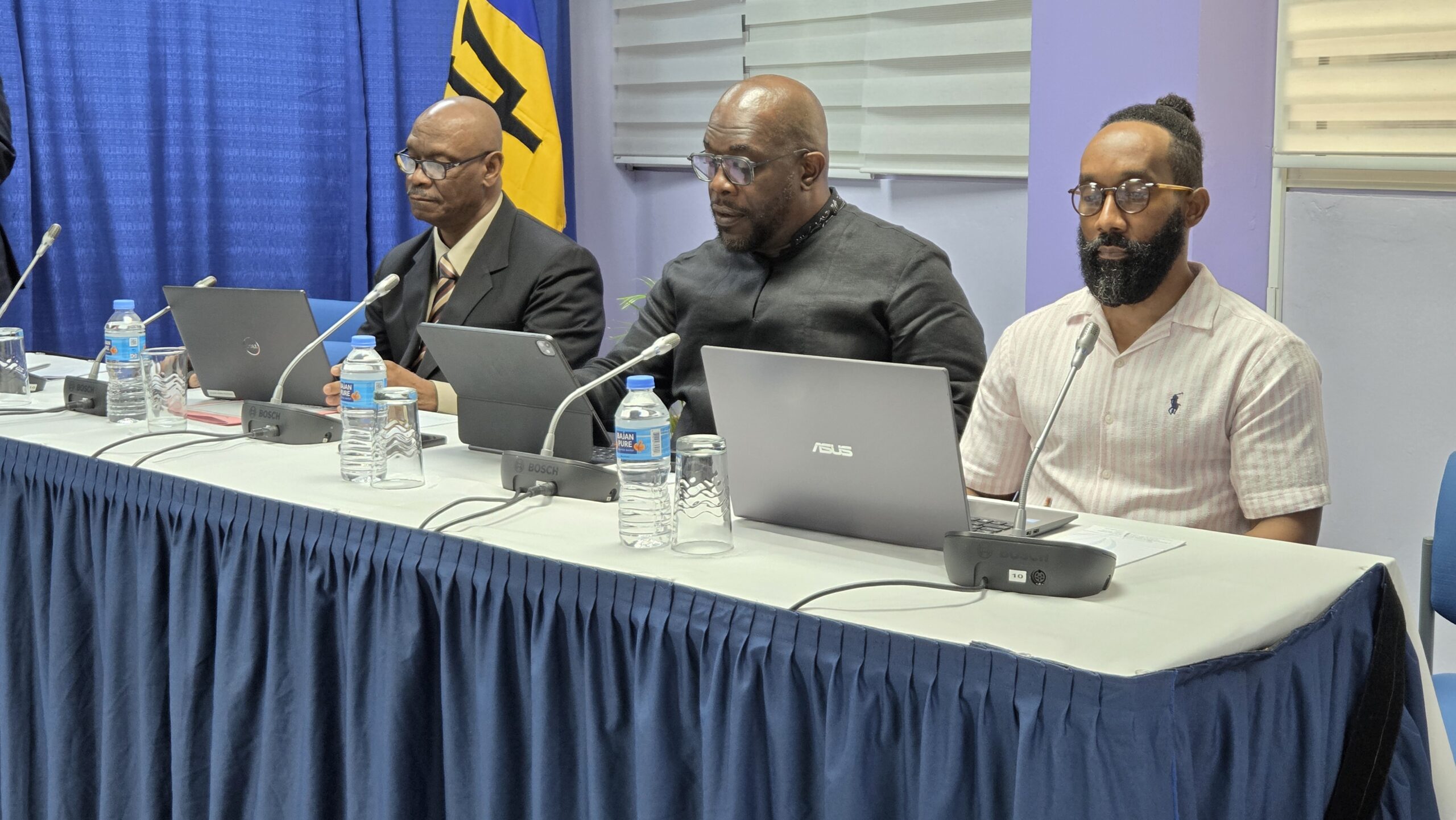
    Barbados is moving forward with an ambitious, comprehensive overhaul of its national prison system, centered on shifting from a purely custodial model to one prioritized on rehabilitation, reduced recidivism and the dismantling of internal criminal networks, Home Affairs Minister Gregory Nicholls has announced. The initiative forms a core pillar of the country’s broader national crime prevention strategy, with a targeted focus on transforming Dodds Prison as the first major site of reform.

    Speaking on the second day of the Barbados Probation Service’s “Modern Perspectives on Sentencing and Penal Reform” symposium held at the Lloyd Erskine Sandiford Centre, Nicholls emphasized that failing to move beyond the outdated model of merely housing inmates would only perpetuate the cycles of crime that have long plagued the country. “Effective prison systems have to rehabilitate offenders, have to break the strength of the criminal networks inside the prisons and reinforce nonviolent norms and identities,” the minister stated.

    Nicholls pointed out that crime disproportionately impacts young men across Barbadian society, and the current largely custodial system has only strengthened criminal networks while failing to cut reoffending rates. To reverse this trend, he said, national security frameworks must be reformed to reduce community violence, with the modernization of penal institutions serving as a critical first step.

    A central target of the six-year transformation plan is cutting recidivism by 30 percent, reshaping traditional prisons into dynamic rehabilitation centers that improve offender reintegration, reduce in-prison violence and build stronger institutional resilience. To achieve this goal, the plan outlines multiple interconnected strategies, starting with the introduction of evidence-based programming designed to drive lasting behavioral change. These programs include structured rehabilitation courses, cognitive behavior therapy, substance abuse treatment, violence intervention training and conflict resolution workshops.

    Nicholls rejected the status quo of confining inmates to cells with only one to two hours of yard time daily as an ineffective approach that does nothing to prepare offenders for release. Instead, the reform plan embeds comprehensive education and skills training into daily prison routines, including Technical and Vocational Education and Training (TVET) certification in high-demand fields such as construction, information and communications technology, agriculture and maritime skills. For inmates who have never earned formal basic qualifications, the system will also expand literacy and numeracy programming, and officials are currently reviewing a proposal from the University of the West Indies to establish a tertiary education pipeline that allows inmates to pursue higher education while incarcerated.

    The reform strategy also prioritizes targeting high-risk groups, including young men involved in gang activity, drug trafficking and firearms-related offenses who remain vulnerable to outside criminal influence even while incarcerated. Additional measures to cut in-prison violence include the launch of peer mentorship programs and the adoption of a formal restorative justice framework that centers accountability and healing over punitive isolation.

    A core end goal of the entire transformation is to ensure that offenders leave prison prepared to rejoin society as productive, contributing citizens. To support this, the plan establishes a national reintegration program that covers pre-release planning, stable housing placement, employment support and sustained connection with family members. An existing prison aftercare committee has been tasked with expanding its mandate far beyond its current role of providing basic clothing and small stipends to releasing inmates. The committee will now work directly with private sector businesses, non-governmental organizations and government bodies, drawing on national crime prevention budgets to develop sustained support programs for returning citizens.

    Nicholls also highlighted efforts to expand job placement partnerships with the private sector, create new apprenticeship opportunities for ex-offenders, strengthen second-chance employment frameworks and challenge the cultural taboos that create unnecessary barriers to work for people with criminal records. Completing the core reform priorities are plans to upgrade outdated prison infrastructure, increase and train staffing levels, and integrate smart security technology into daily operations.

    Speaking on the same panel alongside Nicholls, Dodds Prison Superintendent DeCarlo Payne reaffirmed the shared vision for reform, noting that the sector’s goal is no longer simply to contain people, but to prepare them for successful reintegration into community life. Payne outlined that several behavioral, educational and vocational training initiatives are already up and running at Dodds Prison, and these early programs have already begun to deliver positive results.

    Payne added that the current Prisons Act is archaic and ill-suited to the new model of corrections, meaning comprehensive legislative reform is a critical prerequisite for rolling out all planned changes. New operational frameworks including ankle monitoring for low-risk offenders, expanded parole, community service sentences and transitional housing all require formal monitoring structures, leading to calls for the establishment of a dedicated parole department.

    Payne emphasized that the full transition from a traditional prison service to a modern Department of Corrections will require targeted investment in infrastructure, formalized institutional restructuring and full implementation of new operational frameworks. While a corrections headquarters is already included in existing planning, Payne said officials will revisit the proposal to speed up its activation. Additional key priorities for the transition include policy reform, ongoing staff training, institutional cultural transformation, full technological integration, sustained investment in rehabilitation programming and focused, adaptive leadership across the sector.

  • WK 2026 begint onder politieke druk en protesten

    WK 2026 begint onder politieke druk en protesten

    The 2026 FIFA World Cup, the largest edition of the tournament in history co-hosted by the United States, Canada, and Mexico with 48 participating nations, is finally set to kick off Thursday at Mexico City’s iconic Estadio Azteca, where the host nation will face South Africa in the opening match. But weeks of mounting geopolitical tensions, domestic unrest, and off-field disputes have already overshadowed the on-field action, turning the pre-tournament period into a cycle of controversy. Below, we break down the five most pressing talking points ahead of the first whistle.

    First, Iran has accused the United States of stripping its football federation of allocated match tickets for the country’s group stage games, amid ongoing open conflict between the two nations following joint U.S.-Israeli military strikes on Iran in late February. The Football Federation of the Islamic Republic of Iran (FFIRI) announced that the U.S. unexpectedly revoked the ticket allocation meant for Iranian fans, effectively preventing supporters from traveling to attend the national team’s matches. The U.S. has also imposed a series of bureaucratic barriers on Iran’s delegation, including denying visas for multiple non-playing support staff, as the two countries remain in a formal state of war. As of Wednesday, neither FIFA nor U.S. World Cup organizing authorities have issued a public response to FFIRI’s allegations.

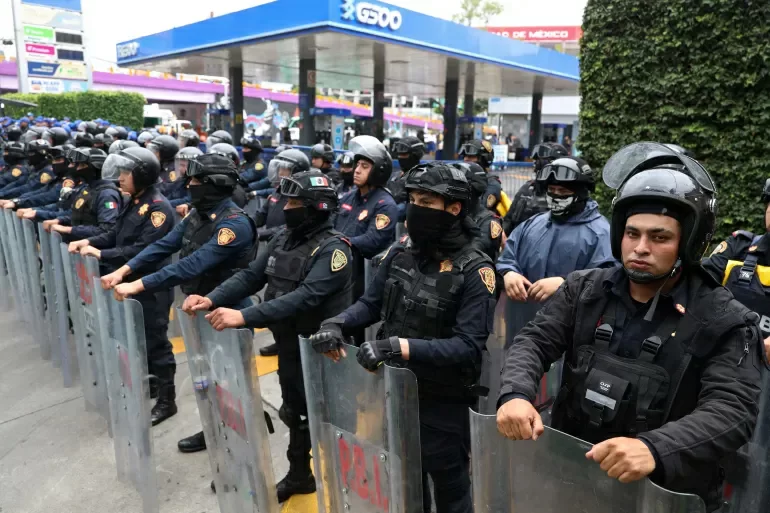
    Second, mass protests in Mexico City have put security authorities under intense pressure just hours before the opening kickoff. The country’s powerful CNTE teachers’ union has been demonstrating across the capital for days, and has threatened to block major access roads leading to Estadio Azteca ahead of Thursday’s match. The union has been on strike since last week, demanding higher wages and opposing a controversial pension reform bill that the current Mexican administration has deemed unworkable. Protesters are also set to be joined by family members of more than 130,000 missing people across Mexico, many of whom are suspected to have been abducted or killed by state actors or criminal drug gangs. In response, Mexican authorities have deployed a massive security presence around the stadium and surrounding areas, with President Claudia Sheinbaum confirming that the opening match will proceed as planned despite the unrest.

    Third, Somali referee Omar Artan received a hero’s welcome in the capital Mogadishu after he was denied entry to the United States to officiate at the World Cup. The U.S. administration confirmed Tuesday that Artan was refused a visa over alleged connections to suspected members of terrorist organizations. Speaking to reporters upon his arrival back in Somalia on Wednesday, Artan called the decision “his fate” and urged fellow Somalis not to lose heart. “What happened is done, it was fate. I am grateful for the support FIFA gave me,” he said. FIFA, which awarded former U.S. President Donald Trump its annual FIFA Fair Play Award last year, has emphasized that it holds no responsibility for visa and entry procedures implemented by host nation governments.

    Fourth, England head coach Thomas Tuchel has confirmed the team is taking a cautious approach to managing the fitness of star winger Bukayo Saka, who remains in recovery from an Achilles injury sustained back in March. The 24-year-old Arsenal attacker played through the pain for his club for the final months of the Premier League season, even featuring in the club’s penalty shootout loss to Paris Saint-Germain in the 2026 Champions League Final. “Bukayo is not 100% yet. He played through pain at the end of the season, but he is managing it and still performing at a high level even if he is not fully fit,” Tuchel told reporters Tuesday. “We are counting on him, and we are taking all the precautions we can to keep him healthy through training.” Saka’s fitness is widely viewed as critical to England’s World Cup hopes: he has featured at both Euro 2020 and Euro 2024, and scored three goals in four matches at the 2022 World Cup in Qatar.

    Finally, despite the tournament kicking off imminently, many competing nations are still wrapping up their final pre-tournament warm-up fixtures this week. England is set to face Costa Rica in Orlando on Wednesday to help the squad acclimatize to the hot, humid conditions expected across several U.S. host cities. Portugal has yet to depart for North America, and will play one final warm-up against Nigeria before flying out to the U.S. Algeria is also scheduled to play a closed-door friendly against Bolivia on Wednesday to fine-tune its tactics before the group stage begins.

  • Tropical Weather Outlook:  Wednesday, 10 June 2026 (8 am)

    Tropical Weather Outlook: Wednesday, 10 June 2026 (8 am)

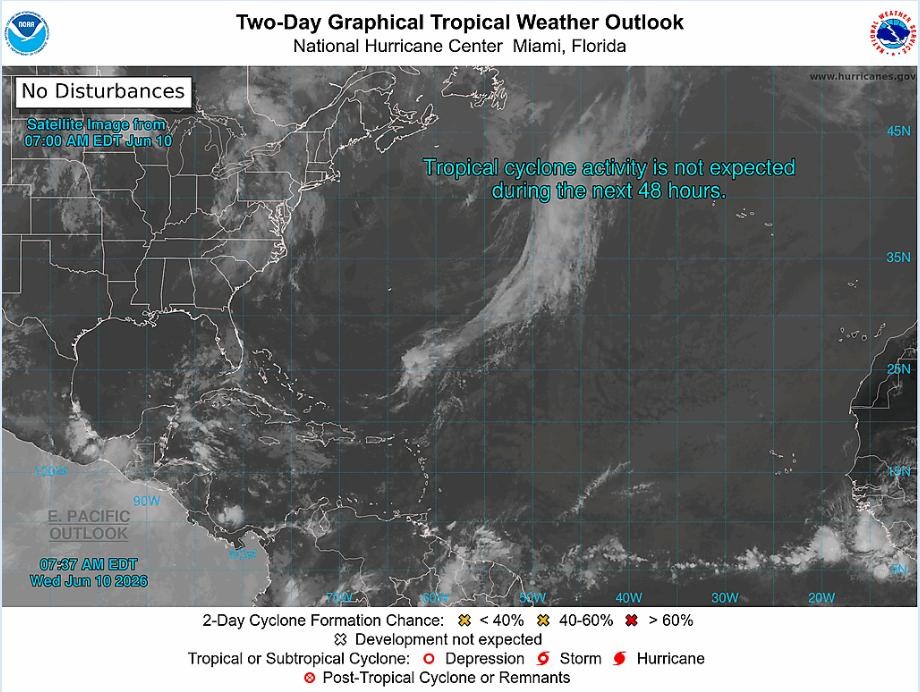
    Meteorological officials from the Meteorological Services of MBIA and the Grenada Airports Authority (GAA) have released an updated advisory tracking three active tropical waves moving westward across the eastern Tropical North Atlantic, within the key monitoring zone stretching from 10° to 20° North latitude and 40° to 65° West longitude that covers the region off the coast of Grenada.

    The westernmost of the three disturbances, Tropical Wave 1, has its central axis positioned just east of Grenada near 61° West, south of 18° North. Currently moving west at a steady clip of 10 to 15 knots, the system is not producing significant organized convective activity, but it is projected to pass over the island of Grenada later today.

    Further east across the Atlantic basin, Tropical Wave 2 sits with its axis near 53° West, south of 15° North, roughly 511 nautical miles east of Grenada. This system is progressing westward slightly faster at approximately 15 knots. Based on its current forward speed and trajectory, forecasters project the wave will move across the southern Windward Islands in the early hours of Thursday morning. The passage of the system will bring increased cloud cover to the region along with scattered showers through the period.

    The farthest system from the Caribbean, Tropical Wave 3, is centered near 41° West, south of 14° North, approximately 1215 nautical miles east of Grenada. It maintains a westward movement between 10 and 15 knots, consistent with the broader trade wind pattern across this stretch of the Atlantic.

    In their latest outlook, meteorologists confirmed that no tropical cyclone formation is expected over the monitored area within the next 48 hours, giving no immediate cause for heightened alert for Caribbean island nations in the region. The next official advisory update is scheduled to be released at 2 pm local time.

    This advisory was distributed in partnership between the Meteorological Services, MBIA, and the Grenada Airports Authority. NOW Grenada, the platform publishing this advisory, notes that it is not liable for opinions, statements, or third-party contributed content shared on its site, and provides a reporting channel for any content that violates community standards.

  • Shark Attack Leaves Urlings Fisherman Fighting to Save Hand

    Shark Attack Leaves Urlings Fisherman Fighting to Save Hand

    A terrifying incident unfolded off the coast of Urlings on Tuesday, when a young local fisherman suffered life-altering severe injuries during a spearfishing trip that landed him in emergency hospital care. According to local reports, the fisherman was submerged in nearshore waters alongside two other spearfishing companions when the unprovoked shark attack occurred. The encounter left the man with extensive, traumatic damage to one of his hands, requiring immediate urgent medical intervention.

    Quick-thinking fellow fishermen working nearby responded to the emergency within minutes, pulling the injured man from the water and coordinating his transport to a local hospital for emergency care. As of the latest updates, the young fisherman remains in the hospital receiving ongoing treatment for his injuries, leaving the tight-knit local fishing community on edge.

    The attack comes amid a growing trend that has raised alarm across the coastal area: multiple local fishermen have reported a noticeable uptick in shark sightings in the nearshore waters surrounding Urlings over the past several months. This rising frequency of encounters has fueled growing anxiety over safety, not only for the hundreds of local workers who rely on the ocean for their livelihoods, but also for recreational users who frequent the area’s coasts for swimming, boating, and other water-based activities. Community leaders and local fishermen are now calling for formal assessments of shark activity in the region to develop new safety protocols that can prevent similar attacks from occurring in the future.

  • Gun court aimed at speeding trials, closing legal gaps – AG

    Gun court aimed at speeding trials, closing legal gaps – AG

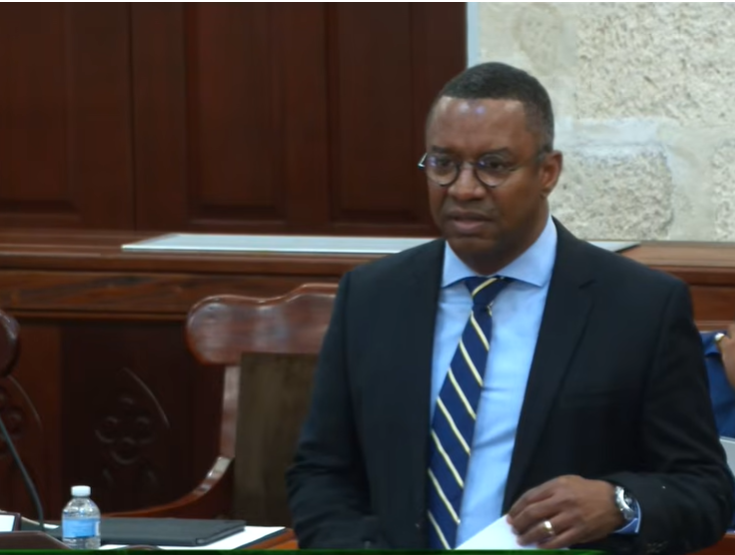
    Barbados has launched a groundbreaking specialized firearms court, a key pillar of the government’s sweeping national security reform agenda designed to cut crippling delays in gun crime prosecutions and address growing public anxiety over violent offending, Attorney General Wilfred Abrahams announced Tuesday during parliamentary debate on the Supreme Court of Judicature (Amendment) Bill.

    The new legislation comes just one week after parliament passed strict new anti-gang statutes, marking the latest step in a broader legislative push to rebuild public trust in Barbados’ judicial system. Abrahams framed the court as a direct response to widespread public pressure over escalating violent crime, noting that constituents from across the political divide are demanding urgent action. “Everywhere I go, I get the same question: What is the government doing to get gun violence under control,” he told lawmakers, acknowledging that while no administration can prevent every individual from choosing to commit crime, the state bears an non-negotiable responsibility to protect citizens through robust security infrastructure and responsive legal processes.

    The reforms build on existing security initiatives that already include joint patrols conducted by the Barbados Police Service and the Barbados Defence Force, whose personnel are currently completing specialized training in civilian policing protocols to support domestic security operations. A core flaw the new court aims to fix is the systemic delay that has allowed people charged with serious firearms offenses to easily obtain bail. Under Barbados’ constitution, every accused person has a right to a speedy trial, Abrahams explained. When prosecution teams fail to bring a case to trial or share disclosure documents within two to three years, courts are legally required to grant bail — even for defendants charged with heinous crimes such as murder. “A person is innocent until proven guilty,” Abrahams said. “When an accused has already waited two years in prison without any progress on their case or disclosure, a court bound by constitutional rights cannot justify holding them indefinitely.”

    To close this gap, the legislation imposes strict, tight timelines for all firearms cases. Simple cases must be fully resolved within six months, while more complex matters are required to be concluded within nine months. Abrahams admitted that for years, regional governments avoided creating specialized gun courts because establishing such an institution required publicly acknowledging that firearm violence had reached a crisis point. “Nobody wanted to admit we had a problem big enough to need a dedicated court,” he said, noting that political hesitation has been set aside in favor of the government’s duty to answer to voters. “That horse has already bolted. The problem is here, and we have to address it.” With this reform, Barbados joins regional neighbors Jamaica and Trinidad and Tobago, which have already implemented similar specialized court frameworks.

    Under the new law, the Firearms Court will hold exclusive jurisdiction over all firearms-related offenses, as well as any related matters assigned by the Chief Justice, eliminating duplicative use of limited state resources. Addressing long-running debate over the death penalty, which remains on Barbados’ statute books for murder and treason, Abrahams clarified that the country’s de facto abolitionist status remains unchanged. He cited the landmark Pratt and Morgan ruling from the Privy Council, which established that holding a prisoner on death row for more than five years qualifies as cruel and inhumane punishment. While Barbados now recognizes the Caribbean Court of Justice as its highest appellate body, the five-year principle remains binding precedent in regional legal practice. Because Barbados’ existing appellate process routinely takes longer than five years to exhaust all appeals, and defendants often petition international human rights bodies that further extend proceedings, capital punishment cannot lawfully be carried out under current frameworks. The accelerated trial timelines introduced by the new court are designed to address this systemic sluggishness, though no change to the country’s de facto abolitionist position is being made.

    The legislation also includes a series of operational adjustments designed to protect witnesses, preserve the pace of proceedings, and safeguard due process. The Firearms Court is authorized to convene at any location approved by the Chief Justice, including high-security sites such as Dodds Prison, reducing the security risks associated with transporting high-risk gang members. The law also allows for virtual hearings and video testimony to shield vulnerable witnesses from intimidation by associates of the accused. While the right to a jury trial remains intact for all defendants, the new legislation formally introduces the option of judge-alone trials to counter widespread juror intimidation. “Jurors are frightened, and that is the reality,” Abrahams said. “No one wants to sit opposite one of Barbados’ most wanted suspects. We have to accept that judge-alone trials will become more common for these serious offenses, and that is a necessary change to keep proceedings fair and safe.”

    Crucially, the legislation enshrines that the rights of minors remain the top priority in any case involving children in conflict with the law. Provisions from the existing Child Protection Act and Child Justice Act will take precedence over the new firearms legislation in all youth cases. Abrahams added that the government will continue refining the framework to close any additional loopholes that defense counsel may identify. “Systemic delays frustrate victims, they frustrate families, and they erode public confidence in our judicial system and the rule of law,” he said. “We will update and amend this legislation whenever it is needed. Our only goal is to do what is right for the people of Barbados.”