分类: society

  • Teenager kills nine, wounds 13 in Turkey school shooting

    Teenager kills nine, wounds 13 in Turkey school shooting

    ISTANBUL — Just 24 hours after a separate school shooting left 16 wounded in southeastern Turkey, a second mass shooting at a middle school in the country’s southern Kahramanmaras province has sent the nation into mourning, leaving nine dead and 13 injured in an attack that upended Turkey’s long history of rare school violence. The shooter, identified by local officials as a 14-year-old eighth-grade student, carried five licensed firearms and seven ammunition magazines belonging to his father, a former police officer, into the school campus on Wednesday morning. What followed was chaos: the teen opened fire indiscriminately across two classrooms, forcing terrified students to leap from first-floor windows to escape the gunfire. Dramatic, AFP-verified footage captured by a nearby resident shows students scrambling across the school courtyard, with roughly 15 gunshots audible across a 90-second clip of the attack.

    Turkey’s Interior Minister Mustafa Ciftci confirmed that nine people lost their lives in the shooting, and 13 wounded people were rushed to local hospitals, with six patients remaining in intensive care and three in critical condition as of Wednesday evening. The shooter himself died during the incident, and local governor Mukerrem Unluer told reporters it remains unclear whether the death was a suicide or an accidental killing amid the chaos of the attack. Law enforcement has since detained the shooter’s father, Ugur Mersinli, for questioning, per reporting from Turkey’s official Anadolu Agency. Video released by Turkey’s private IHA news outlet showed emergency workers evacuating covered bodies from the campus, while dozens of distraught parents gathered outside the school gates waiting for updates on their children. Law enforcement has locked down the campus perimeter, and top Turkish officials including the interior and education ministers traveled to Kahramanmaras to oversee the response, with prosecutors opening an immediate investigation into the incident.

    President Recep Tayyip Erdogan offered an official statement on social media platform X, calling the attack an unmitigated tragedy. “In this tragic attack, we unfortunately lost our bright young children and a devoted educator,” he wrote, adding that authorities would fully investigate every detail of the shooting and urging the public not to politicize the national grief. The Wednesday shooting follows a similar attack just one day prior, in Sanliurfa province’s Siverek district, where a former student opened fire with a shotgun at his old high school, wounding 16 people — 10 of them students — before killing himself during a police confrontation. Following the Tuesday attack, law enforcement detained one suspect and suspended four school officials from their posts, and ordered the affected school closed for four days.

    The back-to-back attacks have sparked urgent debate over school safety across Turkey. Main opposition Republican People’s Party (CHP) leader Ozgur Ozel argued that the violence can no longer be written off as a series of isolated events. “At this point, it is clearly evident that violence in schools can no longer be explained by isolated incidents,” Ozel wrote on X. “This issue has turned into a growing and deepening security vulnerability.” He called for immediate implementation of sweeping new security measures, including full access control at all school entry and exit points, increased on-campus security staff, upgraded campus camera systems, more frequent police patrols around school grounds, and updated emergency response plans. “The security of schools is entrusted to our state. No negligence or deficiency in this regard can be excused anymore,” Ozel added.

    Until this week, school shootings have been extremely rare in Turkey, which enforces some of the strictest gun control regulations in the region. All firearms in the country require official licensing, mandatory registration, mental health screenings and criminal background checks for owners, with heavy criminal penalties for unlicensed gun possession. The most recent high-profile school shooting prior to this week occurred in May 2024 in Istanbul, where a expelled former student shot and killed a private high school principal months after he was dismissed from the school.

  • Stinking sore at UHWI

    Stinking sore at UHWI

    On Tuesday, Jamaica’s Parliamentary Public Accounts Committee (PAC) deepened its probe into longstanding mismanagement allegations at the University Hospital of the West Indies (UHWI), uncovering fresh troubling evidence of systemic improper governance that has raised serious alarms among lawmakers. The review was launched following the release of a damning special audit report from the auditor general into the public hospital’s daily operations and financial management. What PAC members heard during Tuesday’s hearing left many top committee officials stunned: senior UHWI executives confirmed that the major public health institution carries a staggering $40 billion in unpaid tax obligations to the state, and has not developed any formal structured repayment plan to resolve the massive liability. Compounding this revelation, the hospital continues to operate under a temporary tax compliance certificate, a temporary status that is meant only for entities working to resolve outstanding compliance issues, rather than holding billions in unpaid taxes. The hearing also exposed another contradiction in the hospital leadership’s previous accounts: UHWI executives had previously claimed that severe flooding at the facility destroyed key physical files linked to multiple millions of dollars in awarded contracts, but they walked back that explanation during questioning before the PAC. Lawmakers also pressed executives on reports that an outside private entity was allowed to use UHWI’s official tax-exempt import status to bring goods into the country, resulting in more than $10 million in unpaid customs duties that the public is now forced to absorb. UHWI representatives gave inconsistent, halting responses when asked to explain how the private company gained access to the hospital’s tax-exempt privileges. As one of the Caribbean’s leading public teaching and referral hospitals, the ongoing governance and financial irregularities at UHWI have sparked growing public concern about oversight of state-funded health institutions, and the PAC is expected to continue its review of the audit findings in upcoming hearings, with further questioning of hospital leadership planned.

  • Little support for petition to pay school ‘shadows’ more

    Little support for petition to pay school ‘shadows’ more

    A public campaign is pushing Jamaica’s national government to correct longstanding unfair pay practices for school shadows — trained special education support workers — in the country’s public education system, where many of these critical staff members currently earn less than the official national minimum wage.

    Launched on the official Jamaica House online petition platform on April 1, 2025, the appeal formally requests government intervention to uphold equitable compensation for these workers, who deliver specialized one-on-one support to students with disabilities learning in mainstream public school classrooms.

    Also widely referred to as shadow teachers or classroom aides, school shadows play an indispensable role in advancing inclusive education across Jamaica. Their core responsibilities go far beyond basic classroom assistance: they adapt learning activities to match each student’s unique needs, help young people navigate emotional and behavioral challenges, facilitate positive social connections with peers, and intentionally foster long-term independence rather than ongoing reliance on support.

    In their petition, organizers emphasize that the vital work school shadows do to enable vulnerable disabled students to access learning, stay safe, and contribute fully to school community life has been largely unrecognized, particularly when it comes to the personal investments these workers make in their own professional development. Many shadows pay for additional training and advanced qualifications out of their own pockets, yet even after meeting these updated professional requirements, the majority of public sector school shadows still earn wages that fall below Jamaica’s national minimum wage.

    Petition organizers call this systemic underpayment unjust, environmentally and professionally unsustainable, and misaligned with both Jamaica’s existing national labor regulations and the government’s stated commitment to educational equity. Currently, Jamaica’s national minimum wage sits at $16,000 per 40-hour workweek, and the government has already approved a scheduled increase to $17,000 per week that will take effect on July 1, 2026. Even with this planned adjustment, the petition notes that the current pay structure for school shadows remains unlawful and unfair, requiring urgent policy correction.

    The issue of school shadow compensation is not a new one for Jamaica’s education leadership. In 2024, then Education Minister Fayval Williams acknowledged that the public education system employed roughly 500 school shadows, and identified improved pay for these workers as an ongoing policy priority. All public sector school shadows are deployed through the Ministry of Education’s Special Education Unit, which provides specialized support for learners aged 3 to 21 with a wide range of disabilities, including hearing and visual impairments, learning disabilities, intellectual disabilities, emotional and behavioral disorders, and autism, alongside tailored support for gifted and talented students.

    Data from past discussions within Jamaica’s education sector highlights a sharp discrepancy between public and private sector pay for these roles. In a 2022 interview with the Jamaica Observer, then President of the Jamaica Independent Schools’ Association (JISA) Dr. Andre Dyer reported that private school parents who cover shadow teacher pay out of pocket often spend between $15,000 and $90,000 per month, depending on the worker’s qualifications, with lower costs only available when schools offer partial subsidies.

    Demand for qualified school shadows has risen steadily across both public and private Jamaican schools since the COVID-19 pandemic, when two years of suspended in-person learning exacerbated developmental and learning gaps that require targeted one-on-one support for many disabled students.

    Under Jamaica’s official petition framework, any registered citizen can launch or sign a public appeal on the Jamaica House portal. For a petition to qualify for formal review by the Office of the Prime Minister, it must gather 15,000 valid signatures within a 40-day window. If the appeal meets the platform’s participation standards, the Prime Minister’s office is required to issue a formal public response. The current petition on school shadow compensation is set to close on July 1, 2025, and as of reporting, it has not yet gathered any signatures. All petitions undergo a pre-publication review to confirm compliance with platform rules, and only eligible appeals are posted for public signing.

  • Jaii Frais retains Isat Buchanan in shooting case; makes first court appearance

    Jaii Frais retains Isat Buchanan in shooting case; makes first court appearance

    KINGSTON, Jamaica — A post-carnival shooting in the Jamaican capital has left three people wounded, including prominent local podcaster Jhaedee “Jaii Frais” Richards, and sparked an ongoing police investigation with two people now in official custody. The violent incident unfolded Sunday night at the Ranny Williams Entertainment Centre in St Andrew, immediately following the conclusion of official carnival festivities in the area.

    Following the shooting, Richards was taken into police custody as a person of interest connected to the attack. On Wednesday, he appeared before a local court to consider a police application for an extended remand, a request that would allow officers to hold him without formal charges beyond the 48-hour window mandated by Jamaican law. The court ultimately granted the police’s application, scheduling Richards’ next court appearance for Friday.

    Richards has retained prominent defense attorney Isat Buchanan to represent him throughout the investigation and upcoming court proceedings. Buchanan confirmed to local outlet Observer Online that he successfully petitioned the judge to order emergency medical care for his client, noting that the island’s police lockup facilities lack the capacity to properly treat the gunshot wound Richards sustained in the attack. Following the court ruling, Richards was transferred to a local hospital to receive care for his injury.

    “ We await the completion of the investigation and all I can say is trust the process,” Buchanan told reporters outside the courthouse Wednesday.

    Three people were hit by gunfire during the attack at the popular Big Wall after-party venue, according to official updates. Alongside Richards, the injured include a U.S. citizen and a member of dancehall recording artist 450’s personal entourage. The entourage member suffered critical injuries in the shooting but has survived and is currently receiving medical treatment, authorities confirmed.

    Richards is not the only person detained in connection with the high-profile incident. Jahvel “Jahvy Ambassador” Morrison, a well-known music producer and talent manager, has also been held in police custody since Sunday night immediately following the shooting. Morrison has retained top legal representation, King’s Counsel Peter Champagnie, to guide his case through the legal process.

    Local law enforcement has not yet released formal details on possible motives for the shooting, nor have they announced any timeline for the filing of formal charges against the two detainees. Investigations remain ongoing as officers work to piece together the sequence of events that led to the Sunday night attack.

  • ODPEM reports more than $1.4 b in donations following passage of Hurricane Melissa

    ODPEM reports more than $1.4 b in donations following passage of Hurricane Melissa

    KINGSTON, Jamaica — Five months after Hurricane Melissa made landfall and caused widespread damage across Jamaica, the island nation’s disaster management agency has secured more than JA$1.4 billion in donations from a global network of supporters to fund recovery and long-term resilience work.

    Commander Alvin Gayle, Director General of the Office of Disaster Preparedness and Emergency Management (ODPEM), announced the updated donation figures during an April 15 post-Cabinet press briefing at Jamaica House. As of March 31, more than 17,000 individual and institutional donors have contributed to post-hurricane reconstruction efforts, which launched after the storm hit the country on October 28 last year.

    To streamline giving, ODPEM set up multiple donation channels: an online payment gateway integrated into the official Support Jamaica portal for digital contributions, as well as dedicated local bank accounts for both Jamaican dollar and U.S. dollar direct transfers. Gayle confirmed that roughly 80 percent of all total donations arrived via direct bank transfers, highlighting the preference for direct giving among large and institutional donors.

    The donor pool represents a broad cross-section of partners, ranging from local community members and domestic businesses to regional blocs, international governments, global non-governmental organizations, and private individuals from across the world. After accounting for currency conversions, net donations deposited in ODPEM-managed accounts total JA$1,478,269,567, Gayle confirmed.

    To date, a portion of the pooled funds has already been allocated to two core priority areas aligned with the government’s national recovery strategy: the public Shelter Recovery Programme and the purchase of heavy construction equipment to boost national disaster response capacity. Per a donor request, the equipment purchase is already greenlit for funding.

    So far, JA$146 million in donated cash has gone toward the government-led roof repair initiative, which has been further bolstered by an in-kind donation of $400 million worth of roofing materials from international and local partners. An additional JA$7.2 million has been disbursed to cover logistics and operational costs for the housing recovery program.

    As of the latest update, 410 damaged residential roofs have been fully completed under the program, with dozens more scheduled for construction in the coming weeks. Gayle noted that total program spending will rise as more projects move forward, adding that all beneficiaries have been vetted for vulnerability by the Ministry of Labour and Social Security to ensure support reaches the communities most in need.

    Separately, JA$320 million in donations has been earmarked for the procurement of heavy construction equipment designed to strengthen Jamaica’s emergency response capabilities. According to Gayle, this allocation does more than just address the immediate aftermath of Hurricane Melissa: it represents a long-term strategic investment that will upgrade the country’s entire national disaster preparedness and resilience infrastructure for future extreme weather events.

    The remaining unspent donation balance will be held in reserve and allocated to additional recovery and resilience projects as needed, including the upcoming rapid deployable modular housing initiative, which is designed to provide emergency shelter quickly after future natural disasters.

  • Devastating floods leave at least 12 dead in northwest Haiti

    Devastating floods leave at least 12 dead in northwest Haiti

    PORT-AU-PRINCE, Haiti — Haitian civil defense authorities have officially confirmed that severe flooding triggered by three days of torrential rain in early April has claimed at least 12 lives across the country’s northwest department, leaving a trail of widespread destruction that has displaced thousands of residents and disrupted critical public services.

    Preliminary assessments from the Departmental Directorate of Civil Protection show the extreme weather event, which unfolded between April 11 and 13, hit three local municipalities — Port-de-Paix, Saint-Louis du Nord, and Anse-à-Foleur — the hardest. The relentless downpour pushed multiple river systems over their banks, including the major Rivière des Trois Rivières, submerging entire communities and creating an urgent humanitarian emergency that officials warn could escalate if additional rainfall arrives.

    Most of the fatalities were recorded in rural areas of Saint-Louis du Nord, where the 12 victims either died in rain-triggered landslides or were swept away by fast-moving floodwaters. Multiple people have also sustained serious injuries, and an unknown number of residents remain unaccounted for, including local fishermen and riverside inhabitants in Anse-à-Foleur.

    Official data indicates more than 2,500 families have been directly impacted by the disaster. Hundreds of residents were forced to flee their inundated properties overnight, taking shelter with host relatives or in makeshift emergency camps set up by local volunteers. Preliminary damage surveys count roughly 1,200 flooded residential properties, while all three municipalities have seen local schools and health facilities swamped with muddy floodwater. The contamination and structural damage have rendered these essential service sites inaccessible, cutting off affected communities from basic education and medical care.

    The disaster has also delivered a severe blow to local agricultural livelihoods: hundreds of head of livestock, a critical economic asset for small-scale family farmers across the region, have been washed away, resulting in catastrophic financial losses for already vulnerable households.

    Local government leaders have already issued an urgent appeal to Haiti’s national central government for immediate life-saving support. Among the most urgently needed supplies are food rations, clean drinking water, personal hygiene kits, and sanitation infrastructure, which local authorities say are critical to heading off a secondary public health crisis in crowded displacement sites.

  • North Coast Hardware Workers Secure First Collective Bargaining Agreement

    North Coast Hardware Workers Secure First Collective Bargaining Agreement

    For years after North Coast Hardware employees voted to unionize, workers at the Antigua and Barbuda-based retail hardware outlet have finally achieved a long-awaited milestone: a fully finalized Collective Bargaining Agreement (CBA) between company management and the Antigua and Barbuda Workers’ Union (ABWU) that delivers meaningful, tangible gains for every member of the workforce. This landmark accord is the first formal negotiated agreement to be completed since workers formally opted for union representation, marking a watershed moment for labor rights at the company.

    The deal packs a range of financial and work-life improvements for staff, starting with structured wage gains that will roll out over the next four years. In addition to an emergency 3% wage bump awarded to workers in 2024 while negotiations were still ongoing, the CBA locks in an total cumulative 8% base wage increase split across three years: 3% in 2025, followed by 2.5% annual increases in both 2026 and 2027. Beyond pay raises, the agreement codifies a suite of new and expanded benefits designed to support workers across all stages of their careers and personal lives.

    Notably, all contract employees at the company will be converted to full permanent positions, a change that drastically boosts job security for a large segment of the workforce that previously lacked stable employment protections. The CBA also establishes a $20 daily meal allowance for workers, adds three paid days of paternity leave for new fathers, and creates a retirement plan that calculates benefits at 75% of an employee’s final severance rate. For staff employed as full-time company drivers, management has committed to covering the cost of renewing their professional driver’s licenses. The agreement also introduces clear, standardized rules for vacation time accrual and adds a formal compassionate leave provision to support workers dealing with personal or family emergencies.

    Negotiations to reach the final agreement stretched over a longer timeline than many involved anticipated, according to Kem Riley, Senior Industrial Relations Officer at the ABWU. But despite the protracted process, Riley emphasized that the final outcome was well worth the sustained effort from union negotiators and worker representatives.

    “Securing this first agreement and these meaningful benefits on behalf of our members was a top critical priority for our union,” Riley explained in a statement following the deal’s finalization. “We stayed the course through every stage of negotiations, and we are genuinely pleased with the outcome we have delivered for North Coast Hardware workers.”

    For the ABWU, the successful conclusion of this landmark CBA represents more than just gains for one group of workers: it is a significant step forward in the union’s broader mission to advance fair compensation, improved working conditions, and stronger job security for organized labor across Antigua and Barbuda.

  • UWI FIC First Year Experience Programme Leads Community Clean Up, Collects More Than 4,000 Pounds of Garbage

    UWI FIC First Year Experience Programme Leads Community Clean Up, Collects More Than 4,000 Pounds of Garbage

    On April 12, 2025, The University of the West Indies (UWI) Five Islands Campus turned out over 100 participants for a landmark community-wide clean-up organized through its flagship First Year Experience Programme, pulling more than 4,000 pounds – equal to 2 metric tons – of waste from public spaces across the Five Islands region of Antigua and Barbuda.

    The cross-group collaboration brought together incoming first-year undergraduates, tenured and junior faculty members, campus administrative staff, local community residents, and corporate sponsors to rejuvenate high-traffic public areas. Volunteers split into coordinated teams to cover three key stretches of coastline and roadway: the corridor linking Pensioners Roundabout to Green Apple Cafe, the route from Royalton Antigua Resort’s back entrance to Green Apple Cafe, and the coastal stretch from Hawksbill Beach to Green Apple Cafe. This targeted coverage addressed areas popular with both locals and tourists that had accumulated excess waste over recent months.

    Campus leadership framed the event as far more than a one-off environmental action, positioning it as a concrete demonstration of the institution’s pledge to act as a responsible, embedded partner to the community that hosts its campus. The First Year Experience Programme, the framework behind the initiative, was designed specifically to ease new students’ transition into higher education, with core priorities spanning academic preparation, personal growth, and intentional cultivation of civic duty. Unlike traditional first-year orientation programming that focuses solely on on-campus adjustment, this model prioritizes experiential learning outside the lecture hall, pushing students to engage with pressing local social and environmental challenges from their very first semester.

    Rhajhel Brown, the programme’s coordinator at the Five Islands Campus, expanded on this educational mission in comments after the event. “The First Year Experience Programme is built around out-of-classroom learning, designed to help our new students adapt not just to the demands of university academics, but to the real-world challenges that shape our community today,” Brown explained. He also highlighted that the clean-up would not have achieved its large-scale impact without support from regional partners, naming Royalton Antigua, the Akhimo Group, the Rotaract Club of Antigua, Adoptacoastline, Green Apple Café, and the Governor General’s Deputy Sir Clare Roberts as key contributing collaborators.

    Senior campus administrators echoed Brown’s enthusiasm, emphasizing that the event reflects a long-term institutional commitment rather than a temporary public relations exercise. Dr. Camille Samuel, Campus Registrar, noted that the clean-up offers clear proof of the positive contribution the UWI Five Islands Campus makes to surrounding neighborhoods. “The Five Islands Campus has already left its mark on this community, and we hope our faculty, staff, and students will keep working to improve the place we call home,” Samuel said. She added that campus administration will continue allocating resources and support for future community engagement projects, framing the 2025 clean-up as one part of a sustained, ongoing effort to lift overall quality of life for residents of the Five Islands community and the wider nation of Antigua and Barbuda.

  • NOTICE: Section of Newgate Street Temporarily Closed for APUA Repiping; Businesses Remain Open

    NOTICE: Section of Newgate Street Temporarily Closed for APUA Repiping; Businesses Remain Open

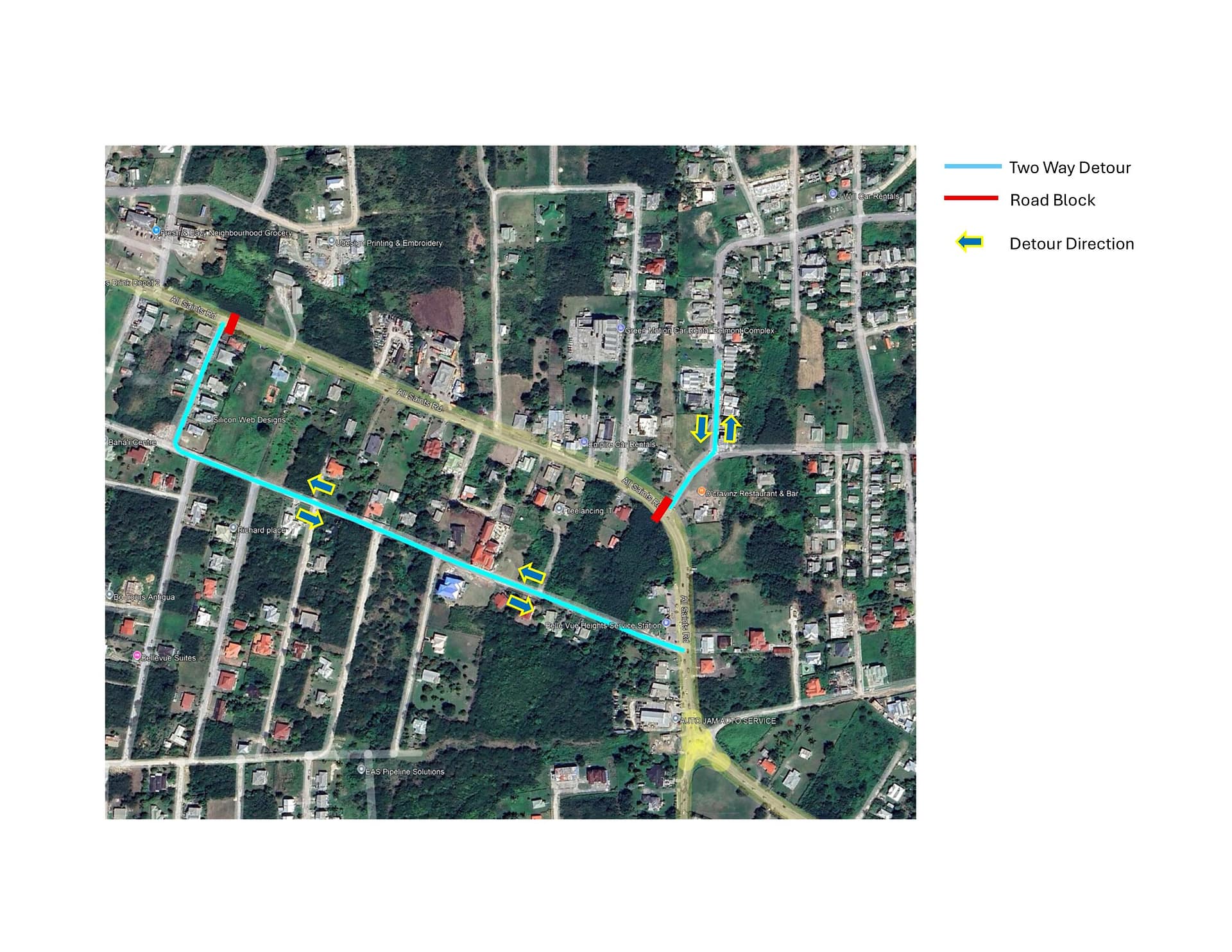
    A short stretch of Newgate Street will be shut down to all through traffic starting today, as crews from the Antigua Public Utilities Authority (APUA) carry out critical repiping work along the corridor. Local transportation officials have confirmed that despite the closure, all retail shops, restaurants, service providers and other commercial operations located along the affected section of the street will continue normal operating hours throughout the duration of the construction project. Commuters and recreational drivers who typically rely on this route to reach their destinations are being urged by transportation authorities to map out alternate paths in advance, and build extra time into their travel schedules to account for inevitable traffic congestion and delays stemming from the blocked roadway.

  • Blue Economy Department Launches Ocean Month Art Competition for Young Children

    Blue Economy Department Launches Ocean Month Art Competition for Young Children

    To kick off official programming for Ocean Month 2026, the Department of the Blue Economy has unveiled a one-of-a-kind art competition open exclusively to children between the ages of 7 and 11, centered on ocean conservation and sustainable blue economy themes.

    Organized in partnership with the Ministry of Education’s Education Broadcasting Unit and a coalition of additional community and institutional partners, the competition invites young creative minds to translate their personal understanding of the blue economy into visual art. Participants can choose to create either murals or posters, with encouraged themes ranging from vibrant depictions of native marine life to illustrations of actionable ocean conservation practices.

    According to event organizers, the competition serves two core goals: to foster the creative talent of young people across the region, and to build broader public awareness of the critical role healthy oceans and marine ecosystems play in supporting communities and economic activity. Unlike many youth art competitions that end with a simple award ceremony, this initiative offers a unique lasting opportunity for the top participant: the winning entry will be converted into a full-size public mural that will be displayed in a community space, leaving a permanent legacy of the young artist’s vision and work.

    Submissions for the competition opened to participants on April 13, and the submission window will remain open through to May 7. Following a period of judging, the winner is set to be publicly announced on June 8, which aligns with the annual observance of World Ocean Day, tying the event to a global movement for ocean protection.

    Department officials are actively encouraging parents, primary school teachers, and guardians to guide and support children in entering the competition. They frame the event as more than an art contest: it is a targeted opportunity to nurture the next generation of creative thinkers, innovative problem-solvers, and dedicated environmental stewards who will carry forward the work of protecting the world’s oceans for decades to come.