分类: society

  • ‘TRAUMATISED’

    ‘TRAUMATISED’

    For dozens of young Caribbean men who invested more than a year of their lives into a second-chance education and development programme, the sudden announcement of a temporary suspension has left deep uncertainty and emotional distress, shaking their hopes for academic and personal progress.

    The Military-Led Academic Training (MiLAT) programme, a youth development initiative designed to support at-risk young people in completing their secondary education through a structured military-style framework, has been paused indefinitely amid budget shortfalls and planned government reforms, Defence Minister Wayne Sturge has confirmed.

    One current participant, Kymani Bailey, spoke publicly about the devastating impact of the announcement, sharing his cohort’s fear that the pause will become permanent, just like other discontinued youth initiatives in the region. Bailey’s group of 58 participants is scheduled to sit their Caribbean Secondary Education Certificate (CSEC) exams next year, a milestone many had worked toward for 15 months after joining the programme to turn their lives around.

    “Last Monday night, leadership gathered us and broke the news: the programme was being suspended. All civilian teachers and non-military staff were sent home immediately, and academic classes were scrapped entirely—we were told only military drill activities would continue, before we were sent on an unplanned break,” Bailey explained in an interview with the Express.

    For Bailey and many of his peers, MiLAT represented a rare second chance. Many participants had previously dropped out of the traditional education system, and the programme offered structured learning, housing, a small stipend, and the opportunity to earn a full CSEC certification, a critical credential for future employment and higher education in the Caribbean.

    “After a year and three months of giving this everything we had, sacrificing everything to build a better future, it just got taken away from us. We’re all traumatized by this,” Bailey said. “I worked so hard to get here, and now I’m back to scrambling for opportunities like I did before. That’s really hard. Most of us were crying yesterday—we’re all heartbroken.”

    Bailey acknowledged that the programme had its challenges, noting that every institution faces highs and lows, but emphasized that MiLAT filled a critical gap for young people who had no other options to get their education back on track. He expressed particular concern for peers who were still in the process of turning their lives around, saying many of those young people will have no other support system if the programme is permanently shut down.

    Officially, the government notified parents that participants in Bailey’s intake were granted leave from July 1 to July 8, ahead of planned end-of-term assessments. But Bailey and his peers worry the leave will be extended incrementally until the programme is formally scrapped, a pattern that has played out with other defunct youth programmes in the country.

    A civilian staff member, who spoke to the Express on condition of anonymity to protect their career, confirmed the shock among non-military employees, saying staff were informed at a last-minute meeting that the programme was suspended, and Tuesday would be their final day of work. The source added that no severance or future employment information was provided, and staff are bracing for the programme to become permanently inactive, drawing direct comparisons to the long-shuttered Civilian Conservation Corps youth initiative.

    Affected staff include teachers, culinary workers, and other administrative employees who kept the residential programme running. Most concerning to both participants and staff, the source added, is that no official information has been released about what long-term plans are for the more than 50 young people currently enrolled in the programme, leaving their academic and personal futures hanging in the balance.

  • Court awards over $2.5m to estate of murdered woman

    Court awards over $2.5m to estate of murdered woman

    In a landmark ruling that holds state institutions accountable for systemic failures to protect a domestic violence survivor, High Court Justice Robin Mohammed has awarded more than $2.5 million in total damages to the estate of Samantha Isaacs, a Trinidad and Tobago woman who was murdered by her former partner after repeated pleas for help went unanswered. Handing down his decision last Friday, the justice ruled that multiple breaches of Isaacs’ constitutional rights — including her fundamental right to life and right to equal protection under the law — by key state bodies, among them the Trinidad and Tobago Police Service (TTPS) and a sitting magistrate, directly contributed to her fatal killing.

    The damages award builds on an earlier finding by the same court that the State bears civil liability for Isaacs’ death. Court documents confirm that Isaacs contacted police on multiple occasions to report escalating threats and ongoing physical abuse at the hands of her ex-partner, Kahriym Garcia, but systemic inaction left her with no meaningful protection.

    In his full ruling, Justice Mohammed outlined critical failures across two separate state agencies. First, he found that the TTPS ignored clear, growing risks to Isaacs’ life: officers failed to conduct proper investigations into her formal complaints, never moved forward with criminal prosecution of her abuser, and took no reasonable precautionary steps to keep her safe. Even after the Police Complaints Authority (PCA) formally recommended disciplinary action against one officer who mishandled Isaacs’ report, no punitive or corrective action was ever implemented, compounding the violation of her constitutional rights. Second, the justice ruled that a local magistrate acted both prematurely and arbitrarily when dismissing Isaacs’ application for a domestic violence protection order. The magistrate never completed a thorough assessment of the lethal danger Isaacs faced, nor did they consider how an unfavorable ruling would impact Isaacs and her young son, Kaiden Garcia. Not long after the protection order was rejected, Isaacs was murdered by Garcia.

    Breaking down the damages award, Justice Mohammed allocated specific sums to address different harms stemming from the state’s failures. He granted $960,000 to compensate for the lifetime of lost earnings Isaacs would have collected if she had survived. A further $450,000 covers the severe pain, suffering, and non-financial harm Isaacs endured in the period leading up to her death, including additional aggravated damages for the deliberate indifference to her plight. Tot Lampkin, Isaacs’ mother, and Kaiden Garcia received a combined $600,000 for the non-pecuniary harm they suffered as a result of the violation of their constitutional right to respect for family life. To underscore the severity of the constitutional breaches and deter future misconduct by state authorities, the court also awarded $500,000 in vindicatory damages.

    In addition to the base damages, the court ordered $131,609.58 in prejudgment interest, calculated at an annual rate of 2.5% on all non-pecuniary damages. It also ruled that a 5% annual post-judgment interest rate will apply to all outstanding sums until the award is fully paid, and ordered the State to cover all of Lampkin’s legal fees incurred during the proceedings.

    In his concluding remarks, Justice Mohammed described the collective response of state agencies to Isaacs’ repeated calls for help as “institutional inertia” that ignored multiple clear warning signs of impending violence. He emphasized that standard compensatory damages are not enough to reflect the gravity of violating a person’s fundamental right to life. Vindicatory damages, he explained, serve a critical public purpose: they formalize widespread public condemnation of constitutional violations, reaffirm that fundamental rights are non-negotiable for all citizens, and create a strong deterrent to prevent similar lethal failures by state authorities in the future.

  • Sandy Point Benevolent Society (SPBS) mourns the passing of Founder and President, Dr. Stewart Orlyn Williams

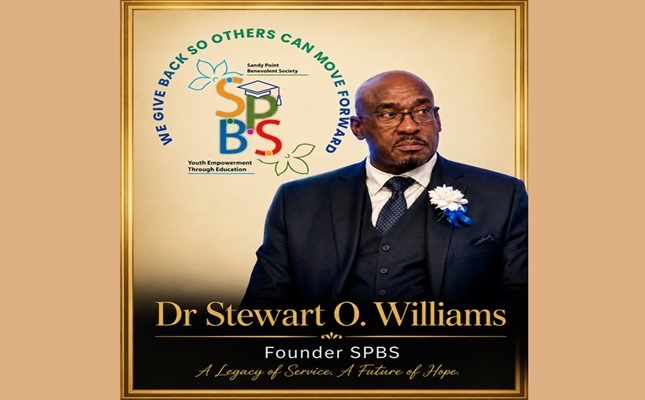
    Sandy Point Benevolent Society (SPBS) mourns the passing of Founder and President, Dr. Stewart Orlyn Williams

    The Sandy Point Benevolent Society (SPBS), a leading non-profit focused on educational empowerment and community outreach, has confirmed the passing of its visionary founder and sitting president, Dr. Stewart Orlyn Williams. Dr. Williams died peacefully on June 26, 2026, after a months-long public battle with glioblastoma, an aggressive and incurable form of brain cancer. The official announcement of his death was released by SPBS in a press statement dated July 2, 2026.

    A native of the Sandy Point community, Dr. Williams was a 1976 alumnus of Sandy Point High School and built a respected professional career as a chemist. But his most enduring impact came from his lifelong commitment to lifting up the next generation in his hometown. What started as a small project among seven close friends to honor top-performing students at the local high school through the Principal’s Award grew dramatically under Dr. Williams’ steady leadership, eventually evolving into the formal non-profit SPBS nearly 20 years ago.

    Over the course of his decades of service, Dr. Williams held the role of SPBS president twice: first from 2005 to 2009, and again from 2015 until his passing in 2026, making him the organization’s longest-serving president to date. Driven by unshakable dedication, radical integrity, and deep compassion for his community, he expanded SPBS’ programming to include need-based scholarships, one-on-one youth mentorship, accessible educational resources, and broad charitable outreach across the region. Thousands of young people have benefited from these initiatives, going on to launch successful careers as doctors, accountants, educators, religious leaders and other professionals that might otherwise have been out of reach.

    Beyond his public contributions, those who knew Dr. Williams remember him as a devoted spouse and father, a loyal confidant, and a thoughtful leader whose quiet generosity and sharp wisdom left a mark on every person he met. His core belief—that those who have succeeded owe a debt to lift up those coming behind them—became the foundational ethos of SPBS, and is still reflected in the organization’s mission statement: “We give back so others can move forward”.

    Dr. Williams is survived by his loving wife Vernice Williams, his three daughters Sherise, Lauren, and Allison, his beloved grandchildren, his brother Lorenza “Larry” Williams, and a wide network of extended family, friends, colleagues, and community members whose lives he transformed through his work.

    The SPBS Executive Board and entire membership have extended their deepest sympathies to the Williams family, saying they are praying for divine comfort, resilience, and peace for the family during this period of grief. While the organization mourns the loss of its founding leader, members are also celebrating the extraordinary life of purpose and service Dr. Williams built.

    In a commitment to honor his legacy, SPBS has pledged to carry forward the work Dr. Williams spent decades building, continuing to expand access to educational opportunity, mentorship, and community service that transforms lives. Dr. Williams’ impact will not end with his passing; his legacy will continue to guide and inspire generations of community leaders and SPBS members for years to come.

    Rest well, Dr. Stewart O. Williams. Your work on earth is done, but the good you created lives on forever.

  • Lowmans man charged over murder of St. Lucian

    Lowmans man charged over murder of St. Lucian

    Authorities in St. Vincent and the Grenadines have secured murder charges against a 21-year-old Lowmans Hill resident in connection with a fatal shooting that claimed the life of a 34-year-old St. Lucian man, Troy Cassely, in the West Kingstown neighborhood on June 23. Alongside the murder count, suspect Delroy Harry faces two additional counts of attempted murder stemming from the same violent incident, which left two other local men injured: a 33-year-old from Campden Park and a 22-year-old from Lower Questelles. Per standard protocol, law enforcement has not released the names of the two wounded men to protect their privacy.

    The series of gunshots was reported to local police shortly after 5:00 p.m. that afternoon. When first responders arrived at the scene, they found Cassely with multiple gunshot wounds across his body. A district medical officer officially pronounced the 34-year-old dead at the site of the attack. Harry is scheduled to be arraigned at the territory’s Serious Offences Court in the coming days.

    In an official statement released Wednesday, the Royal St. Vincent and the Grenadines Police Force (RSVGPF) reaffirmed its unwavering commitment to combating violent crime across the islands, noting that all investigations are conducted with strict discipline, rooted in solid evidence, and pursued with consistent persistence. The force publicly commended the investigative team from its Major Crime Unit and all supporting personnel for their concentrated, thorough work throughout the probe into the June 23 shooting.

    Law enforcement is still calling on members of the public who hold any additional details that could advance the investigation to come forward. Tips can be submitted directly to police through two dedicated contact lines: 456-1810 or 457-1211. To close the statement, the RSVGPF once again extended its deepest condolences to Cassely’s family and friends, who are mourning his loss.

  • Staatsolie renoveert twee scholen in Commewijne voor SRD 5,2 miljoen

    Staatsolie renoveert twee scholen in Commewijne voor SRD 5,2 miljoen

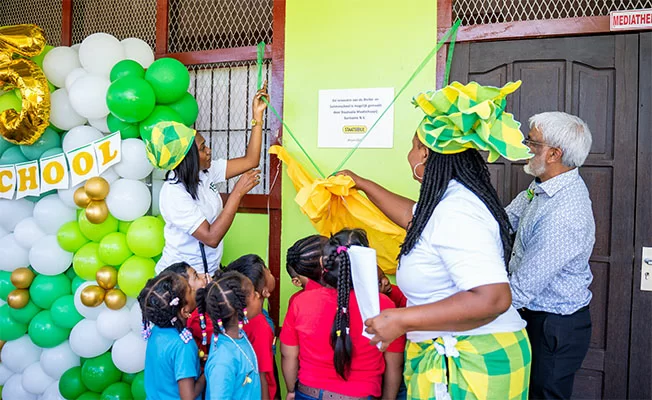
    On June 29, a landmark handover ceremony marked the completion of major renovation works at two public schools in Leliëndaal, Commewijne, Suriname, transforming learning conditions for nearly 300 students and teaching staff. The project, carried out by Staatsolie Maatschappij Suriname N.V. (Suriname State Oil) as part of the company’s 45th anniversary corporate social responsibility program, injected approximately 5.2 million Surinamese dollars into upgrading the H.M. Bielkeschool (GLO) and Saliminschool (MULO), coinciding with the H.M. Bielkeschool’s own 105th founding celebration.

    Before the renovation, deteriorating infrastructure at H.M. Bielkeschool had rendered many classrooms unfit for consistent use, forcing disruptions to daily classes for enrolled students. The comprehensive overhaul addressed critical structural issues: the project team fully replaced the aging roof, damaged ceilings, crumbling interior walls, outdated doors and windows, and worn security mesh across campus. Additionally, the covered connecting walkway linking the two neighboring schools, which had fallen into dangerous disrepair, was also fully restored to safe working condition.

    Speaking at a post-handover thanksgiving service, Cherida Kwasie, principal of H.M. Bielkeschool, expressed profound gratitude for the intervention. “Our school now shines again, it feels welcoming, and most importantly, it is a safe space for every person who learns and works here,” Kwasie said. “This effort has touched so many hearts, and we hope it inspires other organizations to continue investing in our schools and Suriname’s education sector as a whole.” Cheira Denswil, principal of Saliminschool, also shared her public appreciation for the completed works during the event.

    The ceremony was attended by key stakeholders, including Staatsolie Managing Director Annand Jagesar, representatives from the Commewijne District Commission, and board members of the Evangelical Brethren Community Education Foundation of Suriname, which oversees the institutions.

    Staatsolie officials emphasized that the school renovation project forms one piece of a far broader 45th anniversary social investment initiative rolling out across the country. Beyond education-focused projects, the program also targets support for socially vulnerable groups, institutional capacity building, public recreation infrastructure, and community sports development. The company’s core goal with these education investments is to foster safe, motivating learning environments that empower Suriname’s young people to pursue long-term personal and professional growth.

    As of the handover, a portion of the anniversary-themed community projects have been completed, with remaining works still ongoing. According to Staatsolie leadership, these initiatives reinforce the company’s commitment to corporate social responsibility and its mission to deliver sustainable, long-term contributions to national development across Suriname.

  • Belize Unveils Theme for 45th Independence

    Belize Unveils Theme for 45th Independence

    On July 1, 2026, Belize took a key first step toward its upcoming 45th Independence anniversary celebrations, with the National Celebrations Commission officially unveiling the year’s unifying rallying cry: “Look At Me: I Am Belize at 45.” The winning theme was submitted by Amber Mariano, and will anchor all national September festivities held across the country this year.

    Unlike general themes that center national institutions or major historical milestones, this year’s selection was crafted to shine a spotlight on the ordinary Belizeans whose quiet, consistent contributions have built and shaped the nation over its 45 years of independence. Speaking at the official theme launch, Minister of Culture Francis Fonseca walked through the rigorous, inclusive selection process that led to the final pick.

    Every year, the national theme selection draws thousands of submissions from communities across every corner of Belize, with ordinary citizens eager to participate in shaping the narrative of their national celebrations. A dedicated committee reviews all entries to narrow down the options, and this year, “Look At Me: I Am Belize at 45” stood out for its fresh, introspective angle.

    Fonseca explained that the core spirit of the theme is to encourage national reflection at this 45-year milestone. Rather than only looking back at collective history, the theme calls on every individual Belizean to turn inward and examine their own role in the country’s ongoing growth. “What am I doing to make Belize better? How am I contributing to the growth and development of Belize?” Fonseca said, outlining the core questions the theme poses.

    For Fonseca himself as a public servant, the theme translates to a personal challenge: to push himself to do more for Belize and serve the population more effectively. That same challenge extends to all professions across the country: for media workers, it means asking how they can become more committed, responsible reporters and creators; for teachers, it means reflecting on how they can better nurture the next generation of Belizeans; for private sector workers, it means considering how their work lifts local communities. In every sector, the theme invites personal accountability and renewed dedication to national progress.

    With the theme now officially announced, full-scale preparations for the September national celebrations are kicking off across all regions of Belize, bringing communities together to mark the 45th year of independence around the unifying message of introspection and collective commitment.

    This report is adapted from a transcript of an original television evening newscast.

  • President wil leerstoel over slavernijverleden en Afrikaanse geschiedenis

    President wil leerstoel over slavernijverleden en Afrikaanse geschiedenis

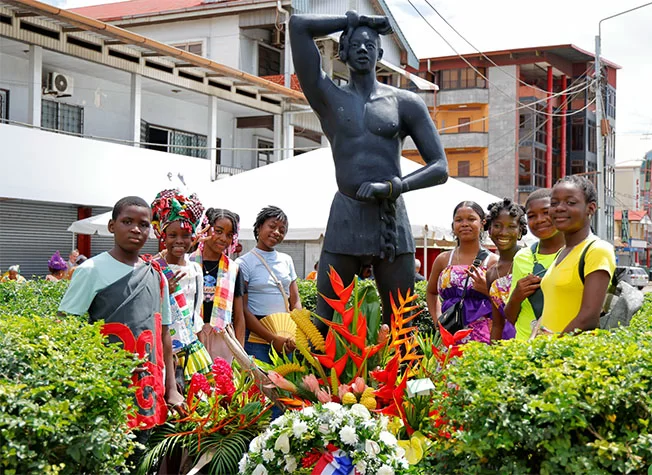
    On July 1, during the annual Keti Koti commemoration marking the abolition of slavery, Suriname President Jennifer Simons has announced a landmark push to expand scholarly research into the nation’s history of enslavement and the broader legacy of African civilizations. Speaking after a wreath-laying ceremony at the Kwakoe monument on Dokter Sophie Redmondstraat, Simons outlined plans to establish a dedicated university chair focused on the history of slavery, African heritage, and the global contributions of African civilizations to human development.

    In her remarks at the event, which was jointly organized by the Committee for the Commemoration of the Abolition of Slavery and the Feydrasi Fu Afrikan Srananman under the theme “Recognition, Justice and Development”, Simons pushed back against incomplete historical narratives that reduce African history solely to the era of transatlantic chattel slavery. “Africans were not inherently enslaved people,” she emphasized. “Long before the slave trade, they built sophisticated kingdoms, advanced systems of governance, pioneered scientific knowledge, and cultivated extraordinary rich cultural traditions. For far too long, this full history has been erased and hidden from mainstream education and public discourse.”

    Simons stressed that rigorous independent academic research is a foundational step to building a more complete, balanced understanding of national and global history. She also highlighted the role of Suriname’s annual Heritage Month, held each August, as a key platform to advance public education around cultural heritage, cross-community connection, and national identity. The month-long initiative is designed to create space for all of Suriname’s diverse population groups to explore their own unique histories and learn about the ancestral backgrounds of fellow communities.

    The president called on all sectors of Suriname’s multi-ethnic society to work collectively to foster greater mutual understanding and social cohesion. Referencing the country’s long-held concept of a “mamio-society” – a community rooted in shared living and mutual care – Simons noted that learning about one another’s histories is the pathway to deeper self-understanding as a nation. “This shared understanding is the only solid foundation we can build upon to move forward together as one nation, rooted in pride, freedom, and mutual respect for all,” she said.

    Simons also re-framed the meaning of the 1863 abolition of slavery, rejecting the common narrative that framed emancipation as a gift from colonial rulers. Instead, she emphasized that the end of chattel slavery was the hard-won outcome of the relentless courage and resistance of generations of enslaved people. She further noted that the intergenerational impacts of slavery on identity, cultural belonging, and human dignity continue to shape Suriname’s society today, meaning the process of national repair and healing is far from over.

    “For decades, the prevailing narrative said the harm of slavery is all in the past, that it’s over and done with,” Simons said. “But it is not over. It will only reach closure when we come together to do the work of healing and repair. That work begins with recognition, open dialogue, remembrance, and honest understanding of what our ancestors endured.”

  • Guns, ganja seized

    Guns, ganja seized

    On Wednesday, July 1, 2026, Guyana’s Customs Anti-Narcotics Unit (CANU) announced a major law enforcement operation that yielded one of the recent larger illicit drug and weapons hauls in the capital region. Acting on intelligence, CANU agents targeted a residential property on Princes Street, located in the Lodge neighborhood of Georgetown, the country’s capital.

    During the search of the premises, law enforcement officers recovered a substantial stockpile of contraband: 86 separate parcels of imported marijuana with a total weight of 98.32 pounds, valued at approximately 80 million Guyanese dollars. Alongside the narcotics, investigators also seized an arsenal of illegal firearms, including four semi-automatic pistols and one rifle.

    In a statement following the raid, CANU confirmed that two Guyanese men were taken into custody at the scene, and are currently being held for interrogation in connection with the suspected trafficking operation. The agency has not yet released further details about the identities of the arrestees, or whether investigators believe the network is connected to larger cross-border drug trafficking operations operating in the region.

    The seizure underscores ongoing efforts by Guyana’s anti-narcotics agencies to crack down on the illicit flow of controlled substances and illegal weapons into the country, particularly as transnational criminal networks continue to target Caribbean nations as transit hubs for drug trafficking bound for North American and European markets.

  • Sport ‘can help steer’ youth away from crime

    Sport ‘can help steer’ youth away from crime

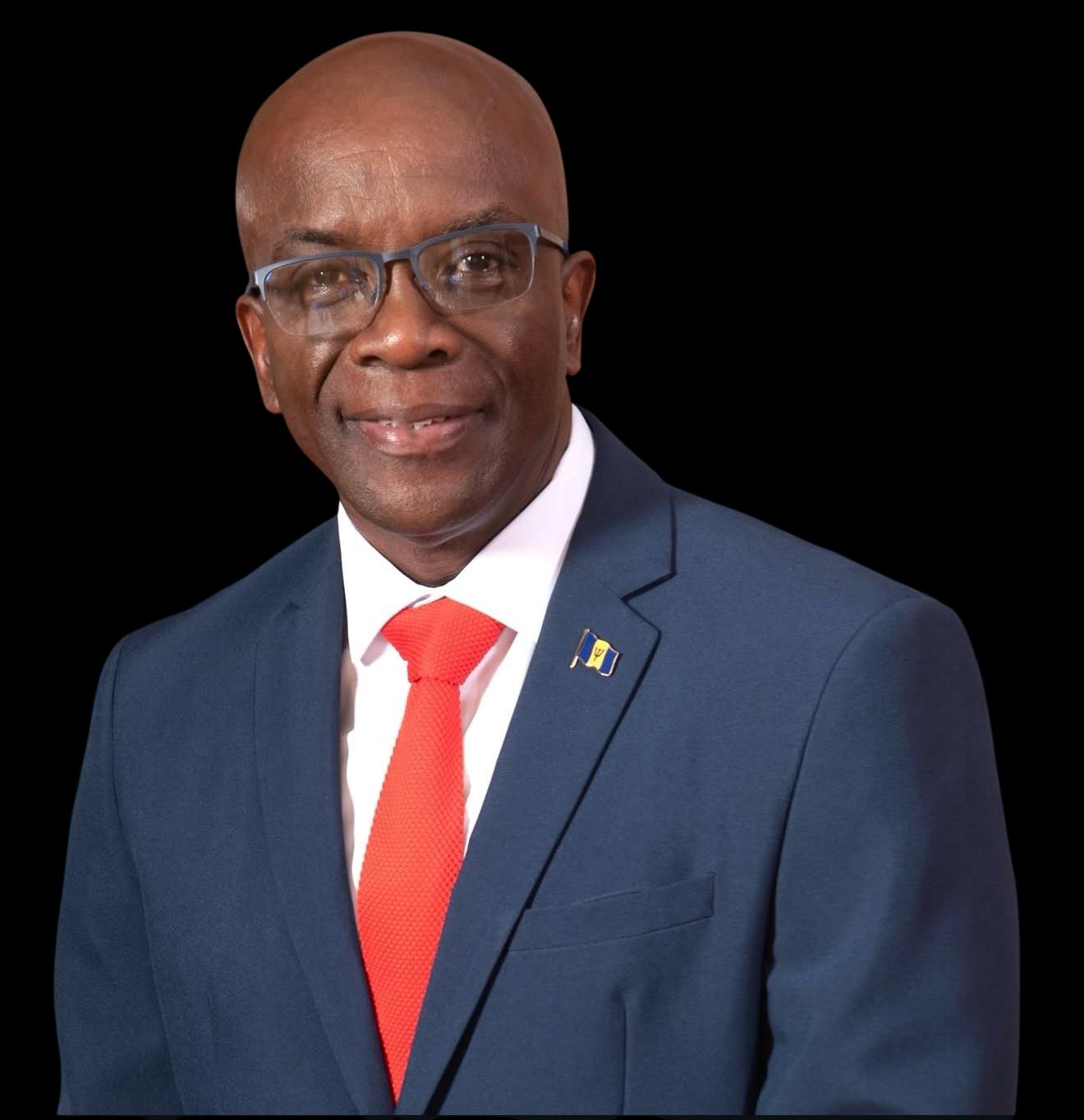
    Barbados is grappling with a sharp upward trend in violent crime, and the island nation’s top sports official is calling for sport to be positioned as a core strategy to steer at-risk young people away from violence and toward life-changing positive opportunities. Charles Griffith, Minister of Sports and Community Empowerment, laid out his vision in an official statement emphasizing that while law enforcement remains a critical pillar of public safety, meaningful crime prevention must start long before any offense is committed — by strengthening family and community structures and opening tangible, accessible pathways for youth.

    Griffith acknowledged the widespread anxiety that the recent crime wave has sparked across all segments of Barbadian society. As of the current year, the country has recorded 28 homicides, a toll that has left dozens of families grieving lost loved ones, communities shaken by pervasive fear and uncertainty, and the entire nation engaged in urgent reflection on how to reverse this troubling trajectory. Offering his sincere condolences to all households affected by the killings, Griffith stressed that the moment calls for solution-focused action rather than despair. “This is not a moment for despair. It is a moment for action, reflection and collective responsibility,” he said.

    The minister pushed back against the idea that increased policing alone can resolve Barbados’ ongoing crime crisis. “While we fully support the efforts of the Barbados Police Service and all agencies involved in maintaining law and order, we must recognise that building a safer society requires more than enforcement alone,” Griffith explained. “Crime prevention begins long before an offence is committed. It starts with strong families, supportive communities, positive role models and meaningful opportunities for our people, particularly our young people.”

    Against that backdrop, Griffith made the case that sport holds unique transformative power to shape the trajectories of young Barbadians and reinforce community cohesion. Beyond athletic achievement and competition, he argued, sport instills core life values that support positive development: discipline, collaborative teamwork, mutual respect, adaptive leadership and persistent perseverance. These foundational skills create space for intentional personal growth and cross-generational social connection, while offering consistent structure, a clear sense of purpose, and a feeling of belonging for young people who may otherwise lack access to supportive networks. Most importantly, Griffith noted, sport provides young people with a positive outlet to channel their energy, talent and ambition, rather than pushing them toward harmful, violent activity.

    Many Barbadians across generations have already attested to sport’s stabilizing impact, Griffith shared, with countless residents crediting athletic programs with helping them stay focused during personal and communal hardship, while opening doors to higher education, professional careers, and lifelong mentorship relationships.

    Building on that proven impact, the Ministry of Sports and Community Empowerment will continue expanding investments in community-centered programs, youth outreach initiatives, accessible sporting opportunities, and personal development workshops, all designed to build confidence and transferable life skills for the island’s young people. Griffith clarified that these investments are far more than investments in recreation: “These efforts are not simply about recreation. They are about building character, encouraging responsibility and providing positive alternatives to the influences that can sometimes lead young people down the wrong path.”

    In a direct appeal to Barbadian youth, Griffith urged young people to reject violence as a solution and actively leverage the public and community opportunities available to them. “Your future is worth protecting. Do not allow anyone to convince you that violence is a pathway to respect or success. Real strength is found in discipline, real confidence comes from achievement, real leadership comes from making positive choices, even when faced with challenges or adversity,” he said. He encouraged all young residents to join local sports clubs, participate in community programming, connect with trusted mentors, nurture their unique talents, and pursue their personal and professional goals with intentionality and determination.

    Griffith also extended a call to collective action across all sectors of Barbadian society, urging parents, teachers, sports coaches, faith-based organizations, community leaders and private sector businesses to collaborate to support the nation’s youth. He emphasized that sustained reduction in crime and violence requires a whole-of-society commitment that extends far beyond government action.

    Closing his statement, Griffith reaffirmed the ministry’s ongoing commitment to partnering with communities and cross-sector stakeholders across Barbados to expand youth-accessible opportunities that foster participation, personal empowerment and inclusive growth. The ministry’s core goal, he said, is to encourage young people to choose purpose over violence, achievement over criminal activity, and empowerment over hopelessness.

  • The Latest Upgrade for Toledo Farmers

    The Latest Upgrade for Toledo Farmers

    For agricultural producers across Trio Village and its surrounding communities in southern Belize’s Toledo District, a long-awaited infrastructure upgrade has dramatically simplified daily work, cutting a grueling two-hour commute to their fields down to a mere 10 minutes.

    The transformation comes following the official completion of the new Trio Bridge, a development highlighted by Dr. Osmond Martinez, the area’s representative for Toledo East. Prior to the project’s completion, farmers faced a lengthy, arduous journey between their home village and agricultural plots, a barrier that ate into working hours and raised operational costs for small-scale producers.

    “In the past, the farmers used to take about two hours from the village to the farm. Now it’s only taking them about five to ten minutes to get there,” Martinez explained in a statement confirming the project’s handover to local communities.

    The infrastructure initiative was delivered as part of the Resilient Rural Belize Programme, a broader development scheme focused on improving livelihoods for agricultural communities across the country. Funding for the bridge project came from multiple partners: the Green Climate Fund provided core financing, matched by counterpart funding from the Government of Belize, with additional in-kind and financial contributions from local beneficiaries who stand to gain from the upgrade.

    Martinez emphasized that the impact of the project extends far beyond the new bridge itself. As part of the scheme, contractors have also paved nearly four miles of rural roadway connecting Trio Village directly to outlying farm plots, eliminating the muddy, uneven routes that slowed travel during rainy seasons for decades.

    Looking ahead, plans are already in motion to expand the connectivity gains. “Now we are in the process of getting the finance from CDB to do the upgrading of the road from the village to the southern highway, which will be paved as well,” Martinez added. The upcoming upgrade will connect the improved local road network to Belize’s main southern arterial highway, opening faster, more reliable routes for farmers to transport their harvests to regional markets and export hubs.