分类: politics

  • STATEMENT: H.E. Melvin Bouva, Chair of the Council for Foreign and Community Relations (COFCOR) closing session of the 29th meeting of COFCOR

    STATEMENT: H.E. Melvin Bouva, Chair of the Council for Foreign and Community Relations (COFCOR) closing session of the 29th meeting of COFCOR

    Against a backdrop of sweeping global geopolitical transformation, the 29th Meeting of the Council for Foreign and Community Relations (COFCOR) of the Caribbean Community (CARICOM) concluded its two-day deliberations in Paramaribo, Suriname on May 21, 2026. Chaired by Suriname’s Minister of Foreign Affairs, International Business and Cooperation, the gathering brought together foreign ministers from across CARICOM member states, alongside CARICOM Secretary-General Dr. Carla Barnett and outgoing COFCOR Chair Dr. Denzil Douglas, Foreign Minister of Saint Kitts and Nevis, to map a unified strategy for the bloc amid growing global uncertainty.

    The meeting opened with a clear recognition that small island and low-lying coastal developing states across the Caribbean face amplified vulnerabilities driven by intensifying great power competition, volatile energy markets, and stubbornly persistent inflation. In addition to formal plenary sessions, participants held closed-door, in-depth discussions on how CARICOM can navigate ongoing geopolitical headwinds, with a focus on strengthening coordinated foreign policy and advancing strategic expansion of the community.

    Participants reached a core consensus that unified action and the deliberate diversification of international partnerships remain the most effective tools for countering global instability and advancing inclusive sustainable development for Caribbean populations. To advance this goal, the gathering carried out a comprehensive review of CARICOM’s existing and emerging relationships with key global partners.

    Among the key developments in bilateral cooperation, delegates explored the establishment of a new CARICOM-Saudi Arabia Joint Collaboration Mechanism, called for deeper institutional engagement with the United Kingdom, and accepted an Austrian offer to host a joint CARICOM office in Vienna to boost the bloc’s multilateral presence. Productive talks with United Arab Emirates Special Envoy Omar Shehadeh advanced negotiations on a proposed Comprehensive Economic Partnership Agreement (CEPA), a deal that would dramatically expand CARICOM’s market access across the Middle East, Africa, and Asia.

    Delegates also held productive exchanges with Japanese Parliamentary Vice Minister for Foreign Affairs Eri Arfiya, acknowledging the strong momentum in ongoing technical cooperation focused on priority areas including disaster risk reduction, sargassum seaweed management, and industrial diversification. Participants reaffirmed the critical value of Japan’s longstanding support in addressing the unique structural vulnerabilities facing small island developing states. Talks with Singaporean Foreign Minister Dr. Vivian Balakrishnan centered on strengthening collaboration between small nations to amplify their collective voice in global governance and strengthen their negotiating positions in international forums.

    Beyond bilateral ties, COFCOR delegates examined a range of pressing issues in multilateral and hemispheric affairs. On United Nations reform efforts, the bloc issued a caution that plans to boost efficiency through a shift to centralized regional hubs must not weaken in-country technical expertise, reduce institutional responsiveness to regional needs, or marginalize core Caribbean priorities such as climate resilience and disaster response. The meeting also included deliberations on ongoing developments at the Organization of American States, including work on the Draft Inter-American Declaration on the Rights of Persons and Peoples of African Descent. Ministers received updated briefings on progress within the Association of Caribbean States and the expanding CARICOM-African Union strategic partnership.

    The ongoing crisis in Haiti remained a top regional priority for attendees. Delegates reaffirmed CARICOM’s unwavering commitment to supporting Haitian-led solutions to restore peace and stability in the neighboring country. Ministers emphasized the urgent need for scaled-up international humanitarian funding to address acute food insecurity and the displacement of more than 1.4 million Haitians. CARICOM will continue to coordinate closely with regional and global partners to advance long-term stability and sustainable progress for the Haitian people.

    On longstanding regional border disputes, the meeting reaffirmed CARICOM’s unshakable solidarity with Belize and Guyana amid their ongoing territorial disputes with Guatemala, Honduras, and Venezuela respectively. After receiving updated briefings from both governments on the status of their claims, delegates confirmed the community’s full support for the security, sovereignty, and territorial integrity of the two member states, and reaffirmed commitment to resolving all disputes through peaceful, judicial processes.

    In discussions of CARICOM’s strategic enlargement, delegates reviewed progress on membership applications from two prospective new members: Bermuda, which has applied for full membership, and French Guiana, which is seeking associate membership. Participants recognized that expansion offers significant opportunities to amplify CARICOM’s global voice and extend its geographic and economic reach, while committing to ensuring that any growth preserves the bloc’s core values and foundational integration goals.

    In closing remarks, chairing officials emphasized that the two days of deliberations delivered a clear, unambiguous conclusion: for CARICOM, unity and collective action are no longer optional policy choices — they are existential strategic imperatives. At a moment of rapid global power realignment, fragmented action would risk pushing the Caribbean bloc to the margins of the emerging global geopolitical order. Delegates departed the meeting with a renewed sense of collective purpose and a firm commitment to deepening policy coordination, ensuring that expanded partnerships and a stronger global voice deliver tangible improvements in security, prosperity, and well-being for every citizen across the CARICOM community.

  • Minister Wijnerman verdedigt uitstel Comptabiliteitswet 2024 tot 2029

    Minister Wijnerman verdedigt uitstel Comptabiliteitswet 2024 tot 2029

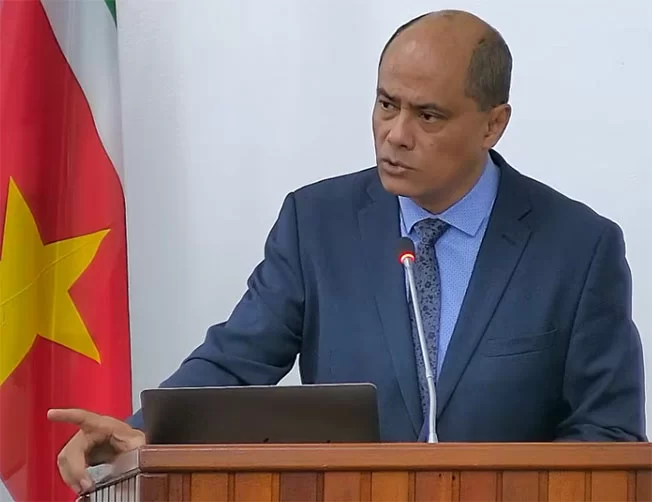
    On a Thursday evening in mid-May, Suriname’s Minister of Finance and Planning Adelien Wijnerman stood before the National Assembly to defend the administration’s controversial proposal to postpone the full enforcement of the 2024 Public Finance Accounting Law until the 2029 fiscal year.

    Minister Wijnerman argued that critical regulatory frameworks, administrative digital systems and institutional preparedness measures remain far from complete for the new legislation to take full effect. Until the end of the 2028 fiscal cycle, the 2019 version of the Public Finance Accounting Law will remain in force to govern government budgeting and financial reporting processes. After hours of extensive parliamentary debate, lawmakers voted to adjourn further deliberation on the proposal until the following Tuesday.

    Rossellie Cotino, chair of the committee of rapporteurs from the National Democratic Party (NDP), outlined the sequence of events that led the current government to request the delay. According to Cotino, the 2026 fiscal budget circulars should have been distributed to all government ministries by May 2025 under the original 2024 law timeline. When the current administration took office, however, it found that the entire 2026 budget had already been drafted in alignment with the 2019 law’s requirements.

    This left the finance minister with two unappealing options: withdraw all completed budget documents and restart the entire drafting process under the new regulations, or ask the National Assembly to grant an extension to the 2024 law’s implementation. Cotino explained that policymakers ultimately opted for a legislative amendment to delay implementation because an on-the-ground assessment found almost no meaningful preparatory work had been completed to make the new law operational.

    Cotino detailed a long list of bottlenecks that currently block full rollout of the reform. Multiple mandatory implementing regulations, budget guidelines and institutional overhauls are still missing. Ministry-level Budget and Financial Affairs (BFZ) departments are not adequately trained or structured to take on their expanded new responsibilities under the law.

    Other unresolved issues include the lack of formalized inter-ministerial collaboration protocols, standardized financial processes, rules for audit committees, budget administration frameworks and asset management systems. Staff training programs have not yet been developed, and the country’s current Integrated Financial Management System (IFMS) does not meet the reporting requirements set out by international International Public Sector Accounting Standards (IPSAS), which the new law mandates adoption of.

    The proposal has drawn fierce pushback from the opposition. VHP party leader Asis Gajadien argued that the delay amounts to a full retreat to the outdated old financial system and puts critical much-needed public finance reforms on hold. He warned that as Suriname prepares to receive substantial future oil revenue, the country cannot afford to weaken public financial discipline or erode state institutional capacity.

    Gajadien contended that implementation challenges should not be an excuse to suspend reform efforts, but rather a motivation to speed up rollout work. Instead of a multi-year delay, he called for a phased implementation of the 2024 law, paired with clear binding deadlines, concrete implementing arrangements and mandatory annual progress reports to the National Assembly.

    In response, Minister Wijnerman reaffirmed the current government’s commitment to eventually implementing the 2024 accounting law, but stressed that a thorough assessment confirms the country cannot meet all legal requirements for the 2026, 2027 and 2028 fiscal cycles. Key outstanding mandates required by the new law that are still missing include a five-year financial plan, a budget policy memorandum, formal budget rules, and primary expenditure ceilings.

    The minister also emphasized the need for sweeping changes to government processes and digital infrastructure across all departments. Full implementation of the law requires a structured, step-by-step approach and major upgrades to human capacity, IT systems and financial workflows across all ministries. Based on the government’s detailed implementation roadmap, the administration has concluded that a three-year preparation period is necessary before the law can take full effect in 2029.

  • Government convenes policy review for new Youth Economic Empowerment Bureau

    Government convenes policy review for new Youth Economic Empowerment Bureau

    Basseterre, Saint Kitts – May 22, 2026 – As Saint Kitts and Nevis’ economy continues its steady expansion, the national government is moving forward with a targeted initiative to unlock youth entrepreneurial potential, convening a cross-sector validation workshop on Friday to refine the policy framework for the newly proposed Youth Economic Empowerment Bureau.

    Hosted at the St. Kitts Cooperative Credit Union Conference Room at the intersection of Cayon and Church Street, the workshop brought together a diverse cohort of stakeholders to shape the bureau’s mandate and operational structure. Attendees included senior public sector officials, leadership from local financial institutions, elected youth representatives, and private sector industry leaders, all brought together to provide on-the-ground input, validate preliminary findings, and refine the bureau’s proposed operating framework.

    Hon. Isalean Phillip, Minister of State with oversight for youth empowerment, opened the workshop by thanking participants for contributing their specialized expertise to the co-design process. She emphasized that the government is prioritizing inclusive, deliberate consultation over rushed implementation to ensure the bureau meets the actual needs of young aspiring entrepreneurs across the federation.

    “This gathering is about bringing all of you to the table to be part of the policy shaping process as we build this new bureau from the ground up,” Phillip explained. “We are taking the time to get this right, gathering input from every group that will be impacted, and validating the data and feedback we have already collected to build something that works for our young people.”

    Phillip reaffirmed the administration’s core commitment to removing systemic barriers that prevent young people from turning their ideas into sustainable businesses, crediting Prime Minister and Minister of Finance Hon. Dr. Terrance Drew with driving the vision for the new initiative. She highlighted that the federation’s greatest asset is its skilled, creative young population, an integral part of Saint Kitts and Nevis’ global reputation for strong human capital.

    “He truly believes in the talent of our young people – and we do have extraordinary talent right here,” Phillip said. “That is what makes Saint Kitts and Nevis special: our human capital, and our young people are stepping up every day to prove that.”

    Once established, the Youth Economic Empowerment Bureau will serve as a cornerstone of the government’s economic development strategy, focused explicitly on fostering a culture of youth entrepreneurship and supporting the long-term sustainability of micro and small business startups launched by young citizens. The initiative comes as growing consumer demand across multiple sectors of the economy creates new opportunities for emerging small businesses, and the government aims to position young entrepreneurs to capitalize on these growing market needs.

  • Prime Minister Drew champions youth innovation and economic empowerment at Validation Workshop

    Prime Minister Drew champions youth innovation and economic empowerment at Validation Workshop

    BASSETERRE, Saint Kitts – On May 22, 2026, Prime Minister and Minister of Finance Dr. Terrance Drew used the opening of the national Youth Economic Empowerment Bureau Validation Workshop to shine a spotlight on the untapped potential of Saint Kitts and Nevis’ young population, while locking in the government’s pledge to build a supportive ecosystem for youth innovation and entrepreneurship.

    Addressing a room of stakeholders, youth leaders and workshop participants, Drew urged the federation’s young people to reject limitations imposed by the nation’s small geographic size and population, adopt a global outlook, and position themselves as active contributors to the fast-interconnected global economy. “The world is your stage, and you must see yourself as capable of competing and succeeding on that stage,” he told attendees, noting that widespread technological advancement and open access to information have opened unprecedented new pathways for young innovators to turn ideas into economic opportunity.

    Drew pointed to recent standout successes by local youth groups to illustrate just how much young people in the federation can achieve. The St. Kitts and Nevis Robotics Association, he noted, developed an electronic health record system that earned a top ranking among Caribbean innovations from the Pan American Health Organization (PAHO) – a recognition that has now translated into a major commercial contract valued at roughly 5 million Eastern Caribbean dollars. He also highlighted the Clarence Fitzroy Bryant College AI Association, which took top honors at a regional tech competition after building interactive stock market learning tools to upgrade the government’s ASPIRE Programme, expanding financial literacy access for young people across the country.

    “These accomplishments demonstrate that the youth of Saint Kitts and Nevis can compete with anyone in the region and beyond,” Drew said. “Our size does not define our potential.”

    The core focus of Friday’s workshop is refining the framework for the upcoming Youth Economic Empowerment Bureau, a new government entity designed to cut through red tape and deliver comprehensive support to young people with entrepreneurial ambitions. Once launched, the bureau will connect emerging youth business owners to critical resources: hands-on mentorship, accessible financing pathways, targeted skills training, and specialized technical support.

    The initiative is structured to help young founders meet growing demand for expanded services across Saint Kitts and Nevis, while integrating young people into fast-growing emerging sectors including sustainable tourism, modern agriculture, digital technology, and the creative orange economy. Drew emphasized that economic empowerment is not limited to scaling large enterprises, noting that small and micro-businesses are the unsung backbone of sustained national economic growth.

    “We cannot underestimate the power of small and micro businesses,” he said. “A small idea, properly supported, can transform a family, strengthen a community, and contribute to national development.”

    Friday’s validation workshop is a key part of the government’s collaborative consultative process, which will gather input from stakeholders to strengthen and fine-tune the bureau’s operating framework before it rolls out formally to the public.

  • United States Announces $8 Million in New Support for Caribbean Forensic Capabilities

    United States Announces $8 Million in New Support for Caribbean Forensic Capabilities

    Against a backdrop of rising transnational synthetic drug trafficking threatening Caribbean security, the United States has announced an $8 million investment in new support for regional forensic capabilities, unveiled during the second Caribbean Regional Forensic Leadership Summit held in Saint Lucia from May 20 to 22, 2026.

    This new funding package will deliver cutting-edge synthetic drug detection technology to Caribbean forensic laboratories, alongside specialized technical training for local personnel and expanded operational collaboration with the U.S. Drug Enforcement Administration (DEA). The three-day summit, hosted jointly by the Saint Lucia Forensic Science Laboratory and the U.S. Department of State under the long-standing Caribbean Basin Security Initiative (CBSI), gathered forensic leadership and security stakeholders from 14 Caribbean nations, including a delegation from the Royal St. Christopher and Nevis Police Force Forensic Services Department.

    The core objectives of the funding and summit align with shared regional priorities: upgrading local capacity to detect fentanyl and other illicit synthetic drugs, cutting persistent backlogs in forensic laboratory processing, and strengthening the quality of forensic evidence that meets admissibility standards for criminal courts prosecuting transnational organized crime groups. Beyond technical upgrades, the summit brought together forensic scientists, senior prosecutors, security agency leaders, and representatives from two key regional bodies—the Regional Security System and CARICOM IMPACS—to align strategies for deeper cross-border cooperation against evolving criminal and drug threats.

    “This partnership between the United States and Caribbean nations reflects a shared, unwavering commitment to disrupting dangerous criminal networks and countering the rapidly shifting drug threats that impact communities across our region,” noted U.S. Chargé d’Affaires Sarah Nelson in remarks during the summit.

    The event also marked two landmark milestones for regional security cooperation. Attendees launched the Caribbean Forensic Scientific Working Group, the first region-wide coordinated platform that connects Caribbean forensic practitioners directly with U.S. forensic experts to harmonize operational standards, improve evidence reporting protocols, and streamline ongoing collaborative efforts. Separately, Saint Lucia and Guyana made history as the first Caribbean countries to roll out the DEA’s Global Uniform Reporting and Drug Seizure (GUARDS) program, a standardized system for analyzing and documenting seized drug-related substances.

    The new investment builds on 16 years of security partnership under the CBSI framework. Launched in 2010, the initiative has brought together the U.S. and Caribbean nations including Saint Kitts and Nevis to systematically strengthen regional security infrastructure, disrupt drug trafficking operations, and dismantle transnational criminal organizations operating throughout the Caribbean basin.

  • “The General of the Army is Cuba, and Cuba must be respected”

    “The General of the Army is Cuba, and Cuba must be respected”

    On May 22, 2026, Cuban President and First Secretary of the Communist Party Miguel Díaz-Canel Bermúdez issued a forceful rebuke of the United States Department of Justice’s unsubstantiated accusation against revolutionary leader Raúl Castro Ruz, using his social media platform to galvanize national unity in the face of what Cuban officials frame as renewed imperial aggression.

    Díaz-Canel emphasized that this latest provocative action by Washington has only deepened solidarity across the island nation, strengthening the long-held sense of national honor, dignity, and anti-imperialist resolve that has defined Cuba’s position in global affairs for decades. “The General of the Army is Cuba, and Cuba must be respected,” he stated in his online address. “The heroes of the Homeland are not to be disrespected, nor are history and traditions to be offended without response. Not in Cuba.”

    Per the Cuban president’s account, the unfounded prosecution attempt against the revolutionary leader in a U.S. court represents the most recent in a long line of provocations from what Cuban leaders describe as the nation’s historic adversaries. He noted that despite decades of systemic economic hardship and critical supply shortages driven largely by the U.S. trade embargo – which the Cuban government describes as a genocidal blockade – the Cuban people have stood firm in rejecting outside interference.

    “Our people have fiercely risen above the daily hardships and shortages, caused primarily by the genocidal blockade, to respond to the latest infamy of the Cuban nation’s historical enemies: the attempt to prosecute the leader of the Revolution in a U.S. court,” Díaz-Canel wrote. He added that the new attack has “further united us and elevated the honor, dignity, and anti-imperialist sentiment of a people already recognized worldwide for their courageous resistance to any kind of subordination to the empire.”

    To demonstrate collective support for Castro, Díaz-Canel echoed a call for a national gathering scheduled for Friday morning at Havana’s iconic Anti-Imperialist Tribune. The rally was organized through a joint initiative by the Young Communists League, a broad coalition of Cuban mass organizations, student groups, and youth movements, all mobilizing to stand with the revolutionary leader.

    A separate official statement from the Revolutionary Government of Cuba clarified that the U.S. accusation relies entirely on deliberate, dishonest manipulation of a 1996 incident, in which Cuban air defense forces downed two Miami-based aircraft operated by Brothers to the Rescue, a U.S.-based organization classified by Cuba as a terrorist group. Cuban officials have long stressed that the aircraft repeatedly violated Cuban national airspace for open hostile activities, a fact that was well-documented and publicly known at the time and in subsequent decades.

  • Cuban Council of State condemns infamous accusation against leader of the Cuban Revolution

    Cuban Council of State condemns infamous accusation against leader of the Cuban Revolution

    In an official statement released on May 21, 2026 — marked as the “Year of the Centennial of Commander-in-Chief Fidel Castro Ruz” — Cuba’s Council of State, acting on behalf of the National Assembly of People’s Power, issued a fierce condemnation of what it calls a politically motivated, outrageous accusation brought by the United States Department of Justice against Army General Raúl Castro Ruz, the iconic leader of the Cuban Revolution.

    The body fully backs the Revolutionary Government’s official declaration rejecting this unlawful and contemptible action, which Cuban authorities frame as a transparent case of political manipulation that deliberately twists historical facts surrounding the 1996 downing of two Brothers to the Rescue aircraft over Cuban territorial airspace. The Miami-based group has long been classified as a terrorist organization by the Cuban government.

    Members of the Council of State further denounce that the U.S. federal government is weaponizing its legal system to advance a long-standing policy of aggression targeting the Cuban Revolution. This tactic, they argue, openly flouts core principles of international law and constitutes a deliberate violation of Cuba’s national sovereignty and national dignity.

    Alongside the condemnation of the accusations against Castro, the Council issued an unqualified rejection of unilateral executive orders from the U.S. President and other coercive policies first introduced during the Trump administration, including a string of recent false, unethical allegations targeting senior Cuban state and government leaders. Cuban officials argue these moves serve a deliberate, harmful goal: to tighten the decades-old illegal U.S. blockade and escalate pressure meant to suffocate the island nation’s resilient population.

    The statement concludes with a defiant assertion that the U.S. executive branch’s anti-Cuban rhetoric of hatred and aggression will once again fail, overcome by the unshakable commitment of the Cuban people to defend their hard-won independence. “The Homeland and its Socialist Revolution will be defended. Always onward to victory!” the declaration reads, closing with a clear message: “Cuba wants peace!”

  • Column: Wie niets te vrezen heeft, kiest voor openbaarheid

    Column: Wie niets te vrezen heeft, kiest voor openbaarheid

    Across democracies globally, elected lawmakers routinely anchor their rhetoric in the will of the people, repeatedly emphasizing that they hold office as public representatives, and that transparency and open governance are non-negotiable pillars of democratic rule. Yet when Suriname’s National Assembly was called to make a critical high-stakes decision on behalf of voters—whether to allow criminal prosecution of three former ministers tied to ongoing corruption investigations—the legislative body failed to uphold the standard of maximum openness it claims to defend. On May 22, the assembly convened three separate closed and open hearings for the ex-officials: Bronto Somohardjo, former Minister of Internal Affairs; Riad Nurmohamed, former Minister of Public Works; and Gillmore Hoefdraad, former Minister of Finance. The country’s prosecutor general has filed a motion against the trio under the country’s 2003 Act on the Institution of Prosecution of Political Office Holders (WIPA), the legal framework that governs parliamentary process for cases involving current or former ministers. Under WIPA rules, parliament must first cast a political vote to determine whether there is sufficient credible evidence to move forward with criminal prosecution and investigation. Importantly, this initial vote does not judge guilt or innocence; it only clears the path for formal legal proceedings to proceed. In this process, parliament acts as a representative of the broader Surinamese public, not partisan or private interests. Of the three former ministers facing scrutiny, Hoefdraad is currently a fugitive, so public and legislative attention has centered on Nurmohamed and Somohardjo, both of whom served in the 2020–2025 Santokhi cabinet. A striking contrast has emerged in how the two former officials have approached the hearings, laying bare the hypocrisy at the heart of the parliament’s decision to let each official choose the openness of their proceeding. From the start of the investigation, Somohardjo has adopted a fully transparent stance. He has repeatedly stated he has nothing to hide, and even gone so far as to say he would vote in favor of opening prosecution against himself if the process required it. Most notably, he formally requested that his entire hearing be open to the public. The parliamentary hearing committee granted his request, and the assembly speaker later approved the decision. The case of Nurmohamed could not be more different. Despite his own past public comments touting governmental transparency and claiming he has nothing to conceal, he has fought to keep his hearing behind closed doors. The assembly has granted his demand, leaving the public shut out of proceedings that directly involve the management of public funds and alleged misconduct in public office. This outcome is a fundamental mistake on the part of the National Assembly. Openness in proceedings for public officials cannot be a privilege that depends on the preferences of the official being called to account. This is not a private legal matter; it is a review of conduct while holding public office, and the Surinamese public has an inalienable right to full transparency. That right is even more pressing given the serious allegations that prompted the prosecutor general’s request. Over the past several years, the Ministry of Public Works, which Nurmohamed led until 2025, has been the center of fierce public debate over rigged contracting, mismanaged infrastructure projects, and widespread corruption allegations. Nearly 10 months after Nurmohamed left the ministry, evidence of widespread mismanagement and misconduct has continued to emerge. His time in office was also marked by unpopular, polarizing comments that many Surinamese viewed as arrogant and out of touch, including a notorious remark that “society needs to be punished.” The prosecutor general’s formal motion accuses Nurmohamed of multiple violations of Suriname’s criminal code, including forgery, fraud, and embezzlement. The filing also notes that the alleged offenses are suspected to have been carried out in collaboration with other unidentified co-conspirators, who could face their own criminal proceedings if the case moves forward. Given the gravity of these allegations, the public unquestionably has a right to observe how Nurmohamed defends his conduct to the elected representatives who will decide the next steps of the case. Transparency is not a punishment for public officials—it is a core requirement of public accountability. Any person who has exercised public power, managed taxpayer funds, and made decisions that impact the entire nation owes the public a transparent accounting of their actions. The argument that closed-door hearings are necessary to protect the procedural rights of the accused holds little weight at this stage of the process. The WIPA process is not a criminal trial that results in conviction; it is a preliminary political decision on whether prosecution should be allowed to move forward. Precisely because parliament is making this decision on behalf of the people, the entire deliberation must be open and visible for the public to monitor. Somohardjo, unlike many of Suriname’s sitting lawmakers, understands this basic democratic principle. His choice to embrace open hearings demonstrates a level of political maturity and commitment to accountability that should be the baseline for all public officials. Anyone who claims to have nothing to hide has no reason to hide behind closed doors, and Somohardjo’s choice should have been the standard applied to all three hearings, not the exception. The hearing committee and National Assembly leadership should have adopted one clear, unwavering rule: all hearings must be open to the public, regardless of personal preference, political sensitivity, or strategic partisan calculation. Once openness becomes a negotiable concession rather than a non-negotiable democratic standard, the public is left with the unavoidable impression that transparency will be applied selectively to protect political interests. That perception erodes public trust in democratic institutions at a time when trust in Suriname’s government is already fragile. The decision to let Nurmohamed bar the public from his hearing does not just violate the public’s right to know—it betrays the core commitment to transparency that lawmakers claim to uphold.

  • Nurmohamed wil achter gesloten deuren gehoord worden; Somohardjo niet

    Nurmohamed wil achter gesloten deuren gehoord worden; Somohardjo niet

    On May 22, a high-stakes parliamentary hearing process kicked off in Suriname for three former senior political officials, who face criminal investigation over allegations of misconduct during their time in government. A key development emerged on the opening day: the hearing for Riad Nurmohamed, the country’s former Minister of Public Works, will proceed behind closed doors, after the former official personally requested that the session not be open to the public.

    Rabin Parmessar, chair of the special parliamentary committee tasked with overseeing these hearings for political officeholders, confirmed the decision in an interview with local outlet Starnieuws, emphasizing that the panel respects Nurmohamed’s choice. “We cannot force him to proceed with an open hearing if he does not want one,” Parmessar noted, adding that National Assembly hearings are closed to the public by default, with exceptions granted only under specific circumstances.

    This closed-door arrangement stands in contrast to the hearing for a second former minister, Bronto Somohardjo, ex-Minister of the Interior. In that case, the committee voted by majority to grant the former official’s request for an open hearing, departing from the standard rule. Four committee members supported holding the public hearing, two opposed the move, and one abstained from the vote, clearing the way for an open session for Somohardjo.

    The entire series of hearings is rooted in a request from Suriname’s Public Prosecutor General, launched under the country’s Prosecution of Political Officeholders Act. Prosecutors at the Public Ministry (OM) say they have accumulated sufficient evidence to justify moving forward with criminal proceedings against all three former cabinet members. Under Suriname’s law, the National Assembly must grant formal approval before any criminal prosecution of former political officeholders can proceed.

    The allegations against each former official center on distinct cases of alleged misconduct:

    The case against Gillmore Hoefdraad, the country’s former Finance Minister, focuses on potential irregularities linked to state funds and the management of assets at the Surinamese Postal Savings Bank. Prosecutors have flagged suspected fraud, abuse of official authority, and circumvention of regulatory oversight as key areas of investigation.

    Nurmohamed, the first former minister scheduled for hearing on May 22, is tied to alleged irregularities in the Pan American Real Estate affordable housing construction project. Investigators are probing financial agreements, contractor payments, and the execution of infrastructure works for the initiative, with prosecutors citing reasonable suspicion of forgery, fraud, and abuse of official power.

    For Somohardjo, investigators are examining allegations that he misused the Ministry of Interior’s personnel, equipment, and public funds for partisan political activities and personal gain. Prosecutors also claim he provided preferential treatment to a connected construction company for government contracts and improper payments from the ministry’s budget.

    Per the published hearing schedule, Nurmohamed’s closed hearing was set to begin at 9:00 a.m. local time, followed by Somohardjo’s open hearing at 11:00 a.m., and Hoefdraad’s hearing scheduled for 1:00 p.m. The outcome and logistics of Hoefdraad’s hearing remain uncertain, however, as the former Finance Minister has been a fugitive from justice for years.

  • After absence of more than 3 months, National Assembly meets on June 5

    After absence of more than 3 months, National Assembly meets on June 5

    After months of public pressure to reconvene the country’s 65-seat National Assembly, which had not held a formal sitting for roughly 110 days, the Guyanese government confirmed on Thursday that the legislative body will return to session on June 5. The announcement was made via a social media statement from Minister of Parliamentary Affairs and Governance Gail Teixeira, who offered no formal explanation for the extended gap between parliamentary sittings.

    The confirmation comes amid growing cross-sector criticism of the prolonged adjournment, including recent public comments from members of Guyana’s diplomatic community that questioned the absence of legislative activity. Teixeira pushed back against these public remarks, noting that it was regrettable that foreign ambassadors, embassies and high commissions opted to share their concerns publicly rather than first reaching out to the governing party to request clarity on the parliamentary schedule.

    According to the minister, if diplomatic representatives had pursued direct consultation with the government ahead of making public statements, they would have already learned that a June 5 sitting had been finalized long before their comments. Teixeira emphasized that Guyana remains committed to maintaining its close, constructive friendships and partnerships with the global diplomatic community. However, she underscored that engagement on domestic matters tied to the country’s legislative agenda and parliamentary operations must follow appropriate, respectful protocols.

    The minister made clear that the government hopes unprompted public commentary from diplomatic missions on internal parliamentary affairs does not become a standard practice going forward. She added that the administration expects future discussions related to parliamentary business will be conducted through more in-depth, mutually respectful channels that align with Guyana’s sovereign processes.

    The government’s announcement also came just 24 hours after a small opposition political grouping, the Forward Guyana Movement, submitted a formal petition decrying the extended absence of parliamentary sittings. In the petition, the opposition group argued that the prolonged halt to legislative operations was actively eroding core democratic principles in Guyana, including government transparency, accountability to the public, and freedom of expression. The move from the opposition added to growing domestic pressure on the administration to set a firm date for the reconvening of the National Assembly.