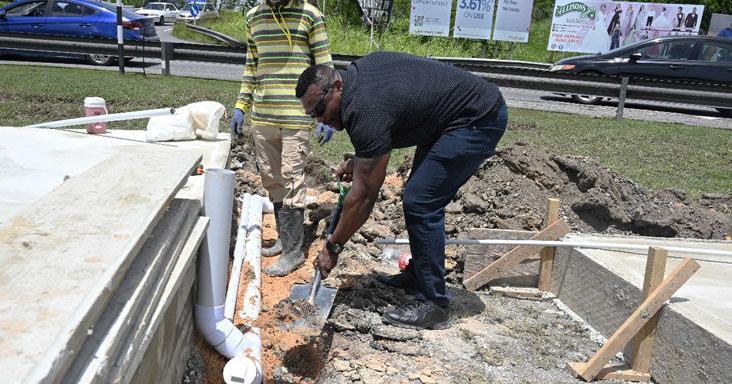
A decades-long battle against out-of-control violent crime in Trinidad and Tobago is entering a new phase of action, as the national government breaks ground on 30 permanent joint army-police security posts across the country, a major crime-fighting intervention that has already earned broad public and local business support. On a inspection tour of construction sites on Wednesday, Minister of Homeland Security Roger Alexander emphasized that protecting public lives is the government’s top priority, stating that no financial cost is too great to reduce preventable deaths and spare families from unnecessary grief.
分类: politics
-
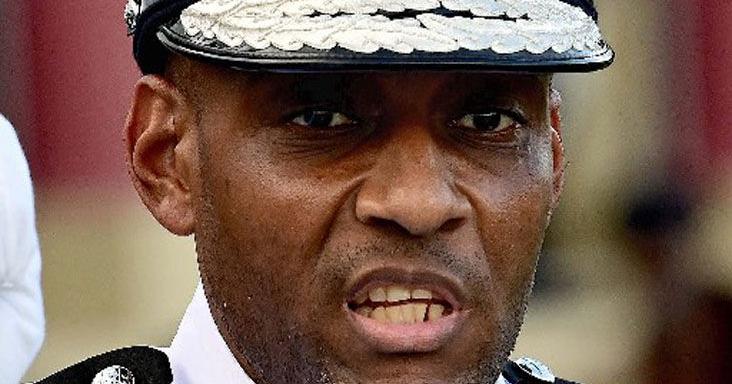
CoP defends police posts
Amid rising public scrutiny and criticism from self-described security experts, Trinidad and Tobago Police Commissioner Allister Guevarro has publicly defended the nation’s new initiative to establish 30 joint army-police mobile posts across the country, framing the project as a transformative upgrade to the Trinidad and Tobago Police Service’s (TTPS) public safety capabilities. In the Commissioner’s first formal address on the program, he pushed back hard against detractors, noting that the criticism of the basic operational concept behind the posts is puzzling coming from individuals who claim expertise in security matters.
In an official statement released by the TTPS Wednesday, the agency laid out the core purpose of the under-construction posts: to expand operational capacity for frontline officers without permanently locking personnel to fixed geographic locations. Guevarro emphasized that the TTPS remains unwavering in its core mandate to protect public safety, and dismissed critical commentary as an unhelpful distraction from the agency’s work. He repeatedly reaffirmed that the primary goals of the joint posts are to extend the service’s operational reach, cut response times to emergency and criminal incidents, and boost overall law enforcement effectiveness across the islands.
To address public concerns over oversight and legal compliance, Guevarro offered a formal assurance that the entire initiative is being carried out strictly within the TTPS’s statutory authorities, with transparency and accountability built into every stage of planning and deployment. He explained that all decisions tied to the program are rooted in empirical crime data, aligned with the service’s legal obligations, and guided by a commitment to open governance for the Trinidad and Tobago public. Framing the mobile micro-units as a key milestone in police service modernization, he noted the initiative directly equips the agency to adapt to rapidly evolving national security challenges.
The TTPS’s release clarified that deployment of the 30 posts is a core component of the agency’s ongoing anti-crime strategy, with site selection and rollout guided entirely by data-driven crime analysis and operational needs, rather than arbitrary geographic or political considerations. Contrary to claims that the posts are an untested new concept, the service highlighted that mobile policing units have been a standard part of TTPS operations for decades, and the new joint posts represent a deliberate upgrade to existing infrastructure that aligns with the national government’s strategic law enforcement priorities.
Unlike older generations of mobile units, the new micro-police posts require only minimal foundational construction, meaning they can be repositioned across the country quickly to adapt to shifting crime patterns. Each new unit also offers expanded space to accommodate additional officers and integrates more advanced communications and surveillance technology than older models. Site selection for the posts is being led by the TTPS’s Crime and Problem Analysis Branch, with locations picked to match current local crime trends rather than permanent fixed boundaries.
Beyond routine patrol support, the joint posts will serve multiple critical public safety functions: they will act as hubs for community engagement with local residents, enable faster coordinated responses to neighborhood issues, support planning and coordination for major public events, and function as forward operating bases for specialized law enforcement operations. During natural disasters or other large-scale emergencies, the posts can also serve as on-the-ground command and control centers to coordinate emergency response efforts, and provide dedicated support for tactical deployments and targeted crime suppression initiatives.
-

9 augustus: Viering zonder recht is een lege ceremonie
As the world prepares to mark the International Day of Indigenous Peoples on August 9, Suriname is gearing up for its own commemorations, featuring speeches, vibrant cultural performances, and public statements honoring the nation’s first inhabitants. While these gestures of appreciation are well-intentioned, opinion leaders Uriel Sabajo and Tadzio Sarijoen argue that gratitude without justice is empty, and celebration without substantive recognition is little more than a symbolic ritual that masks harsh, unaddressed realities. For Suriname, they insist, August 9 must first and foremost be a day of national reflection on the unfinished struggle for Indigenous territorial and collective rights.
Beneath the colorful pageantry of annual celebrations lies an uncomfortable truth that Suriname has yet to fully confront: the entire nation is built on the traditional territory of its original Indigenous peoples, yet after centuries of nation-building, their collective rights remain unrecognized in full by the Surinamese state. This is not merely a minor political oversight, the authors emphasize; it is a fundamental flaw in the country’s commitment to the rule of law and basic moral principle.
The modern history of Suriname did not begin with European colonization, the writers remind readers. Indigenous communities inhabited, governed, and stewarded the land thousands of years before the arrival of European settlers. Their inherent rights to territory and self-determination are not granted by the Surinamese government, nor do they depend on parliamentary approval. Instead, these rights flow directly from their centuries-long original presence on the land: they are pre-existing rights, older than the Surinamese state itself, that the state is obligated to recognize rather than create. To deny this historical reality, the authors argue, is to deny the very origins of the Surinamese nation.
This understanding of Indigenous rights is not a new claim in Suriname. As early as 1686, a peace accord signed between Indigenous communities and colonial authorities implicitly acknowledged that Indigenous peoples were sovereign, self-governing nations with their own legitimate claim to territory. Peace is never negotiated with subjects, the authors note; it is only signed between parties that recognize one another as distinct political actors.
In 1976, 50 years ahead of this year’s commemoration, Indigenous leaders and their supporters made history with a protest march from Albina to Paramaribo. Their demands were not for special privileges, but for the Surinamese state to finally deliver justice to the people who first called the land home. Half a century later, the core demands remain unchanged: formal legal recognition of traditional residential and cultural territories, protection of Indigenous cultural heritage, guaranteed self-determination, and meaningful participation in all policy decisions that shape the future of Indigenous communities.
Recent decades of Surinamese history bear continued witness to this ongoing struggle. The Tucajana Amazones movement successfully pushed Indigenous emancipation back to the top of the national political agenda. Leaders like Thomas Sabajo have repeatedly emphasized that recognition is not a charitable favor granted by the state, but an inherent right that existed long before Suriname achieved independence. This legacy of activism is commemorated every August 8, marking the 1992 peace accord that ended the Surinamese Interior War.
Beyond Suriname’s borders, the global framework for Indigenous rights has evolved substantially. In 2007, the United Nations adopted the United Nations Declaration on the Rights of Indigenous Peoples (UNDRIP), through which the entire international community formally affirmed that Indigenous peoples hold inherent rights to self-determination, protection of their traditional territories, and the right to give free, prior, and informed consent before any major development or policy changes are implemented on their land. This global standard has also been reinforced by legal action.
The landmark Kaliña and Lokono ruling from the Inter-American Court of Human Rights legally binds Suriname to formally recognize and protect the collective rights of these Indigenous peoples. The ruling once again confirmed that these demands are not arbitrary political requests or charitable concessions, but enforceable human rights under international law. Despite this clear legal mandate, full implementation of the ruling has yet to be delivered.
From both historical and legal perspective, the authors conclude, Indigenous peoples are the original inhabitants of Suriname, and their pre-existing rights make them the legitimate original owners of the land. This recognition does not undermine the rights of other Surinamese citizens, they stress; on the contrary, it creates a stronger foundation for a pluralistic Surinamese society built on historical truth, equal dignity, and equal legal certainty for all communities.
A mature, democratic rule of law does not need to fear its own history, the authors argue. It has the courage to confront its foundational origins, and to repair historical injustice that has persisted for centuries — even long after Suriname declared independence in 1975.
Against this backdrop, August 9 demands far more from Suriname than traditional dance performances, symbolic speeches, or even half-hearted state policies that fail to deliver effective protection for Indigenous communities. It requires political courage: the courage to acknowledge that the current 5-kilometer radius protection framework for Indigenous residential and living areas laid out in existing law is completely inadequate and unacceptable. It demands the courage to align Suriname’s constitution with international human rights standards, the courage to finally and unambiguously recognize the pre-existing rights of original inhabitants and enshrine those rights in the national constitution, the courage to fully implement international legal rulings, and above all, the courage to accept that a nation’s dignity begins with recognizing the people who first called it home.
Only when these steps are taken will August 9 truly be a meaningful national day of celebration for all Surinamese. Until that day arrives, it must remain first and foremost a call to national reflection and action.
-
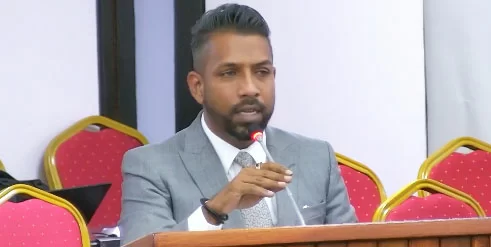
Onderzoek naar verdwenen kwik nog altijd zonder resultaat
Nearly half a year after more than 500 kilograms of mercury went missing from the Geyersvlijt police station in Suriname, the official investigation into the high-stakes disappearance has yet to yield any concrete results, Suriname’s Minister of Justice and Security Harish Monorath has confirmed to the country’s National Assembly.
Addressing lawmakers on Tuesday, Monorath stated that the probe remains ongoing, with investigators currently working to analyze new sets of data from alternative channels, a process that is expected to take additional time. He added that he has received consistent updates on the case from the police corps commissioner, but this response failed to satisfy members of parliament, who are demanding full transparency around what happened to the toxic, controlled material.
Mahinder Jogi, a legislator from the ruling VHP party, pushed back hard on the minister’s update, noting that the case has been open for several months with no clear answers to fundamental questions: how the mercury was able to disappear from a guarded police facility, where the material is currently located, and which individual or group is responsible for the loss. Jogi questioned whether senior officials are intentionally withholding information from the legislature, arguing that the government cannot continue to deliver the same vague update to parliament indefinitely.
Rabin Parmessar, leader of the opposition NDP faction, echoed these concerns, raising a series of unanswered questions about the conduct of the investigation. Parmessar asked what investigators have learned from the police station’s security camera footage, which officers were on duty during the window when the mercury went missing, whether any cameras were deliberately disabled, and whether all required protocols for the storage and security of seized hazardous material were properly followed.
Parmessar emphasized that it is critical to avoid creating a public perception of lack of transparency, particularly when the incident involves the national police force. “Members of the public have to be able to trust that materials held in police custody are kept secure,” he said, “We need to be open and honest about what has gone wrong here.”
Defending the slow pace of the probe, Monorath reminded lawmakers that complex criminal investigations often require extended timelines, pointing to a prior high-profile case at the same Geyersvlijt station where 90 kilograms of cocaine disappeared from a police safe. In that case, it took more than a year before a suspect was identified, the minister noted.
Monorath also clarified the division of responsibilities in the case, stating that management of all seized goods falls under the authority of the police corps commissioner, while the criminal investigation is led by the Public Prosecution Service. The minister added that any breaches of integrity within the Suriname Police Corps will not be tolerated, and any officers found to have violated rules will face both criminal and disciplinary action. He also noted that decisions to release individuals detained as part of the investigation are not made by his office, but rest with the Public Prosecution Service, the investigating judge or the broader judiciary.
-
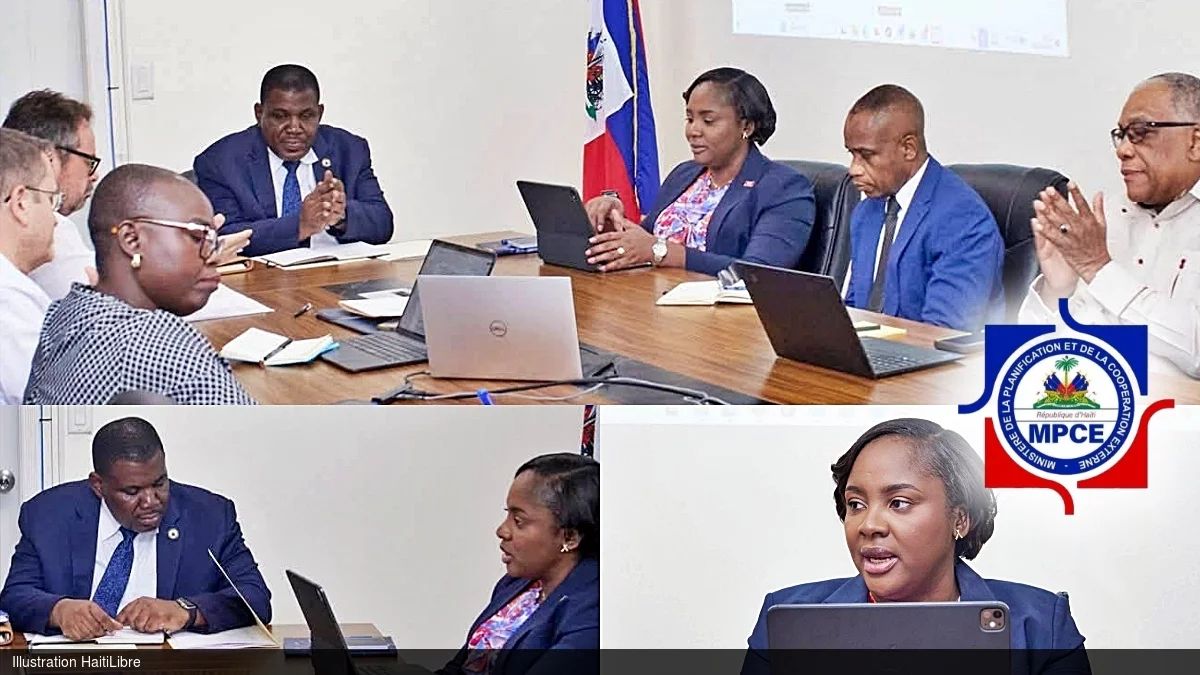
Elections : The Minister of Planning calls for accelerating the electoral process
Nearly a decade after national elections faded from everyday public life in Haiti, the country’s top planning official has issued a urgent call to move the long-stalled democratic transition into full swing, pushing for widespread citizen engagement and immediate action from all electoral stakeholders.
Speaking this week at a gathering of the Steering Committee for the Electoral Process Support Project, Sandra Paulemon, Haiti’s Minister of Planning and External Cooperation, joined a cross-section of national leaders and international partners for the high-level meeting. Attendees included Jacques Desrosiers, president of Haiti’s Provisional Electoral Council (CEP), senior electoral advisors, Carlos Ruiz Massieu — the UN Secretary-General’s Special Representative and head of the United Nations Integrated Office in Haiti (BINUH), Xavier Michon, UNDP’s resident representative in Haiti, plus delegates from the United Nations Office for Project Services, the Organization of American States, and other key technical and financial backers of the process.
In her address to the committee, Paulemon reaffirmed that organizing credible inclusive elections remains the Haitian government’s top national priority. She stressed that every public institution has already mobilized behind a unified strategic roadmap to align implementation of the official electoral timeline and eliminate coordination gaps.
Paulemon emphasized that a successful electoral process cannot rely on technical and financial inputs alone. She recalled that back in February of this year, the nation’s core stakeholders signed the National Pact for Stability and the Organization of Elections, a landmark agreement that binds state bodies, political parties, civil society groups, the private sector, religious institutions, media outlets, and all individual Haitians to a shared promise: deliver a credible, peaceful, and inclusive vote for the Haitian people.
One of the most pressing realities of the long electoral delay, Paulemon noted, is that an entire generation of young Haitians has reached adulthood without ever casting a ballot in a national election or participating in the open democratic debate that forms the backbone of functional democratic societies. While a formal electoral calendar has been outlined, the minister argued that Haiti has not yet shifted into full operational electoral mode. To address this gap, she called for the immediate rollout of a far-reaching national public awareness and information campaign that would make the electoral process visible and accessible to communities across every region of the country.
“We want to hear dedicated election programming on radio and television, see informational displays and posters across our public streets, outreach campaigns in local neighborhoods, young Haitians debating democratic priorities, families discussing voting rights, citizen organizations mobilizing their communities, and public institutions delivering a consistent message of hope,” Paulemon said. “We want every Haitian to feel that elections are truly approaching, and that democracy is gradually reclaiming its rightful place in our national life.”
With that goal in mind, she urged the Provisional Electoral Council to take decisive action to shift the entire nation into genuine electoral preparedness mode. “This is not just about adhering to a written schedule,” she explained. “It is about building a national momentum that can restore public trust, boost citizen participation, and revive hope for democracy. Elections need to be visible, audible, and present in the daily lives of all Haitians, so every person feels fully invested in this historic moment.”
Outlining the commitments the Haitian government has already locked in to deliver the vote, Paulemon noted that the word “election” has slowly disappeared from the daily vocabulary of Haitian people over the past 10 years. In recent weeks, she confirmed, all public institutions have convened to align their operations around the electoral timeline, and the government has committed $120 million in domestic funding to support election organizing. To avoid administrative holdups, she added, all necessary measures will be put in place to mobilize these funds immediately, bypassing routine bureaucratic delays. “Our commitment is unambiguous: the electoral calendar will not be slowed down by state budget procedures,” Paulemon stated.
The minister also outlined additional executive actions the government has implemented to speed up preparations: the government has prioritized the clearance of electoral materials at Haitian ports and customs, fully mobilized the National Identification Office to accelerate the issuance of national ID cards required for voting, established ongoing coordination between national security bodies and the Electoral Council, and partnered with local authorities to facilitate the deployment of polling stations and electoral materials across the country.
In her role leading the Ministry of Planning and External Cooperation, Paulemon confirmed her department will maintain its central coordinating function to track government commitments and remove any administrative, institutional, or financial barriers that could delay the electoral timeline. She also repeated her call for the CEP and UNDP to immediately release the funding required to launch the national electoral information and awareness campaign, so every Haitian can see, hear, and feel that the country is firmly moving toward elections.
“We want awareness messages to start airing across all radio stations, television channels, and digital platforms in the coming days. We want to see billboards and banners across our cities, public service messages on public transit, and targeted campaigns on social media, so every citizen knows Haiti is committed to the path of free elections,” Paulemon said. She went on to stress that elections are far more than just a one-day voting event: “They are the foundation for a return to legitimate state institutions, political stability, consistent public action, and long-term economic recovery for our nation.”
Elections, the minister reminded attendees, are not planned exclusively behind closed doors in CEP offices. “They are prepared in homes, schools, churches, marketplaces, newsrooms, and in the minds of every single Haitian citizen,” she said. “The Haitian people must feel, hear, and see that elections are coming. The government is ready. Now we call on all stakeholders to pick up the pace so the country moves decisively into electoral mode. History will judge our collective ability to keep this appointment with democracy. We cannot afford to waste another day.”
The Haitian government is calling on all state institutions, political actors, national and international partners, and every sector of Haitian society to mobilize without further delay. No delay can be allowed to put the Haitian people’s appointment with democracy at risk. Restoring the legitimacy of national institutions is an urgent national imperative that demands commitment from every stakeholder.
-
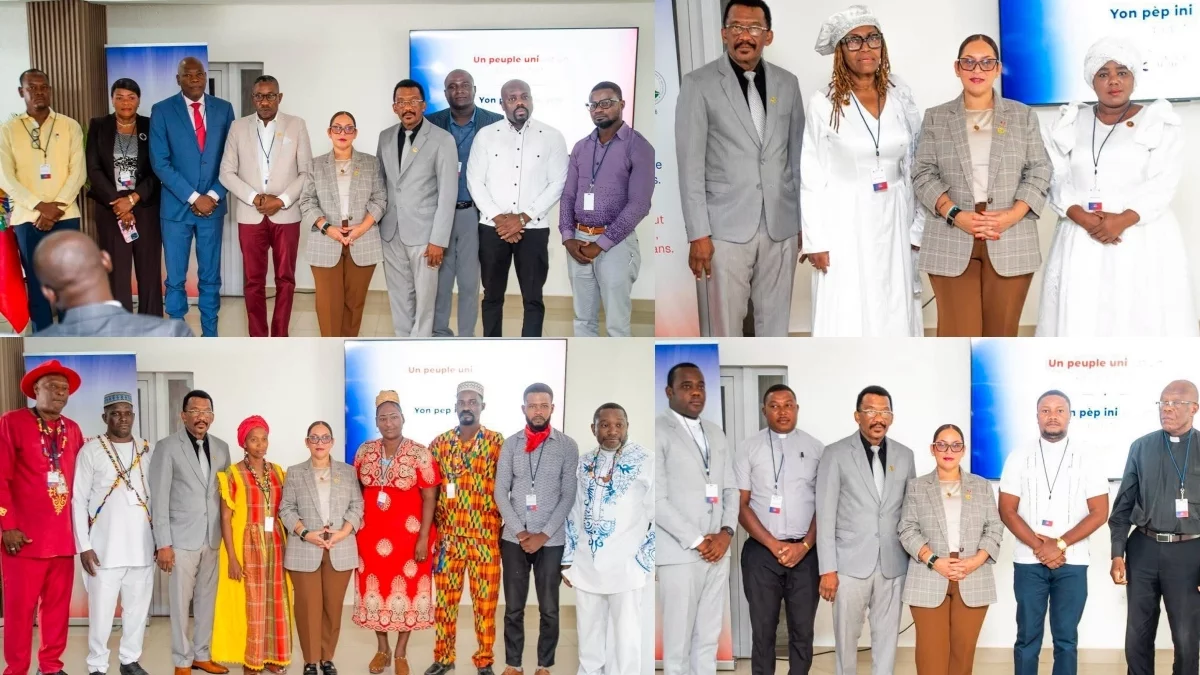
Grand North : Second phase of the National Conference of Religious Leaders
In a pivotal step to foster collaboration between state institutions and faith-based groups across Haiti, the second phase of the National Conference of Religious Leaders for Peace, Stability, and Civic Engagement got underway on August 7, 2026, at Villa Caracol in the country’s Grand North region. The opening ceremony was led by Raina Forbin, Haiti’s Minister of Foreign Affairs and Religious Affairs, kicking off a day of collaborative dialogue that builds on the outcomes of the first national conference hosted in Port-au-Prince back in May.
Over 100 stakeholders gathered for the event, bringing together representatives from every major religious denomination across Grand North alongside delegates from Haiti’s public government institutions. This gathering is not an isolated initiative: it directly follows up on commitments and discussions outlined during the inaugural National Conference of Religious Leaders, which took place May 28–29 in the Haitian capital, where religious leaders signed a joint declaration outlining their shared commitment to national recovery.
For the Haitian government, the conference serves as a clear demonstration of its dedication to deepening productive dialogue with religious communities, and integrating these trusted local groups into the work of advancing core national priorities. Top among these priorities are the urgent restoration of nationwide security, long-term peacebuilding, expanded economic and social integration for young Haitians, and the strengthening of fractured social cohesion across the country. Beyond these pressing issues, participants will also deliberate on the upcoming national electoral process, exploring concrete roles that religious communities can play to ensure the critical democratic exercise is conducted successfully and peacefully.
During her opening address to delegates, Minister Forbin emphasized the need for a renewed partnership between the Haitian state and religious groups built on three foundational pillars: trust, mutual respect, and shared responsibility for the country’s future. “Religious leaders, you are a transformative force across this country,” Forbin told the gathering. “You carry a responsibility to work hand in hand with the state. It is only together, each of us upholding our respective roles and honoring the scope of our shared responsibilities, that we can restore security, consolidate lasting peace, deliver a successful upcoming election, and put Haiti back on a steady path toward long-term stability and inclusive development.”
-
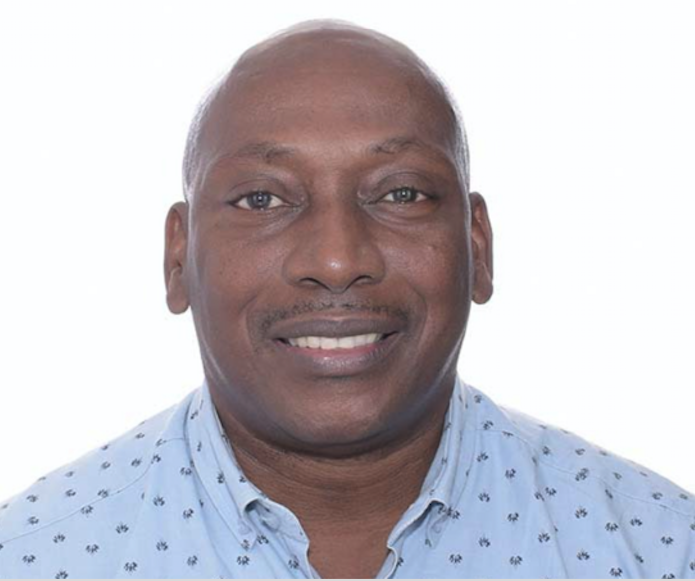
NHC looks to youth to fill construction skills gap
As Barbados ramps up national housing development across the island, a critical shortage of skilled construction labor has pushed the state-run National Housing Corporation (NHC) to accelerate targeted recruitment and skills training programs for young local workers, NHC General Manager Ian Gill announced in a statement Friday.
Gill made the announcement during the official groundbreaking ceremony for a new 34-unit residential development in Deanstown, St. James. He emphasized that the ongoing boom in construction activity across Barbados has created an urgent gap in skilled talent that cannot be left unaddressed. “With the rapid expansion of construction projects nationwide, we are facing a looming shortage of skilled workers,” Gill explained. “Our goal is to train young enrollees quickly, so they can gain the hands-on expertise needed to bolster NHC’s workforce and keep our housing development targets on track.”
To fill this skills gap, the NHC has partnered with two leading local technical training institutions: the Samuel Jackman Prescod Institute of Technology and the national Technical and Vocational Education and Training (TVET) program. The partnership has already yielded early results: the NHC recently hired 10 new young workers who completed their training through the TVET pathway, Gill confirmed, adding that building a pipeline of young skilled talent remains the corporation’s top priority.
Among NHC’s most successful workforce development initiatives is the Barbados Construction Gateway Initiative, a program designed to train new entrants and connect them to long-term opportunities in the construction sector. Gill noted that dozens of program graduates have gone on to secure permanent contractor roles with the NHC, many of whom still work with the corporation today. The program even proved its value during the national response to Hurricane Elsa, when Gateway Initiative trainees stepped in to support emergency reconstruction work across the island. “It is an awesome initiative that has delivered real results for our organization and for young Barbadians looking for stable careers,” Gill said.
Beyond workforce development, the NHC is also undergoing a broad internal overhaul of its planning division, integrating new digital tools and emerging technologies like artificial intelligence to modernize operations. “Digitization has completely transformed how we approach planning and drafting work,” Gill explained. “New digital platforms streamline workflows, and even artificial intelligence can now assist with core drafting tasks, letting teams make adjustments faster and more efficiently than ever before.”
The digital upgrade is part of a broader government mandate to expand the NHC’s role across Barbados’ public sector. Gill confirmed the Mia Mottley administration’s official intention to reposition the NHC as the central planning agency for all central government departments and state-owned enterprises. Under the new mandate, the NHC will take on responsibility for planning all public infrastructure projects across every government agency in the country, a mandate that corporation leadership is preparing to fully deliver on in the coming months.
-

Cabinet Yet to Decide on B.T.L. Takeover of Speednet
As the proposed acquisition of telecommunications provider Speednet by BTL continues to stir public and political discourse in Belize, one senior cabinet minister has confirmed that no official government decision has been reached, despite early backing from a key internal party faction.
In comments reported on August 7, 2026, Cabinet Minister Thea Garcia-Ramirez made clear that she will not take a public stance on the deal until the full cabinet receives a comprehensive formal briefing, scheduled for the government body’s upcoming meeting next Tuesday.
While the Northern Caucus of the ruling People’s United Party (PUP) has already held a vote and formally endorsed the acquisition proposal, Garcia-Ramirez emphasized that the caucus’s position does not equate to an official binding position for the entire cabinet. The minister, who personally attended and voted in that Northern Caucus meeting, walked a careful line: she acknowledged that all caucus members hold the right to express their individual and collective stances, but reaffirmed that the full cabinet has not yet debated or vetted the terms of the proposed takeover.
Garcia-Ramirez also openly admitted that she currently lacks sufficient, verified information to form a considered opinion on the acquisition. In a candid remark about the flow of information inside the government, she told reporters that she, like many members of the public, has relied on local news outlets including Channel 5, Love TV, and Channel 7 to get updates on the proposal, rather than receiving official updates directly from government or party leadership. So far, all she has encountered are unsubstantiated rumors with no formal documentation or official presentation of the deal’s terms, impacts, or benefits, she added.
“Everybody has equal rights to state their position. It is not a cabinet position. It’s the caucus, caucus is the one that is saying that they support the acquisition. I myself don’t really know very much about what has happened recently,” Garcia-Ramirez told reporters, noting she only learned of the caucus vote immediately after a separate cabinet meeting earlier this week. “I am unsure, and I’m unwilling to state anything further because I really don’t have all that information. It’s not within my grasp.”
Once the formal briefing is presented to cabinet next week, Garcia-Ramirez says she will be able to conduct a full assessment of the proposed acquisition and share her official position on the deal.
-
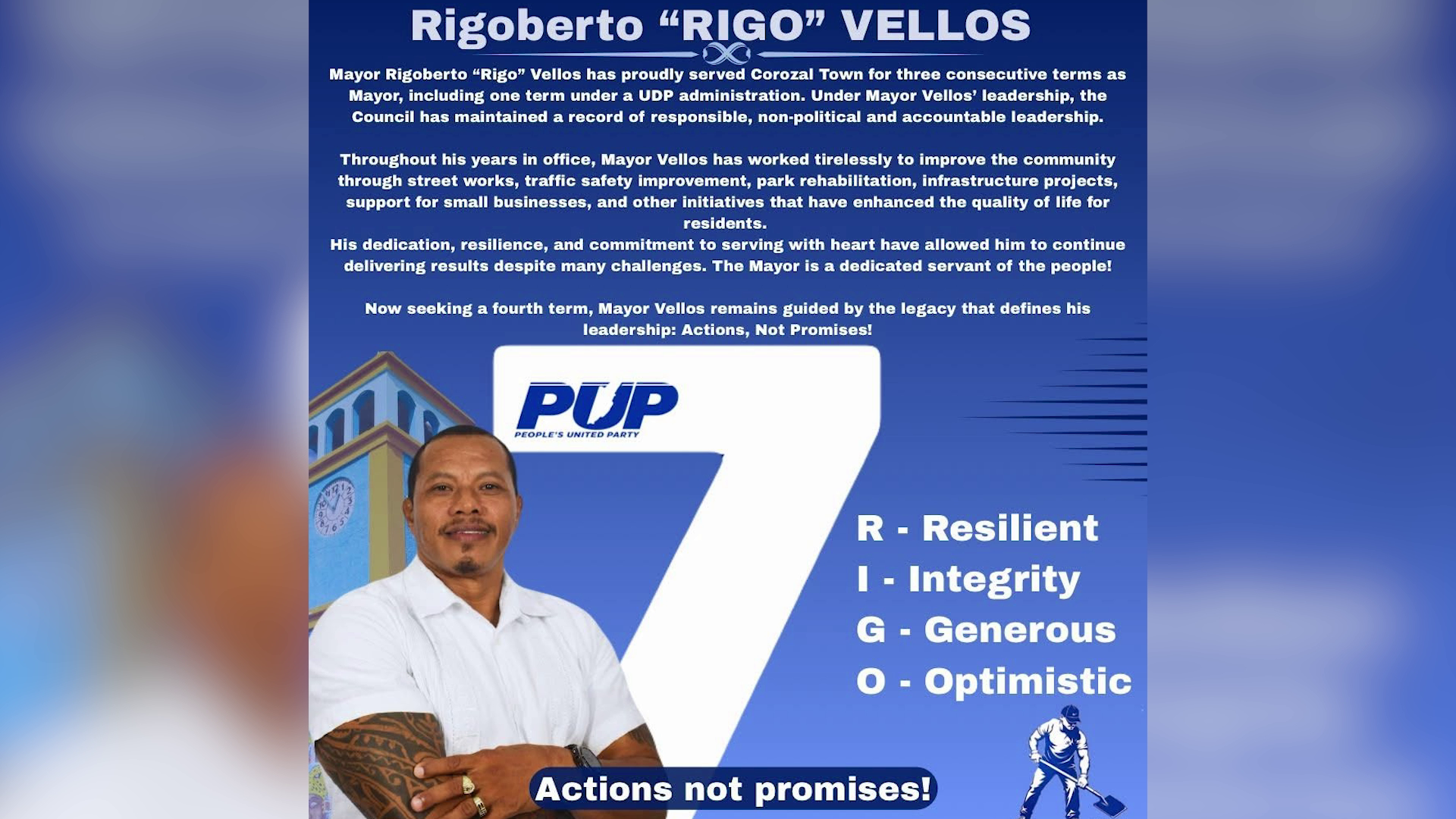
Vellos Fights to Hold Political Ground in Corozal Convention
As the countdown ticks down to Sunday’s internal People’s United Party (PUP) mayoral convention for Corozal Town, the small northern Belizean municipality has become the center of one of the country’s most closely watched political contests, pitting three-term incumbent Rigoberto Vellos against challenger Shajerie Rogers in a race rife with factional undertones.
Vellos, who has led Corozal Town for three consecutive terms, has launched a public defense of his tenure, pushing back against what he frames as coordinated efforts to unseat him and derail his administration’s progress. In a public address posted to Facebook Thursday night, the incumbent mayor struck a defiant tone, emphasizing that he and his council have delivered tangible results for the town’s residents during his time in office. He stated he is not seeking special treatment and is fully prepared to go head-to-head with Rogers at the convention, but pushed back against the factional maneuvering that has marred the lead-up to the vote.
Most notably, Vellos claimed that multiple public infrastructure and development projects developed in partnership with Belize’s central government have been abruptly paused or slowed in recent weeks – a move he suggests is politically motivated to sabotage his campaign ahead of the convention. “We keep a positive mindset, and we remain committed to working alongside the people of Corozal,” Vellos said in his address. “Our partnership with this community is strong, and we will keep moving forward together, no matter the challenges.” The three-term mayor added that local residents remain firmly in his corner, backing what he calls Team Rigo ahead of Sunday’s vote.
The challenger, Rogers, has secured the public backing of Corozal Bay Area Representative Thea Garcia-Ramirez, a high-profile PUP figure whose support has framed the contest as a proxy battle between competing factions within the party. Ahead of the vote, Garcia-Ramirez pushed back against framing of the race as a divisive internal split, arguing that the contested convention is a healthy demonstration of democratic process within the party. She emphasized that regardless of which candidate wins on Sunday, she is ready to collaborate with the victorious ticket to hold the Corozal Town Council for the PUP in the upcoming March general municipal elections.
Beyond the immediate contest, Garcia-Ramirez used the lead-up to the convention to sound the alarm about a pervasive issue in Belizean politics: systemic gender-based harassment and violence that discourages women from seeking public office. Speaking from personal experience as a female elected official, Garcia-Ramirez noted that political spaces in Belize still operate largely as an exclusionary “boys club”, where women candidates face disproportionate shaming, scandalmongering, and abuse – particularly on social media platforms.
“Any country that chooses to shut women out of electoral politics does itself a profound disservice,” Garcia-Ramirez said. “It weakens the very democracy we claim to value, when half the population is sidelined from leadership.” She went on to praise the growing number of women stepping forward to run for office across Belize, noting that every woman who puts her name on the ballot moves the country closer to fair, equal gender representation in government. Garcia-Ramirez also highlighted that the PUP has deep bench strength in Corozal, with multiple qualified candidates stepping forward to run – a contrast she says to the opposition, which has struggled to field a full slate of candidates for the town council.
The outcome of Sunday’s convention will shape the PUP’s nominee for Corozal Town mayor in the 2026 municipal elections, making the internal contest a critical test of factional power within the party and a key indicator of political dynamics in northern Belize ahead of the general vote in March.
-
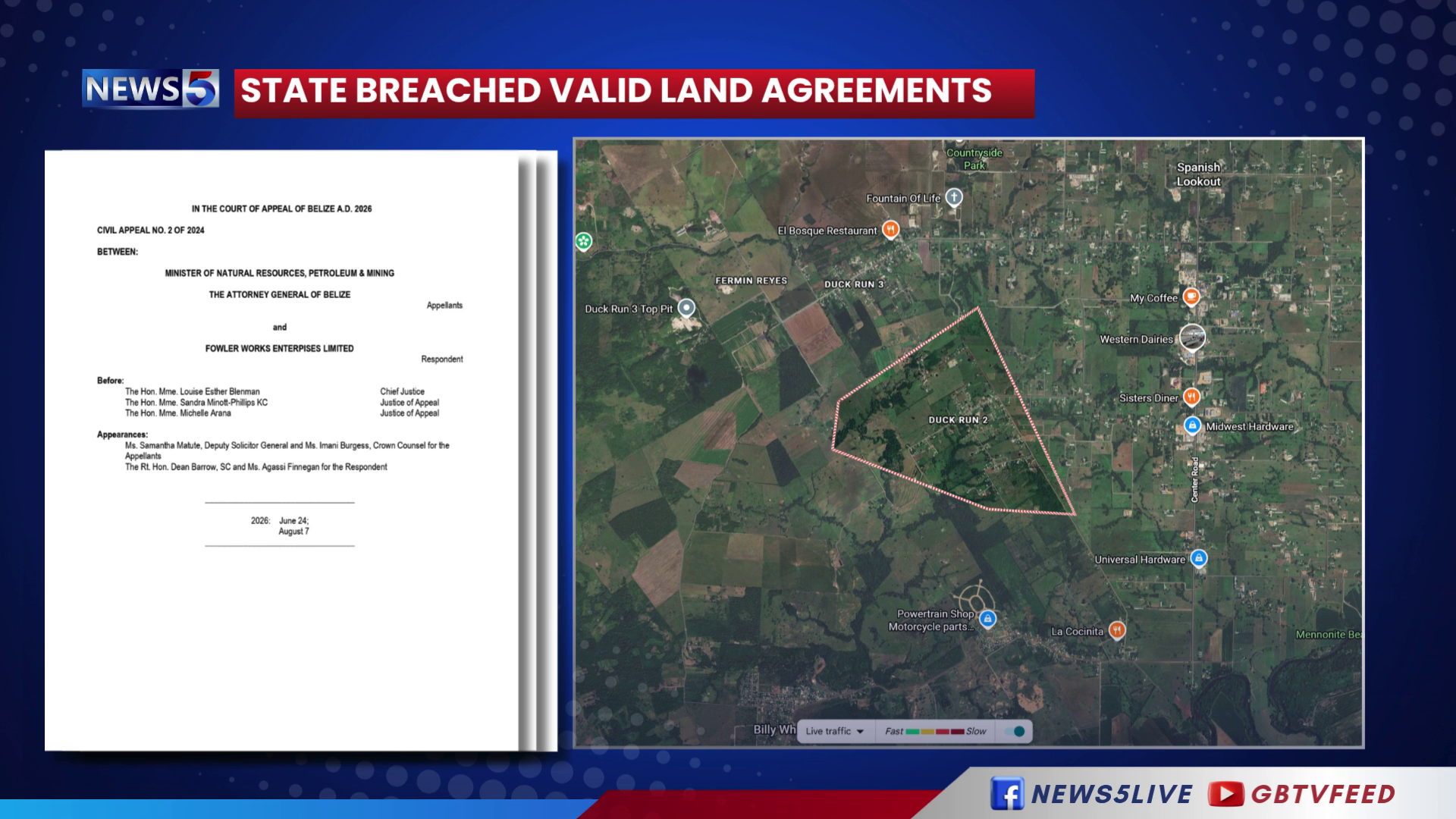
State Loses Duck Run Land Fight, Damages Now Ahead
In a landmark ruling issued on August 7, 2026, the Court of Appeal has dealt a decisive legal defeat to the national government in a high-stakes land dispute covering more than 1,900 acres of public territory in the Duck Run region. The case centers on a legal battle launched by the Minister of Natural Resources, Petroleum and Mining and the Attorney General against private firm Fowler Works Enterprises Limited, challenging the validity of four land purchase agreements the company struck with the previous administration.
The origins of the conflict stretch back to 2020, when Fowler Works entered into the four deals to acquire the state-owned land for a planned large-scale sustainable agriculture and residential homestead development project. The company fulfilled its end of the agreement by paying the full $266,000-plus purchase price upfront. However, following a change in national government later that same year, the new administration refused to finalize the transaction by issuing the official land titles to Fowler Works.
In its defense, the state argued that all four agreements were illegal and unenforceable under existing law. One key point of contention was that a single parcel of land included in the deal exceeded 500 acres, a threshold that the state claimed required formal approval via a National Assembly resolution that had never been granted. The government also claimed that the remaining smaller parcels violated internal land management policies.
The Court of Appeal rejected every one of the state’s legal arguments. In its findings, the court clarified that while the state had failed to complete the required National Assembly approval process for the large parcel, that procedural oversight on the government’s part did not invalidate the existing contract. In clear, direct terms, the court ruled that the government cannot use its own failure to follow statutory requirements as a justification to back out of a binding commercial agreement. The court also found that Fowler Works had fully complied with all applicable procedural requirements for the smaller parcels, dismissing the state’s claim that the agreements violated internal policy.
The ruling upholds the earlier 202X High Court decision that declared all four land purchase agreements legally valid, found that the state had breached its contractual obligations to Fowler Works, and ordered the case returned to the lower court to determine the amount of financial damages the government will be required to pay to the private enterprise. Fowler Works was represented throughout the appeal process by Senior Counsel Dean Barrow and associate attorney Agassi Finnegan.