分类: education

  • DAT president encourages teachers to lead with courage and embrace innovation during summer training

    DAT president encourages teachers to lead with courage and embrace innovation during summer training

    As the Caribbean nation of Dominica prepares for the start of a new academic year in September, hundreds of educators have gathered for the annual Dominica Association of Teachers (DAT) Summer Training Institute, a two-week professional development event designed to equip teaching professionals with the skills and motivation needed to meet the evolving demands of 21st-century education.

    The opening ceremony of this year’s institute was held on Monday at the Convent High School Auditorium, where top DAT leadership urged participating teachers to approach the program as more than a passive training requirement — framing it as a transformative opportunity to reignite their professional passion and recommit to their core mission of supporting student success.

    Mervin Alexander, President of the DAT, opened the event by challenging attendees to move beyond the role of passive listeners during the two weeks of workshops and collaborative sessions. In his opening address, he called on educators to actively engage with new concepts, exchange insights with fellow teachers, and draw on their own classroom experiences to enrich group discussions.

    “I urge you teachers, [during these] two weeks, do not be impassive listeners through this workshop,” Alexander told the gathered crowd. “Challenge the ideas presented, collaborate with the colleague sitting next to you, [and] share your brilliant successes.”

    Alexander encouraged participants to leave the institute with a renewed sense of professional purpose, urging them to build on the training to bring fresh energy to their classrooms when the new school year kicks off. He emphasized that students across the country are counting on educators to return ready to drive meaningful, positive change in their learning journeys. “Live these two weeks with a renewed vow: a vow to teach with passion, to lead with courage and to innovate without fear,” he said. “Build that version right here, starting today.”

    This year’s institute centers on the intentional theme: “Empowering Educators for Inclusive, Innovative, and Effective Teaching and Leadership.” DAT Treasurer Kathleen Cornelius explained in her address that the theme was chosen to reflect the shifting requirements of modern education, and the critical role that continuous learning plays in maintaining a strong, equitable national education system.

    Cornelius noted that as the education landscape continues to evolve to meet changing student needs, educators must also grow their skills and approaches to keep pace. Today’s dynamic classrooms require more than just strong mastery of subject content, she explained: modern teachers must also be prepared to embrace new teaching methodologies, foster inclusive learning environments that support every student, integrate educational technology into daily instruction, lead with confidence, and inspire learners to reach their full potential.

    Against this backdrop, Cornelius argued that ongoing professional development is no longer an optional add-on for teaching professionals — it is a non-negotiable requirement to deliver high-quality instruction. “It enables us to refine our practices, strengthen instructional delivery and ultimately improve the learning outcomes for every child entrusted in our care,” she said.

    She confirmed that the DAT designed the 2026 Summer Training Institute specifically to address these changing sector demands, with programming tailored to give teachers the practical tools and mindset shifts needed to thrive in today’s diverse, technology-integrated classrooms.

  • Top students begin internships after UWI outreach programme

    Top students begin internships after UWI outreach programme

    A select group of high-achieving secondary school students across Barbados is on the cusp of launching their first formal work experience this month, capping off half a year of targeted skills training built to address a longstanding gap between classroom academic achievement and real-world employability. The 2024 cohort, drawn from 16 local secondary schools, has successfully completed the University of the West Indies (UWI) Global Campus Alumni Outreach Programme – officially titled *Preparing Today for Tomorrow’s Challenges – Transforming Children’s Lives (PTFTC-TCL)* – and is gearing up for four-week private sector internships set to begin July 15. On Monday, participating students gathered for a comprehensive pre-internship orientation at the Roy Marshall Teaching Complex on UWI’s Cave Hill Campus, where they received detailed guidance on professional workplace expectations ahead of their placements with partner organizations.

    Now marking its tenth anniversary, the PTFTC-TCL initiative was launched in response to a critical observation from regional educators: many students who excelled academically still lacked the soft interpersonal and professional skills required to smoothly transition from secondary school into the workforce. The six-month foundational curriculum covers a range of practical, job-focused competencies, including professional communication, workplace etiquette, financial literacy, interview preparation, leadership development, and core professional conduct.

    Speaking at Monday’s orientation, Michael Chen, a programme representative for PTFTC-TCL and a former participant who parlayed his own internship into a permanent role at UWI Global Campus, congratulated students on earning their spot in the cohort after standing out throughout the training period. Chen explained that the orientation session was designed to demystify the private sector workplace for young participants, framing the pre-internship preparation as a critical step to set students up for success. “The main reason for today’s orientation is to teach you what is expected when you go into different companies and how to behave and what to expect,” he said.

    Drawing on his own personal trajectory, Chen encouraged students to push past any initial nervousness about entering a professional environment, emphasizing that the experience would build lifelong habits. “After getting used to it you learn how to schedule yourself better, not to be late, how to be on time,” he noted, adding that the internship could open unplanned career pathways. “The internship is a good opportunity for you to learn and grow and this is a real work experience… You may even get the opportunity to stay on such as me. I stayed on with the Global Campus and I’ve been here for three years.”

    Aryanne Williams, a member of the 2023 internship cohort who completed her placement at the Barbados Association of Retired Persons, shared her firsthand experience to help ease this year’s participants’ anxiety. Williams recalled that she entered her internship with significant trepidation, shaped by common anecdotes about difficult workplace interactions. “I was extremely nervous, extremely scared because I heard all the horror stories about… bad customers, people coming and shouting in your face,” she said. However, the experience far exceeded her expectations, thanks to supportive on-the-job mentorship that taught her practical customer service skills and conflict de-escalation. Working in the organization’s accounting department also solidified her long-term career goal of becoming a forensic accountant. Williams urged the 2024 cohort to make the most of the four-week opportunity: “This internship brought a lot of insight on the world of work, how to dress, how to behave and it was a really good opportunity… I believe that for this month of July… y’all will learn a great set and y’all will have a very good time.”

    Sandra Griffith-Carrington, UWI Cave Hill Campus Officer of Alumni Relations, used the orientation to emphasize that employers evaluate far more than just task performance during internships. “You need to showcase that you have grown over the six months programme and you need to be able to meet people for the first time and have a conversation with them,” she told students. Griffith-Carrington noted that the programme has a mixed track record of outcomes: past participants have gone on to secure permanent roles through their internships, but others have left negative impressions on partner employers. “We have had some people who have gone on to have permanent jobs and we have had some others whom we got complaints about. And so I don’t want to get any complaints here,” she said.

    Griffith-Carrington outlined core ground rules for the interns: arrive on time, maintain professional dress, limit personal mobile phone use during work hours, avoid office gossip, and communicate respectfully with supervisors and colleagues. She also stressed that asking for clarification is far preferable to completing a task incorrectly, noting that mistakes waste employers’ time and erode trust. “There is nothing wrong in asking. It is better that you ask me to explain something than you go on your own and do it and do it wrong because you would have wasted your employer’s time,” she said. She further encouraged students to demonstrate proactivity by seeking additional work once they complete assigned tasks, adding that initiative and consistent professionalism are key traits that employers notice and remember. For students hoping to secure full-time work after the internship, Griffith-Carrington advised them to leverage their connections: “Go to your teachers. Go to your principals… Let them know, ‘I’m ready to work. I have done PTFTC-TCL. I’m transformed. I need a job.’”

  • Republic Bank honours 5 TAMCC scholars for academic excellence

    Republic Bank honours 5 TAMCC scholars for academic excellence

    Five standout scholars from Grenada’s T.A. Marryshow Community College (TAMCC) have been recognized with the prestigious Republic Bank Award for Overall Academic Excellence, marking a rare and impressive achievement: each earned a flawless 4.0 grade point average across their full course of study. The accomplished awardees represent a diverse range of academic and vocational programs at the institution: Destiny Antoine, who studied Culinary Arts, Micah Pinnock from the Mechanical Technology program, Jaida Victor of Building Technology, Alyssa Goddard in Natural Science, and Jace Neptune, who completed training in Electrical Installation. In addition to the public honor of the award, each student received a custom commemorative plaque and a $1,000 gift certificate loaded to an e-Free account, a prize that supports both immediate and future financial needs for the young scholars. The formal presentation of the awards took place during TAMCC’s annual Academic Awards ceremony, hosted on July 2 at the Grenada Trade Centre. Peaches George, Acting Manager of Retail Services at Republic House, had the honor of presenting the awards to the five exceptional students on behalf of the bank. Republic Bank’s support of this academic recognition program extends more than 20 years, delivered as part of the bank’s long-running “Power to Make a Difference” community initiative. This sustained partnership between the leading Caribbean financial institution and TAMCC is rooted in a core institutional commitment: to uplift and empower the next generation of Grenadian professionals, and to drive broad, sustainable growth for the country of Grenada by investing in educational excellence. In a statement following the ceremony, Republic Bank (Grenada) Limited extended warm, sincere congratulations to all five honorees, and shared well wishes for continued success in the students’ upcoming academic and professional journeys. This announcement was prepared by a contributor to NOW Grenada, which notes it does not take responsibility for contributor opinions, statements, or third-party media content included in contributed posts, and provides a reporting pathway for any content that violates platform standards.

  • Navigating the realities of Grenada’s 2026 CPEA results

    Navigating the realities of Grenada’s 2026 CPEA results

    As early July arrives each year, a distinct mix of pride, nostalgia and eager anticipation rolls across Grenada, Carriacou and Petite Martinique. Graduation season unfolds with tearful goodbyes between classmates and teachers, celebratory certificate ceremonies, and the jittery excitement of young primary school scholars preparing to transition to secondary education. This year, the release of 2026 Caribbean Primary Exit Assessment (CPEA) results brought plenty of positive milestones to celebrate, alongside critical gaps that demand targeted policy and curricular adjustment.

    Across the 1,709 students who completed the external assessment this cycle, 93.6% earned an overall score of 50% or higher — a strong baseline outcome for the nation’s primary education system. Language Arts posted the strongest performance among tested subjects, while Social Studies and Science held steady at consistent performance levels. These results confirm that Grenada’s primary school teachers continue to build a resilient foundation for core literacy and critical inquiry skills across the student population.

    Even with these overall gains, a deep dive into the data reveals two key areas where administrative and academic reforms are needed, starting with persistent structural challenges in mathematics performance. The national external average for mathematics dropped from 55.16 in 2025 to 52.58 in 2026, a decline that brings the average back near the 2021 low of 49.06 — a result recorded at the height of COVID-19 pandemic classroom disruptions. This trend makes clear that primary-level numeracy struggles are not just a residual effect of pandemic-era learning loss, but a long-term structural issue requiring sustained intervention.

    Further analysis also found a notable gap between students’ internal classroom coursework averages in mathematics and their scores on the external standardized multiple-choice exam. One leading hypothesis for this variance is mathematical automaticity: the ability to quickly recall arithmetic facts and solve problems under timed exam conditions. When students move from low-pressure, familiar classroom assessment settings to high-stakes standardized exams, increased cognitive load can erode both confidence and performance. This gap does not mean numeracy skills are entirely lacking, however. Just weeks before the CPEA results release, the power of interactive numeracy learning was on full display at the National Mental Math Quiz, hosted 16 June at the Grenada Boys’ Secondary School auditorium by the Ministry of Education. At the competition, Grade 6 students solved complex arithmetic problems quickly and confidently, proving that numeracy can be engaging, vibrant and high-performing when students get regular opportunities to build and showcase these skills.

    Experts and education analysts argue that strengthening national numeracy will require scaling these interactive learning models from annual one-off competitions to daily core classroom practice. Pairing widespread adoption of interactive approaches with broader structural reforms — including early numeracy intervention, targeted professional support for teachers, expanded after-school mathematics programs, and a full review of current assessment alignment — could form the backbone of a national strategy to reverse the recent decline in mathematics scores.

    The second critical area for review centers on safeguarding the universal access goals at the heart of Grenada’s Universal Secondary Education Policy, a landmark initiative designed to advance social equity by ensuring no student is locked out of secondary education based on a single high-stakes exam. Even with this strong inclusive framework, 2026 CPEA registration data reveals a small but meaningful anomaly: out of 835 registered female candidates who completed internal assessment requirements, only 833 sat for the final external exam, leaving two students who did not complete the full assessment process. While this small number does not alter national aggregate results, it demands careful investigation in a system built around universal inclusion. Every student matters, and identifying the root causes of these missed assessments is essential to strengthening Grenada’s educational safety nets for marginalized or at-risk students.

    A third ongoing policy debate has emerged from the Ministry of Education’s 2023 shift away from public school rankings and top performer announcements. The department moved to publish only decentralized, alphabetized school lists shared directly with individual institutions, a policy designed to reduce harmful hyper-competition, emotional distress and intense psychological pressure on Grade 6 students and school staff. The shift has successfully shielded lower-performing students and schools from public shaming, but it has also created an information gap that hinders targeted intervention. Without public access to aggregated regional and school-level performance trends, policymakers, local communities and education development partners struggle to identify which schools and student groups need additional targeted support. Proponents of greater data transparency note that aggregated public performance data is not a tool for shaming — it is a diagnostic resource that directs after-school programming, targeted funding, teacher training and other interventions to the communities that need them most.

    One of the most widely felt unintended consequences of the ranking policy shift has been the loss of national public recognition for Grenada’s highest-achieving students. Under current rules, the nation’s top 10 CPEA performers, even the top three, are not publicly announced. While the policy is intended to protect students at the lower end of the performance spectrum, it inadvertently deprives high-achieving, dedicated students of the national recognition they deserve, while eliminating a key source of inspiration for younger students working toward their own academic goals.

    Crucially, education analysts note that the Ministry of Education can restore public celebration of top performers without violating existing education law or compromising its core commitment to equity. When the policy was introduced in 2023, officials cited Section 23 of the Education Act, which classifies individual student academic records as privileged information that cannot be released to the public without written consent. The same legal framework that restricts disclosure also provides a clear solution: voluntary consent.

    The ministry could easily add a standard, opt-in consent waiver during annual CPEA registration, or reach out directly to the families of top-performing students after grading is finalized to request permission to publish their names and achievements. By securing explicit consent from students, parents and participating schools, the government can legally and ethically celebrate these outstanding academic achievements on the national stage.

    Across all these ongoing conversations, education leaders emphasize that equity and excellence do not need to be competing goals. A strong, inclusive education system fulfills two equally important missions: it supports every student, regardless of their starting point, while also elevating the achievements of top performers to inspire the next generation. Grenada has already built a solid foundation of equity through the Universal Secondary Education Policy, which guarantees access to secondary school for all students. The next step for the nation’s education system is matching its commitment to inclusion with an equally intentional commitment to celebrating excellence and addressing long-standing structural gaps in core learning outcomes.

  • Brazil : Internationalization of the UEH through the signing of Strategic Agreements

    Brazil : Internationalization of the UEH through the signing of Strategic Agreements

    In a landmark step for the State University of Haiti (UEH) to expand its global academic footprint, UEH Rector Professor Dieuseul Prédélus signed a series of strategic cooperation agreements with three leading Brazilian higher education institutions on June 30, 2026. The signing, which took place following an official invitation from Brazil’s Ministry of Education, partners UEH with the Federal University of Latin American Integration (UNILA), the Federal University of Pará (UFPA), and the Federal University of South and Southeast Pará (UNIFESSPA).

    Designed to formalize cross-border academic, scientific, and cultural collaboration, the new agreements run for an initial five-year term. Under the terms of the partnerships, the participating institutions will open new pathways for student, faculty, and administrative staff exchange across borders. They will also co-develop joint teaching curricula and collaborative research initiatives, host shared academic events including conferences and workshops, pool access to rare documentary and academic resources, and open shared use of specialized research laboratories and campus infrastructure for affiliated researchers and students.

    University leadership confirmed that the new Brazilian partnerships align directly with UEH’s long-running, intentional internationalization strategy. The core goal of this institutional push is to expand the university’s global connections, ultimately strengthening its capacity to deliver high-quality professional training, advance innovative research, and foster a culture of academic innovation that serves Haitian students and researchers. This latest round of agreements is not the final step in UEH’s current expansion push: university officials note that additional partnership deals with other Brazilian higher education institutions are already in the works and expected to be signed in the near future.

    The new Brazilian partnerships mark the latest in a series of international cooperation deals UEH has secured in recent months. Prior agreements have been finalized with academic institutions in the United States, Spain, Morocco, and Colombia, as the public Haitian university continues to build out its global network of collaborative partners.

  • Post Millennial Academy Places 12 Students in 2026 Grade Six National Assessment Top 100

    Post Millennial Academy Places 12 Students in 2026 Grade Six National Assessment Top 100

    Following the recent public release of the 2026 Grade Six National Assessment results, one institution has stood out above the rest: Post Millennial Academy. The Jamaican Ministry of Education, Science and Technology has officially confirmed that PMA claims the distinction of having more students represented on the elite Top 100 list than any other school across the country, with a total of 12 students earning coveted spots on the ranking.

    In an official public statement issued shortly after the results announcement, the ministry extended formal congratulations to the entire Post Millennial Academy community for the outstanding academic outcome. Government education officials commended every stakeholder connected to the institution, from school leadership and classroom teaching staff to enrolled students and their families, noting that the exceptional result is a direct reflection of the school’s long-term, unwavering dedication to upholding rigorous standards of academic excellence.

    “The Ministry of Education, Science and Technology congratulates Post Millennial Academy (PMA) on being the school with the highest number of students, twelve (12), represented on the 2026 Grade Six National Assessment Top 100 List,” the statement read in part.

    Education officials added that the top-tier performance further demonstrates the academy’s consistent, concentrated focus on advancing individual student achievement. Officials also praised the institution’s intentional, targeted efforts to foster a campus culture that prioritizes and nurtures academic success at the elementary level. This official recognition forms part of the ministry’s broader ongoing effort to celebrate the accomplishments of high-performing students and standout schools across the nation in the wake of the 2026 assessment release.

  • Perfect scores for SEA trio

    Perfect scores for SEA trio

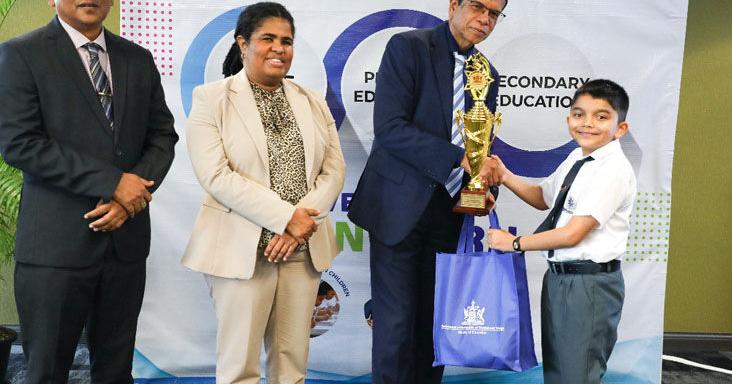
    A landmark achievement for Trinidad and Tobago’s primary education system was celebrated this week, as nine top-performing students from across the country were honored at an awards ceremony hosted by the Ministry of Education at its Port of Spain headquarters.

    Among the standout cohort, three students achieved a rare perfect 100% score on the 2026 Secondary Entrance Assessment (SEA), the national examination that determines placement for secondary school. While Ministry officials opted not to publicly rank the top nine awardees to avoid singling out individual students, Education Minister Dr. Michael Dowlath confirmed the three-way tie for first place, adding that the highest overall Composite Weighted Standard Score hit an exceptional 253.423. One of the perfect scorers, Shazana Mohammed of Debe Hindu School, publicly shared her full-mark achievement during her acceptance speech at the event.

    Senior education officials including Acting Permanent Secretaries Simone Williams and Keshore Lutchman, Chief Education Officer Dr. Peter Smith, and National Parent-Teachers Association (NPTA) president Walter Stewart joined the ceremony to congratulate the cohort. The nine honorees, called to the stage in alphabetical order to deliver remarks and collect their awards, are Katherine Ajodha (St Peter’s Private School), Amara Batan (Curepe Presbyterian), Shivan Khan (Caroni Hindu), Shazana Mohammed (Debe Hindu), Adam Ng Tang (Montrose Government), Liam Rajnauth (Trinidad Renaissance Preparatory), Ethan Ramlackhansingh (San Fernando TML), David Ramlakhan (Montrose Government), and Vivek Supersad-Maharaj (Munroe Road Hindu).

    Beyond the top individual performances, the 2026 SEA results reflect broad, encouraging gains across the entire national student body, Dowlath announced. A total of 17,509 students sat the examination this year, and across all subject areas, national mean scores improved from 2025 results. In Mathematics, the average score rose from 52.10 to 53.84; English Language Arts saw an increase from 66.70 to 68.66; and the writing component of the exam edged up from 11.25 to 11.57 out of a possible 20 points.

    These improvements extended across all performance tiers, the minister noted. This year, 70.73% of all test-takers (12,384 students) scored above the 50% benchmark, up from 66.18% (11,827 students) in 2025, meaning 557 more students crossed this key achievement threshold. Gains at the highest end of performance were even more striking: 670 students scored above 90% in 2026, compared to just 421 in 2025, a jump of 249 exceptional performers.

    “These results demonstrate that our collective efforts to strengthen teaching and learning are beginning to bear fruit, and it signals what I believe is a meaningful return to excellence across our education system,” Dowlath said. “The data tells us a clear story: more students are reaching higher levels of achievement, and more students are proving that with the right support, academic success is within reach.”

    NPTA president Stewart opened his remarks saying he felt ecstatic and proud of the cohort, highlighting a particularly notable trend: six of the nine top awardees are boys. For years, education stakeholders in Trinidad and Tobago have flagged persistent underperformance among male primary students, making this outcome especially welcome. “When I see boys excelling in this way, I’m doubly proud and doubly pleased,” Stewart said.

    He also praised the resilience of this year’s entire SEA cohort, noting that these students entered primary school just as the COVID-19 pandemic hit, and spent their first two years of primary education learning remotely through digital devices. “That speaks volumes about their resilience and perseverance. Apart from their incredible achievement, I really want to applaud that determination that gave us the kind of results we are seeing today,” Stewart added. He also thanked principals and teachers for their tireless work to lift student outcomes, and expressed optimism for even stronger results in coming years as the education system transitions to integrate a new Continuous Assessment Component into student evaluations.

  • Necasia Ralph of J.T. Ambrose Primary Finishes Third Overall in Grade 6 Assessment

    Necasia Ralph of J.T. Ambrose Primary Finishes Third Overall in Grade 6 Assessment

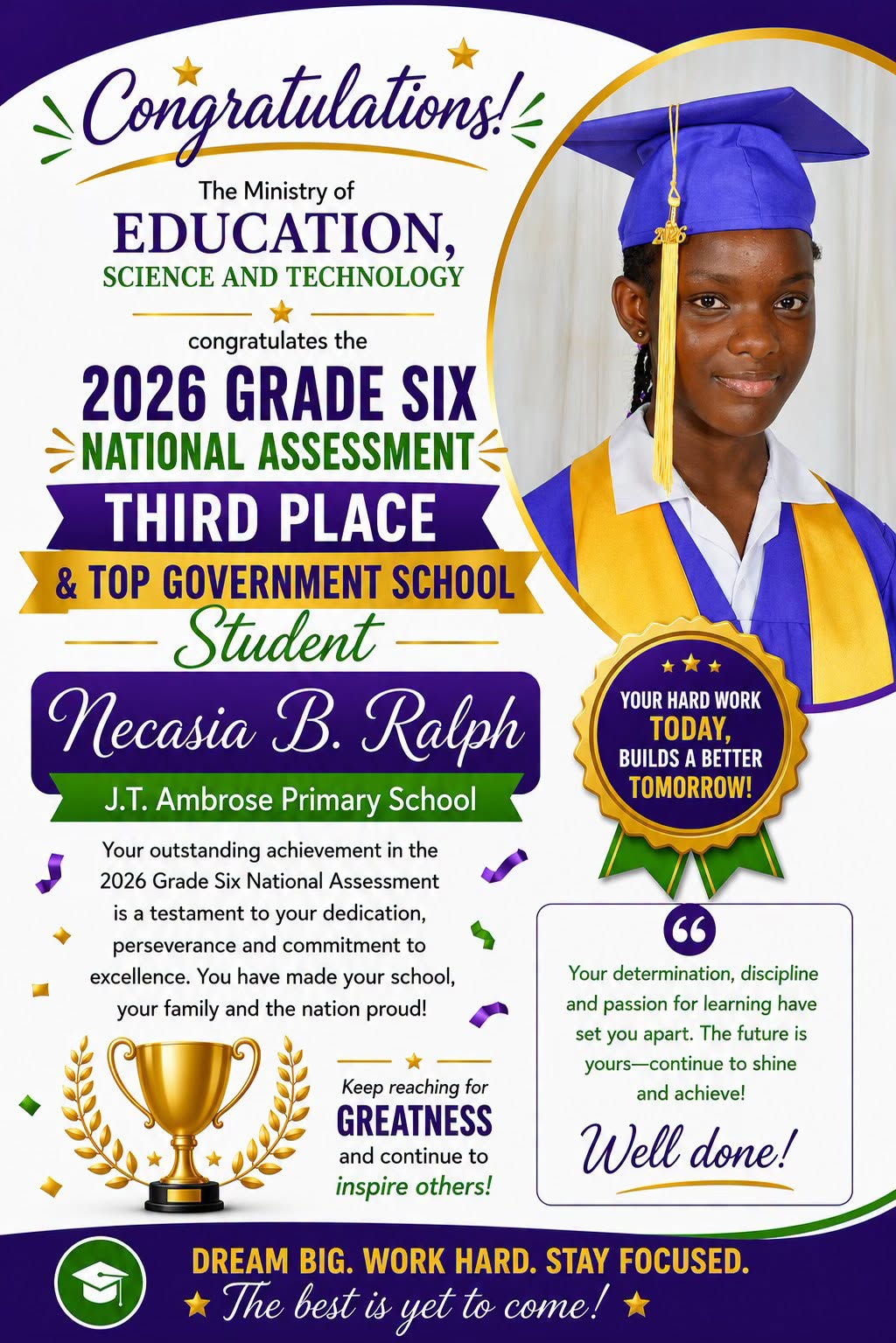
    A young primary school student has cemented her place among the nation’s top academic performers after an impressive showing in the 2026 Grade Six National Assessment, earning high praise from the country’s top education governing body. Necasia B. Ralph delivered a standout performance across the standardized national evaluation, ultimately ranking third overall out of all participating students. Beyond this national top-three finish, Ralph also claimed a unique distinction: she is the highest-scoring student attending a government-run primary school in this year’s testing cycle.

    In an official congratulatory statement released following the release of assessment results, the Ministry of Education, Science and Technology highlighted the personal qualities that led to Ralph’s success. The statement commended her consistent hard work, unwavering perseverance, strict personal discipline, and relentless commitment to her studies, noting that her landmark achievement is a source of collective pride that extends far beyond Ralph herself. According to the ministry, her success brings honor and celebration to her immediate family, the administrative and teaching staff of her school, and the entire nation.

    The ministry also took the opportunity to acknowledge the critical role that support networks played in nurturing Ralph’s academic growth. It formally recognized the contributions of Ralph’s parents, her classroom teachers, her school’s leadership team, and all other community and educational stakeholders who provided guidance, resources, and encouragement to the young student at every stage of her primary school journey.

    Looking ahead to Ralph’s future academic endeavors, senior ministry officials have encouraged her to frame this impressive accomplishment as a foundational source of motivation, urging her to maintain her pursuit of excellence as she advances through her education. “Let this achievement inspire you to continue striving for excellence as you pursue even greater accomplishments in the years ahead,” the ministry shared in its official message.

    Ralph’s result solidifies her standing among the cohort of highest-achieving sixth-grade students across the country in the 2026 assessment cycle, while marking a notable win for government-run primary education across the nation.

  • The UWI Celebrates 14 Top Postgraduate Presentations and Prepares for 2026 Regional Conference

    The UWI Celebrates 14 Top Postgraduate Presentations and Prepares for 2026 Regional Conference

    As one of the Caribbean’s leading higher education institutions with a 75-year legacy of regional impact, The University of the West Indies (The UWI) has formally announced plans for its 4th Annual One UWI Postgraduate Student Conference, scheduled to run from November 18 to 21, 2026. The upcoming gathering will center on the forward-thinking theme “Advancing Knowledge, Shaping Futures: Research, Innovation, and Impact Across the Caribbean and Beyond,” a vision shaped by the overwhelming success of the conference’s third iteration held earlier this year.

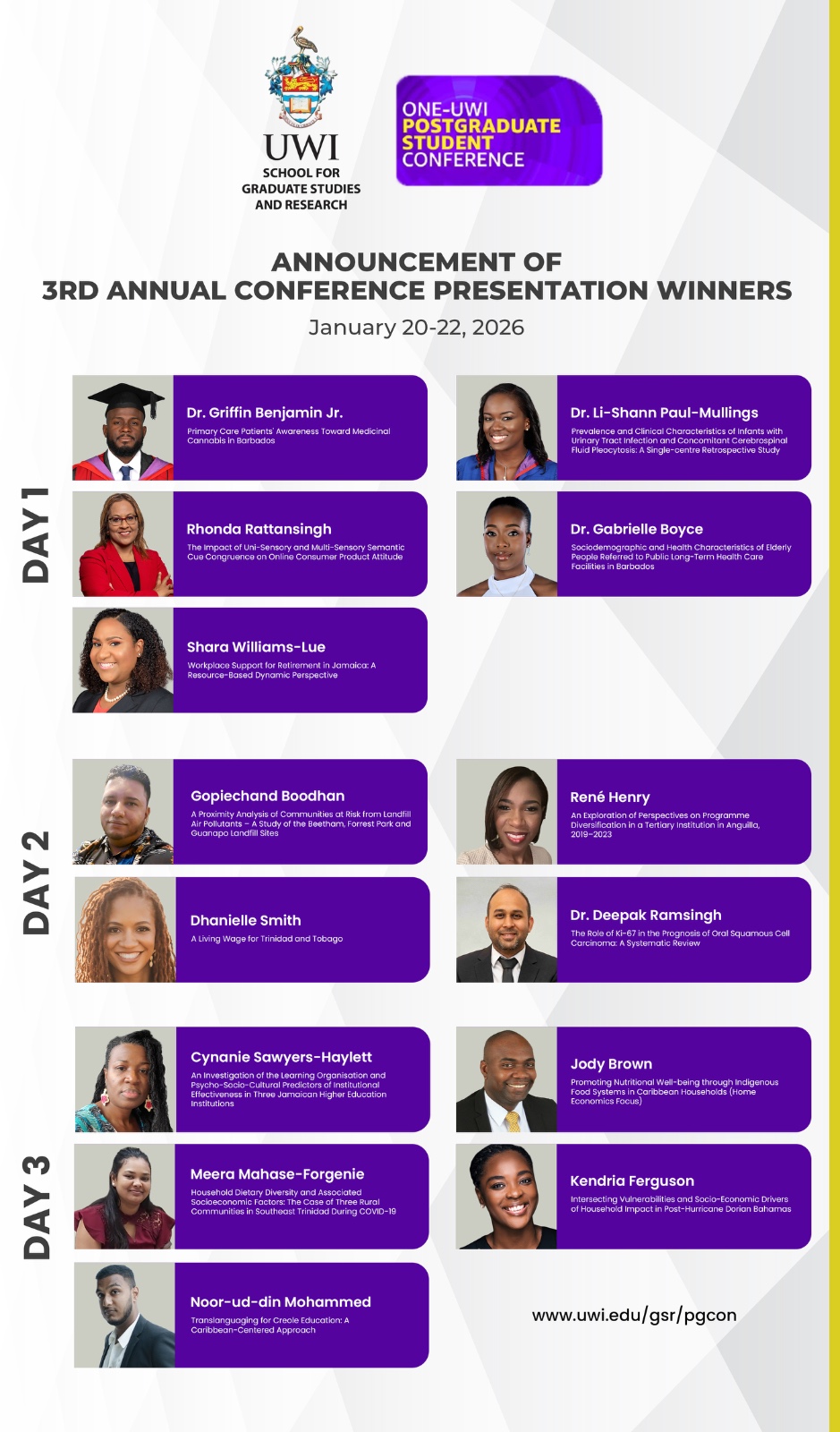
    Originally planned for November 2025, the third annual conference was rescheduled and held as a fully virtual event between January 20 and 22, 2026. The event drew more than 600 registered attendees from across the region and beyond, showcasing 51 original research presentations spanning a diverse range of pressing topics: public health, climate resilience, education, governance, and sustainable development, all aligned with the Caribbean’s most urgent development priorities. Following the conclusion of the virtual event, organizers awarded honors to 14 standout oral presentations, recognizing the exceptional quality of postgraduate scholarship across the university’s five regional campuses.

    The 14 award recipients, who recently received electronic gift cards and commemorative prizes, were selected based on three core criteria: research originality, strict academic rigor, and direct relevance to Caribbean community and policy needs. The winning projects represent the full breadth of postgraduate research at The UWI, spanning public health, social science, agricultural sustainability, education reform, and economic justice. Standout winning works include a retrospective analysis of pediatric urinary tract infection comorbidities from the Mona Campus’ Faculty of Medical Sciences, a study of primary care patient awareness of medicinal cannabis in Barbados from the Cave Hill Campus, and an analysis of socioeconomic drivers of post-hurricane household vulnerability in the Bahamas, among other high-impact projects.

    The third annual conference opened with a keynote address from The UWI’s Vice-Chancellor Professor Sir Hilary Beckles, and featured a lineup of distinguished international speakers including Nadine Bushell of Lions Clubs International, Rodolpho Gonçalves da Silva from Brazil’s Universidade Estadual Paulista (UNESP), and Indian sustainability entrepreneur Ishaan Sudan. Across their remarks, speakers centered on the critical roles of community resilience, interdisciplinary innovation, youth leadership, and cross-sector service in addressing interconnected global challenges from climate change to public health inequality.

    In comments following the award ceremony, Professor Aldrie Henry-Lee, Pro Vice-Chancellor for Graduate Studies and Research (SGSR), highlighted the real-world value of the research presented at the conference. “These presentations demonstrate the exceptional quality of postgraduate research across The UWI and direct application to real-world challenges. They reflect a strong commitment to producing knowledge that matters to the Caribbean,” she said. Professor Henry-Lee also extended gratitude to all contributors to the conference’s success, including session chairs, discussants, campus graduate study directors, student and guild representatives, presenters, attendees, and the central organizing team.

    Beyond academic exchange, the third annual conference integrated a tangible community outreach component: on January 23, 2026, a team of postgraduate students and institutional partners traveled to Hanover, Jamaica, to deliver disaster relief and practical support to more than 200 families impacted by Hurricane Melissa. The outreach effort, organized in partnership with the Lions Clubs of Jamaica and the Kiwanis Club of New Kingston, aligned with The UWI’s longstanding institutional commitment to civic engagement. It will also serve as a pilot program for the proposed UWI Give Back Day, scheduled to coincide with the 4th annual conference in November 2026.

    Founded in 1948 as a small affiliate university college of the University of London with just 33 medical students based in Jamaica, The UWI has grown exponentially over the past seven decades to become a globally recognized research university serving nearly 50,000 students across five regional campuses: Mona in Jamaica, St. Augustine in Trinidad and Tobago, Cave Hill in Barbados, Five Islands in Antigua and Barbuda, and a distributed Global Campus. The university also maintains global academic partnership centers across North America, Latin America, Asia, Africa, and Europe, offering more than 1,000 credential programs ranging from professional certificates to doctoral degrees across nine broad academic disciplines.

    Consistently ranked among the world’s top universities by Times Higher Education (THE) since 2018, The UWI holds the distinction of being the only English-speaking Caribbean institution featured in four separate THE ranking categories: the overall World University Rankings, the Golden Age University Rankings for institutions founded between 50 and 80 years ago, the Latin America and Caribbean Regional Rankings, and the Impact Rankings that evaluate institutional contributions to the United Nations’ Sustainable Development Goals (SDGs). This global recognition has supported the recent launch of The UWI’s International School for Development Justice (ISDJ), an innovative global online graduate business school focused on training the next generation of leaders in equitable sustainable development.

  • Denushka H. Gibbs Tops 2026 Grade Six National Assessment

    Denushka H. Gibbs Tops 2026 Grade Six National Assessment

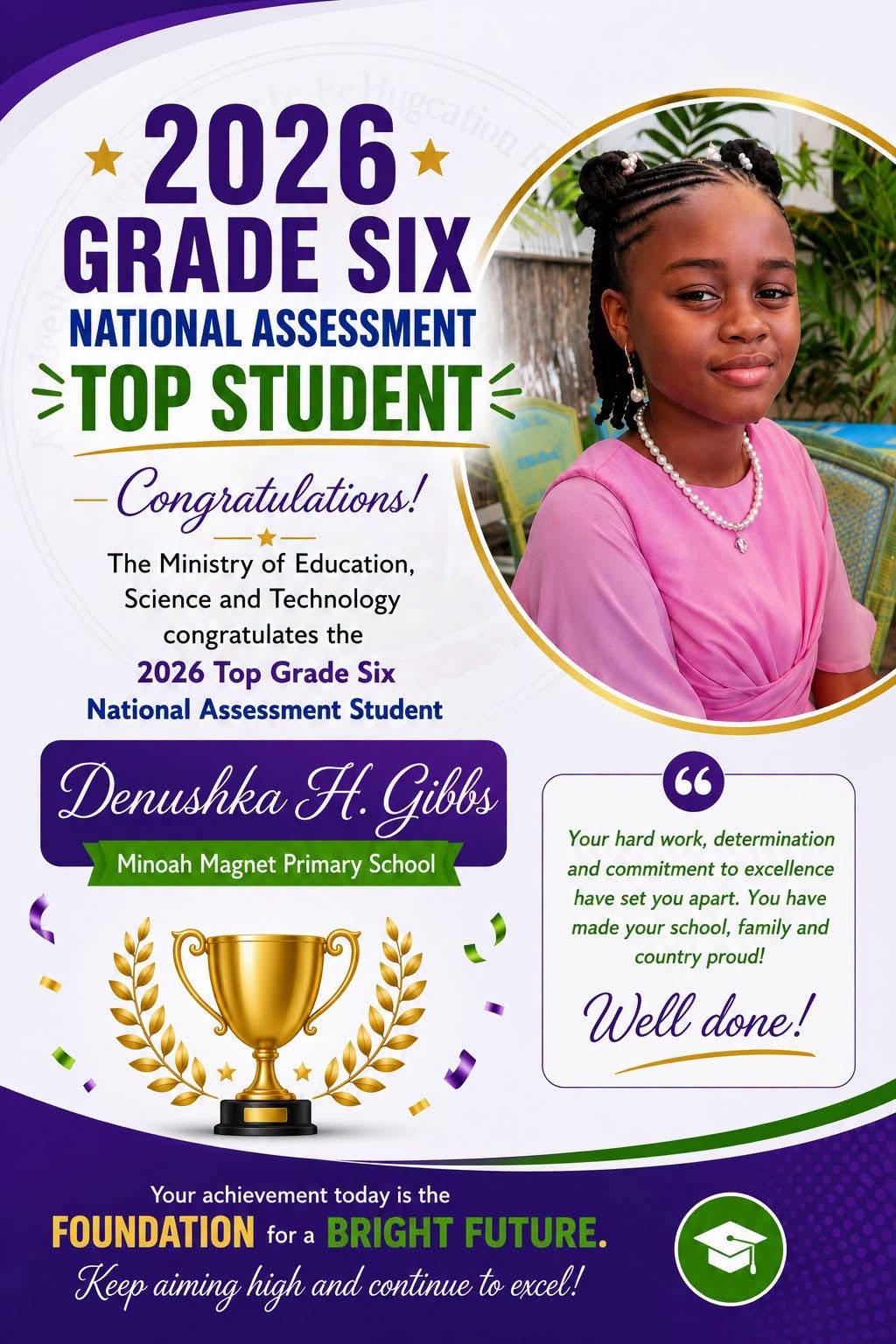
    The Ministry of Education, Science and Technology has officially announced the results of the 2026 Grade Six National Assessment, naming Denushka H. Gibbs from Minoah Magnet Primary School as the nation’s top-performing student this year. Gibbs secured the highest national ranking with an outstanding total score of 383, outperforming hundreds of thousands of sixth-grade students across the country.

    In an official statement following the results release, the ministry celebrated Gibbs’ historic achievement, emphasizing that her success is a direct reflection of her consistent effort, unwavering resolve, and lifelong dedication to academic excellence. “Your exceptional achievement is a testament to your hard work, determination, and commitment to excellence. You have made your school, your family, and the nation proud,” the statement read.

    The ministry also extended its formal congratulations to all members of Gibbs’ support network, including her parents, classroom teachers, school administrators, and community mentors who guided her through her primary education journey. Officials expressed strong confidence that Gibbs’ remarkable accomplishment will serve as a source of motivation for young learners across the nation, encouraging them to pursue their own academic goals with dedication.

    Alongside the announcement of Gibbs’ top ranking, the ministry released the full official list of the top 100 performing students in this year’s assessment. Marlen sky J. Salien of Antigua Baptist Academy claimed the second-highest national score with 382 marks, earning him the title of the top male student in the 2026 cohort. Closing out the top three overall placements was Necasia B. Ralph of J.T. Ambrose Primary School, who scored 377 marks. Ralph’s performance also earned her distinction as the highest-ranked student from a government-run primary school.

    Education Minister Daryll S. Matthew also joined in offering congratulations to all participating students, their families, teaching staff, and entire school communities following the results release. Minister Matthew highlighted a key standout from the top 100 rankings: Post Millennial Academy secured the highest number of placements on the national list, with 12 of its students earning spots among the top 100 performers nationwide.