分类: business

  • Ayrtons expands defyAGE skincare line with local sunscreen

    Ayrtons expands defyAGE skincare line with local sunscreen

    Celebrating nearly 30 years in operation, Jamaican family-owned enterprise Ayrtons Distributors is expanding its footprint in the cosmetics industry with the debut of its defyAGE Sunscape Sunscreen. This new product enhances the company’s growing skincare portfolio, specifically engineered to meet the demands of consumers in tropical climates while addressing longstanding concerns of melanin-rich skin tones.

    The SPF 30 broad-spectrum formulation delivers approximately 97% protection against harmful UVA and UVB radiation, effectively reducing risks of premature aging and sunburn. A distinctive advantage highlighted by Sales and Marketing Coordinator Jodi-Lee Oakley is its elimination of the white residue commonly reported by darker-skinned users—a frequent drawback in many sun protection products. ‘Based on extensive consumer reviews, we’ve confirmed no white cast remains upon application,’ Oakley stated.

    Contrary to popular belief, Oakley clarified that the protective difference between SPF 30 and higher ratings like SPF 50 is marginal. She emphasized that consistent reapplication every two hours is crucial for maintaining efficacy. The sunscreen also boasts an 80-minute water resistance rating, making it suitable for humid conditions and vigorous activities. Designed for universal use across face and body, it incorporates hydrating agents like vitamin E and ceramides to combat skin dehydration under intense sun exposure.

    Ayrtons began as a pharmaceutical distributor in 1995 under founder Dorothy Finlayson before diversifying into beauty and personal care. The company first gained recognition with staple products like cocoa body oils, butters, and scented Epsom salts. Its defyAGE skincare line represents a strategic expansion into targeted facial care, featuring a structured regimen of cleanser, toner, moisturizer, and specialized serums addressing issues from hyperpigmentation to acne.

    In 2025, the brand further extended its acne solutions with a Salicylic Acne Care range containing a 2% salicylic serum. The new sunscreen serves as the final step in the defyAGE routine, sealing in moisture and active ingredients from prior products.

    Accessibility and affordability remain core to Ayrtons’ philosophy, with products available islandwide through pharmacies, beauty retailers, and select supermarkets. The company also supplies wholesalers, spas, and dermatologists who incorporate these products into professional treatments.

    Oakley addressed a critical misconception that individuals with darker skin do not require sunscreen, underscoring its importance in preventing premature aging and skin cancer. Early consumer feedback praises the product’s lightweight texture, pleasant fragrance, and budget-friendly pricing—positioning it as a competitive player in the market.


  • AI, automation and accounting: How technology is changing tax filing for SMEs

    AI, automation and accounting: How technology is changing tax filing for SMEs

    For small and medium-sized enterprises (SMEs) across Jamaica and the wider Caribbean region, the annual tax filing process has traditionally ranked among the most dreaded operational challenges. This aversion stems not from non-compliance but from the overwhelming nature of consolidating financial records—a task characterized by scattered receipts, disparate payment channels, and inconsistent expense tracking.

    A significant shift is now underway as businesses increasingly abandon paper-based systems and fragmented spreadsheets in favor of integrated digital solutions. This technological evolution is transforming financial management from an annual panic into a seamless aspect of daily operations.

    The adoption of cloud-based accounting platforms has fundamentally altered financial practices. Unlike the manual systems prevalent a decade ago, modern tools provide real-time visibility into financial metrics, centralized document storage, and instant report generation—eliminating the frantic search for historical transaction evidence.

    This technological advancement proves most valuable during tax season. Maintaining continuously updated financial records transforms tax preparation from an information-gathering scramble into a simple review process, resulting in faster, more accurate filings with significantly reduced stress levels.

    Enhanced financial visibility represents another critical benefit. Business owners now leverage platforms like NCB Business Online Banking to monitor cash flows in real-time, schedule payments efficiently, and access consolidated digital statements. The strategic use of business credit cards, such as those offered by National Commercial Bank Jamaica, further simplifies financial management by creating unified spending records that streamline reconciliation.

    Artificial intelligence compounds these advantages by operating invisibly within financial tools. AI algorithms automatically categorize transactions, identify anomalous activities requiring attention, and analyze spending patterns to generate predictive insights—substantially reducing the cognitive load on business owners managing multiple responsibilities.

    Conversely, businesses adhering solely to manual processes face increasing operational strain. Physical document loss, spreadsheet discrepancies, and deadline pressures create unnecessary business vulnerabilities.

    The transition to digital need not be overwhelming. SMEs can initiate their digital transformation through incremental steps: digitizing receipts, implementing basic accounting software, and optimizing online banking capabilities. These cumulative changes ultimately create financial systems that work synergistically with business operations rather than creating friction.

    As financial technology continues evolving, early adopters stand to gain the most significant advantages. When financial information becomes transparent, current, and easily accessible, businesses not only simplify tax compliance but also enhance daily decision-making capabilities. In an economic landscape where time efficiency, cash flow management, and operational clarity determine success, digital financial tools provide transformative competitive advantages.

    Anitha Cross, Product and Portfolio Manager for Issuing at National Commercial Bank Jamaica Limited, observes these developments reshaping the financial practices of Caribbean businesses.

  • After Melissa: How the capital market can power Jamaica’s road to recovery

    After Melissa: How the capital market can power Jamaica’s road to recovery

    Jamaica faces an unprecedented reconstruction challenge following Hurricane Melissa’s catastrophic landfall in October 2025, which caused damages exceeding $12.2 billion—equivalent to 56.7% of the nation’s GDP. The Category 5 storm’s 185 mph winds devastated infrastructure, displaced 279,000 people, and damaged 450 schools, creating a fiscal deficit projected to reach $190.7 billion by FY2026/27.

    While international institutions have committed $6.7 billion in assistance over three years through organizations including the IMF, World Bank, and IDB, this support remains insufficient for immediate recovery needs. The Atlantic Council estimates Jamaica requires $5.8 billion solely for resilient road infrastructure.

    Finance Minister Fayval Williams has outlined an innovative approach leveraging private capital markets through five strategic pillars:

    1. Blended Finance: Utilizing first-loss tranches and guarantees from International Financial Institutions to attract risk-averse private capital for tourism, SMEs, and housing reconstruction.

    2. Catastrophe Bonds: Expanding parametric insurance instruments following Jamaica’s successful $150 million World Bank catastrophe bond payout, with plans to issue disaster-clause bonds targeting ESG-focused institutional investors.

    3. Resilient Infrastructure: Rebuilding with climate-resilient standards through public-private partnerships that incentivize local equity participation and transparent governance.

    4. Direct SME Lending: Deploying capital through community development financial institutions and microfinance networks to accelerate support for agricultural and small business recovery.

    5. Pension Fund Mobilization: Landmark regulatory reforms will increase pension fund investment limits from 5% to 10% of total assets, potentially unlocking nearly $50 billion in domestic capital through sale-leaseback arrangements for public infrastructure.

    The proposed model involves pension funds purchasing rebuilt hospitals and schools, which the government would then lease back over 25-35 years. This approach converts illiquid assets into immediate reconstruction capital while providing pension funds with inflation-linked returns backed by tangible assets. Strict guardrails including independent valuations, statutory ring-fencing of lease payments, and consortium ownership models will ensure responsible implementation.

    This pioneering financial strategy represents a potential paradigm shift for disaster recovery in developing nations, transforming catastrophe into opportunity through sophisticated capital market solutions.

  • CLAMPING DOWN

    CLAMPING DOWN

    The Bank of Jamaica (BOJ) is introducing comprehensive minimum standards to regulate how financial institutions handle customer grievances, addressing longstanding inconsistencies and delays in dispute resolution processes. This regulatory intervention comes as a direct response to the absence of industry-wide standards that has resulted in uneven treatment of consumer complaints across deposit-taking institutions (DTIs).

    According to the central bank’s 2025 annual report, the newly developed framework mandates that all DTIs establish robust governance and accountability mechanisms to ensure complaints are addressed with fairness, transparency, and promptness. This initiative represents a critical component of Jamaica’s broader transition toward a Twin Peaks regulatory model, which will separate prudential oversight from consumer protection functions.

    Recent data reveals persistent challenges within the banking sector. The Office of Consumer Complaints (OCC), which handles cases escalated beyond individual banks, received 443 complaints in 2025—a slight decrease from 463 the previous year. Nearly half (206 cases) involved account-related issues, particularly concerning electronic banking channels and automated banking machines (ABMs), indicating significant customer difficulties in accessing funds and resolving routine banking problems.

    While complaint resolution rates showed remarkable improvement—jumping to 84% in 2025 from 57.4% in 2024—the BOJ emphasized that underlying systemic issues necessitate stronger regulatory action. The absence of uniform standards has created inconsistent complaint handling practices across institutions, prompting enhanced regulatory scrutiny.

    The central bank completed development of the new standard in 2025 and plans to issue a consultation paper to the banking industry this quarter before finalizing the regulations. Beyond account-related disputes, the OCC also addressed complaints concerning fraud, loan practices, fee structures, and fund accessibility issues.

    Notably, the BOJ reported a temporary surge in complaints related to the Real Time Gross Settlement (RTGS) system during December 2025, attributed to operational challenges during the JamClear®-RTGS transition to ISO 20022 standards. The institution also acknowledged that previous standards implemented for ABMs in 2024 have already yielded improvements in system uptime and recovery durations.

    As part of this regulatory overhaul, the BOJ will introduce a structured online complaints intake mechanism requiring customers to submit grievances through a dedicated web-based form rather than written correspondence. This platform will initially be hosted on the BOJ’s website before transitioning to the Financial Services Commission under the Twin Peaks framework.

    The OCC’s role is expected to expand significantly beyond complaint resolution to encompass broader market conduct supervision, including a thematic review of financial offerings initiated in October 2025. These developments reflect Jamaica’s comprehensive approach to strengthening consumer protection mechanisms and enhancing financial sector resilience.

  • GK delivers on solar savings despite Melissa disruptions

    GK delivers on solar savings despite Melissa disruptions

    Jamaican conglomerate GraceKennedy Limited is reporting exceptional performance from its renewable energy initiatives, achieving greater-than-anticipated financial savings despite significant infrastructure damage from Hurricane Melissa. The corporation’s solar power transition program has yielded over US$700,000 in energy savings for 2025, substantially exceeding its initial target of US$600,000 and advancing toward its ambitious goal of US$1 million in annual savings by 2026.

    Group CEO Frank James revealed during a recent investor briefing that the savings would have been even more substantial had Hurricane Melissa not destroyed the solar installation at the company’s meat processing facility. The catastrophic Category 5 hurricane—the most intense storm ever recorded in Jamaican history—caused extensive operational disruptions across the conglomerate’s network.

    The renewable energy program, launched in 2022 under former CEO Don Wehby, represented a US$3 million investment to convert multiple operations to solar power. The initiative had already demonstrated its viability with approximately US$400,000 in savings during 2024 as the program began scaling across the organization.

    James emphasized the company’s commitment to rebuilding stronger solar infrastructure despite the hurricane’s impact: ‘We continue to see the savings from solar, so we’re not daunted and we’ll be rebuilding bigger and better.’

    The hurricane’s devastation extended beyond energy infrastructure, particularly affecting the Savanna-la-Mar meat processing plant (Grace Food Processors Meats), which sustained substantial damage requiring temporary closure. The facility, described by James as a profitable operation, resumed production by December’s end following repairs, restoring key product lines including Vienna sausages and frankfurters to supermarket shelves.

    Financially, the hurricane generated approximately J$1.4 billion in one-time profit impacts primarily from business interruptions and increased insurance claims. This marked the first instance where a majority of GraceKennedy’s profits originated from international operations rather than domestic markets, as Jamaican operations absorbed the storm’s consequences.

    Additional hurricane-related challenges included inaccessibility to one of the company’s three spring water sources in the Blue Mountains’ Newcastle area due to road damage. James confirmed that despite this setback, the company has maintained uninterrupted supply through its two remaining sources, ensuring continued availability of spring water products while awaiting road repairs.

  • Food price swings mask underlying pressures as inflation dips

    Food price swings mask underlying pressures as inflation dips

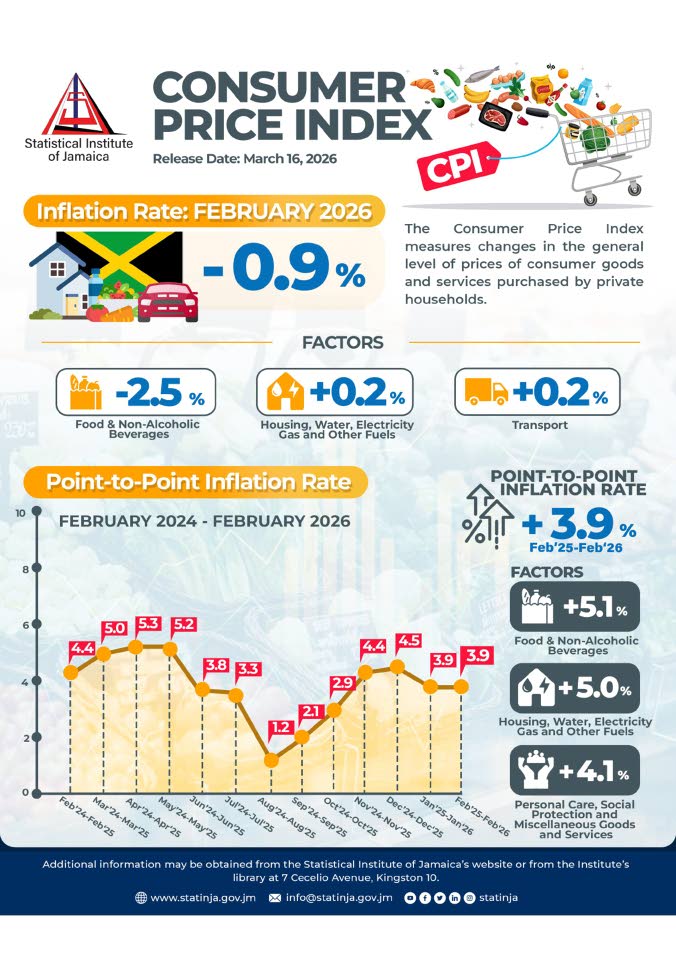
    Jamaica experienced a significant downturn in inflation during February, with official statistics revealing a 0.9% monthly contraction in the All-Jamaica Consumer Price Index. This substantial decline was predominantly propelled by a dramatic 11.3% collapse in vegetable prices alongside reductions in tubers, plantains, and pulses, culminating in a 2.5% decrease within the food and non-alcoholic beverages category. Superficially, these figures position annual inflation at 3.9%—comfortably within the Bank of Jamaica’s target corridor of 4-6%—suggesting economic stability.

    However, beneath this apparent tranquility lies a more complex economic narrative. Despite the dramatic monthly food price correction, annualized food inflation persists at 5.1%, maintaining its position as the primary driver of overall price increases. Concurrently, housing utilities and fuels recorded 5% inflation while personal care services rose 4.1%, indicating sustained pressure across essential expenditure categories.

    The February data reveals critical sectoral divergences: while agricultural products experienced deflationary trends, housing-related costs including electricity advanced 0.2% alongside similar increases in transportation fueled by rising petrol prices. This dichotomy underscores Jamaica’s fundamental inflation characteristic—volatile food prices creating optical illusions that mask structural cost increases in energy-dependent sectors.

    This presents policymakers with a formidable challenge, as monetary tools designed to combat demand-driven inflation remain largely ineffective against supply-side volatility in agricultural production. The current stability thus appears contingent upon unpredictable factors including harvest yields and global energy markets, creating a fragile equilibrium that could rapidly reverse.

    For Jamaican households, the statistical decline offers limited relief as reduced grocery expenses are offset by mounting utility and transportation costs, maintaining constant pressure on household budgets. The economy consequently demonstrates superficially controlled inflation while remaining vulnerable to sudden shifts in commodity markets and energy pricing.

  • Everyday Value Jamaica Ltd is the exclusive distributor of Britannia products

    Everyday Value Jamaica Ltd is the exclusive distributor of Britannia products

    KINGSTON, Jamaica — A landmark distribution agreement has been finalized between Everyday Value Jamaica Limited and Britannia Industries Limited, India’s premier biscuit and dairy products manufacturer. This exclusive partnership signifies Britannia’s official market entry into Jamaica, with Everyday Value Jamaica appointed as the sole distributor for its extensive product portfolio.

    The strategic alliance represents a mutual commitment to market expansion and consumer accessibility. Zhen Tang, Managing Director of Everyday Value Jamaica, emphasized the significance of this collaboration, stating, ‘This partnership aligns with the steady progress and trust we have cultivated as an organization. Our five decades of expertise in distribution have prepared us for such high-caliber alliances, which serve as testaments to our operational resilience and growth trajectory.’

    Shanice Nation, Senior Marketing and Business Development Manager, expressed enthusiasm about the collaboration: ‘We are honored to be selected as the distribution partner for this multinational conglomerate. Facilitating Britannia’s debut in Jamaica reinforces our dedication to forging enduring partnerships and driving mutual commercial success.’

    The distribution framework will encompass nationwide logistics, marketing campaigns, and customer support services for Britannia’s diverse biscuit range. Jamaican consumers will gain direct access to popular brands including Marie Gold, Tiger, Treat, Milk Biskis, 50/50, Little Hearts, Jim Jam, Good Day, Bour Bon, Pure Magic Choco, Nutro, and NiceTime.

    To catalyze market penetration, Britannia will launch its ‘Biscuits-BUY THE DOZEN’ promotional campaign featuring two months of intensive marketing activities. The initiative will include trade incentives for retailers and wholesalers, complemented by in-store product sampling events and consumer giveaways at major retail chains including John R Wong, General Foods, Sampars/Select Grocers, Sovereign, and Loshusan.

  • Jamaica Broilers cuts losses but weak US unit still drags results

    Jamaica Broilers cuts losses but weak US unit still drags results

    Jamaica Broilers Group Limited has achieved a remarkable financial turnaround during the nine-month period ending January, substantially narrowing losses through strengthened domestic operations that have helped stabilize the poultry conglomerate following last year’s accounting crisis. While the company’s challenging US division continues to negatively impact overall performance, the Jamaican operations have emerged as the primary engine driving the group’s recovery.

    The third-quarter interim financial report reveals a net loss of approximately $1 billion, representing a dramatic improvement from the $3.5 billion deficit recorded during the same period last year. This significant recovery stems from a complete reversal in operating performance, with the company posting an operating profit of about $2 billion compared to an operating loss of $1.2 billion in the previous year.

    Revenue for the nine-month timeframe reached $73.6 billion, accompanied by a 22% surge in gross profit to $13.5 billion, indicating substantially improved margins despite modest revenue growth. Company management credited this margin enhancement to refined operational execution across all business units, emphasizing their continued focus on efficiency measures and disciplined implementation strategies.

    The financial resurgence occurs against the backdrop of Jamaica Broilers’ ongoing efforts to stabilize its financial position after accounting irregularities discovered in its US operations prompted a massive $46 billion restatement of financial statements. This development led to the planned transition from long-standing auditor PricewaterhouseCoopers to Ernst & Young.

    Currently, the company is negotiating the resolution of approximately $120 million in debt associated with its US operations, while a $24 billion refinancing arrangement with local banks has provided essential liquidity during balance sheet restructuring. Despite these challenges, Jamaica Broilers maintains its commitment to enhancing operational efficiency and strengthening performance across all business segments as it works toward restoring sustained profitability.

  • Family Island hoteliers ‘wait and see’ on fuel hike impact

    Family Island hoteliers ‘wait and see’ on fuel hike impact

    Hotel operators across the Bahamian Family Islands are adopting a vigilant ‘wait and see’ strategy as escalating global fuel prices, fueled by the Middle East conflict, prompt dire warnings from local airlines about imminent airfare hikes. While current bookings remain robust, industry leaders are bracing for potential disruptions ahead of the critical summer season. This cautious optimism underscores the delicate balance between maintaining operational viability and preserving the archipelago’s competitive edge as a premier travel destination. General Manager Molly McIntosh of the Bluff House Beach Resort and Marina on Green Turtle Cay, Abaco, reported full occupancy for now but acknowledged the looming threat. ‘In my assessment, it will undoubtedly impact tourism,’ McIntosh stated. ‘The full effect simply takes time to materialize. We anticipate challenges in maintaining affordability without compromising service excellence or financial sustainability.’ The sentiment is echoed in smaller establishments like Andros’s Augusta Bay, where Manager Arlene Rolle confirms full bookings driven largely by domestic clientele attending local festivals. However, with Western Air—the sole commercial carrier serving Andros—forecasting a 40% surge in fuel costs, even resilient local markets face uncertainty. ‘One never knows,’ Rolle admitted, highlighting the pervasive anxiety. In Exuma, Hideaways Resort’s Assistant Manager Cindy Romer noted that steep airfares are already straining local travelers, potentially constraining domestic tourism. Despite these concerns, no significant booking declines have been recorded thus far. Economists like the University of The Bahamas’ Assistant Professor Rupert Pinder warn of broader repercussions: a protracted conflict could trigger heightened consumer caution, directly threatening discretionary spending—the lifeblood of tourism. As the industry monitors key indicators, such as upcoming engagements at the Palm Beach Boat Show, the overarching focus remains on delivering unmatched value to safeguard the Bahamas’ tourism-driven economy.

  • Beslag van €5 miljoen komt vrij na schikking DSB in geldzendingzaak

    Beslag van €5 miljoen komt vrij na schikking DSB in geldzendingzaak

    The Surinaamsche Bank N.V. (DSB) has successfully concluded a protracted legal dispute with the Dutch Public Prosecutor’s Office through a €124,500 settlement agreement, resulting in the release of approximately €5 million in previously frozen funds. The resolution, announced on March 17, 2026, stems from a contentious money transfer incident that occurred in April 2018.

    Following six months of intensive negotiations described by the bank as ‘productive,’ both parties reached an out-of-court settlement that DSB considers an appropriate resolution to the long-standing case. The Dutch banking institution confirmed the arrangement with reference to an official statement from the Netherlands Public Prosecution Service.

    The primary motivation for DSB’s acceptance of the settlement was the termination of an extended and financially draining legal battle, coupled with the recovery of seized assets. Upon payment of the agreed €124,500 penalty, the bank will regain access to the full €5 million that had been under seizure.

    In an official statement, DSB emphasized its ongoing commitment to regulatory compliance, stating: ‘From our societal responsibility perspective, we remain unwavering in our dedication to strict adherence to national and international compliance laws and regulations, thereby promoting an integrity-based financial system.’

    The settlement represents a significant development in cross-border financial regulation enforcement, demonstrating how international banking institutions can resolve compliance disputes through negotiated settlements rather than prolonged litigation.