分类: business

  • Antigua Sailing Week announces new bank partnership

    Antigua Sailing Week announces new bank partnership

    CIBC Caribbean has announced an exciting new collaborative partnership with the iconic Antigua Sailing Week, marking a strategic move to spotlight its exclusive Platinum Banking Service, a custom offering designed for discerning professionals, corporate executives, and international clients seeking financial solutions for regional investments and Caribbean property purchases.

    Priscilla Leonce, Country Head of CIBC Caribbean, emphasized the strong alignment between the sailing event and the brand’s vision for its premium banking division. “We are thrilled to enter into this partnership with Antigua Sailing Week, a leading lifestyle event that shares our core values for Platinum Banking,” Leonce stated in a press release announcing the collaboration. “Our Platinum Banking Service is built around a specialized, dedicated team that prioritizes understanding each client’s unique long-term financial goals, then works hand-in-hand with them to craft customized solutions that drive sustained growth and success. What sets our offering apart is the combination of personalized one-on-one support, innovative forward-thinking financial strategies, and an unwavering commitment to building enduring, trust-based relationships with every client.”

    Leonce also noted that the partnership extends beyond brand visibility, framing the iconic regatta as a valuable opportunity to connect with sailing enthusiasts, international visitors, and existing clients based on the island of Antigua, fostering organic networking in a relaxed, premium setting.

    Organizers of Antigua Sailing Week have welcomed the regional banking giant as a key sponsor for the 2026 event, praising CIBC Caribbean’s standing as a foundational financial institution across the Caribbean. Event representatives noted that the partnership does more than boost the regatta’s prestige: it also underscores the critical importance of forging strong, mutually beneficial ties between local businesses, global brands, and the regional community.

    The 2026 Antigua Sailing Week roster of sponsors already includes a diverse array of public and private partners, ranging from the Antigua & Barbuda Ministry of Tourism, Investment & Economic Development and the island’s Citizenship by Investment Unit to global brands such as Heineken Beer and Virgin Atlantic, luxury hospitality providers like The Residences at Nikki Beach Resort and Spa Antigua and Palmer Champagne, and local businesses including Seahawk Paints, English Harbour Rum, CalvinAir Helicopters, and APUA Inet.


  • Antigua and Barbuda Targets Africa, Middle East and Latin America in Tourism Expansion Push

    Antigua and Barbuda Targets Africa, Middle East and Latin America in Tourism Expansion Push

    As the Caribbean nation of Antigua and Barbuda prepares for its upcoming general election on April 30, the country’s Tourism Minister Charles Fernandez has laid out an ambitious plan to reshape the nation’s core economic sector: tourism. In a public “Know Your Candidate” interview, Fernandez detailed a strategy that moves beyond the nation’s long-standing reliance on traditional source markets, with new outreach focused on high-growth regions across Africa, the Middle East and Latin America.

    For decades, Antigua and Barbuda’s tourism industry has drawn the vast majority of its visitors from established markets including the United States, the United Kingdom and Canada. While these core markets will remain important, Fernandez says expanding into new regions is no longer optional in an increasingly competitive global travel landscape. “I think what we need to do now, and we have started it, is to look at other source markets apart from the US, UK, Canada,” he noted, pointing to advanced ongoing negotiations with one of the world’s leading air carriers.

    The centerpiece of the new airlift strategy is a pending deal with Emirates Airline that would bring three weekly direct flights from Dubai to Antigua and Barbuda starting in 2027. Fernandez explained that this air link would unlock access to a large base of high-net-worth travelers across the Middle East, while also creating easier connections for visitors from African and South Asian markets. “There are a lot of very, very wealthy people in Africa, the Middle East, and so on, and Antigua has now positioned itself as a high-end destination,” he said.

    The diversification push extends beyond tourism alone, with parallel plans to boost bilateral trade and economic ties with the new target regions. To support this dual goal of growing travel and commerce, the government has outlined major infrastructure upgrades for the nation’s main airport, including expanded cargo storage space and new temperature-controlled refrigeration facilities. These upgrades are designed to complement ongoing expansion work at the country’s commercial seaport, with the end goal of transforming Antigua and Barbuda into a comprehensive logistics and transportation hub for the entire Caribbean region.

    “We’re now looking to build out a larger cargo area… all in making the airport, just as the port is being done, a hub for the Caribbean,” Fernandez explained. He emphasized that the broader diversification strategy is a critical step to insulate the national economy from sudden disruptions, noting that over-reliance on a small number of source markets leaves the tourism sector vulnerable to shocks such as economic downturns or public health emergencies in any single region.

    Even with the push for new markets, Fernandez reaffirmed that the existing tourism ecosystem remains the primary engine of Antigua and Barbuda’s national economy. Today, the sector supports widespread employment across the country, with growth coming not just from large international hotel brands but also a fast-expanding network of locally owned short-term vacation rentals that keep more tourism revenue in local communities. By expanding into new high-yield markets while strengthening core infrastructure, the government aims to deliver long-term, stable growth that benefits all segments of the national economy.

  • Construction starts on road connecting Nisibón to Uvero Alto

    Construction starts on road connecting Nisibón to Uvero Alto

    The Dominican Republic has officially broken ground on a major infrastructure initiative designed to unlock further tourism potential in one of the country’s most popular coastal regions. Tourism Minister David Collado launched the reconstruction of the access corridor leading to Uvero Alto Beach, starting from the Las Lagunas de Nisibón district, with dual goals of upgrading local connectivity and driving sustainable tourism development across the nation’s eastern corridor.

    The project spans 9.2 kilometers of roadway, split into three distinct construction segments that will create a direct, improved link between the Uvero Alto tourism cluster and the existing Miches–Nisibón highway. A full suite of upgrades is planned for the corridor, including modernized drainage infrastructure, targeted soil stabilization to extend road lifespan, updated directional and safety signage, new pedestrian sidewalks and curbs, enhanced street lighting, full asphalt resurfacing, reinforced retaining walls, complete culvert reconstruction, and comprehensive erosion control measures to protect the roadway from coastal weather damage.

    Being delivered by the national Committee for Infrastructure in Tourist Zones, the initiative carries a total investment of 711 million Dominican pesos, equivalent to approximately 13.8 million U.S. dollars. Government officials project that the upgraded road will cut travel times and improve safety for both local residents and out-of-town visitors, while creating a seamless connected route between major hotel developments and the scenic Uvero Alto–Nisibón coastline, a major draw for domestic and international travelers alike.

    Speaking at the official groundbreaking ceremony, Minister Collado emphasized the far-reaching economic benefits the project is expected to deliver to local communities in Nisibón, Uvero Alto, and surrounding areas. He reaffirmed that the eastern region of the Dominican Republic retains its position as the country’s top tourism hub, welcoming more than 5.4 million international and domestic visitors in 2023 alone, a figure that reflects steadily growing demand for the region’s beaches, resorts, and recreational offerings.

    Immediately following the groundbreaking event, Collado held a closed-door working meeting with hotel operators and key tourism industry stakeholders at the Grand Bávaro Princess resort. During the session, attendees reviewed current industry performance metrics, discussed ongoing challenges facing the sector, and collaborated on developing actionable strategies to sustain consistent visitor growth through continued public-private partnership across all levels of the tourism ecosystem.

  • Scammers Beware: Belize Launches Instant Payment System

    Scammers Beware: Belize Launches Instant Payment System

    For months, small business owners and consumers across Belize have fallen victim to a pervasive and costly digital scam: fraudsters send convincing fake screenshots of completed bank transfers to secure goods or services, leveraging the multi-hour or even overnight delays in traditional payment processing to disappear before victims discover the funds never actually arrived. That loophole that scammers have exploited for years is about to be closed, after the Central Bank of Belize announced the full rollout of its new Instant Payments System (IPS), a 24/7 real-time transaction network designed to eliminate processing delays and cut off digital fraud at its source.

    Under Belize’s current banking framework, all digital payments are restricted to standard business operating hours and processed in segmented settlement windows. Payments initiated after the midday cutoff do not reach recipient accounts until the following business day, creating a gap between when a payment is marked as “sent” and when it is officially finalized in a user’s account. This gap has been the critical enabler for the screenshot scam, which has cost local merchants thousands of dollars in lost goods across the country.

    Central Bank of Belize Governor Kareem Michael explained that the new IPS system eliminates this gap entirely by enabling year-round, 24/7 payment processing that settles transactions in seconds. “What our target is that these transactions will be processed and settled typically in ten seconds or less. It is like sending a WhatsApp message,” Michael said. Unlike the current system that locks payments outside of banking hours, the IPS aligns transaction speed with the actual pace of economic activity, allowing funds to move whenever consumers and businesses need them to.

    Beyond cutting out delays to stop fraud, the new platform also addresses longstanding interoperability issues in Belize’s financial sector by connecting all domestic banks, credit unions, and digital wallet providers into a single unified network. This means users will be able to send instant transfers between different financial institutions seamlessly, no longer facing extra wait times or fees for cross-provider transactions. “IPS will connect banks, credit unions, and digital wallets into one shared payment system, allowing money to move easily and instantly between individuals, businesses, regardless of the provider,” Michael added.

    To deliver a system that meets global security and functionality standards, the Central Bank partnered with Montran Financial Services, an international payment infrastructure provider with decades of experience implementing real-time and instant payment systems for central banks across nearly 100 countries. Matt Walsh, Montran’s Global Sales Director, noted that the firm’s customizable solution is built to adapt to Belize’s unique financial ecosystem while adhering to the latest international technology standards. “All of our solutions are customizable, very flexible in terms of scaling them and implementing the exact requirements,” Walsh explained. “They’re all of course modern and built on the latest standards and technology. All of our solutions are multicurrency, multi-institutional and multilingual, so that could be accommodated and we have references all over the world.”

    For everyday consumers and small business owners, the changes brought by the IPS will be subtle but transformative. The system will support convenient quick payments via QR codes, and most importantly, it delivers immediate confirmation that funds have been successfully deposited to a recipient’s account. This removes the need for merchants to rely on a customer’s screenshot proof of payment, closing the key loophole scammers have relied on for years. When fully operational, the system will bring Belize’s domestic payment infrastructure in line with global modern banking standards, cutting fraud risk and streamlining everyday commercial activity for all users.

  • Minimum Purchase and Extra Charges for Using Your Credit Card

    Minimum Purchase and Extra Charges for Using Your Credit Card

    For countless consumers across Belize, running into arbitrary minimum purchase requirements or unexpected surcharges when paying with a credit or debit card has long been a persistent source of frustration. Now, the country’s top financial regulator is stepping up its long-running campaign to stamp out these controversial industry practices, framing them as harmful to consumers and counter to national goals for broader financial inclusion.

    Kareem Michael, Governor of the Central Bank of Belize, explained that the issue has plagued shoppers for years, and he has even encountered the unfair practices firsthand during his own regular transactions. In one recent example, Michael shared that he attempted to purchase roughly $9 worth of goods at a local grocery store, only to be turned away when he tried to pay with his debit card because the store enforced a $15 minimum card purchase requirement, forcing him to pay with cash. When he returned to the same outlet for another sub-$15 purchase later, the store had adjusted its policy — but not to the benefit of customers: it instead added a mandatory $1 surcharge for processing debit card payments for small transactions.

    Many merchants that impose these rules argue that minimum purchase thresholds and surcharges are necessary to offset the transaction processing fees they are required to pay to financial institutions. But regulators push back that these practices are fundamentally unfair to consumers and directly contradict the core mission of Belize’s financial system.

    The Central Bank is now collaborating closely with the Belize Bankers Association and local credit unions to develop a permanent solution to the problem. Michael noted that discussions between stakeholders have been productive, with proposals ranging from strict outright bans on the practices to more nuanced frameworks designed to balance the needs of both merchants and consumers. The regulator is aiming to finalize a resolution in the near future.

    Michael emphasized that the campaign against these unfair card practices is not an attempt to push Belize toward a fully cashless economy. Instead, it centers on protecting the most vulnerable members of society, who are disproportionately harmed by policies that disincentivize card use. When merchants impose extra costs or barriers to card payments, they push many people away from participating in the formal financial sector entirely, undermining years of work to expand access to affordable financial services across the country. Ending these abusive practices, Michael said, is a top priority for the regulator and its industry partners.

  • Banks Change Savings Accounts, Customers Now Face New Fees

    Banks Change Savings Accounts, Customers Now Face New Fees

    Scheduled publication date: April 21, 2026

    A quiet but significant shift in retail banking policy has left thousands of customers across Belize grappling with unexpected new costs, as the nation’s two largest commercial lenders—Belize Bank and Atlantic Bank—have restructured their basic savings account offerings into new “Full Access” and “Essential” tiers that bear a striking resemblance to traditional checking accounts.

    While the reclassification comes with one key customer benefit: looser withdrawal limits and more flexible ATM access, the trade-off has proven far more impactful for ordinary account holders. Under the new terms, all restructured savings accounts no longer generate any interest earnings, and new monthly maintenance fees and per-transaction charges are now applied to regular account activity.

    For the large share of Belizean households that live paycheque to paycheque, these incremental fees add up quickly at a time when the country is already facing rising cost of living. The banks have defended the change, arguing that it aligns account structures with how the majority of customers actually use their savings accounts day-to-day. But many consumers have pushed back against the framing, questioning whether “full access” is nothing more than a rebranding for increased revenue for the banks.

    When pressed for comment on the policy shift, Central Bank of Belize Governor Kareem Michael emphasized that the country’s top banking regulator played no role in approving or mandating the changes. “First thing I have to correct is that the Central Bank was not involved in that decision. There was no approval sought for Atlantic Bank or any other bank to have done that,” Michael stated in a press briefing.

    He went on to clarify the scope of the Central Bank’s regulatory authority over commercial banking in Belize, noting that the regulator only has power to set caps and floors for lending rates and minimum floors for savings deposit interest rates. Roughly 18 to 24 months ago, the Central Bank launched a collaborative review of fee-based income practices at Belize’s commercial banks, a process that took months of negotiation to reach a compromise that satisfied both regulators and financial institutions. Michael acknowledged, however, that public frustration over growing bank fees has mounted amid broader inflation, pointing out that consumers are now facing the double blow of lost interest earnings on savings alongside rising everyday expenses.

    Michael also confirmed that the move is not limited to one smaller institution, noting that the decision by Belize’s two largest banking players to restructure their accounts reveals key dynamics of the country’s domestic banking market. “Those two are the biggest banks,” he added, underscoring the widespread impact of the policy change across the nation’s consumer banking sector.

    As it stands, no regulatory reversal of the changes is currently on the table, leaving customers to adjust to a new normal where their savings generate no passive income, and regular account activity comes with recurring out-of-pocket costs.

  • Vendor Says CitCo’s Decision Ripples from Market Stall to Farm Fields

    Vendor Says CitCo’s Decision Ripples from Market Stall to Farm Fields

    For more than a decade, customers shopping for farm-fresh goods at Belize City’s iconic Michael Finnegan Market could count on one constant: a stall near the second gate stocked with vegetables straight from the Little Belize farming community. That familiar routine has been upended in recent weeks, after a controversial policy dispute forced long-time wholesale vendor Herman Freisen to abandon his spot and relocate to a new facility, sending economic ripples from the city marketplace all the way out to rural farming households.

    Freisen, a Mennonite wholesaler who has operated at the market for over 15 years, built his business around a consistent dual model: moving bulk product to smaller resellers on designated wholesale days (Tuesdays and Fridays), then selling directly to retail customers on Saturdays to clear remaining stock. That arrangement allowed him to keep prices low for everyday shoppers while delivering steady income to the farming families that supply his produce. But under new pressure from small retail vendors who say his Saturday retail sales undercut their own businesses, Freisen says he was told to end retail sales at the municipal market and ultimately forced to move.

    “We weren’t even given a grace period to let our regular customers know we were leaving,” Freisen explained. “I asked for at least one more Saturday to inform people, and that request was denied. We had no choice but to pack up last weekend and move to our new location at Pound Yard Market, a privately run facility where there are no restrictions on mixing wholesale and retail sales. We can still offer fair, competitive prices there that match what we charged at Michael Finnegan, but we’ve already seen a sharp drop in foot traffic and sales as customers adjust to the new location.”

    Freisen emphasizes that the harm from this disruption extends far beyond his own bottom line. Every decline in his sales translates directly to lower income for the small farming families in Little Belize that grow the vegetables he sells, putting unplanned financial strain on rural households that already operate on thin margins.

    The Belize City Council, however, is pushing back against Freisen’s account, denying that any formal order to relocate or end retail sales was ever issued. Market manager Delroy Herrera says the conflict is the result of long-simmering tension between wholesale and small-scale retail vendors over day designations at the publicly run market, and that the council has not yet made any final binding decisions on the dispute.

    Under existing municipal regulations laid out in Chapter 85 of the Belize City Council code, Tuesdays and Fridays are reserved exclusively for wholesale trade, while Saturdays are designated for open retail sales. Herrera explained that complaints have mounted from both sides for months: small retailers have been selling on wholesale days and forcing bulk vendors to cut prices, while wholesalers like Freisen that choose to sell on retail days are accused of undercutting smaller vendors who rely on Saturday walk-up traffic.

    “After a meeting with vendors on April 15, there was a lot of informal discussion among vendors, but the council never issued any formal written or official order telling Mr. Freisen he couldn’t sell here,” Herrera noted. “The issue is that Mr. Freisen often skips Friday wholesale days to make off-site deliveries, and he wants to make up those sales by selling retail on Saturday. But Saturdays are set aside for small retail vendors who buy their stock wholesale on Fridays and sell directly to shoppers to earn their own living. The council is committed to balancing the needs of both large wholesalers and the small, independent vendors who come into the city from areas like Bomba to make a living. Right now, we’re still working through the problem, and no final decisions have been made.”

    Councilor Evan Thompson echoed that position in comments to local media, confirming that the council has not issued any instructions blocking Freisen or any other vendor from selling at Michael Finnegan Market, calling any claims to the contrary inaccurate.

    The dispute has left both Freisen and his network of farming suppliers in limbo, as the vendor adjusts to his new private market location and waits to see if a resolution can be reached that would allow him to return to his long-time spot at the municipal market.

  • Hewanorra International Airport control tower more than halfway complete

    Hewanorra International Airport control tower more than halfway complete

    The major redevelopment initiative for Hewanorra International Airport continues to advance on schedule, with St. Lucia’s Prime Minister Philip J. Pierre sharing key milestone updates during his official 2026/2027 Budget address earlier this week. Among the most critical infrastructure components of the multi-phase upgrade, construction of a brand-new air traffic control tower has crossed the halfway completion mark, standing at 52 percent finished as of the budget presentation. Prime Minister Pierre confirmed that the project remains on track for full completion of the control tower by the end of the current calendar year.

    Beyond the control tower works, the Prime Minister outlined the next major phase of the redevelopment: the construction of a reimagined terminal building. To ensure transparency, competitive pricing, and global expertise, the government launched an international open tender process to select a qualified construction contractor for the high-profile terminal project. According to Pierre, the tender window closed on November 30, 2025, with a total of seven formal bids submitted by international and regional construction firms.

    After an initial rigorous technical evaluation to assess each bidder’s experience, operational capacity, and ability to meet the project’s strict design and safety standards, three shortlisted firms have moved forward to the final financial bid submission stage. The Prime Minister told stakeholders that evaluation of the competing financial proposals is currently ongoing. Once the assessment process concludes, a winning contractor will be appointed, and physical construction work on the new terminal is scheduled to break ground before the end of 2026. This large-scale airport upgrade is expected to boost St. Lucia’s tourism capacity, improve air travel safety, and support long-term economic growth in the island nation.

  • Dominican shipping sector rules out disruptions despite higher freight rates

    Dominican shipping sector rules out disruptions despite higher freight rates

    In a recent public statement addressing growing concerns over rising shipping costs, the Dominican Republic Shipping Association (ANRD) has pushed back against speculation that local operational disruptions are driving recent maritime freight rate increases, instead attributing the jump to broader global logistics and economic forces.

    The industry group confirmed that freight rates have climbed roughly 25% over the past several weeks, a noticeable jump that has drawn attention from importers, exporters, and domestic supply chain stakeholders across the island nation. However, ANRD emphasized that current rates are still far lower than the all-time peak recorded in 2024, when global shipping costs hit unprecedented levels that far outpace today’s adjustments. Benchmark global metrics, including the widely tracked World Container Index, continue to reflect that overall freight costs remain well below the 2024 peak, the organization added.

    According to ANRD’s analysis, the primary catalysts for the current rate increase are two interconnected global challenges: steadily climbing fuel prices and escalating geopolitical tensions that have roiled international trade flows across the globe. Beyond these two key factors, the association noted that all freight rate fluctuations stem from systemic market dynamics rather than unilateral decisions by domestic shipping players. These broader forces include shifting global supply and demand balances, rising vessel operating expenditures, increasing maritime insurance premiums, and evolving international environmental regulations that add compliance costs for shipping lines.

    A key point of reassurance from ANRD centers on the stability of the Dominican Republic’s maritime supply network. The organization stressed that the country’s core trade routes, which connect it to major North American, European, and Latin American markets, do not pass through the world’s most geopolitically tense hotspots. This geographic positioning has protected the Dominican Republic from widespread shipping disruptions that have plagued other regions, with no reported interruptions to logistics operations or restricted access to imported goods to date.

    While the impact has so far been limited to incremental cost adjustments, ANRD has called for ongoing proactive monitoring of global market conditions and strengthened cross-sector coordination across the entire domestic logistics chain. These measures, the group argues, will help stakeholders anticipate emerging risks, mitigate unexpected cost spikes, and preserve consistent supply chain stability for the Dominican Republic’s economy.

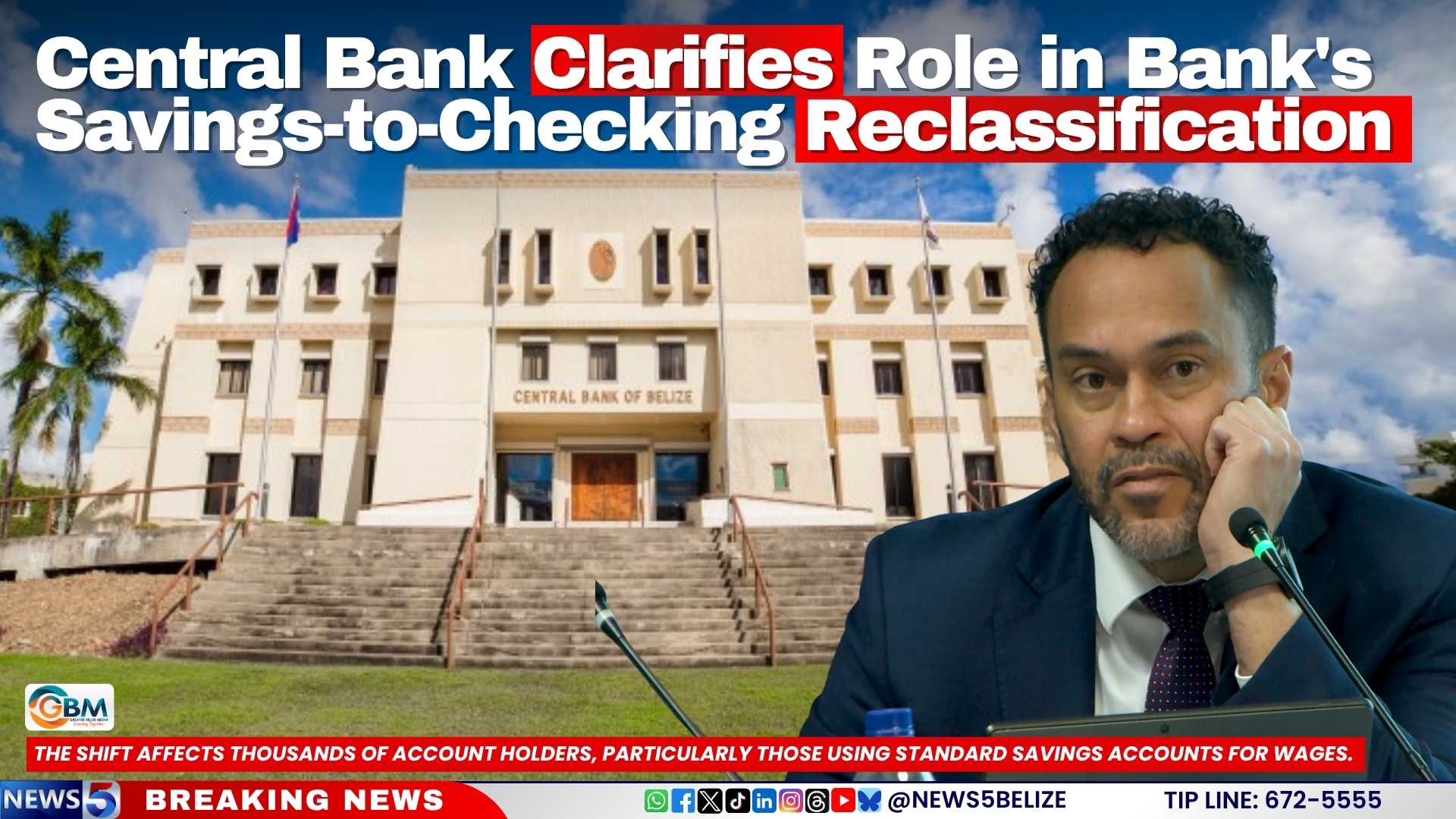
  • Central Bank Clarifies Role in Bank’s Savings-to-Checking Reclassification

    Central Bank Clarifies Role in Bank’s Savings-to-Checking Reclassification

    In a recent public clarification that has stirred concern among thousands of banking customers across Belize, the Central Bank of Belize has distanced itself from sweeping changes rolled out by two of the nation’s largest commercial lenders – Belize Bank Limited and Atlantic Bank Limited. The reforms, which reclassified existing basic savings accounts into two new tiers labeled “Full Access” and “Essential”, eliminated interest earnings on salary deposits and introduced new monthly maintenance and transaction fees, converting what were once interest-bearing savings products into checking-like accounts with associated costs.

    The changes, implemented several weeks prior to the central bank’s statement, have disproportionately impacted working account holders who relied on their basic savings accounts to receive regular wage deposits. Under the new structure, affected customers now face a monthly maintenance fee of roughly 1.5 Belize dollars, plus teller withdrawal fees that can reach up to 4 Belize dollars per transaction, with no interest accrued on their account balances. Thousands of households across the country have seen their small but steady interest earnings disappear overnight, with many unaware the changes did not receive formal regulatory sign-off.

    Central Bank Governor Kareem Michael made the regulator’s position clear in an official statement released April 21, 2026: “There was no approval sought for Atlantic Bank or any other bank to have done that.” Michael further outlined the scope of the central bank’s regulatory authority, explaining that the institution’s mandate is limited to setting binding caps and floors on interest rates across the banking sector, not pre-approving new account structures or product offerings from commercial institutions.

    Amid the ongoing fallout from the unexpected reclassification, Governor Michael noted that the central bank is currently engaged in active discussions with Belize’s commercial banking sector to address the public’s concerns. The regulator is also working through a broader package of financial sector reforms, including the development of new financial consumer protection legislation and the rollout of a formal national credit reporting system – changes intended to strengthen safeguards for banking customers moving forward. The talks are focused on striking a functional balance between supporting the expansion of digital banking services, covering banks’ operational costs through reasonable fees, and protecting consumers from unfair, unexpected changes to their account terms.