分类: business

  • Staatsolie start seismisch onderzoek in ondiep zeegebied

    Staatsolie start seismisch onderzoek in ondiep zeegebied

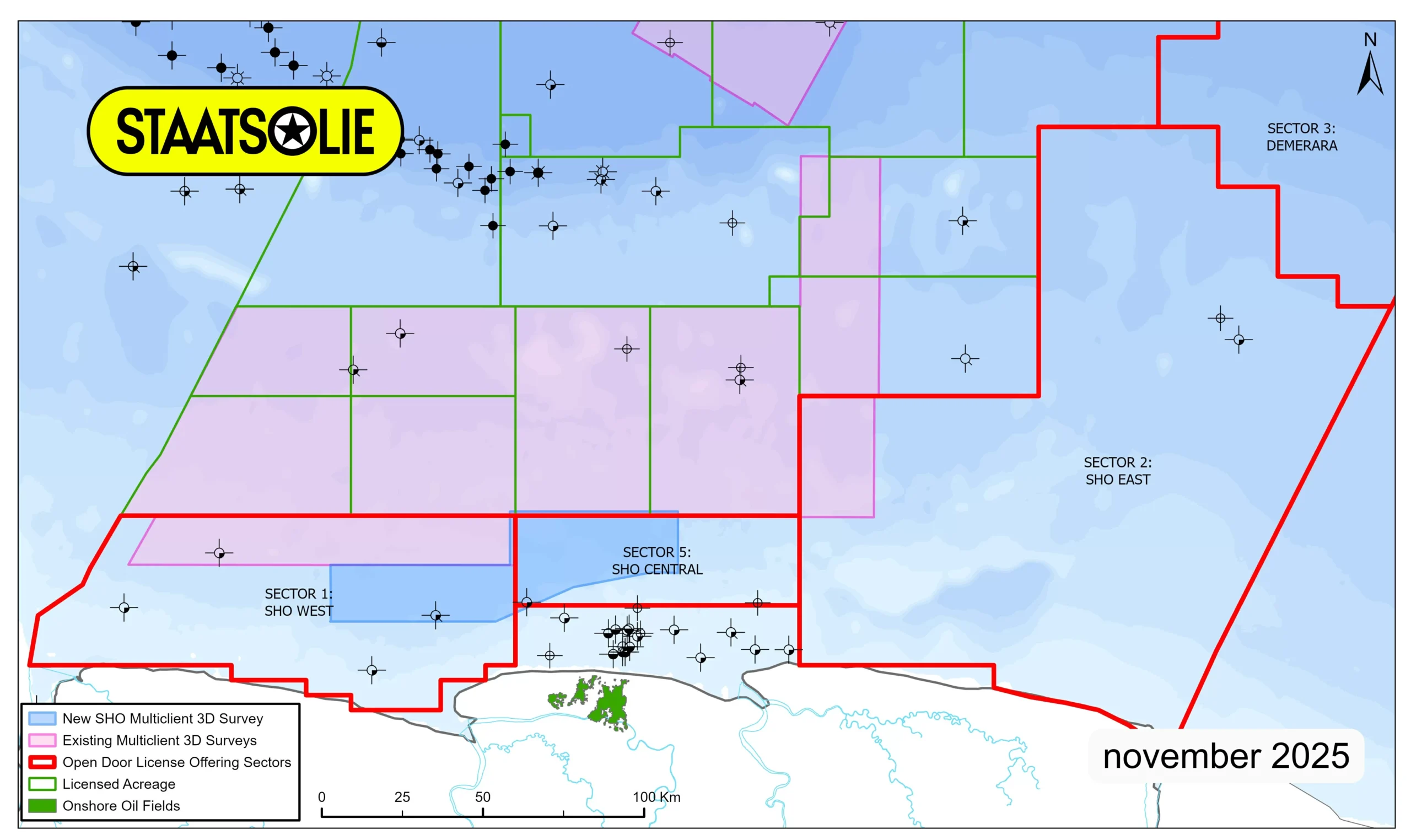
    Suriname has initiated a comprehensive seismic survey in its shallow offshore waters, marking a significant advancement in the nation’s energy exploration efforts. The project, spearheaded by Staatsolie Maatschappij Suriname N.V., involves collaboration with China’s Bureau of Geophysical Prospecting (BGP Offshore) and Norwegian/American firm Tomlinson Geophysical Services Inc. (TGS).

    Covering approximately 2,000 square kilometers in coastal regions near Saramacca and Coronie, the survey will operate at water depths ranging from 20 to 50 meters. Over a two-month period, the initiative will gather high-quality geological data to map potential oil and gas reserves beneath the seabed.

    The specialized vessel BGP Prospector will deploy an advanced array of eight six-kilometer-long streamer cables, submerged nine meters below the surface. These cables will capture reflected sound waves to create detailed subsurface imagery. Support vessels will ensure safety by maintaining distance between the research operation and local fishing activities.

    This project operates under a multi-client agreement model, allowing the consortium to sell collected data to third parties while Staatsolie retains ownership. This innovative approach enables access to premium geological information without bearing full financial burden, while generating revenue through data sales.

    The environmental aspects of the survey have been rigorously addressed through an approved Environmental Management and Monitoring Plan (MMMP). From August to October this year, extensive consultations were conducted with local communities, fishermen, and stakeholders from Coronie and Saramacca, with their feedback incorporated into the final environmental framework.

    This seismic investigation aligns with Suriname’s recent Open-Door Offering initiative, designed to attract international energy companies to invest in the country’s emerging offshore exploration opportunities.

  • Measures announced to make foreign investment more flexible and dynamic

    Measures announced to make foreign investment more flexible and dynamic

    In a significant policy shift, the Cuban government has unveiled comprehensive measures to revitalize foreign investment as a cornerstone of its economic strategy. The announcement came during the 8th Investment Forum at the 41st Havana International Fair, where Deputy Prime Minister Oscar Pérez-Oliva Fraga outlined sweeping reforms designed to create a more dynamic business environment.

    The new framework introduces substantial monetary flexibility, allowing dual currency operations in both national and foreign currencies according to investor needs. Foreign investment enterprises will be encouraged to focus on generating foreign income through exports or sales to domestic sectors with foreign currency capabilities. The government will establish ‘more competitive and realistic’ foreign exchange rates across certain sectors and permit companies to maintain offshore bank accounts to circumvent blockade-related financial restrictions.

    Procedural simplifications represent another major component of the reform package. The requirement for feasibility studies has been eliminated in favor of business plans, evaluation timelines have been halved from 15 to 7 days, and ‘positive silence’ provisions will automatically approve applications if agencies fail to respond within specified periods. Documentary requirements have been streamlined to essential documents only, and property appraisal validations have been extended beyond one year.

    Novel investment modalities include automatic establishment of wholly foreign-owned companies for hotel leasing tenders, reactivation of underutilized national assets with profit-sharing arrangements, unrestricted wholesale trading rights, and direct fuel import authorization when domestic supplies are unavailable. Labor reforms grant investors final hiring decisions, while permitting foreign currency bonus payments from profits generated through external income.

    The government is actively promoting foreign participation in banking and financial services while continuing development of special economic zones for targeted sectors like real estate and technology parks. Innovative financial instruments include selective swap operations—not merely for debt repayment but structured around sustainable businesses generating foreign currency income.

    Deputy Prime Minister Pérez-Oliva identified food production and knowledge economy sectors as strategic priorities, citing successful Vietnamese rice production partnerships as models. The administration is promoting ‘flexible and simpler business models’ to rapidly increase food output while leveraging Cuba’s skilled workforce in IT, biotechnology, and pharmaceutical industries.

    The updated investment portfolio features 426 projects across all provinces, with emphasis on food production, industry, tourism, and energy—particularly oil exploration and extraction. Eighty-three high-priority projects have been selected for their export potential.

    Yanet Vázquez Valdés, Deputy Minister of Foreign Trade and Foreign Investment, clarified that while direct hiring remains exceptional, the state employment agency system remains the general rule. These measures will inform a new Foreign Investment Law creating legal frameworks for partnerships between state-owned enterprises and non-state sectors, combining resources to rescue installed capacities and drive economic growth.

    Regarding debt management, officials emphasized that swap operations won’t involve asset-for-debt exchanges but rather negotiate medium-to-long-term business arrangements that simultaneously reduce foreign company debts while contributing to economic expansion.

  • ‘Fat Thursday’ as airport sees flights peak, braces for new record

    ‘Fat Thursday’ as airport sees flights peak, braces for new record

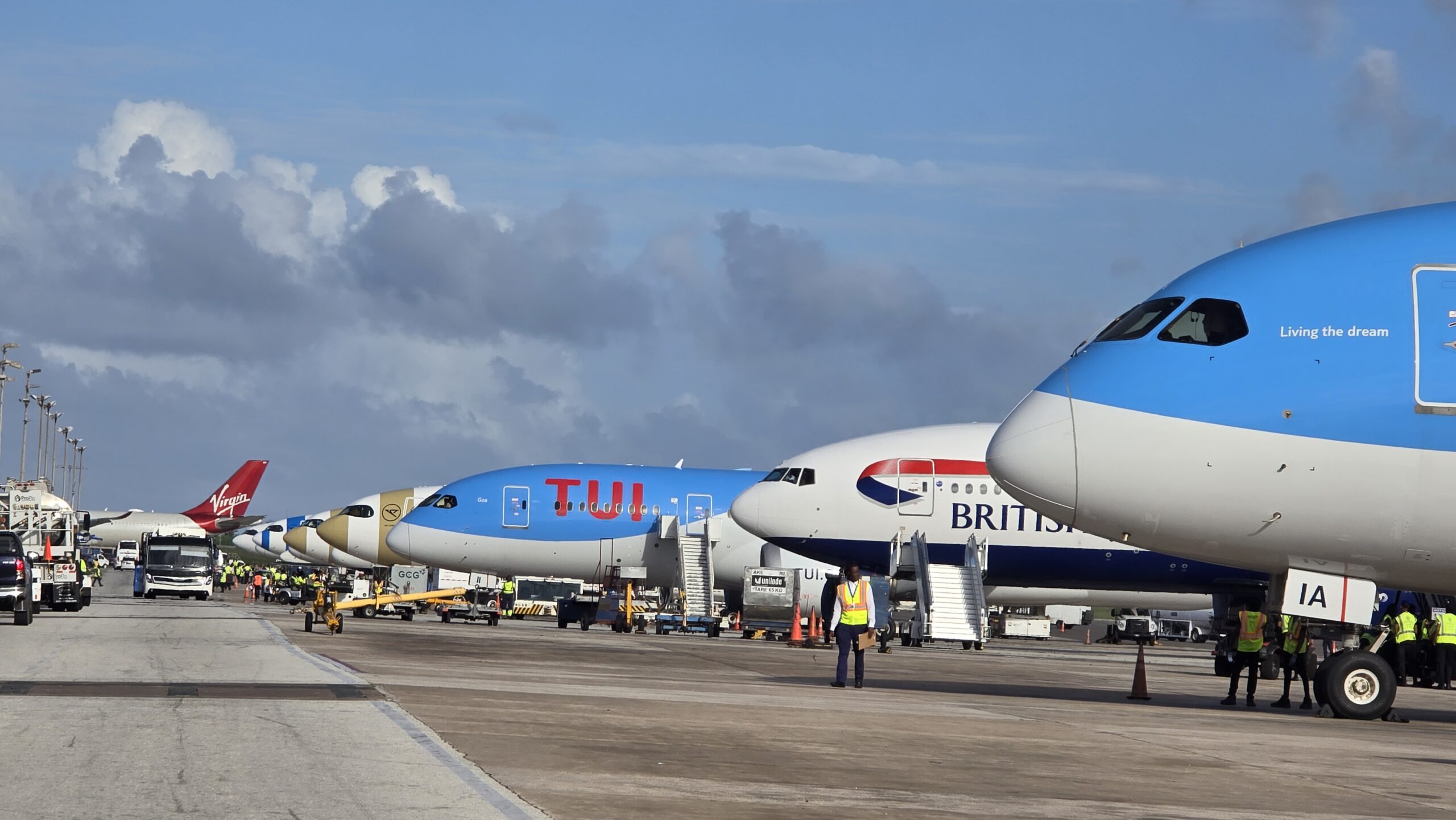
    Grantley Adams International Airport (GAIA) in Barbados experienced its most intense operational day of the year this Thursday, handling over 11 simultaneous air-to-sea cruise flights in an event airport staff have nicknamed ‘Fat Thursday.’ Chief Executive Hadley Bourne confirmed this was merely a precursor to an unprecedented surge expected on December 20th, which is projected to eclipse all previous records with more than 50 flights anticipated just days before Christmas.

    Air-to-sea passengers, who utilize Barbados as either a starting point or final destination for their cruises, created a bustling environment that prompted airport management to conduct a media tour of the apron. This demonstration highlighted the operational intensity required to manage the influx, which followed Tourism Minister Ian Gooding-Edghill’s announcement of approximately 8,000 passengers transiting through GAIA that day.

    The day’s operations involved a total of 53 aircraft, comprising 21 scheduled commercial flights, over 11 dedicated air-cruise transfers, and multiple regional services, excluding cargo and private aviation. Bourne reported seamless operations across various carriers including TUI’s Thomson brand and Condor, with the Concorde facility alone processing 11 flights.

    Bourne emphasized that December 20th presents a unique challenge as it combines peak winter commercial traffic with additional air-to-sea transfers, creating what is expected to be the airport’s busiest day in its 87-year history. Airport staff have been preparing throughout the year for this peak period, with enhanced training programs and earlier recruitment of seasonal workers starting as early as September to ensure operational familiarity.

    The increased traffic reflects Barbados’ expanding tourism strategy, which focuses on strengthening European air connectivity, particularly from northern England and Eastern Europe. Minister Gooding-Edghill has characterized the upcoming December surge as a ‘historic occasion’ for Barbadian tourism, signaling the island’s growing prominence as a premier cruise gateway.

  • Energiebanenhub voor Granmorgu-project gelanceerd

    Energiebanenhub voor Granmorgu-project gelanceerd

    Suriname’s energy sector received a significant workforce development boost on Thursday with the official launch of Energy Jobs Suriname, a digital employment platform initiated by TotalEnergies. The innovative portal immediately features 142 available positions while serving as a centralized hub for Surinamese citizens seeking opportunities within the country’s rapidly expanding energy industry.

    The unveiling ceremony gathered government ministers, educational institution representatives, major contractors, and international energy companies, marking a pivotal moment in efforts to enhance local participation in Suriname’s emerging energy economy. The platform constitutes a core component of TotalEnergies’ local content program, which encompasses 14 strategic pillars designed to elevate Surinamese knowledge, skills, and economic engagement.

    TotalEnergies EP Suriname General Manager Artur Nunes-da-Silva emphasized the platform’s role in increasing transparency and providing direct access to energy sector opportunities. “Energy Jobs Suriname transcends being merely a website—it represents a gateway to career possibilities and a concrete step toward integrating local talent into our industry’s growth,” Da Silva stated during the launch event.

    The platform currently showcases 437 identified positions within the sector, with 142 vacancies immediately available. Seven major corporations—TotalEnergies, Staatsolie, SBM Offshore, Halliburton, OneSubsea, Weatherford, and CCC Group—have contributed these initial openings, with additional companies expected to join as the sector expands in coming months.

    Education, Science, and Culture Minister Dirk Currie praised the initiative as a crucial advancement in national capacity building. “This platform bridges our people’s ambitions with opportunities in one of Suriname’s most vital sectors. It represents more than an instrument; it embodies a partnership between education, industry, and talent,” Minister Currie remarked.

    The platform’s introduction coincides with growing recognition of Suriname’s need to address workforce qualification gaps. Industry representatives during a panel discussion highlighted shortages in skilled technicians, engineers, operators, and specialized professionals, emphasizing the critical importance of education and practical training.

    Halliburton’s Operations Manager for Suriname and Trinidad & Tobago, Santiago Zambrano Figuerroa, noted the increasing importance of data analysis, automation, and digital competencies in modern oil and gas operations. Meanwhile, SBM Offshore’s Suriname Country Entry Manager Pierre Gaté emphasized that floating production storage and offloading (FPSO) vessels will require a broad spectrum of technical positions that Surinamese workers could fill with proper training.

    Staatsolie Hydrocarbon Institute Director Vandana Gangaram Panday identified structural challenges, noting that only 60% of Suriname’s potential workforce currently participates actively, with many youths failing to complete secondary education. “Without improvement, a significant gap will emerge between industry requirements and Suriname’s capabilities,” Gangaram Panday warned.

    Oil, Gas, and Environment Minister Patrick Brunings discussed the platform’s strategic significance within Suriname’s broader economic transition. According to Minister Brunings, revenues and knowledge from the oil sector should establish foundations for “Suriname 2.0″—a diversified economy incorporating green industries, agriculture, ICT, and sustainable energy.

    The Energy Jobs Suriname platform ultimately aims to evolve into a comprehensive national employment hub, extending beyond oil and gas to support emerging industries that will ensure economic sustainability. As Suriname prepares for its Granmorgu offshore oil development project, the platform represents a crucial mechanism for ensuring that energy sector benefits genuinely reach the Surinamese population.
  • GNBS developing national policy, adds more products, services for testing

    GNBS developing national policy, adds more products, services for testing

    Guyana is taking significant strides in enhancing its national quality infrastructure through a comprehensive standardization strategy. Minister of Industry and Commerce Susan Rodrigues announced Wednesday that the Guyana National Bureau of Standards (GNBS) is developing a national policy to formalize stakeholder interactions and strengthen quality assurance mechanisms across sectors.

    The policy initiative, revealed during the GNBS’s National Quality Awards ceremony, aims to ensure both public and private sector products and services meet rigorously defined standards. This development comes as the bureau recognized 35 enterprises for excellence in quality standards, including state-owned Guyana Sugar Corporation (GuySuCo), selected from over 100 qualified contenders.

    In collaboration with the Caribbean Regional Organisation on Standards and Quality (CROSQ) and the United Nations Industrial Development Organisation (UNIDO), GNBS has formulated a national standardization strategy for 2025-2028. Minister Rodrigues emphasized this strategy supports digital transformation while focusing on economic growth and competitiveness.

    The bureau has substantially expanded its operational scope, adopting 22 new national standards covering diverse products including salt, ice cream, milk, abattoirs, helmets, and liquid petroleum gas. Beginning in 2026, GNBS will introduce verification services for electric vehicle chargers and expand the ‘Made in Guyana’ certification program to include export requirement criteria through partnership with Guyana Office for Investment (GO-Invest).

    With over 600 standards already developed and 11 additional standards awaiting approval, GNBS has exceeded key performance indicators. The bureau’s capabilities are enhanced through 26 laboratories at its Sophia Exhibition Center facility and expanded legal and metrology services. Administrative improvements include digitizing the metrology database to reduce processing times and enable real-time certificate issuance.

    CROSQ CEO Sharonmae Smith-Walker commended GNBS’s ‘remarkable journey’ since its 2017 establishment, noting that several Caribbean nations have followed Guyana’s lead in developing quality recognition ceremonies. She highlighted Guyana’s commitment to regional collaboration through free training and mentorship programs, specifically mentioning technical assistance provided to Belize in metrology.

  • Victoria Street Transformation Turns Heads Downtown

    Victoria Street Transformation Turns Heads Downtown

    Downtown Belize City is undergoing a significant transformation with the establishment of an innovative fish market and restaurant complex on Victoria Street, a previously overlooked area now at the forefront of urban renewal. Spearheaded by the Belize Tourism Board, this development represents a strategic effort to boost economic activity through tourism-driven initiatives.

    The project, located at the intersection of Victoria and North Front Streets in the Pickstock constituency, features vibrant structures that have already become local landmarks. Tourism Minister Anthony Mahler’s constituency is set to benefit from this culinary tourism concept, which draws inspiration from successful Caribbean models.

    Evan Tillett, Director of Tourism, explained the vision behind the development: “This facility will allow visitors to purchase fresh fish and have it prepared immediately at adjacent restaurants. While inspired by Barbados’ famous Oistins fish market, our implementation will operate at an elevated standard, enhancing the overall Belize City tourism product and aligning with our sustainable tourism masterplan.”

    Reynaldo Malik, President of the Belize Hotel Association, emphasized the broader economic implications: “Such projects create opportunities for small entrepreneurs to access markets while simultaneously improving quality of life. This holistic approach uses tourism as an economic catalyst to empower local businesses, their families, and employees through sustainable development.”

    The Victoria Street revitalization forms part of a comprehensive strategy to position Belize City as a competitive Caribbean destination while addressing urban economic disparities through targeted infrastructure investment.

  • Caribbean Organic Foodstuff Promises Cheaper, Better Flour

    Caribbean Organic Foodstuff Promises Cheaper, Better Flour

    In a strategic expansion beyond its brewing origins, Caribbean International Brewery has launched a significant venture into the food production sector through its subsidiary, Caribbean Organic Foodstuff. The company unveiled its newest product, Mana Flour, on November 27, 2025, marking a substantial shift from its initial bottled water business established merely six years prior.

    The flour product enters a market long dominated by established brands, with Caribbean Organic Foodstuff positioning Mana Flour as both more affordable and higher quality than existing alternatives. According to Communications Director Fortunato Noble, the pricing strategy represents approximately an 11% reduction compared to government-mandated control prices for hundred-pound sacks, ranging between seventy-nine to eighty-five dollars.

    This initiative aligns with broader national economic objectives, receiving strong governmental endorsement evidenced by Prime Minister John Briceño’s personal attendance at the ribbon-cutting ceremony directly upon his return from international travels. The Prime Minister emphasized the project’s significance in job creation, foreign exchange conservation, and enhanced food security for Belize.

    The company’s vision extends beyond domestic market disruption. With a state-of-the-art milling facility capable of processing 150 metric tons daily, Caribbean Organic Foodstuff possesses sufficient capacity to supply the entire Belizean market while pursuing export opportunities. The company is actively engaged in negotiations with potential partners across the Caribbean region, exploring distribution channels not only for flour but also for complementary products including noodles, cooking oil, biscuits, and snacks.

    The manufacturing operation currently employs over one hundred workers, predominantly women, contributing to local economic development. This expansion represents part of a continuous strategic planning process initiated in 2023 to identify and locally produce goods that Belize traditionally imports, thereby strengthening national economic resilience and self-sufficiency.

  • BELTRAIDE Tackles Challenges Facing New Entrepreneurs

    BELTRAIDE Tackles Challenges Facing New Entrepreneurs

    In a significant boost to Belize’s small business ecosystem, twenty-nine aspiring entrepreneurs each received substantial grants of $7,000 through the Belize Enterprise Empowerment Project (BEEP). The initiative, administered by BELTRAIDE with financial backing from the CARICOM Development Fund, addresses the critical challenges facing new business owners—from startup capital acquisition to strategic planning and network development.

    BELTRAIDE CEO Nardia Garcia emphasized the program’s comprehensive approach, noting that BEEP has already distributed $475,000 in grants to forty-four micro, small, and medium enterprises (MSMEs) in its first cohort alone. The selection process notably prioritized women-led ventures and businesses operating in rural communities, with special attention to enterprises within the orange, green, and blue economies.

    The program distinguishes itself through its capacity-building framework. Recipients undergo rigorous five-week training in financial management, digital marketing, and investment planning before receiving funding. This educational component ensures entrepreneurs can effectively utilize grants for working capital, equipment acquisition, product development, or marketing initiatives.

    Among the beneficiaries, Lucien Dawson of Effortless Memories event planning company described how BEEP helped formalize his business concept: ‘The program actually helped me to put my business on paper… developing a business model canvas enabled me to see what my business is and how I could expand upon it.’ Dawson plans to launch a website to access the destination wedding market.

    The current cohort demonstrates BEEP’s commitment to inclusive growth—twenty-one recipients are women entrepreneurs and thirteen operate from rural communities. Two Hopkins-based business owners, Kenima Williams (Kenima’s Garifuna Cooking Class) and Selina Avila (Seemore Adventures dive shop), highlighted plans to expand their cultural tourism and diving operations respectively.

    BELTRAIDE Executive Director Ishmael Quiroz confirmed ongoing support through the Small Business Development Center and partnerships with organizations like the Caribbean Export Development Agency. By project completion in 2026, BEEP is projected to have supported ninety-five MSMEs with approximately $800,000 in total funding, creating a lasting impact on Belize’s economic landscape.

  • Abinader announces Corona Beer will be produced in the Dominican Republic

    Abinader announces Corona Beer will be produced in the Dominican Republic

    SANTO DOMINGO – In a significant economic development for the Caribbean nation, global beverage giant Anheuser-Busch InBev has selected the Dominican Republic as a new strategic production center for its iconic Corona beer brand. The landmark decision was finalized during a high-level meeting between Dominican President Luis Abinader and senior executives from AB InBev at the National Palace.

    The investment is being hailed as a powerful endorsement of the country’s robust economic climate and institutional progress. President Abinader formally recognized the delegation, which included Jean Jereissati, CEO for AB InBev’s Middle Americas Zone; Fabián Suárez, President of the National Council of Private Enterprise (CND); and executives Luis Álvarez and Jochi Pérez.

    In his statements, President Abinader directly linked the corporation’s commitment to the nation’s sustained atmosphere of legal, economic, and social stability. He emphasized that such high-caliber foreign direct investment is a direct result of these favorable conditions. The establishment of the new production facility is projected to deliver substantial economic benefits, including a notable boost to local economic growth and the generation of a significant number of new employment opportunities.

    This corporate move underscores a deepening partnership between the Dominican public sector and international private enterprise. AB InBev’s choice reaffirms its long-term confidence in the Dominican Republic’s operating environment and its strategic position within the region. The collaboration marks a pivotal step in the country’s ongoing efforts to position itself as a premier destination for major international manufacturing investments.

  • Remittances to Belize Hit $173 Million

    Remittances to Belize Hit $173 Million

    The Inter-American Development Bank (IDB) has documented a historic surge in remittance flows to Latin America and the Caribbean, with Belize emerging as a significant beneficiary. New data reveals that migrant transfers to Belize reached $173 million in 2025, representing 5.2% of the nation’s GDP—a higher proportional impact than observed in larger economies like Mexico and Colombia.

    This financial lifeline, primarily originating from the United States where approximately 50,000 Belizean migrants reside, has become fundamental to household stability across the region. Remittances consistently cover essential expenses including nutrition, housing, education, and healthcare for countless families. The IDB emphasizes that these cross-border transfers have now maintained sixteen consecutive years of uninterrupted growth, with a projected 7.2% increase across the LAC region for 2025.

    The resilience of these flows is particularly remarkable given the economic and political uncertainty in host countries. The report identifies migrant behavioral adaptations—including utilizing savings for extraordinary transfers and increasing working hours—as key drivers sustaining this financial pipeline. This response mechanism emerged amid policy discussions surrounding remittance taxation and migration reforms under the current U.S. administration.

    Despite demonstrating robust growth, the IDB cautions that this resilience has limits. Potential declines in migration patterns or increased barriers to money transfers could immediately jeopardize household incomes. The bank notes that while remittances have lifted millions from extreme poverty, the most vulnerable populations often lack access to migration opportunities due to associated costs, creating an ongoing developmental challenge.